Here Is What Nobody Tells You About Lay Flat Book Printing (Until Now)
There is a specific moment every photographer, designer, and art book publisher dreads — opening a freshly printed book for the first time and seeing a beautiful two-page spread get swallowed by the gutter. Half an image disappears into the binding. A panoramic shot becomes two disconnected halves. The entire visual impact you spent weeks designing evaporates in that one fold.
Lay flat book printing exists precisely to prevent that moment. It is not just another binding option on a spec sheet. It is the difference between a book that fights you every time you open it and one that invites you in. At EcoPrinting, we have watched thousands of clients move from standard perfect binding to lay-flat for premium projects, and the feedback is always the same — “I wish I had done this sooner.”
This guide walks through everything that matters: how the binding actually works, which techniques exist (and when to use each one), what it costs, what the China advantage really looks like, and the small details most guides skip. If you are ordering custom lay flat book printing for the first time — or trying to decide whether lay-flat is worth the extra budget — you are in the right place.
What Lay Flat Binding Actually Means
How Does a Book Open to a Perfect 180 Degrees?
A lay-flat book does exactly what the name promises: when you open it on a table, both pages sit completely flat at 180 degrees, with zero resistance from the spine. There is no need to press the book open. There is no awkward hump in the middle. The gutter — that dark valley where left and right pages meet in standard bindings — simply does not exist in the same way.
The secret is in how the pages are constructed. Instead of folding individual sheets and gluing or sewing them directly into a rigid spine, lay-flat binding pairs folded sheets back-to-back. Each spread is created by mounting two sheets together, leaving a tiny hinge at the fold. When the book opens, that hinge flexes — not the spine — so the pages lay completely flat while the binding block stays intact. The result is a seamless panoramic spread across both pages with nothing lost in the middle.
The Difference Between Lay-Flat and Standard Binding
Standard perfect binding — the kind you find on most paperback novels — glues the spine edge of every page directly into a block. When you open the book, the spine bends, the pages curve, and content near the center fold gets pulled inward. You lose roughly 3–5 mm of visible space on each side, which is fine for text-heavy books but devastating for full-bleed images. Lay-flat binding sidesteps this entirely because the spine itself barely moves when the book is opened. The hinge mechanism does all the work, preserving every millimeter of your layout.
Types of Lay-Flat Binding Techniques
Ota-Binding: The Japanese-Style Standard
Ota-binding — sometimes spelled Otabind — was originally developed by the Otava Bookbinding Company in Finland and later refined as a go-to method for high-end softcover books. In an Ota-bound book, the text block is glued with a cold adhesive and reinforced with gauze, then attached to the cover only at the sides, not at the spine. This creates a hollow back that floats freely from the cover when the book is opened. The spine remains pristine and uncracked even after repeated use, while the pages lay flat with zero effort.
Ota-binding really shines for paperback-format books that need to feel premium — think trade paperbacks for photography, design monographs, and instructional manuals where readers need both hands free. Because the cover and spine are not glued together, the book opens far more easily than a standard perfect-bound paperback, and the spine never creases. The trade-off is that Ota-binding requires skilled hand assembly and adds labor cost per unit. For smaller print runs under 1,000 copies, however, that premium can be well worth it for a product that feels genuinely different from a mass-market paperback.
Standard Layflat Binding (Duplex-Backed)
Sometimes called seamless layflat, flush mount, or butterfly binding, this method is what most people picture when they think of premium lay-flat photo books. Individual sheets are printed, folded, and then glued back-to-back in pairs — a process called duplexing. Each pair becomes one spread, and the facing sides are bonded with adhesive across their entire surface. The fold between them functions as a hinge, not the spine itself.
The result is a book where every spread is a single continuous piece of paper stock with a micro-hinge at the center fold. Double-page images cross the gutter without interruption, and there is zero image loss. This method tends to produce thicker pages than standard binding because each “page” is actually two sheets glued together — 150 gsm paper effectively becomes 300 gsm. That extra heft is part of the appeal: pages feel substantial, they turn with a satisfying weight, and the book overall has a tactile quality that screams “premium.”
Standard layflat is the workhorse for photo books, wedding albums, art portfolios, and corporate presentation books. It handles high page counts well — typically up to 80 spreads or 160 pages — and works across both digital and offset print workflows.
PUR Layflat Binding: Adhesive That Flexes
PUR stands for polyurethane reactive adhesive — a mouthful, yes, but the important part is what it does. Unlike standard EVA (ethylene vinyl acetate) hot-melt glue, PUR adhesive cures through a chemical reaction with moisture, forming a bond that is both stronger and significantly more flexible. When combined with spine notching and proper paper grain alignment, PUR-bound books open flatter and last longer than their EVA counterparts.
PUR layflat occupies a sweet spot in the market. It costs more than standard perfect binding — roughly 10–15% extra on the binding alone — but less than full Ota-binding or duplex layflat. It does not achieve quite the same gutterless perfection as duplex-backed methods, but for books where images cross the spread occasionally rather than on every page, PUR is often the smart economic choice. Textbooks, manuals, trade paperbacks with photo sections, and mid-range cookbooks all benefit from PUR without blowing the budget. The pages stay put far longer than EVA-bound alternatives; pull tests show PUR bonds surviving tens of thousands of flex cycles without page detachment.
Who Needs a Lay-Flat Book — and Why
Photo Books and Wedding Albums
This is easily the most common application. A wedding album spread showing the ceremony across two full pages should not have the bride and groom split apart by a gutter fold. Photographers who switch to lay-flat albums consistently report higher client satisfaction and fewer complaints about image placement. The panoramic continuity lets you design spreads that tell a story across the full width, not just within individual page boundaries. For anyone selling premium photo products, lay-flat is not an upgrade — it is the baseline expectation.
Art Books and Portfolios
Artists and designers live or die by how their work is presented. A tight binding that obscures brushstroke detail at the center fold compromises the entire viewing experience. Lay-flat binding lets every inch of a painting reproduction, illustration spread, or architectural plan remain visible. Portfolio books sent to galleries, publishers, or clients feel more professional and deliberate when they open flat on a table without coaxing. For more on preparing art books, see our art book printing guide .
Cookbooks and Coffee Table Books
Anyone who has cooked from a book knows the frustration: you set the recipe open on the counter, turn away to grab an ingredient, and the pages snap shut. Lay-flat cookbooks solve this completely — the book stays open hands-free, which is not just convenient, it is a safety feature when your hands are covered in flour. Coffee table books benefit for a different reason: they are meant to be displayed, flipped through, and admired. A book that lies beautifully flat when opened to any spread turns casual browsing into an immersive experience. Browse our cookbook printing guide and coffee table book guide for format-specific details.
Corporate and Presentation Books
Annual reports, brand books, and premium corporate presentations increasingly use lay-flat binding to elevate their perceived value. A 60-page brand guidelines book that opens flat on a conference table communicates attention to detail before anyone reads a single word. The format signals that the content inside matters.
Sizes, Paper, and Cover Options
Popular Dimensions for Lay-Flat Books
Lay-flat books are manufactured in a wide range of sizes, from compact portfolios to oversized display books. The most common dimensions include 8×8 inches (200×200 mm), 10×8 inches (250×200 mm), 12×12 inches (300×300 mm), A4 (210×297 mm), and A3 (297×420 mm) for large-format art books. Square formats — particularly 10×10 and 12×12 — are wildly popular for photo books because they create a balanced canvas for both portrait and landscape images. Rectangular landscape formats like 11×8.5 inches work exceptionally well for panoramic spreads that run edge to edge across two pages.
Custom sizes are absolutely possible, though they generally require a custom die or cutting setup, which adds a one-time setup fee. Most Chinese printing partners offer at least 20–30 standard trim sizes for lay-flat books, so there is a good chance your preferred size already exists in their template library. Check our book sizes guide for a full regional breakdown.
Paper Stocks That Work Best
Not every paper is suited to lay-flat construction. Because duplex-backed layflat bonds two sheets together, the combined thickness needs to feel balanced — too thin and pages feel flimsy; too thick and the book becomes unwieldy. Coated art paper in the 128–200 gsm range is the go-to for photo books and image-heavy projects, offering rich color saturation without adding excessive bulk. Uncoated woodfree paper at 100–150 gsm works well for art books, portfolios, and text-heavy publications where a natural, matte reading surface is preferred. For luxury applications, specialty stocks like Fedrigoni or textured uncoated papers can elevate the tactile feel, though they typically require longer lead times due to stock availability. See our specialty paper guide for more options.
One thing worth noting: because lay-flat pages are duplexed, the perceived paper weight doubles. Two 150 gsm sheets bonded together feel like a thick 300 gsm card. This is not a drawback — it is one of the main reasons lay-flat books feel so premium in the hand — but it does mean you should avoid paper weights above 200 gsm unless you want a book that feels more like a board book than a photo album.
Hardcover vs Softcover for Lay-Flat Binding
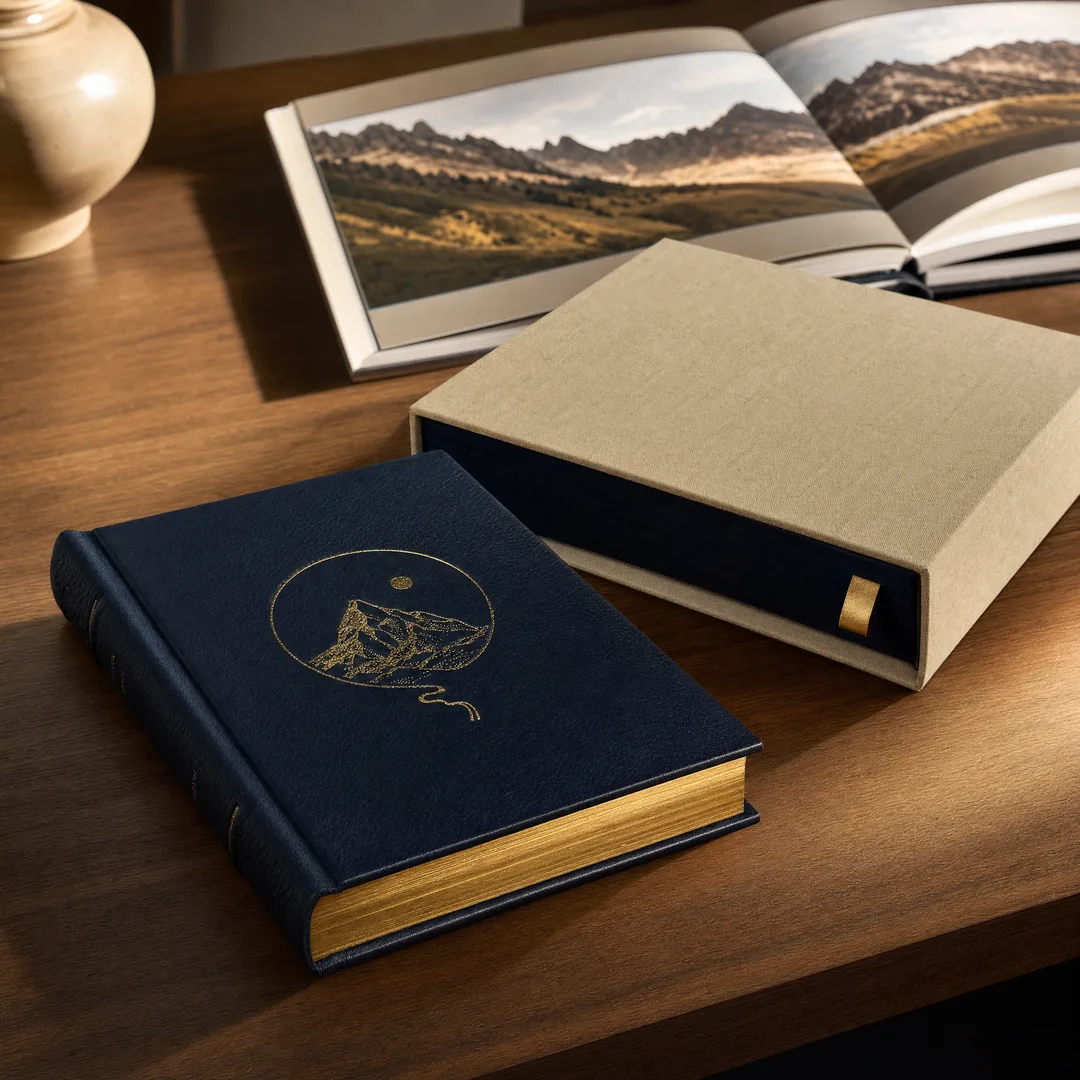
Both cover types are compatible with lay-flat binding, but the structural mechanics differ. A hardcover lay-flat book typically uses a case-bound construction where the book block is attached to rigid greyboard covers through endpapers, with a hollow spine tube that lets the block move independently. The cover itself stays rigid while the pages open freely — this is the gold standard for premium presentation.
A softcover lay-flat book, by contrast, uses a wraparound cover made from heavier card stock (typically 250–350 gsm) with scoring at the spine to create flexible hinges. Ota-binding is the most common technique here, where the cover is only glued at the side hinges, leaving the spine unglued and flexible. Softcover lay-flat books are lighter, cheaper to ship, and cost roughly 20–30% less to produce than their hardcover equivalents. They are an excellent choice for trade publications, portfolios, and mid-range photo books where cost matters but the lay-flat experience is non-negotiable. For a deeper comparison, see our hardcover vs softcover guide and our detailed hardcover binding overview .
Cost Factors and Ordering Realities
What Drives the Price of Lay-Flat Book Printing?
Lay-flat books cost more than standard perfect-bound books. That is the honest reality, and it is driven by labor, not materials. Duplexing — gluing sheets back-to-back — requires a dedicated machine or skilled hand assembly depending on the volume. Each spread passes through at least two additional production steps compared to a perfect-bound book: fold, pair, glue, and press. Those steps add time and cost, typically in the range of 20–40% above an equivalent perfect-bound title.
Page count matters more than you might expect. Because each spread is two sheets bonded together, doubling the page count nearly doubles the labor time rather than just adding paper cost. Cover finishing — matte lamination, spot UV, foil stamping — adds incremental cost per unit, but these finishes often deliver outsized perceived value for a lay-flat book where the cover is the first thing a buyer touches. For a detailed breakdown of how each specification affects the final price, our book printing cost guide walks through the math with real numbers.
Minimum Order Quantities and Quantity Tiers
For offset-printed lay-flat books from Chinese manufacturers, the typical MOQ starts at 300–500 copies. Below that threshold, digital printing becomes the more practical route, though unit costs run higher and paper choices narrow. Here is how the tier structure typically breaks down:
At 500–1,000 copies, you are looking at roughly USD 3.50–6.00 per copy for a standard 80-page hardcover lay-flat photo book, landed overseas. The setup costs — plates, die preparation, color calibration — are spread thin at this volume, which is why the per-unit price is highest at this tier. At 2,000–5,000 copies, setup costs are negligible on a per-unit basis, and pricing drops to roughly USD 2.00–3.50 per copy for the same book. Above 5,000 copies, the economics become genuinely compelling — USD 1.50–2.50 per unit — which is why larger publishers and photo brands consolidate their lay-flat production into annual bulk orders. For more on MOQ strategy, visit our MOQ guide .
The key insight: the cost curve flattens dramatically between 2,000 and 5,000 copies. If your projected demand sits in that range, going slightly higher often costs very little extra per unit while giving you inventory buffer.
Why Print Lay-Flat Books in China
Quality Without the Premium Price Tag
Let us be direct about the numbers. A hardcover lay-flat photo book — 80 pages, full-color, 10×10 inches, matte lamination — costs roughly USD 13–17 per copy from a US or European printer at 500 copies. The same book printed through a reputable Chinese manufacturer like EcoPrinting lands at roughly USD 4–7 per copy landed, depending on shipping method. That is a 50–60% cost reduction on a product where margins otherwise get tight fast.
The quality gap that existed 15 years ago has largely closed. Modern Chinese book printing facilities run the same Heidelberg, Komori, and Kolbus equipment you would find in Germany or the United States. Color management follows G7 or Fogra standards depending on the printer. Many factories hold ISO 12647 certification. The binding technicians who hand-case lay-flat hardcovers in Shenzhen or Guangzhou have been doing it for a decade or more — lay-flat is a mature category in the Chinese print industry, not a novelty. For a reality check on what to expect, read our piece on whether printing in China is reliable .
Turnaround Times and Shipping Realities
Production lead time for lay-flat books runs 15–25 business days from file approval, depending on the binding complexity and finishing requirements. Ota-binding adds roughly 3–5 extra days compared to standard layflat. PUR-bound books fall in the middle. Shipping method determines the rest of the timeline: express courier delivers in 5–8 days, air freight in 8–12 days, and sea freight in 4–6 weeks. Sea freight is dramatically cheaper — often 60–70% less than air — but the longer window means you need to plan production at least 2–3 months before you need books in hand. For a full breakdown, see our shipping guide and our lead time overview .
One strategy worth considering: print a larger batch once a year via sea freight for cost efficiency, and keep a smaller digital-print reserve for reorders and rush jobs. The math works surprisingly well once annual demand exceeds 2,000 copies.
Expertise at Scale
China has built deep institutional knowledge around lay-flat binding because the domestic market itself is enormous — wedding albums, children’s board books, and educational materials all use lay-flat extensively. A factory that runs thousands of lay-flat books daily has encountered and solved edge cases that a boutique printer handling 50 books a month has never seen. They know which paper grain direction prevents warping in humid climates. They know how to calibrate PUR curing times for coated vs uncoated stocks. That accumulated expertise translates directly into fewer quality surprises for you.
A Few Things Nobody Tells You About Lay-Flat Books
First, grain direction matters far more with lay-flat books than with standard binding. If the paper grain runs perpendicular to the spine, the pages resist the hinge motion and the book will never open truly flat, regardless of how well it is bound. A competent printer knows this and orients the grain correctly, but it is worth confirming during the proof stage — especially if you are supplying your own paper stock.
Second, lay-flat books are thicker than you expect. A 100-page lay-flat book takes up roughly the same shelf space as a 180-page perfect-bound book. This affects shipping costs, retail display considerations, and whether your book fits into standard mailer boxes. Plan your logistics accordingly rather than discovering the thickness at the unboxing stage.
Third, testing a physical proof is not optional. Lay-flat binding involves more variables than almost any other binding method — duplex adhesive coverage, hinge alignment, spine tube tolerance, paper stability under humidity. A digital proof on screen cannot tell you whether the book opens correctly or whether pages show through. Order at least one physical production sample before committing to a full print run. For guidance on proofing, our proofing guide covers the options.
Finally, do not over-design for the hinge. The center fold of a lay-flat spread has a tiny, almost invisible crease where the duplexed sheets meet. Placing critical text or a subject’s face directly across that fold will always create a slight visual disruption, even in the best-produced lay-flat book. Keep the focal point of any important element at least 10 mm away from the center line, and let backgrounds and continuous imagery flow across the hinge instead.