Why More Tarot Creators Are Printing Their Decks in China Than Ever Before
If you have spent any time on Etsy or Kickstarter lately, you have probably noticed it: the sheer number of independent tarot and oracle decks flooding the market. Creators are launching their own card decks at a pace that would have been unthinkable a decade ago. And here is the part most buyers never see behind the curtain — a huge chunk of those beautifully finished decks come from the same place. A handful of specialized printing factories in China that have quietly become the backbone of the indie card publishing world.
This is not some underground secret, though it sure feels like one when you first stumble into it. The reason is straightforward: Chinese card printers offer a combination of manufacturing quality, flexible minimum order quantities, and per-unit pricing that domestic printers in North America and Europe simply cannot match. Whether you are a tarot reader designing your first deck, a spiritual coach building a line of affirmation cards, or an Etsy seller looking to scale your oracle card business, understanding how tarot card printing china works can save you thousands of dollars and months of headaches.
In this guide, I am going to walk you through everything you need to know about printing custom card decks in China — the four major card types, material and finish options, packaging decisions, quality control, and the real numbers on pricing and MOQs. By the time you finish reading, you will know exactly what to ask for when you reach out to a factory.
Tarot Card Printing
What Are the Standard Specifications for Tarot Card Printing?
When it comes to tarot card printing , there is a widely accepted standard that most factories default to: 78 cards per deck split into 22 Major Arcana and 56 Minor Arcana, printed at 70 × 120 mm (roughly 2.75 × 4.75 inches). That size has been the industry norm for decades, and for good reason — it fits comfortably in hand, shuffles well, and matches what consumers expect when they unbox a deck.
The cardstock weight is where things get interesting. Most mass-market decks you find at big-box bookstores are printed on 300gsm stock, which is fine for casual use but tends to feel a little flimsy after repeated shuffling. Chinese factories specializing in custom tarot card production typically push creators toward 350gsm art paper as the baseline. At 350gsm, cards have a satisfying heft, resist bending and edge wear, and produce that crisp “snap” sound that experienced readers associate with quality. Some manufacturers offer 400gsm as a premium option, but I generally advise against going that heavy — the deck becomes harder to shuffle and the thicker stack can feel awkward in smaller hands.
The finish on a tarot deck is equally important. Matte lamination is the most popular choice because it reduces glare during readings under bright light and gives cards a soft, velvety touch. Glossy lamination has its fans, too — the colors pop more aggressively and the finish is more resistant to fingerprints, though the reflective surface can be distracting. Some creators split the difference with a matte body and spot UV highlights on specific design elements, which adds a layer of visual intrigue without overwhelming the reader.
What Makes Custom Tarot Card Printing From China Different?
If you have ever requested a quote from a domestic printer for a full 78-card tarot deck with a guidebook and a rigid box, you probably remember the number that came back. It was likely high enough to make you question whether the project was viable at all. Chinese manufacturers change that equation entirely. The reason is scale and specialization: factories in Guangdong and Zhejiang provinces have entire production lines dedicated to card printing. They buy paper and finishing materials in bulk volumes that domestic printers cannot negotiate. And because they run card jobs back-to-back year-round, their operators know exactly how to handle registration, cutting, and collation without the learning curve that a general commercial printer would face.
One thing I want to be clear about: tarot card printing china is not about cutting corners or accepting lower quality for a cheaper price. The top-tier factories print for major publishing houses alongside indie creators, and the quality standards are the same for both. The difference is that you get the same professional-grade output at a fraction of what you would pay locally, with access to a much broader range of finishing techniques.
Oracle Card Printing
How Does Oracle Card Printing Differ From Tarot?
Oracle card printing is where the rulebook gets thrown out the window — in the best possible way. Unlike tarot, which is locked into the 78-card structure, oracle decks can have any number of cards the creator wants. I have seen oracle decks with as few as 36 cards and as many as 68. There is no standard card count, no standard size, and no standard theme. That freedom is what makes oracle decks so appealing to both creators and buyers, but it also means you need to be more intentional about your printing specifications.
Because oracle card dimensions can vary wildly, the first decision you need to make is your card size. Square formats like 88 × 88 mm are popular for oracle decks because they feel distinct from the elongated tarot proportion and stand out on a shelf. Round oracle cards are a growing trend, especially for nature-themed and celestial decks, though the die-cutting adds a small premium. If you want your oracle deck to feel like a premium object — which, let us be honest, is most of the appeal — 350gsm art paper with a soft-touch matte lamination is the combination that consistently wins with customers.
Getting the Most From Your Custom Oracle Card Project
A custom oracle card deck gives you complete control over the creative direction, but that also means you carry more responsibility for getting the specs right. One mistake I see creators make repeatedly is designing their cards without confirming the printable bleed area with their factory first. Every printer has slightly different requirements, and if your artwork runs too close to the trim line, you risk losing important visual elements when the cards are cut. Always request a template file from your manufacturer before you start the final artwork.
Another point worth knowing: oracle card printing china factories are generally far more experienced with non-standard card counts than domestic printers, because they run such a high volume of indie creator orders. A factory that prints 200 different oracle decks a month has seen every edge case you can imagine — unusual sizes, asymmetric card backs, mixed finishes within a single deck. That institutional knowledge matters a lot when you are on a tight launch timeline and cannot afford multiple rounds of sampling.
Affirmation Card Printing
Designing Affirmation Cards That People Actually Use
Affirmation card printing occupies a fascinating niche between oracle decks and self-help tools. These are not divination cards — nobody pulls an affirmation card to predict next month’s love life. Instead, they function as daily prompts, mental health tools, and gentle reminders that people keep on their nightstands or office desks. Because the use case is different, the design and printing considerations shift in ways that matter.
Affirmation cards tend to be smaller than tarot or oracle cards. A typical affirmation deck runs 52 × 88 mm or thereabouts — compact enough to toss in a bag or keep in a car console. The card count is usually lower too, often falling between 30 and 50 cards. The text is the star of the show here, not the artwork, so legibility needs to be your top priority. That means choosing a cardstock with a matte or even uncoated finish so there is no glare competing with the words, and making sure the font size is generous enough that someone can read it without squinting.
When you order custom affirmation card printing from a Chinese factory, you can specify a softer, more tactile cardstock than what you would use for tarot. Many creators go with a linen-textured art paper at 350gsm, which gives the cards a gentle, almost fabric-like feel that matches the nurturing tone of affirmation content. Rounded corners are non-negotiable — sharp corners on small cards that get handled daily will start looking ragged within weeks, and that is not the energy you want associated with a product about self-care.
Why Creators Choose Affirmation Card Printing China Over Local Options
The economics of affirmation card printing china follow the same logic as tarot and oracle cards, with one added benefit: because affirmation decks are smaller and use fewer cards, the per-unit cost drops even further. If you are building a business around a line of affirmation products — say a morning deck, an evening deck, and a gratitude deck — the cost savings from printing all of them through one Chinese supplier becomes substantial. Many factories also offer bundle pricing when you print multiple card decks in a single production run, which is worth asking about during the quoting phase.
Holographic Card Printing
When and Why to Use Holographic Finishes
Let us talk about the finish that stops people mid-scroll on Instagram: holographic. Holographic card printing has exploded in popularity over the past three years, and it is not hard to understand why. A deck with holographic card backs or foil-stamped borders catches light in a way that photographs beautifully and feels undeniably premium in person. For tarot and oracle decks positioned as luxury or collector items, holographic finishes are often the difference between a deck that sells at $29 and one that commands $55 or more.
There are two distinct techniques that get lumped together under the “holographic” umbrella, and knowing the difference will help you communicate with your factory more precisely. The first is holographic cardstock, where the rainbow-reflective pattern is embedded directly into the paper material before printing. Your artwork is printed on top of this substrate, so the holographic effect shows through wherever your design is transparent or lightly inked. The second technique is foil stamping, where metallic or holographic foil is applied to specific areas of the card using heat and pressure. Foil stamping gives you precise control — you can add holographic accents to card titles, borders, or specific illustration elements without affecting the rest of the design.
Getting Custom Holographic Card Results You Can Be Proud Of
Ordering a custom holographic card deck requires a little more back-and-forth with your printer than a standard matte deck. The reason is that holographic effects are notoriously difficult to proof digitally — what you see on your screen and what comes off the press are two very different things. Every experienced holographic card printing china factory will recommend a physical pre-production sample before running the full order. This step adds about a week to your timeline but is absolutely worth it. The sample lets you see how the holographic pattern interacts with your artwork under real lighting conditions, and you can adjust the opacity or foil coverage before committing to the full batch.
One practical tip: holographic cardstock tends to be slightly thinner than standard art paper at the same GSM rating, because the holographic layer adds stiffness without adding thickness. If you want the same hand-feel as a 350gsm standard deck, ask your printer to step up to 400gsm for the holographic version. It is a small detail, but your customers will notice the difference when they hold both decks side by side.
Finishes, Edges, and Packaging
Gilded Edges, Rounded Corners, and the Paper That Holds It All Together
Once you have settled on a card type and artwork, the next round of decisions is all about how the finished deck feels in someone’s hands. These are the details that separate a deck that looks amateurish from one that reads as professional and intentional.
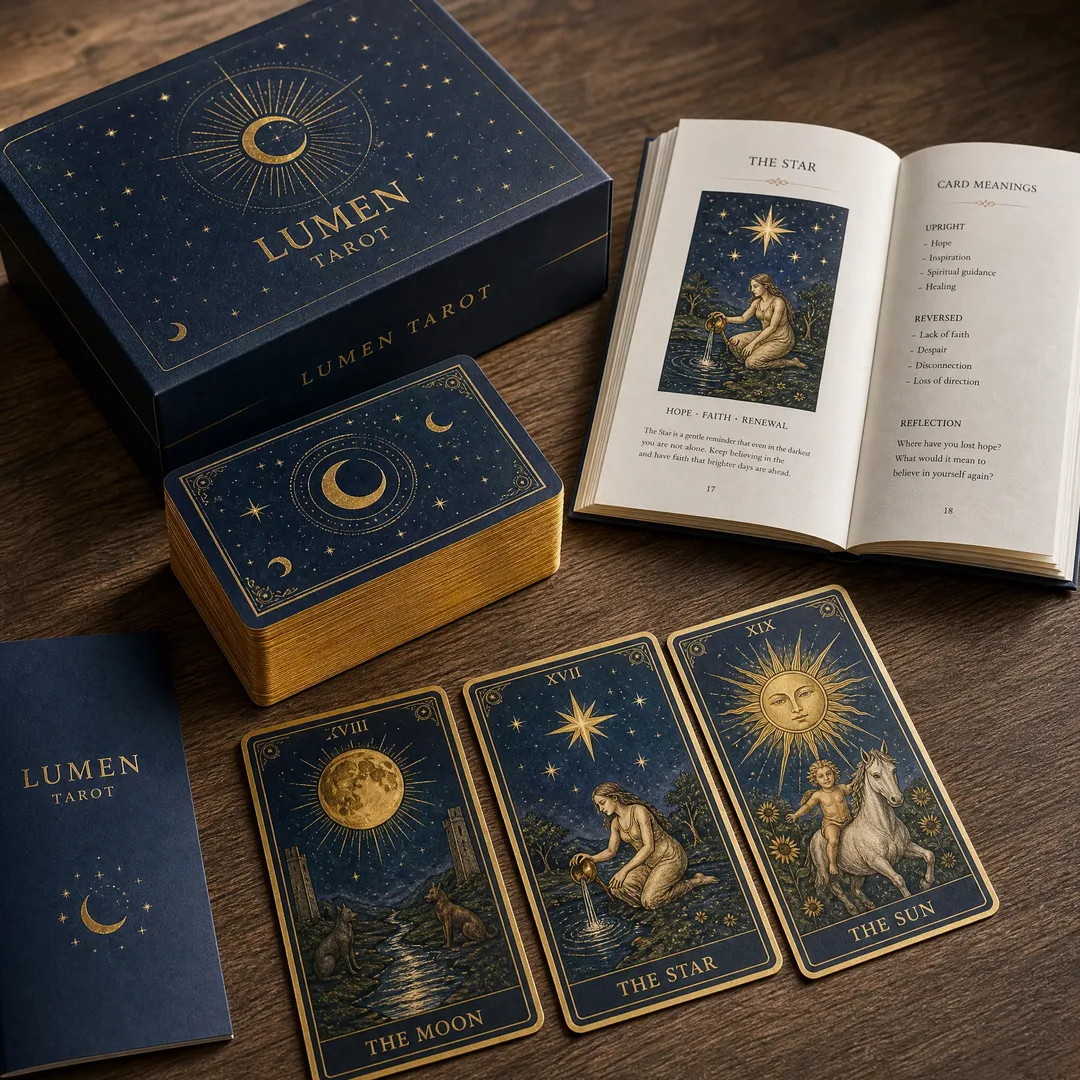
Gilded edges — sometimes called gilt edges — are a thin metallic layer applied to the sides of the card stack. Gold gilding is the classic choice and pairs beautifully with decks that have warm-toned artwork, but silver gilding has been gaining ground, especially for celestial and moon-themed decks. Some factories also offer holographic edge gilding, which creates a shimmering rainbow effect along the deck’s sides when you tilt the stack. One thing to know: gilding does add cost and requires careful handling during production, because any misalignment during the gilding process will be immediately visible on every single card edge. This is one area where Chinese factories with dedicated card production lines have a clear advantage — their gilding machines are calibrated for card decks specifically, not repurposed from book production.
Rounded corners are standard on nearly every card deck for a combination of practical and aesthetic reasons. Sharp corners catch on sleeves, bags, and each other — after a few weeks of use, they start to fray and peel. Rounded corners wear evenly and look intentional from day one. Most Chinese card printers default to a 3mm or 3.5mm corner radius for tarot-sized cards, but you can specify a tighter or looser radius if your design calls for it.
The foundation of all of this is the paper. I have mentioned 350gsm art paper several times already, and I am going to keep mentioning it because it genuinely is the sweet spot. Art paper — also called coated paper or C2S — holds ink beautifully and produces vibrant, sharp colors. At 350gsm, you get a card that feels substantial without being difficult to shuffle. Some factories offer black core paper as an alternative, which has a dark inner layer that prevents light from passing through the card. This is primarily a concern for playing cards used in competitive games where seeing through a card would be an advantage, but it adds a premium feel that some tarot creators appreciate.
Box Packaging: Tuck Box, Rigid Box, or Magnetic?
The box your cards come in is the first thing your customer touches before they even see a single card. If the box feels cheap, the perceived value of the entire deck drops before the unboxing is complete. Chinese card printing factories typically offer three tiers of box packaging, and the one you choose should align with your retail price point and brand positioning.
A tuck box is the most basic option — it is the standard two-piece paper box with a top flap that tucks into the body, similar to what standard playing cards come in. Tuck boxes are inexpensive and lightweight, which keeps shipping costs down, but they are not particularly durable and do not signal premium quality. If you are selling your deck at a lower price point or as part of a larger bundle, a tuck box is perfectly fine.
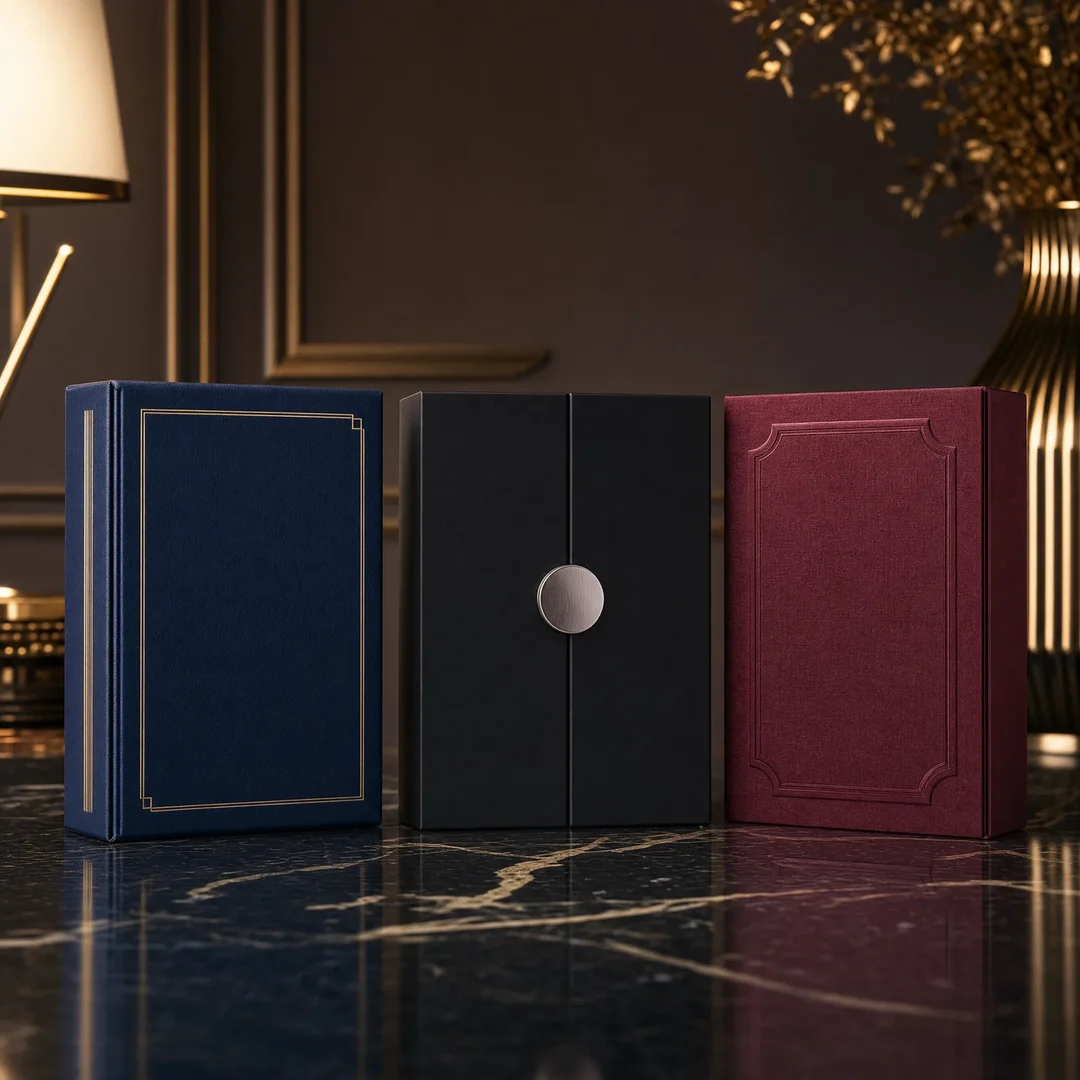
A rigid box — sometimes called a setup box or a two-piece rigid box — is the step up that most indie creators choose. The box has a sturdy chipboard core wrapped in printed paper, with a separate lid that lifts off completely. Rigid boxes feel substantial, protect the cards well during shipping, and photograph beautifully for product listings. Most factories can add a foil-stamped logo or title to the lid for an additional cost, which makes the unboxing experience feel genuinely special.
A magnetic box adds a magnetic closure flap to the rigid box structure, combining premium materials with a satisfying closure mechanism. The flap snaps shut with a quiet click, and the whole package feels more like a luxury gift box than simple packaging. Magnetic boxes are the most expensive option, but for decks priced above $40, the ROI typically justifies the cost. Your customers feel like they are unwrapping something valuable, and that impression carries over into reviews and word-of-mouth recommendations.
Companion Guidebooks: The Missing Piece Most Creators Forget
I cannot count how many creators I have seen pour months of effort into their card artwork and finish specifications, only to treat the companion guidebook as an afterthought. That is a mistake. The guidebook is not just a booklet that explains card meanings — it is part of the product. A beautifully printed deck in a premium box with a cheaply produced, flimsy guidebook creates a jarring disconnect that customers notice.
Chinese printing factories that specialize in card decks almost always offer companion guidebook printing as part of the package. The typical format is saddle-stitched or perfect-bound, with 80 to 120 interior pages printed on 128gsm or 157gsm coated paper. The cover is usually 250gsm or 300gsm with a matte or glossy lamination. Size-wise, the guidebook is typically designed to fit inside the same box as the cards, so it needs to be slightly smaller than the deck dimensions — for a 70 × 120 mm tarot deck, a common guidebook size is 65 × 115 mm or 68 × 118 mm. Having the cards and the guidebook printed under one roof ensures that the colors, paper quality, and overall aesthetic are consistent across the entire product.
Production and Partnerships
What MOQs Actually Look Like for Custom Card Decks
If you have spent any time researching card printing, you have probably seen MOQs (minimum order quantities) that made your eyes water. Some Western printers require 1,000 or even 2,000 units before they will take your order. That is a huge bet for a first-time creator. Chinese card printing factories have moved in the opposite direction over the past several years — many now offer MOQs as low as 500 decks, and some will go even lower for a surcharge. A 500-unit minimum means you can test the market without tying up tens of thousands of dollars in inventory, and if the deck sells well, you already have a production relationship in place for a reorder.
The price breaks at higher quantities are significant, though. Your per-unit cost at 500 decks might be, say, $4.50, while at 2,000 decks it could drop to $2.80 or lower, depending on your specifications. If you have a marketing plan and a clear path to selling through 2,000 units, ordering more upfront will dramatically improve your margins. But if this is your first deck and you are still figuring out your audience, starting at 500 is the smarter play. You can always reorder.
Quality Control, Sampling, and What to Actually Inspect
The quality control process at a reputable Chinese card printing factory follows a structured workflow that you should understand before placing an order. It typically starts with a digital proof — a PDF or a set of high-resolution images that show how the cards will look with your artwork, trim lines, and bleed areas marked. You review this, approve it or request changes, and the factory moves to a physical sample.
The physical sample — sometimes called a pre-production sample or a press proof — is the most important checkpoint in the entire process. This is a small batch of actual printed cards, usually 3 to 5 cards from your deck, produced on the same machines and with the same materials that will be used for the full run. When you receive it, you are checking for: color accuracy against your original artwork, sharpness of text and fine lines, alignment of the cut (is the design centered on the card?), the quality of the lamination (no peeling or bubbling), and the overall hand-feel. If you ordered gilded edges or foil stamping, the sample cards should include those as well. Do not skip this step. A sample that costs $50 to produce and ship is the cheapest insurance you will ever buy against a full production run that comes out wrong.
During the main production run, the factory conducts inline quality checks — random cards pulled from the line at intervals to verify that color registration and cutting alignment have not drifted. After production is complete but before shipping, most factories will send you photos or a short video of the finished goods as a final confirmation. Some creators also hire a third-party inspection service to visit the factory and do an independent quality audit before the shipment leaves. This costs a few hundred dollars and is most worthwhile for orders above 3,000 units where the financial exposure is significant.
The Real Advantages of Printing Cards in China
I have touched on the cost advantage throughout this guide, but there is more to the story than just lower prices. Chinese card printing factories offer a one-stop-shop model that is genuinely hard to replicate elsewhere. The same factory can print your cards, produce the guidebook, manufacture the rigid box, assemble everything into the final retail-ready package, and arrange international shipping — all under one project manager. When you work with separate vendors for cards, books, and packaging in different countries, the coordination overhead eats up the cost savings and introduces multiple points of failure. Having a single factory handle the entire production chain eliminates those coordination risks.
The range of available finishes at Chinese factories is also broader than what most Western printers offer for card projects. Cold foil stamping, hot foil stamping, spot UV, soft-touch lamination, holographic edge gilding, embossing, debossing — these are standard options, not specialty requests. The factories have already invested in the equipment and trained their operators because the domestic and international demand for premium card finishes is high enough to justify it.
Lead times for a standard custom card deck order — 500 to 2,000 units with cards, guidebook, and box — typically fall between 15 and 25 production days from sample approval, with another 5 to 15 days for international shipping depending on the destination and shipping method. Air freight is faster but more expensive; sea freight is economical but takes longer. If your launch date is tied to a Kickstarter campaign, a holiday season, or a conference, plan your production schedule backward from the date you need inventory in hand, and build in at least a two-week buffer for customs clearance and unexpected delays.