China has grown into the world’s largest hub for custom card and game printing. Whether you are launching a Kickstarter board game, publishing a tarot deck, or ordering wholesale playing cards for a casino or promotional campaign, Chinese manufacturers offer competitive pricing, flexible minimum order quantities, and an enormous range of customization options. This guide breaks down twelve card categories — from standard poker decks to scratch-off loyalty cards — with the specs, materials, finishes, and MOQ details you need before placing an order.
1. Playing Cards
Specs
The standard poker-size card measures 63 × 88 mm (2.48 × 3.46 inches). Bridge-size cards run narrower at 57 × 88 mm. Most playing card printing china factories also support custom dimensions if your deck needs a unique format.
Materials
Playing cards are almost always printed on multi-layer paper stock. The two dominant options are blue-core paper (280-300 gsm, entry-level) and black-core paper (310-330 gsm, premium). Black-core stock blocks light completely — no one can see through the card back. German black-core stock adds an extra layer of stiffness and a linen-textured air-cushion finish that cardists and magicians prefer.
Finishes
Glossy UV coating delivers vivid color pop. Matte lamination offers a soft, glare-free feel. Linen/air-cushion embossing improves shuffle handling and slide. For casino-grade decks, a combination of black-core stock plus linen finish is the industry standard.
MOQ
Custom playing card printing MOQ typically starts at 500 decks for offset printing. Digital print-on-demand services accept single-deck orders, though unit costs run higher. Wholesale playing card printing at 5,000+ decks brings the per-unit price down significantly.
2. Board Game Cards
Specs
Board game cards come in several common sizes. Mini cards at 44 × 68 mm work well for resource decks. Standard cards at 57 × 87 mm handle most gameplay use cases. Tarot-size cards at 70 × 120 mm suit oversized action or reference cards. Custom game card printing China services accommodate any dimension your game design calls for.
Materials
Most board game publishers choose 300-350 gsm art paper (white-core cardstock) or 310 gsm black-core paper. White-core stock costs less and prints vivid colors; black-core stock prevents light bleed-through and feels more substantial in hand.
Finishes
Matte lamination is the go-to finish for board game cards — it hides fingerprints and resists glare during long play sessions. Glossy varnish sharpens artwork contrast. Spot UV adds a tactile highlight to specific design elements. Linen texture gives cards better grip and reduces sticking in humid environments.
MOQ
Game card printing China manufacturers generally set MOQ at 500-1,000 decks for offset production. Many factories accept trial runs of 100-200 decks with a surcharge. Game card printing services with digital equipment can handle as few as one deck, making them ideal for prototype testing.
3. Tarot Cards
Specs
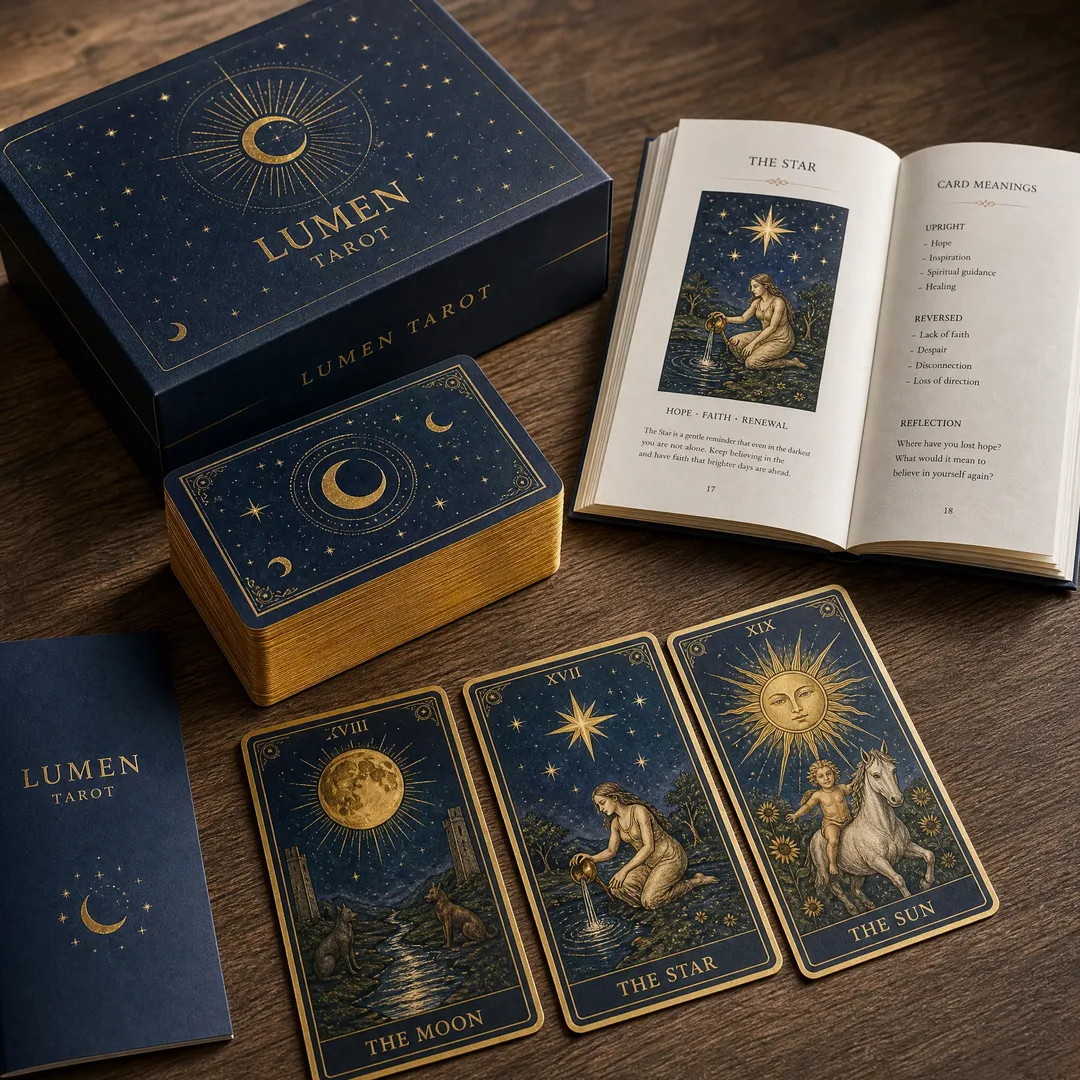
Traditional tarot cards measure 70 × 120 mm (2.75 × 4.75 inches). A standard deck contains 78 cards — 22 Major Arcana plus 56 Minor Arcana. Many tarot card printing China services offer custom sizes, with mini tarot at 44 × 80 mm becoming popular for travel decks.
Materials
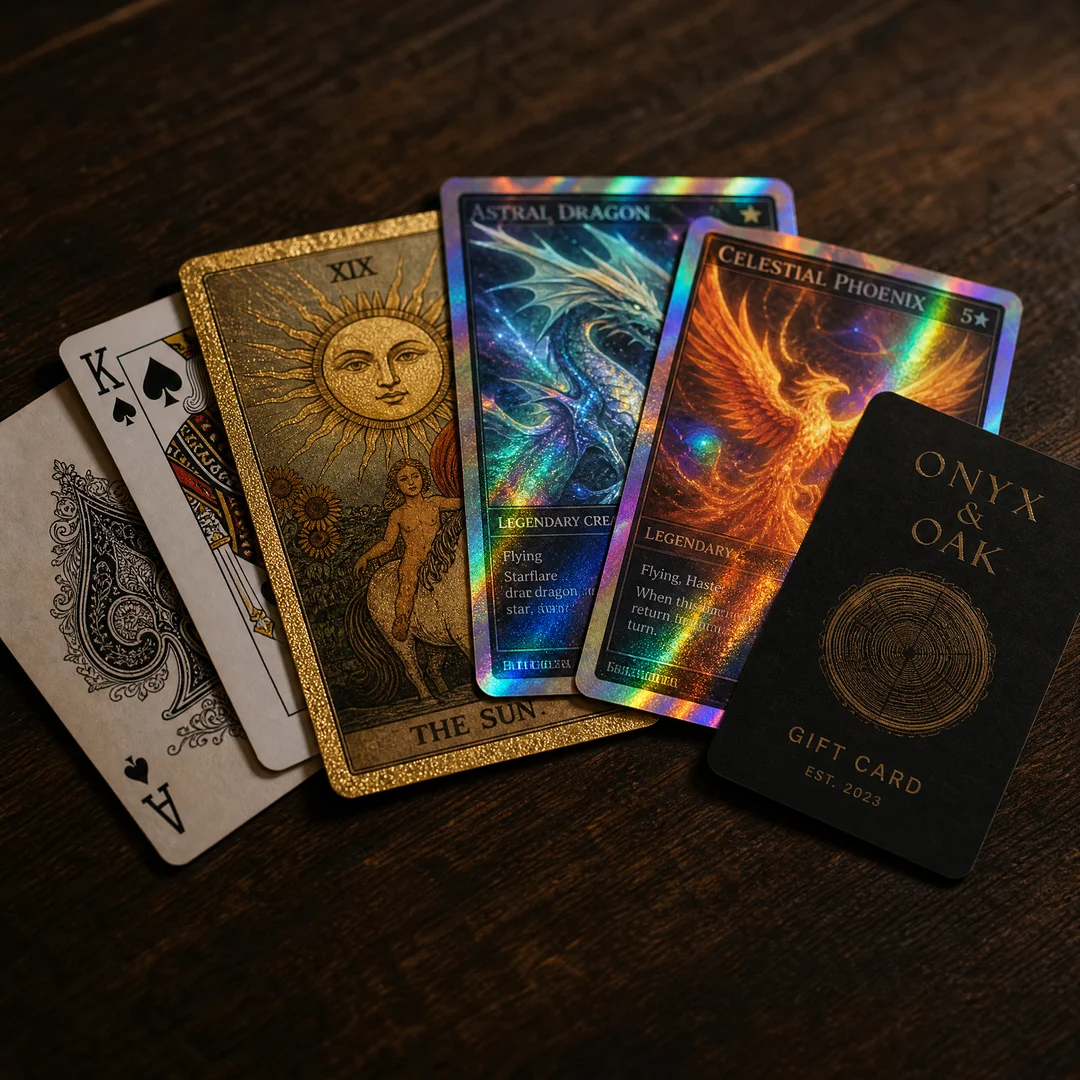
Premium tarot decks favor 350 gsm art paper or 310 gsm black-core stock. Holographic paper (275-425 gsm) adds a shimmering rainbow effect prized in collector editions. Gold foil cardstock and silver foil cardstock deliver a luxurious metallic sheen across the card surface.
Finishes
Matte lamination dominates the tarot world — it prevents glare during readings and gives cards a silky, meditative feel. Gilded edges (gold, silver, or rose gold) elevate the deck’s collectibility. Soft-touch lamination creates a velvety grip. Spot UV on card artwork accents symbols and illustrations without overpowering the design.
MOQ
Custom tarot card printing typically requires 200-500 decks minimum. Wholesale tarot card printing at 1,000+ decks unlocks tiered pricing. Some manufacturers offer sample runs of 50 decks for crowdfunding prototypes, though unit costs rise steeply at that volume.
4. Trading Cards
Specs
Trading card printing china factories produce cards at 63 × 88 mm (standard TCG/CCG size). Sports trading cards often use 64 × 89 mm to match traditional collector formats. Japanese TCG formats like Yu-Gi-Oh! use 59 × 86 mm. Custom sizes are fully available for original IPs.
Materials
The TCG market demands black-core paper (310-350 gsm) as the minimum standard — it stops players from identifying cards through their backs. Blue-core (280 gsm) works for budget-friendly mass-market releases. Holographic paper stock creates the shimmering foil effects that define rare and ultra-rare cards.
Finishes
Holographic foil is the signature TCG finish. Options include rainbow foil, cracked ice, shattered glass, and custom holographic patterns. Matte UV coating on non-foil cards provides a smooth shuffle. Cold foil stamping adds metallic borders and icons. Custom trading card printing services often bundle randomized booster-pack collation as a value-added service.
MOQ
Custom trading card printing MOQ starts at 500-1,000 decks for offset production with basic finishes. Holographic decks may require 1,000+ due to foil setup costs. Print-on-demand platforms now offer zero-MOQ TCG printing with foil options, though per-card pricing is higher. Wholesale trading card printing at 5,000-10,000+ decks drives per-unit costs to their floor.
5. Flashcards
Specs
Flashcard printing china factories produce cards in 63 × 88 mm (standard), 76 × 127 mm (large), and 89 × 127 mm (jumbo) formats. Rounded corners (3-5 mm radius) are essential for child safety and handling comfort. Standard packs range from 26 cards (alphabet sets) to 200+ cards (vocabulary and math decks).
Materials
Flashcards use 300-350 gsm coated art paper for most educational products. 350 gsm white cardstock provides the stiffness needed for repeated handling by children. Waterproof synthetic paper (PP/PET) suits outdoor or wet-environment use. Recyclable grey board cards work for budget classroom sets.
Finishes
Glossy lamination makes colors pop and adds wipe-clean functionality — a must-have for classroom flashcards. Matte lamination reduces glare and fingerprints. Rounded corner die-cutting is the default safety requirement. Some flashcard printing services add dry-erase coating so students can write and erase directly on the card surface.
MOQ
Custom flashcard printing MOQ starts at 500 sets. Digital flashcard printing services accept orders as low as 50-100 sets. Educational publishers ordering 3,000+ sets benefit from steep volume discounts.
6. Photo Cards
Specs
Photo cards span a wide range — from 55 × 85 mm (credit-card size) to 102 × 152 mm (4 × 6 inch postcard format). K-pop idol photo cards use 55 × 85 mm. Wedding photo cards run 102 × 152 mm. Custom photo card printing services accept any dimension between these ranges.
Materials
Photo card printing demands high-quality coated paper stock. 300-350 gsm glossy art paper delivers the photo-quality reproduction customers expect. 250 gsm photo paper with a PE coating on one side replicates the look of traditional photo prints. PVC cards suit premium collectible photo cards that need waterproof durability.
Finishes
Glossy lamination is near-universal for photo cards — it makes images pop with depth and saturation. Soft-touch matte lamination creates a premium, velvety feel popular for wedding and keepsake cards. Edge painting (colored or metallic) adds a boutique finishing touch. Spot UV can highlight a signature or logo on the card face.
MOQ
Custom photo card printing starts at 100-200 pieces for digital production. Offset printing MOQ runs 500-1,000 pieces. Photo card printing services targeting the K-pop and wedding markets often support lower minimums due to the personal nature of these products.
7. Holographic Cards
Specs
Holographic card printing works across all standard card sizes — 63 × 88 mm (playing-card format), 70 × 120 mm (tarot format), and custom dimensions. The holographic effect can cover the entire card surface or be applied selectively to specific design areas.
Materials
Holographic cards use two primary material approaches. The first is holographic paper stock (275-425 gsm), where the shimmering rainbow pattern is embedded in the paper itself. The second is holographic lamination film applied over standard art paper, which gives designers more control over which areas pop. Black-core holographic paper blocks light transmission for double-sided cards.
Finishes
Custom holographic card printing China factories offer multiple foil patterns: rainbow, cracked ice, shattered glass, starry, and custom-branded holographic designs. Cold foil stamping applies metallic patterns with precision. Hot foil stamping adds raised, reflective elements. A protective gloss or matte overcoat seals the holographic layer and prevents scratching.
MOQ
Holographic card printing requires 500-1,000 pieces minimum for offset production due to foil setup costs. Digital holographic printing lowers the barrier to 100-200 pieces. Custom holographic card printing with unique foil patterns may need 2,000+ MOQ to justify mold creation.
8. Gift Cards
Specs
Standard gift cards measure 85.6 × 54 mm (ISO/IEC 7810 CR80 format — the same as a bank card). This size fits standard wallet slots and POS terminals. Oversized gift cards at 152 × 102 mm work well for presentation gifts. Custom gift card printing china services can produce any dimension you specify.
Materials
Gift cards split into two categories. PVC gift card printing produces durable, waterproof plastic cards rated for 3-5 years of use. Paper-based gift cards use 350-400 gsm coated art paper with heavy lamination — they cost less but wear faster. Biodegradable PVC alternatives are emerging for eco-conscious brands.
Finishes
Matte or glossy lamination protects both paper and PVC gift cards. Scratch-off panels conceal PIN codes or activation numbers. Magnetic stripes and barcodes are standard add-ons for POS integration. Foil stamping (gold, silver, holographic) elevates the gift card’s perceived value.
MOQ
Paper gift card printing starts at 500 pieces. PVC gift card printing requires 1,000+ pieces. Large retail chains ordering 10,000+ cards benefit from per-unit pricing below $0.10.
9. Loyalty Cards
Specs
Loyalty cards use the same 85.6 × 54 mm CR80 format as gift cards. Key-tag loyalty cards (mini format at 35 × 54 mm with a hole punch) attach to key rings for convenience. Custom loyalty card printing accommodates die-cut shapes — circle, oval, or brand-specific silhouettes.
Materials
PVC is the dominant material for loyalty cards — it survives wallets, washing machines, and years of daily handling. 0.76 mm PVC thickness matches the ISO standard for payment cards. Biodegradable PLA plastic cards offer a green alternative at a 15-20% cost premium.
Finishes
Barcode printing (1D and 2D/QR codes) is the most common loyalty card feature. Magnetic stripe encoding adds POS swipe capability. NFC chip embedding transforms loyalty cards into tap-to-redeem smart cards. Sequential numbering, signature panels, and embossed account numbers are standard add-ons.
MOQ
Custom loyalty card printing China manufacturers set MOQ at 1,000-2,000 cards. QR-code-only loyalty cards on paper stock can run as low as 500 pieces. NFC-enabled loyalty cards need 2,000+ MOQ to offset chip procurement costs.
10. Scratch-Off Cards
Specs
Scratch-off card printing uses standard CR80 (85.6 × 54 mm) or custom sizes. The scratch-off panel typically occupies 20-50% of the card face, covering a PIN code, prize message, or activation number beneath. Panel shapes can be rectangular, circular, or custom-branded.
Materials
Scratch off card printing requires coated paper stock (300-350 gsm) or PVC. The surface under the scratch panel must be smooth and non-porous so the scratch-off layer adheres properly. A base coat of silver or white opaque ink sits between the printed message and the scratch-off top layer, ensuring the hidden content stays unreadable until scratched.
Finishes
The scratch-off panel itself is a latex-based removable coating — typically silver, gold, or custom-colored. A UV gloss varnish applied under the panel protects the hidden message from being read through the coating. Scratch-off cards often include security features like micro-printing, UV-reactive ink, and tamper-evident patterns.
MOQ
Custom scratch off card printing China services require 2,000-5,000 pieces minimum. The higher MOQ reflects the multi-layer printing process and security ink setup. Digital short-run scratch-off printing has lowered the floor to 500 pieces for simple designs.
11. Oracle & Affirmation Cards
Specs
Oracle card printing and custom affirmation card printing use 70 × 120 mm (tarot-size) or 89 × 127 mm (square format). Decks range from 30 to 64 cards — smaller than tarot’s 78-card standard. Guidebooks accompanying the deck typically run 80-160 pages in A5 or digest format.
Materials
Oracle and affirmation card creators gravitate toward 350 gsm premium art paper with a soft, almost velvety finish. Matte art paper stock prevents glare during reflective personal readings. Some spiritual brands request eco-friendly recycled cardstock or FSC-certified paper to align with their values.
Finishes
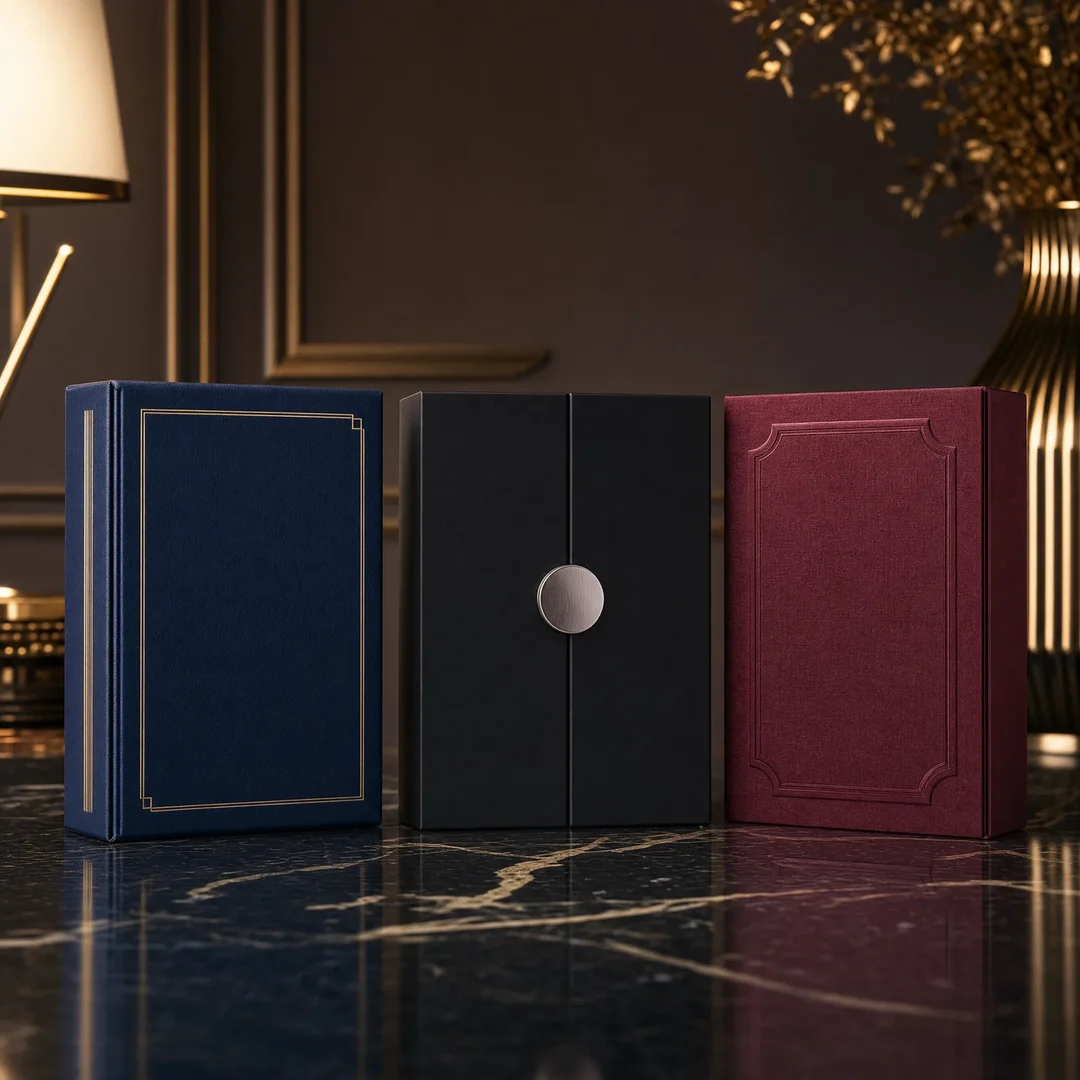
Soft-touch matte lamination dominates the oracle and affirmation space. Gilded edges in rose gold, copper, or holographic silver add ritualistic beauty. The packaging matters as much as the cards — custom two-piece rigid boxes with magnetic closure, slide-out drawer boxes, and organza pouches are standard requests for oracle card printing and affirmation card printing projects.
MOQ
Custom oracle card printing starts at 200-500 decks. Custom affirmation card printing typically runs 300-500 decks. Small-run orders of 50-100 decks work for limited editions or crowdfunding fulfillment but carry a premium. Boxed sets with guidebooks printed under one roof save on logistics.
12. Miscellaneous Custom Cards
Beyond the eleven categories above, card deck printing China factories handle dozens of niche formats. Wedding invitation cards printed on 350 gsm stock with foil-stamped names. Restaurant menu cards with spot UV and rounded corners. Membership cards with sequential numbering and QR codes. Collectible art cards on holographic stock in limited editions of 100. Escape-room puzzle cards with hidden UV-reactive clues. Funeral remembrance cards on textured paper with gold-foil typography. The infrastructure for custom card deck printing China is deep enough to accommodate virtually any card-based project you can design.
Key Considerations Before You Order
File Preparation
Chinese printing factories expect design files in AI, PDF, or PSD format at 300 DPI minimum. Include 3 mm of bleed on all four edges. Use CMYK color mode — RGB files will be converted and may shift tones. Embed all fonts or convert text to outlines. For holographic cards, supply separate layers for foil and non-foil areas.
Sampling
Always order a physical sample before committing to a production run. A sample deck costs $20-50 including shipping and arrives in 5-10 business days. It lets you check color accuracy, card thickness, finish feel, and print registration. The sample fee is usually credited toward your production order.
Packaging Options
Card decks ship in tuck boxes, two-piece rigid boxes, magnetic closure boxes, slide-out boxes, tin cases, or velvet pouches. Shrink-wrap or cellophane wrapping protects the deck during transit. Booster packs for TCGs need foil wrappers with tamper-evident seals. Bundling the card printing and packaging order with one manufacturer simplifies logistics and lowers total cost.
Shipping & Lead Times
Standard production takes 10-18 business days after artwork approval. Sea freight to North America or Europe adds 25-35 days but costs the least. Air freight delivers in 5-8 days at a mid-range price. Express courier (DHL, FedEx, UPS) takes 3-5 days at the highest rate. Factor customs clearance into your timeline — card games and paper products rarely face tariffs in most importing countries.
Common Questions About Card Printing in China
How much does custom card deck printing cost?
Cost depends on card stock, quantity, finish complexity, and packaging. A basic 54-card poker deck on 300 gsm art paper with tuck box runs $1.50-3.00 per deck at 500 units, dropping to $0.70-1.20 at 5,000 units. Add holographic foil, rigid box packaging, or gilded edges and the per-unit cost rises 30-60%.
Can I print small quantities for crowdfunding?
Yes. Most card deck printing China manufacturers accept 100-200 deck trial orders. Digital print-on-demand services go as low as one deck. Use small runs for Kickstarter prototypes or market testing, then scale to offset production once you have validated demand.
Do Chinese factories own my artwork?
No. Reputable manufacturers operate on a white-label basis — you retain full IP ownership. Sign an NDA before sharing design files. Work with audited, certified factories (ISO, FSC, BSCI, SEDEX) for the strongest IP protection.
What is the turnaround time from order to delivery?
Production: 10-18 business days. Sea shipping: 25-35 days. Air shipping: 5-8 days. Express courier: 3-5 days. Total door-to-door timeline: 3-8 weeks depending on shipping method and destination country.
Choosing the Right Card Printing Partner in China
Start with manufacturers that specialize in your specific card type. A factory that prints 10,000 poker decks a month may not handle holographic TCG booster packs well, and vice versa. Request samples from 2-3 shortlisted suppliers. Compare not just price but communication speed, artwork guidance, and packaging capabilities. The best card and game printing china partnerships are built on clear specs, a signed contract, and a test order that proves quality before scaling to volume.
Summary
China’s card printing industry covers every format imaginable — poker cards, board game cards, tarot, trading cards, flashcards, photo cards, holographic cards, gift cards, loyalty cards, scratch-off cards, and oracle/affirmation decks. Each card type has its own sweet spot for materials, finishes, and minimum order quantities. The common thread: prepare your artwork properly, order samples, and choose a manufacturer with specific experience in your card category. Whether you need 200 tarot decks for a Kickstarter launch or 50,000 gift cards for a nationwide retail rollout, a Chinese printing partner can deliver the quality and price point that makes your project viable.