Why Rigid Boxes Outsell Folding Cartons for Luxury Brands
Walk into any high-end boutique and pick up a premium product. The weight of the box, the resistance of the lid, the soft whoosh as it opens — none of this happens by accident. Brands that charge $200 for a bottle of perfume or $2,000 for a watch know that the unboxing experience starts the relationship. A rigid box delivers that moment. A folding carton packaging option, by comparison, rarely does.
The difference comes down to materials. Folding cartons use single-layer paperboard — typically 0.3mm to 0.6mm thick — die-cut, folded, and glued. They work fine for cereal boxes and everyday cosmetics. Rigid boxes, by contrast, are built on a 1.5mm to 3mm greyboard core wrapped in decorative paper or fabric. The walls don’t collapse under pressure. The corners stay sharp after shipping. The tactile impression tells the customer something expensive is inside before they even read the logo.
Brands choose custom luxury packaging in rigid format for three reasons that go beyond aesthetics. First, perceived value: multiple consumer studies confirm that packaging weight and rigidity directly affect willingness to pay. Second, product protection: rigid boxes absorb impact during transit far better than folding cartons. Third, reusability: people keep beautiful boxes. A well-made rigid box lives on a dresser or shelf for years, serving as a daily brand reminder that no digital ad can replicate.
Types of Rigid Boxes: Which Structure Fits Your Product
Not every rigid box is built the same way. The structure you pick determines cost, assembly time, shipping volume, and the unboxing rhythm. Here are the four main types buyers choose between.
Two-Piece Rigid Box (Lid and Base)
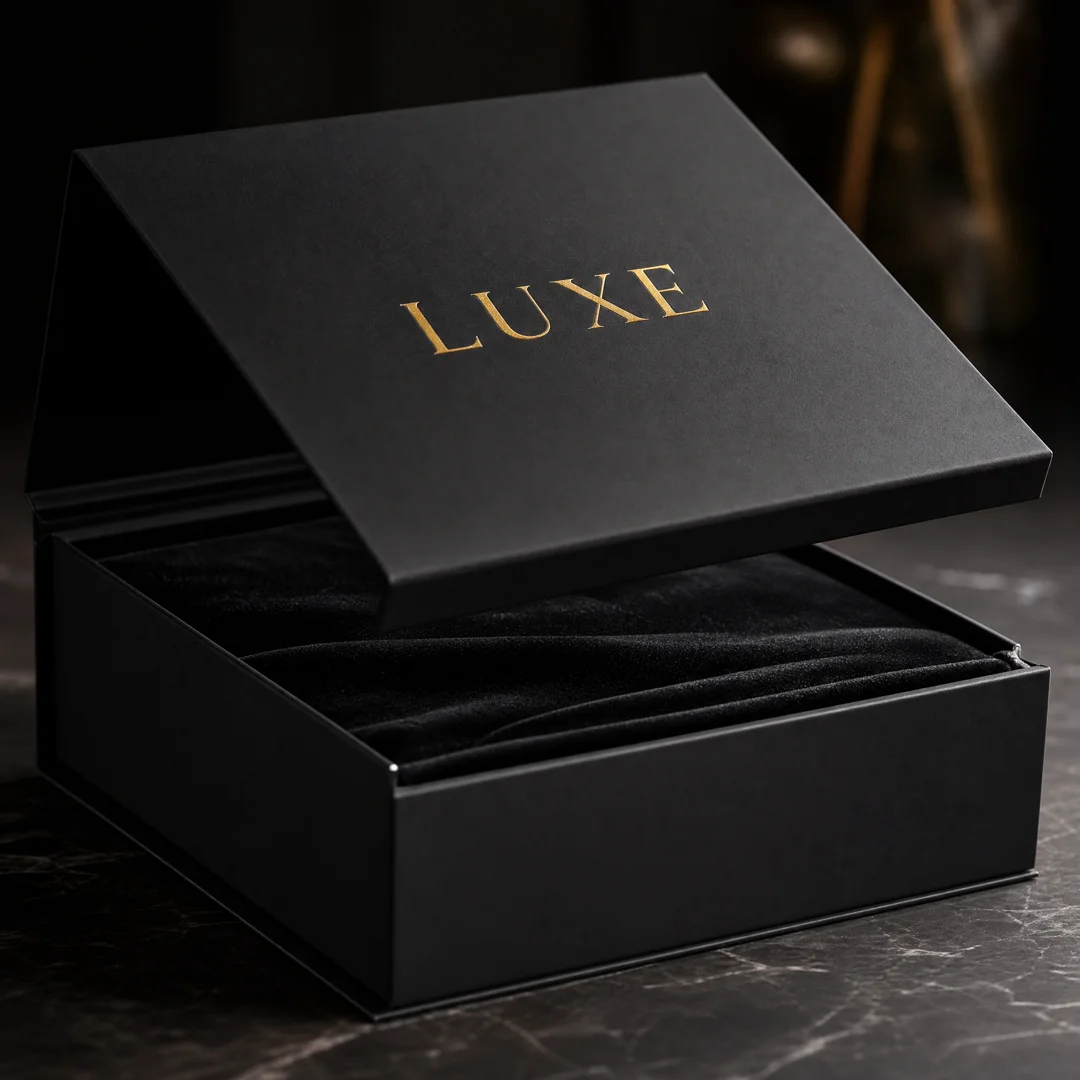
The classic. A separate lid slides over a separate base — no hinges, no magnets, just precise friction fit. Two piece rigid box designs dominate the jewelry and watch industries because the lift-off reveal feels ceremonial. Production is straightforward: the lid and base are manufactured independently on the same wrapping line. The downside? Two-piece boxes take up roughly 40% more storage space than collapsible alternatives, which adds up when you are warehousing 5,000 units.
Collapsible Rigid Box
If logistics cost keeps you up at night, this structure deserves a close look. A collapsible rigid box ships flat and assembles in seconds — the walls fold up and lock into place, often with a magnetic base panel that snaps flat. For e-commerce brands shipping direct to consumer, the savings are real: flat-packed rigid boxes cut shipping volume by up to 70% compared to pre-assembled two-piece boxes. The trade-off is structural feel. A collapsible box cannot quite match the monolithic solidity of a fully wrapped two-piece, though modern locking mechanisms have narrowed the gap substantially.
Magnetic Closure Rigid Box
This is the structure behind most luxury smartphone packaging and high-end beauty subscription boxes. Hidden magnets embedded in the lid flap create a satisfying snap-close action. Magnetic box printing and finishing typically command the highest per-unit cost in the rigid category, because magnet insertion and alignment add a manual assembly step. But the user experience is hard to beat. The magnetic closure also protects the contents better than friction-fit lids — magnets pull the lid tight against the base, creating a near-seal that keeps dust out.
Hinged Lid Rigid Box
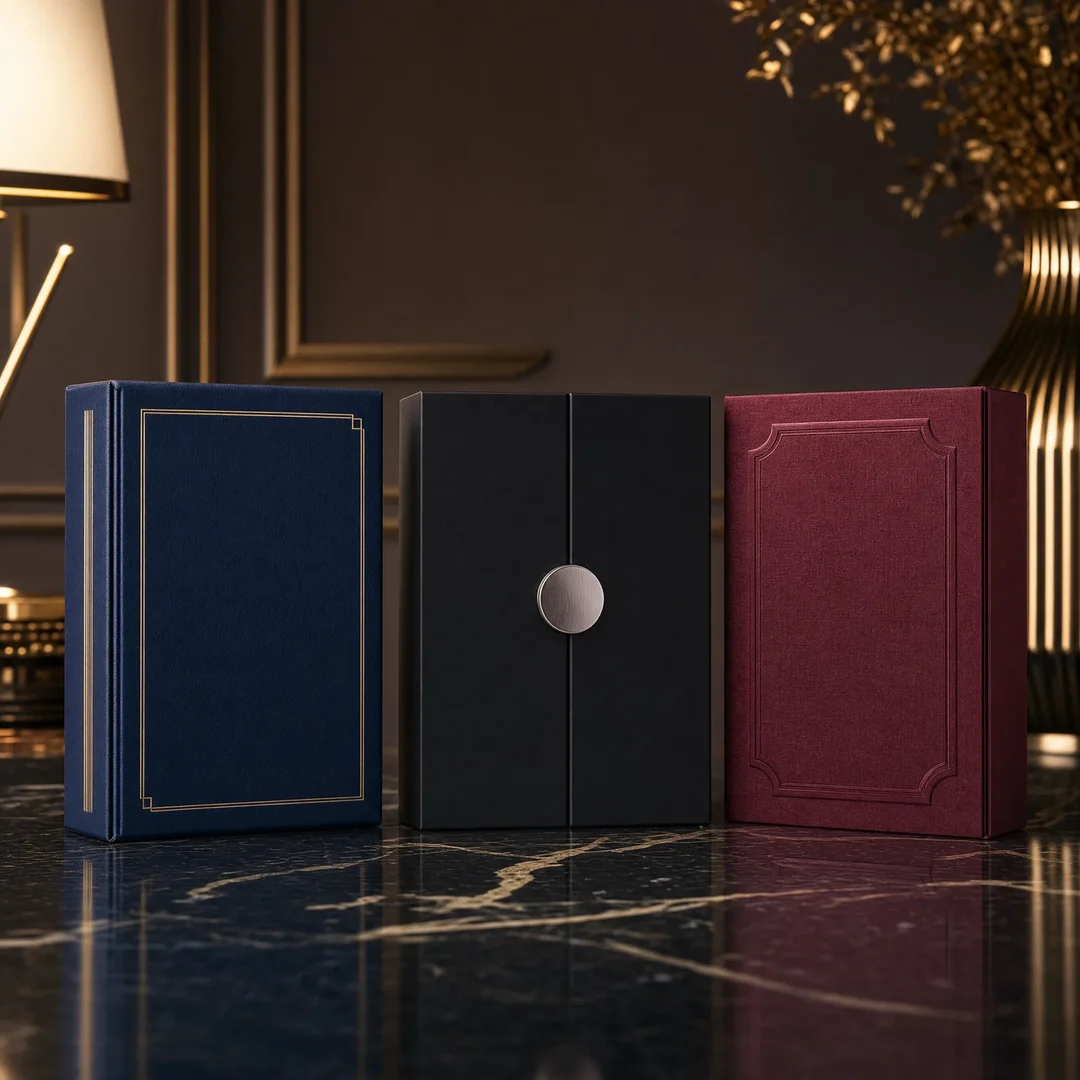
Think of a book cover attached to a rigid tray. Hinged boxes use a wrapped spine — usually reinforced with fabric tape or paper — that connects the lid to the base. They open like a book, which makes them popular for custom gift boxes , presentation kits, and corporate welcome packages. The hinge adds roughly 10-15% to the manufacturing cost versus a two-piece design but eliminates the risk of a lost lid and creates a more guided reveal.
Custom Finishing Options That Define the Box
Structure gives the box its bones. Finishing gives it a personality. The most successful custom luxury packaging projects combine at least two of the following techniques in a deliberate hierarchy — one dominant finish and one accent.
Hot foil stamping applies metallic foil (gold, silver, rose gold, copper, holographic) onto the box surface using a heated die and pressure. It creates a reflective, premium mark that catches light from any angle. Embossing and debossing press the paper surface into a raised or recessed pattern. Embossed logos sit above the surface and feel substantial under the finger. Debossed designs sink below the surface and cast subtle shadows that shift with ambient light — a favorite of minimalist fragrance brands.
Spot UV applies a glossy, transparent coating to specific areas — logo, product name, pattern elements — while leaving the surrounding area matte. The gloss-matte contrast draws the eye exactly where the designer intends. Soft-touch lamination is arguably the most addictive finish in the industry. A matte film with a velvety, almost rubbery texture, it makes people instinctively run their fingers across the box. Candle brands and skincare lines have adopted soft-touch almost universally because it signals “premium” without shouting.
Other options worth knowing: foil stamping with textured patterns (linen, leather grain), metallic edge gilding on the board edges, and window patching — a clear PET window that shows the product inside while keeping the box sealed.
Industry Use Cases: What Actually Works
Jewelry Box Printing
Jewelry packaging walks a tightrope: the box must feel luxurious but never upstage the product. Most jewelry box printing projects use two-piece rigid construction with a velvet or suede-lined interior. The exterior favors matte lamination with a single foil-stamped logo — restrained, elegant, confident. Interior trays are precision die-cut to hold rings, bracelets, or necklaces in fixed positions so nothing shifts during shipping.
Perfume Box Printing
Fragrance packaging is the most technically demanding category in rigid boxes. Perfume bottles are heavy, often irregularly shaped, and must remain upright during transit. Perfume box printing typically calls for high-gauge greyboard (2.5mm-3mm), foam or molded-pulp inserts that grip the bottle, and exterior finishes that match the fragrance’s personality — soft-touch for floral scents, glossy black with silver foil for masculine orientals. The box often includes a die-cut window, allowing the bottle silhouette to preview the product before the box opens.
Wine Box Printing
A single bottle of premium wine or spirits weighs roughly 1.3kg. Drop it from counter height in a folding carton and you will be mopping up glass. Wine box printing solves this with rigid construction rated to hold 2-5kg, a magnetic or hinged closure, and a satin-lined interior that cradles the bottle. Wood-textured paper wraps and foil-stamped vineyard names are standard. For gift sets containing two bottles plus accessories, multi-compartment trays keep everything separated and silent — no clinking during delivery.
Luxury Gift Sets and Electronics
Brands assembling holiday gift sets or corporate appreciation kits often run into the same problem: they need one box that holds five different items — none of which share the same shape. This is where custom gift boxes with multi-layer trays, foam cutouts, and ribbon pulls earn their keep. The box becomes a curated experience: open the lid, lift the first tray to reveal the hero product, pull the ribbon to access the accessories underneath. For consumer electronics, magnetic box printing on rigid greyboard has become the industry default — Apple set that standard, and premium audio brands, smart home device makers, and boutique gadget companies have followed.
Interior Options: Lining, Inserts, and Trays
The inside of a rigid box is where design quietly becomes experience. Open a box lined with black velvet and a foam insert that holds the product perfectly, and the message is immediate: someone thought about this.
Common interior materials run from budget to ultra-premium. Velvet lining — either real or high-grade synthetic — dominates jewelry and watch packaging. It has a deep, light-absorbing pile that makes metal and gemstones glow. Satin lining is lighter, smoother, and typically less expensive than velvet; wine and spirits boxes favor satin for its clean, reflective surface. Foam inserts (EVA or polyurethane) are CNC-cut to precise product contours. For electronics, flocked PET trays offer a compromise between foam’s protection and fabric’s elegance.
Custom trays deserve special attention. A well-designed tray is not just a holder — it guides the unboxing. Cardboard trays wrapped in matching paper create a seamless look inside the box. Ribbon pulls, finger notches, and lift-out panels turn a static box into an interactive reveal. Magnetic flaps on interior compartments keep smaller items — USB cables, care booklets, sample vials — from sliding around.
The rule of thumb: interior costs typically run 20-40% of the total box cost. If the product is the star, invest in the tray and keep the lining simple. If the box itself is the gift — as with custom gift boxes for corporate events — spend on both.
MOQ and Pricing: What Actually Drives Cost
Buyers approaching gift box printing china suppliers for the first time often fixate on unit price. Smart buyers fixate on setup costs. Here is why.
A custom rigid box in China from a mid-tier factory costs roughly $2.50-$8.00 per unit at 1,000-3,000 pieces, depending on complexity. But every project starts with fixed costs that must be amortized across the order: die-cutting molds ($80-$200 per die), embossing plates ($50-$150), foil stamping dies ($60-$180), and printing plates if offset printing is involved. On a 500-unit run, these setup costs can add $1.50-$3.00 per box. On a 5,000-unit run, they shrink to pennies.
Typical MOQ ranges from Chinese manufacturers:
Simple rigid box (one-color print, no special finishes): 300-500 unitsMid-complexity (foil stamping + embossing + magnetic closure): 500-1,000 unitsHigh-complexity (multiple finishes, custom inserts, multi-layer tray): 1,000-2,000 units
What moves the needle on cost most? Board thickness. Moving from 1.5mm to 2.5mm greyboard adds 25-40% to the material cost. Magnetic closures add $0.30-$0.80 per box for the magnets plus inline assembly labor. Soft-touch lamination adds roughly $0.15-$0.35 per box versus standard matte. And custom interior trays — especially CNC-cut foam — can double the per-unit cost of the box.
One pricing tactic worth knowing: many factories will quote a lower unit price on collapsible rigid box designs because they ship and store flat, reducing factory floor space and freight volume. If your brand sells primarily through e-commerce, the collapsible structure can save 20-35% on total landed cost versus a pre-assembled two-piece box of equivalent quality.
For kraft box printing options — where the box surface uses uncoated kraft paper rather than art paper — expect costs at the lower end of the range. Kraft has a raw, natural texture that appeals to organic and sustainable brands, and it eliminates the cost of lamination on the exterior surface.
How to Design Files for Custom Rigid Box Production
Getting dielines right saves weeks of back-and-forth. A rigid box dieline is not the same as a folding carton dieline because rigid boxes are handmade — paper is wrapped around greyboard panels, and the wrapping allowance must account for board thickness plus adhesive tabs.
Your designer should provide:
Structural dieline in .AI or .PDF format, showing cut lines, fold lines, glue tabs, and magnet positionsArtwork file in CMYK with 3mm bleed on all edgesFinishing plate files — separate layers for foil stamping areas, embossing zones, and spot UV masksPantone references for any brand colors
A common mistake: placing fine text or thin lines inside embossed or foil-stamped areas. The pressure and heat of these processes cause slight paper expansion, so anything smaller than 6pt type risks becoming illegible. Keep embossing areas bold and simple.
Most Chinese rigid box factories accept Adobe Illustrator (.AI), PDF, or EPS formats. Some also accept CorelDRAW (.CDR), which remains widely used in China’s printing industry. Always request a physical prototype before signing off on the full production run. A pre-production sample costs $50-$150 and takes 5-10 business days. It is the cheapest insurance against a 5,000-unit mistake.
Why Source Luxury Packaging from China
China produces an estimated 60-70% of the world’s rigid gift boxes. The reasons go beyond labor costs — though labor does play a role, since rigid boxes are inherently handmade products that resist full automation. A skilled wrapper in a Dongguan factory can hand-wrap 150-250 boxes per day with a consistency that semi-automated lines in other countries struggle to match.
The deeper advantage is the supply chain cluster effect. Within a 50-kilometer radius of manufacturing hubs like Dongguan and Shenzhen, a rigid box factory can source greyboard from one supplier, decorative paper from another, magnets from a third, and foam inserts from a fourth — all within same-day delivery. This proximity compresses lead times and gives buyers leverage to negotiate components separately. European and North American converters rarely have this density of upstream suppliers.
Lead times from Chinese rigid box manufacturers typically run 15-35 days for production, with an additional 7-21 days for ocean freight to Western ports. Air freight cuts transit to 5-7 days but multiplies shipping cost by 4-6x. For most orders above 1,000 units, ocean freight via consolidated container (LCL) hits the sweet spot between speed and cost.
A word on quality control: factories producing rigid box printing for export markets are generally familiar with international standards — AQL 2.5 for major defects, color consistency within Delta E 3.0, and adhesion testing for foil and lamination. But do not assume. Specify your QC standards in the purchase order, budget for a third-party inspection ($300-$500 per inspection day), and never authorize mass production based on a photo of a sample alone.
Frequently Asked Questions
What’s the minimum order for custom rigid boxes from China?
Most factories set MOQ at 300-500 units for simple designs. For boxes with magnetic closures, foil stamping, and custom inserts, expect MOQs of 500-1,000 units. Some suppliers offer low-MOQ programs (100-200 units) at a premium per-unit price, but these are the exception, not the rule.
How long does rigid box production take?
Production typically takes 15-25 business days after sample approval. Add 5-10 days for sampling and 7-21 days for ocean shipping. Door-to-door from order confirmation to delivery: plan on 5-8 weeks.
Can I mix different sizes in one order?
Yes, but each size requires its own tooling (dies, plates), which increases total setup costs. Most factories allow size mixing within the same order as long as each variant meets the MOQ individually. Some will split MOQ across sizes for simpler designs — ask during quoting.
What’s the difference between rigid box and folding carton packaging for luxury products?
Rigid boxes use thick greyboard (1.5mm-3mm) wrapped in decorative paper; folding cartons use single-layer paperboard (0.3mm-0.6mm) that is die-cut and folded. Rigid boxes feel heavier, last longer, protect better, and command higher perceived value. Folding cartons cost less, ship flatter, and work for mid-market products where the unboxing is not the story.
Are kraft box printing options available for rigid boxes?
Yes. Kraft box printing on rigid greyboard uses uncoated kraft paper as the exterior wrap, giving the box a natural, textured, eco-conscious look. Kraft rigid boxes are popular with organic skincare brands, sustainable fashion labels, and artisan food producers. The cost is typically 10-20% lower than comparable art-paper-wrapped boxes because kraft paper costs less and requires no lamination.
Making the Decision: A Practical Checklist
Before you request quotes, pin down these six variables. They determine 80% of the final cost and timeline:
Box structure : Two-piece, collapsible, magnetic, or hingedDimensions : Inner cavity dimensions in millimeters — these determine board gauge and material usageExterior finish : Matte lamination, soft-touch, or uncoated kraft — pick one dominant treatmentAccent finishes : Foil stamping, embossing, spot UV — pick at most twoInterior : Velvet, satin, foam insert, custom tray, or emptyOrder quantity : Realistic volume, not aspirational — factories price differently at 500 vs 5,000 units
Once you have numbers for all six, request quotes from three factories. Compare not just the unit price but the total landed cost — unit price × quantity + tooling fees + freight + duties + inspection. The cheapest per-unit quote often hides higher tooling costs or longer lead times that erase the savings.
Custom packaging is a capital investment that touches every customer. A rigid box done well sells the product before the product gets a chance to sell itself. Done poorly, it signals corner-cutting before the lid comes off. The brands that win on shelf and in the unboxing video treat the box not as packaging but as the first moment of product experience.