Types of Custom Bags: Paper, Canvas, and Non-Woven
Most buyers arrive knowing they want “custom bags.” The first real split happens at material selection because the bag type dictates everything downstream: printing method, minimum order quantity, unit cost, and the brand perception you create.
Paper Bags
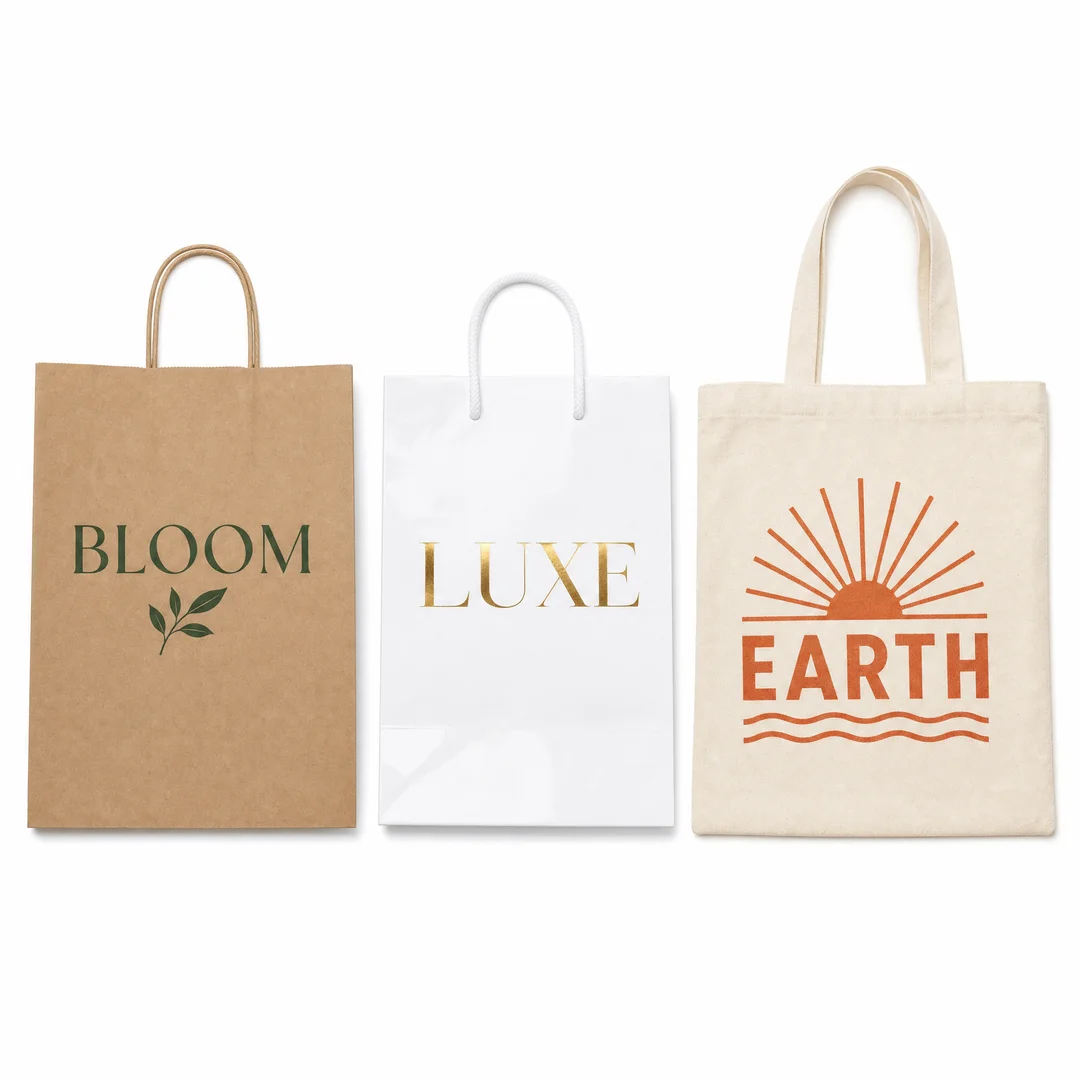
Paper bags are the workhorse of retail packaging. They range from uncoated brown kraft bags used in grocery and takeaway settings to luxury white art paper bags with foil-stamped logos found in high-end boutiques.
From a branding perspective, custom paper bag printing offers the widest range of graphic possibilities. Offset lithography on coated white paper can reproduce photographs, gradients, and intricate illustrations at near-magazine quality. On kraft paper, simpler flexographic or screen-printed designs tend to work better because the brown substrate absorbs more ink and dulls bright colors unless a white under-base is laid down first.
Typical paper bag constructions include:
SOS (Self-Opening Satchel) bags — flat-bottom, gusseted, used heavily in food service and groceryTwisted-handle bags — the classic boutique shopping bag with reinforced paper cord handlesFlat-handle bags — often used for luxury retail, where flat paper ribbon handles create a cleaner lookDie-cut handle bags — handle cut directly into the bag body, no attachment needed, economical for light loads
Canvas Bags
Canvas bags — typically made from cotton or cotton-polyester blends — occupy a different positioning entirely. Customers perceive them as premium reusable items rather than disposable packaging. This makes canvas bag printing particularly effective for brands that want to associate themselves with durability, sustainability, and a higher price point.
The material matters for printing. Cotton canvas has a textured, absorbent surface that takes screen printing exceptionally well. The ink sits into the fibers, creating a soft-hand feel that does not crack or peel with folding. Direct-to-garment (DTG) digital printing works for short-run, full-color designs but costs more per unit at scale. Heat transfer and dye sublimation are also options, though sublimation only works on polyester-blend canvas, limiting its use for natural-fiber bags.
Most canvas bags in the B2B trade fall into two camps:
Lightweight canvas (4-6 oz) — promotional giveaways, event swag bagsHeavyweight canvas (10-12 oz) — premium retail bags meant to be kept and reused for years
Non-Woven Bags
Non-woven polypropylene (PP) bags sit at the intersection of affordability and reusability. They are not fabric in the traditional sense — the material is made by bonding polypropylene fibers under heat and pressure, creating a sheet that feels somewhere between paper and cloth.
Non woven bag printing is widely used for trade show giveaways, supermarket reusable bags, and promotional campaigns where cost-per-impression is the primary metric. These bags are lighter than canvas, cheaper than paper at comparable sizes, and printable via screen printing or heat transfer. The typical material weight ranges from 60 to 120 GSM — 80 GSM being the most common for general-purpose shopping bags.
A key decision with non-woven bags is whether to laminate them. Laminated non-woven bags have a thin PP film bonded to the surface, which makes colors pop and adds water resistance. Unlaminated versions feel more fabric-like and are often marketed as more “natural,” though they are still synthetic.
Materials Comparison: What the Bag Is Actually Made Of
Understanding substrate specifications helps you communicate with suppliers and avoid the “I thought it would be thicker” conversation after samples arrive.
Material
Typical GSM Range
Best For
Eco Profile
Print Compatibility
Brown Kraft Paper
80–150 GSM
Grocery, takeaway, general retail
Recyclable, biodegradable, FSC-certifiable
Flexo, screen, limited offset
White Kraft Paper
100–150 GSM
Boutique retail, food, gifts
Same as brown kraft; cleaner look for full-color
Offset, flexo, digital
Coated / Art Paper
128–350 GSM
Luxury retail, fashion, cosmetics
Recyclable (coating-dependent); premium finish
Offset, digital, foil stamping
Cotton Canvas
4–12 oz (≈140–340 GSM)
Premium retail, events, promotional
Natural fiber, reusable for years
Screen, DTG, heat transfer
Non-Woven PP
60–120 GSM
Supermarket, trade shows, giveaways
Recyclable (PP #5); reusable but synthetic
Screen, heat transfer, offset (laminated)
GSM is not the whole story. Two bags can both be listed at 120 GSM and feel completely different. Kraft paper at 120 GSM is stiffer and holds creases well but tears more easily than coated art paper at the same weight. Non-woven PP at 80 GSM feels flimsy with a single-layer construction but surprisingly sturdy when gusseted and stitched. Always request a physical sample before committing to a production run — nothing replaces touching the material.
For brands prioritizing sustainability messaging, brown kraft with water-based flexo ink and twisted paper handles creates the strongest eco-narrative. Coated art paper with foil stamping and lamination, while visually striking, trades off some recyclability for that premium shelf presence.
Custom Printing Options: Matching Method to Material
This is the section where most buyers lose time — requesting a printing method that does not work on their chosen material, or vice versa. Here is how each method performs in practice.
Screen Printing
Screen printing pushes ink through a mesh stencil directly onto the bag surface. Each color requires its own screen, so costs scale with color count.
Best for: Kraft paper bags, canvas bags, non-woven bags — essentially any material where a bold, opaque logo matters more than photographic detail. Screen printing on canvas creates a particularly durable result because the ink bonds into the fiber structure.
Limitations: Not practical for designs with more than 3–4 colors. Color gradients and photographic images will not reproduce well. Setup costs per color mean it becomes expensive for very small quantities.
For custom canvas bag printing , screen printing is the default method used by most Chinese manufacturers. The results are wash-resistant and the per-unit cost drops sharply above 500–1,000 pieces. For custom non woven bag printing , screen printing handles the textured PP surface better than digital methods at medium-to-large volumes.
Offset (Lithographic) Printing
Offset printing transfers ink from a plate to a rubber blanket, then to the paper. This indirect transfer is why it achieves such sharp detail — the rubber conforms to slight surface irregularities.
Best for: Coated art paper bags, white kraft bags. This is the go-to method for custom paper bag printing when the design includes photographs, fine typography, or full-color artwork. Luxury brands almost exclusively use offset for their retail bags.
Limitations: Requires smooth, coated surfaces. Does not work on canvas or non-woven PP. Higher plate setup costs mean it is uneconomical below roughly 500–1,000 pieces, though some specialized paper bag printing china suppliers have brought this threshold down.
Flexographic Printing
Flexo uses flexible relief plates on rotating cylinders. It is fast, continuous, and cost-efficient at high volumes.
Best for: Large-quantity kraft paper bags with simple graphics. Grocery chains and quick-service restaurants almost always use flexo-printed bags because the economics make sense at scale: once the plates are paid for, the incremental cost per bag is minimal.
Limitations: Cannot match offset for detail or color gamut. Registration (alignment between colors) tends to be looser. Not ideal for bags where the logo needs to look photographic.
Hot Stamping / Foiling
Hot stamping uses heat and pressure to transfer metallic or pigmented foil onto the bag surface. It is not a full printing method in itself, but a finishing technique that adds a premium focal point.
Best for: Logos on luxury retail bags. A gold or silver foil logo on matte black or kraft paper is one of the most effective combinations in packaging — it communicates quality before the customer even touches the product. Works on paper bags and, with the right adhesives, on some coated non-woven bags.
Limitations: Mostly single-color (the foil color). Detail is limited to what the heated die can press. Not practical for large coverage areas.
Digital Printing
Digital printing skips plates entirely and prints directly from a digital file.
Best for: Short runs, sampling, variable-data campaigns. If you need 100 custom bags for a pop-up event with full-color artwork, digital is likely your only viable option. It also allows versioning — printing 50 bags with one design and 50 with another for A/B testing.
Limitations: Higher per-unit cost at scale. Ink adhesion on textured or uncoated surfaces can be inconsistent. Not a long-term production method for most bag types.
Handle and Finishing Options
Handles are one of the most overlooked decisions in bag design, yet they affect both cost and user experience more than most buyers expect.
Handle Types
Handle Type
Material
Typical Use
Cost Level
Flat Paper / Ribbon
Kraft or coated paper ribbon
Luxury retail, gift bags
$$
Die-Cut
Cut directly into bag body
Lightweight promotional bags
$
PP Webbing
Polypropylene webbing
Non-woven bags, heavy-duty
$$
| Twisted Paper | Kraft paper cord | Retail, boutique, grocery | $ |
Twisted paper handles are the industry default for a reason: they are inexpensive, strong for their weight, and fully recyclable with the bag. However, they can look generic. Flat ribbon handles add a clearly premium signal — customers notice the difference immediately when the handle sits comfortably in hand rather than digging in.
For canvas and non-woven bags, cotton rope or PP webbing handles are standard. The attachment method matters: reinforced stitching with cross-stitch anchors will outlast simple single-stitch attachment by a wide margin.
Finishing Options
Lamination (Gloss or Matte): A thin plastic film applied to the printed surface. Gloss lamination intensifies colors and makes them pop. Matte lamination creates a soft, understated luxury feel. Both add durability and water resistance. The trade-off: laminated bags are harder to recycle through standard paper streams.
Spot UV: A clear, glossy coating applied to specific areas (usually the logo). It creates a tactile contrast between the shiny coated areas and the matte background. Very effective on dark-colored art paper bags.
Embossing / Debossing: Pressing the paper to create raised (embossed) or recessed (debossed) design elements. Works best on thicker paper stock (157 GSM and above). Often combined with foil stamping for maximum impact.
Varnish (Aqueous or UV): A thin protective coating applied across the entire surface. Aqueous varnish is water-based and more eco-friendly. UV varnish cures instantly under ultraviolet light and can be applied selectively or all-over.
Minimum Order Quantity and Pricing Factors
Understanding MOQ and cost drivers helps you have realistic conversations with suppliers instead of wasting time on quotes that will never work.
Typical MOQ by Bag Type
Bag Type
Standard MOQ (China Suppliers)
Notes
Custom Paper Bags (Flexo)
1,000–3,000 pcs
Lower MOQ possible at higher unit price
Custom Paper Bags (Offset)
500–2,000 pcs
Plate costs amortized over run
Custom Canvas Bags
500–1,000 pcs
Screen-printed; embroidery MOQ similar
Custom Non-Woven Bags
1,000–5,000 pcs
Lower MOQ for stock sizes with print
Hot Stamp / Foil Bags
1,000–3,000 pcs
Die cost is the fixed component
MOQs from custom paper bags china suppliers have trended downward over the past five years as more factories invest in digital and short-run capabilities. It is now possible to find suppliers offering 500-piece MOQ for offset-printed paper bags, though the per-unit price will be noticeably higher than at 5,000 pieces.
What Affects Pricing
The factors that move the needle on cost, ranked by impact:
Quantity — The single biggest variable. Doubling your order quantity can reduce unit cost by 30–50%, depending on the bag type and printing method.
Number of Print Colors — For screen printing and flexo, each additional color adds a setup charge and ink cost. Offset printing is more forgiving here because CMYK four-color process is standard.
Material Grade — Jumping from 120 GSM brown kraft to 200 GSM coated art paper can nearly double the material cost alone, before printing or finishing.
Finishing — Lamination adds 5–15% to unit cost. Foil stamping adds a die charge (typically USD 50–150, one-time) plus a per-piece stamping fee. Spot UV adds a plate cost plus per-piece coating cost.
Handle Type — Twisted paper handles are the cheapest. Cotton rope handles can add USD 0.10–0.30 per bag depending on thickness and attachment method.
Bag Size — Larger bags use more material and cost more to ship. Standard sizes (e.g., 25×20×10 cm for small retail, 32×26×12 cm for medium) are cheaper than custom dimensions.
A practical rule of thumb learned from industry buyers: if your per-bag budget is under USD 0.30, you are looking at uncoated kraft with 1–2 color flexo or screen print. Between USD 0.50–1.00, coated paper with offset printing becomes feasible. Above USD 1.00 per bag, you can spec luxury finishes — foil, embossing, spot UV, premium handles.
Use Cases and Industries
Different bag types dominate different verticals. Understanding what your competitors and adjacent brands are using helps you position your packaging appropriately.
Retail and Fashion
This is the largest segment for custom printed bags. Fashion retailers use custom paper bag printing with offset lithography on coated white paper, typically with matte lamination and ribbon handles. The bag itself becomes part of the unboxing experience — luxury brands invest heavily in bag quality because customers reuse them as everyday totes, extending brand visibility.
Boutique clothing brands often opt for smaller-format kraft bags with foil-stamped logos to balance premium feel with perceived eco-consciousness.
Food and Beverage
Takeaway and food service rely on brown kraft SOS bags and flat-handle bags printed with simple flexographic designs. Water-based inks are mandatory for direct food contact applications. Bakeries and specialty coffee roasters increasingly use custom printed kraft bags with a clear window panel — combining branding with product visibility.
Events and Trade Shows
Canvas bag printing and custom non woven bag printing dominate event swag. Canvas bags convey quality and are kept longer by recipients, making them better for premium brand associations. Non-woven bags are cheaper per unit and better suited when the goal is maximizing distribution — handing out 5,000 bags at a trade show, for instance.
A common mistake: ordering beautiful full-color canvas bags but underestimating the lead time. Custom canvas bag production from China typically runs 15–25 days for production alone, plus shipping. Rush orders almost always incur a surcharge.
Promotional Giveaways
Non-woven bags rule this category on cost grounds. A 1,000-piece order of screen-printed 80 GSM non-woven bags can land below USD 0.25 per unit from Chinese suppliers. For giveaways where the bag is a vehicle for the logo rather than a product in itself, that price point is hard to beat.
Luxury and Gift Packaging
This segment pushes the upper limits of bag quality. Rigid boxes with magnetic closures, thick art paper bags (250–350 GSM) with foil stamping and ribbon handles, and custom-sized gift bags with tissue paper inserts. The printing quality must be flawless because these bags sit under Christmas trees and at gala dinner tables — any registration error or lamination bubble becomes glaringly obvious.
How to Order Custom Bags from China
If you are sourcing from China for the first time, the process can feel opaque. Here is a step-by-step walkthrough based on what experienced buyers actually do.
Step 1: Prepare Your Requirements
Before contacting any supplier, have these details ready:
Bag type and material (e.g., white kraft paper, 150 GSM, twisted handles)Dimensions (width × height × gusset depth in cm — metric is standard)Print design (ideally in AI, PDF, or EPS format with CMYK color values and Pantone references for spot colors)Quantity (target quantity and minimum you would accept)Target budget per unit (be upfront — it saves time on both sides)Timeline (when you need the bags in hand)
Suppliers that quote without asking for these details are guessing. The ones that come back with clarifying questions are engaging seriously.
Step 2: Request Quotes and Compare
Cast a net of 3–5 suppliers. Platforms like Alibaba and Made-in-China aggregate most paper bag printing china manufacturers, but direct referrals from industry contacts often yield better results. When comparing quotes, look beyond the unit price:
What is included in the quote? (printing plates, die costs, sample costs, domestic shipping to port)
What payment terms are offered? (30/70 T/T is standard — 30% deposit, 70% before shipment)
What is the stated production lead time and is it guaranteed?
Step 3: Artwork and Pre-Production Sample
Once you select a supplier, they will create a digital proof (usually a PDF mockup showing print placement, fold lines, and color references). Approve this carefully — the factory will match production to this proof, not to whatever you “meant.”
After proof approval, request a pre-production sample (PPS). This is a physical bag made on the actual production line with your exact materials and print setup. It typically costs USD 50–150 and takes 3–7 days. The PPS is your last chance to catch issues before committing to the full run.
Common issues caught at PPS stage: colors that looked right on screen printing darker or lighter on the actual material, handle attachment that does not feel sturdy enough, and gusset depth that does not fold cleanly.
Step 4: Production and Quality Control
Production lead times from Chinese bag manufacturers typically run:
Paper bags (flexo): 7–12 days
Paper bags (offset): 10–15 days
Canvas bags (screen-printed): 15–25 days
Non-woven bags (screen-printed): 10–15 days
If your order exceeds 10,000 pieces, consider hiring a third-party inspection service (SGS, Bureau Veritas, or local firms) to check quality mid-production or before shipment. The cost is modest relative to the risk of receiving 20,000 unusable bags.
Step 5: Shipping
Sea freight is the economical default for most orders. A standard pallet of paper bags (roughly 2,000–3,000 pieces) ships from Shanghai or Ningbo to the US West Coast in about 15–20 days port-to-port, with another 5–7 days for customs clearance and inland delivery. Air freight cuts total transit to 7–10 days but can triple the logistics cost.
For smaller orders (under 500 pieces), express courier services (DHL, FedEx, UPS) are often faster and simpler than LCL sea freight — just factor the higher shipping cost into your per-unit calculation.
Conclusion
Choosing the right custom bag is a series of interconnected decisions: the material sets the printing possibilities, the printing method sets the cost structure, and the supplier relationship determines whether the end result matches your expectations. There is no single “best” combination — the right answer depends on your brand positioning, budget, and distribution strategy.
For brands selling in North American and European markets, the combination of custom paper bags china manufacturing with offset printing on coated white paper delivers perhaps the strongest price-to-quality ratio currently available. Canvas bags from the same supply chain work brilliantly for premium retail and long-term brand visibility. Non-woven bags fill the promotional and budget-sensitive end of the spectrum effectively.
If you are evaluating custom paper bag printing options, start with a clear brief, request physical samples from shortlisted suppliers, and do not skip the pre-production sample stage. The difference between a bag that elevates your brand and one that ends up crumpled in a corner usually comes down to the details you check before pressing “approve” on the production run.
For more information on custom printing and packaging solutions, visit our custom book printing services or explore our complete packaging guide . If you are ready to discuss a specific project, contact our team for a tailored quote.