Google Says “Is It Safe?” — So Let’s Answer That Question Directly
Type “China book printing” into Google. The first autocomplete suggestion is not “China book printing cost” or “China book printing services.” It is “Is China book printing safe?” The search engine is telling you what thousands of people before you have already asked. Every publisher, every self-published author, every corporate buyer who has ever typed those words has felt the same hesitation.
The hesitation makes sense. You are sending files worth months or years of work to a factory you have never visited, in a country you may have never been to, run by people you have never met. You are wiring money across borders. You are trusting that someone 7,000 miles away will care about your project as much as you do. If that does not make you pause, you are not thinking hard enough.
But here is what the autocomplete does not tell you: China has been printing books for the global market for over three decades. The printed book export value from China reached $4.24 billion in 2024 , according to UN COMTRADE data. Every major English-language publisher — Penguin Random House, HarperCollins, Simon & Schuster, Hachette — has printed titles in China. The photo book on your coffee table, the children’s board book your toddler chews on, the textbook your teenager carries to class — odds are decent that at least one of them was manufactured in Guangdong Province.
This article is not a sales pitch that tells you everything is perfect. It is a straight answer to the five questions every buyer asks before printing a book in China: quality control, certification, communication, defect handling, and shipping. If you are considering book printing in China for the first time — or if you tried it before and got burned — this is what you need to know before you send a file.
The Scale of Chinese Book Printing Is Not Something You Can Ignore
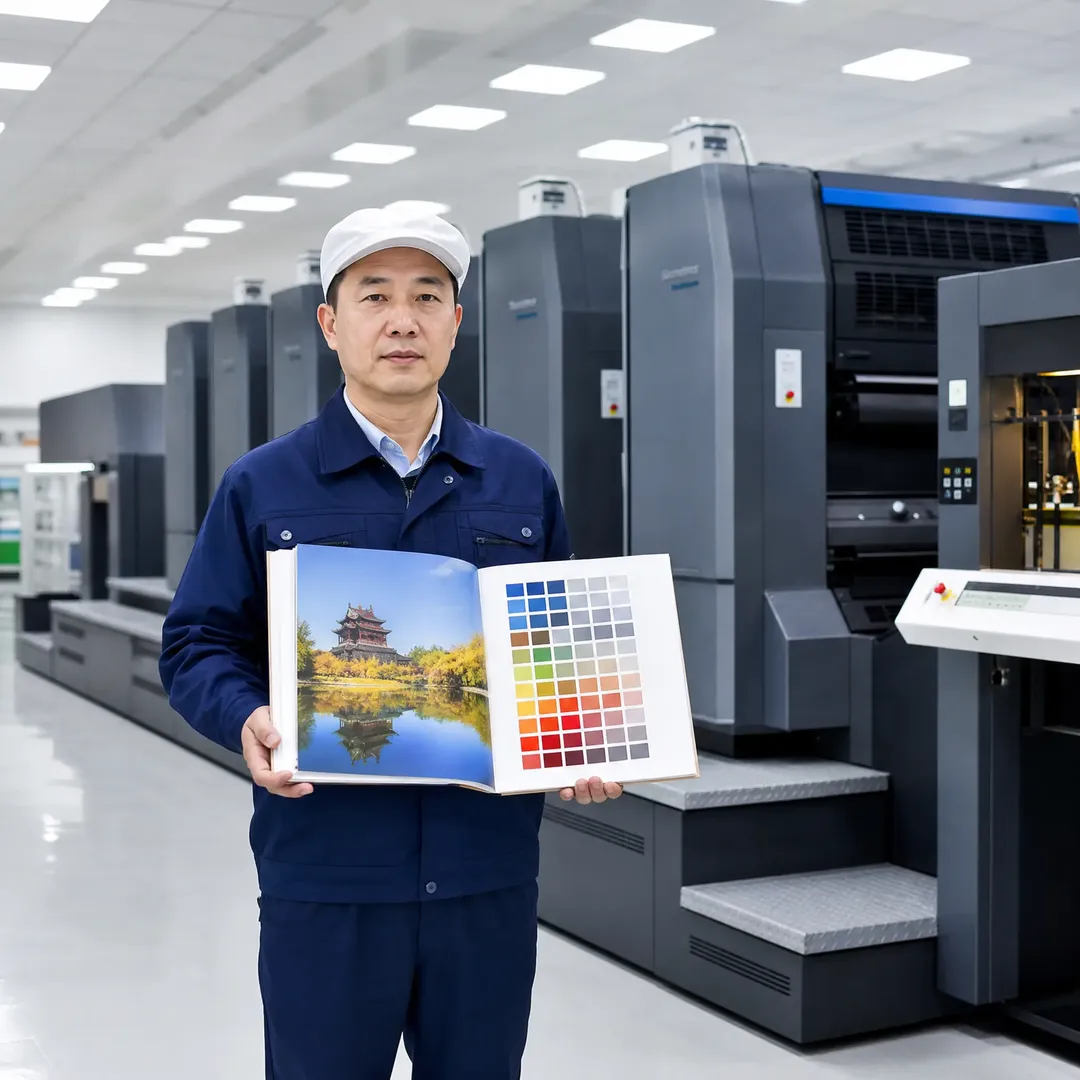
Walk into any major book printing factory in Shenzhen or Dongguan and the first thing that hits you is the scale. These are not print shops. They are industrial campuses. A mid-size export-oriented book printer runs 8 to 12 Heidelberg or Komori sheet-fed offset presses simultaneously, each printing 15,000 sheets per hour. The bindery line — Smyth sewing machines, perfect binders, case-making stations, foil stamping — stretches the length of a football field.
This scale matters for two reasons that have nothing to do with “cheap labor” and everything to do with how book production actually works at volume.
First, equipment. The Heidelberg Speedmaster XL 106 that prints a Penguin Random House hardcover in Germany is the same machine printing a self-published author’s photography book in Shenzhen. Export-oriented Chinese printers invest in the same Heidelberg, Komori, Kolbus, and Muller Martini equipment as European and North American printers. A Heidelberg press does not print worse because it sits in Guangdong instead of Bavaria. The machine does not care about geography.
Second, specialization. Because a single Chinese book printing factory might run 1,200 different titles per year — everything from 24-page saddle-stitched brochures to 400-page Smyth-sewn hardcovers with foil stamping and ribbon markers — the production team has seen more binding variations, more paper combinations, and more prepress quirks than a printer running 50 titles a year can encounter in a decade. When you ask “can you do lay-flat binding with a dust jacket and gold foil on cloth?” the answer is not “let me check.” It is “which foil — matte gold or bright gold? And do you want the spine rounded or square?”
This does not mean every Chinese printer is good. It means the infrastructure exists for good printing, and the difference between a good printer and a bad one is knowable. It shows up in certifications, in communication quality, and in how they handle the moment something goes wrong.
Quality Control Does Not Happen by Accident
The question behind “is it safe” is really “how do I know the books will look right?” The answer is not trust. It is process.
Color Management: ISO 12647-2 and Why It Matters
If you have ever received a print job where the cover photo looked greenish compared to your screen, or the skin tones in a portrait came out muddy, you have experienced what happens when a printer does not run a calibrated color pipeline. The international standard that governs color consistency in offset printing is ISO 12647-2 , which specifies target values for tone reproduction, ink density, and dot gain across sheet-fed offset presses. A printer running ISO 12647-2 compliant processes is not guessing at color — they are measuring it against a defined standard at every stage, from plate making through the press run.
In practice, this means the printer uses a spectrophotometer to read color bars printed alongside your book pages on every signature. If the cyan density drifts by 0.05 during the run, the press operator adjusts before the next sheet comes through — not after 2,000 copies have been printed. The target values — specified ink densities, Lab color coordinates for primaries and secondaries, tone value increase curves — are printed on a quality control sheet that gets signed off at the start, middle, and end of every production shift.
A good export-focused Chinese printer will also be Fogra PSO certified (Process Standard Offset), which means an independent auditor from Germany’s Fogra Research Institute has verified that the printer’s entire color workflow — plate calibration, press fingerprinting, proof-to-press matching — meets ISO 12647-2 tolerances. G7 Master certification from IDEAlliance serves the same function in the North American market. If a printer holds both Fogra and G7 certifications, they are serious about color.
Physical Proofs: The Moment of Truth
No certification replaces a physical proof. When you print a book in China, you should receive a printed and bound sample — either a few representative signatures or a full copy — before the production run starts. This proof is printed on the same paper, on the same press, with the same ink as your final books. It is not an inkjet approximation. It is the actual product.
What you check on the proof: color accuracy against your calibrated monitor (yes, your monitor needs to be calibrated), trim alignment (are your full-bleed images actually bleeding to the edge?), binding integrity (does the book open properly, do the endpapers lay flat?), and cover-to-text alignment (is the spine text centered, are the cover flaps the right width?).
Physical proofs add roughly 7 to 10 days and $80 to $150 to the project timeline — and they are worth every dollar and every day. A proof catches the error that costs $80 instead of the error that costs $8,000 in a reprint. It also gives you a physical object to show your team, your investors, or your author. “The books will look like this” is a much stronger statement when you are holding the proof in your hand.
Retained Samples: The Reference Copy
Reputable Chinese printers retain a sealed reference copy from your production run — typically one sealed copy per 500 or 1,000 printed units. If a dispute arises about whether a batch meets specifications, the retained sample serves as the objective standard. Both you and the printer agreed that sample represents acceptable quality. If your received shipment differs from the retained sample, the printer is obligated to make it right. This practice, standard in export manufacturing across industries, is not a favor — it is part of the production contract.
Certifications That Separate Professional Printers From the Rest
Anyone with a website can call themselves a “professional book printer.” Certifications are what make the claim verifiable. Here are the ones that matter when evaluating a China book printer — and what each certification actually proves.
ISO 9001: Quality Management Systems. This is the baseline. ISO 9001 certification means the factory has documented procedures for every production stage — raw material inspection, in-process quality checks, finished product inspection, corrective action when defects are found. A printer without ISO 9001 can still produce good books, but they are relying on individual operator skill rather than a repeatable system. When the senior press operator takes a sick day, quality should not drop. ISO 9001 is how you know it will not.
FSC (Forest Stewardship Council) Chain of Custody. FSC certification means the printer can trace every sheet of paper in your book back to responsibly managed forests. This matters if you sell on Amazon, where FSC-certified packaging and paper products carry a sustainability badge, or if your publisher requires environmental compliance as part of their vendor policy. An FSC-certified printer can also print the FSC logo on your copyright page and provide the chain-of-custody certificate your distributor may require.
ISO 12647-2 / Fogra PSO / G7 Master. As discussed above, these are the color management certifications. A printer who holds all three — ISO 9001 for process, FSC for paper sourcing, and Fogra/G7 for color — is operating at the same certification level as top-tier European and North American printers.
BRCGS (Brand Reputation Compliance Global Standards). If you are printing children’s books, board books, or any product that might end up in a child’s mouth, BRCGS certification matters. It verifies that the factory meets safety standards for materials, production hygiene, and contaminant control — the same standards required for food packaging.
GMI (Graphic Measures International). If you are printing for a major retail brand — Target, Walmart, Costco — their packaging and print vendors typically need GMI certification, which verifies color consistency and print quality against the retailer’s specific standards.
One certification that is harder to verify but equally important: ISO 14001 for environmental management. This means the factory has systems for waste reduction, energy efficiency, and responsible disposal of printing chemicals, inks, and solvents. A printer with ISO 14001 is not dumping plate chemistry into the local river.
The presence of certifications does not guarantee a perfect job, but their absence tells you everything you need to know. A printer who has not invested in third-party audits is a printer who has not invested in process. Ask for certificate numbers and verify them on the issuing body’s public database. It takes five minutes.
You Do Not Need to Speak Chinese to Print a Book in China
This is the concern that stops more first-time buyers than any other. “How do I communicate technical printing specifications — paper weight, binding method, bleed requirements, color profiles — to someone who does not speak my language?” The short answer: export-oriented Chinese printers have built their businesses around English-speaking clients. They would not exist without them.
A professional China book printer serving the international market employs an English-speaking sales and project management team. These are not translators running your emails through Baidu Translate. They are printing professionals who discuss paper specifications in GSM, binding methods in technical terms (Smyth sewn, notch bound, PUR adhesive), and color requirements in ISO standards. They use the same vocabulary your local printer uses, because they were trained on the same equipment and the same standards.
Here is what good communication with a Chinese printer looks like in practice: you send a spec sheet and PDF files. Within 24 hours — typically within 12 hours during their business day, which overlaps conveniently with North American evening hours — you get a response that includes a technical review of your files (are bleeds present? are images 300 DPI? are fonts embedded?), a formal quotation with line items for each production stage, and specific questions about anything ambiguous in your spec. The conversation continues on email or WhatsApp, with file transfers via WeTransfer or the printer’s FTP.
Red flags to watch for: responses that take more than two business days, answers that are vague or non-technical (“we can do good quality” instead of “we print to ISO 12647-2 with Fogra 51/52 color targets”), and reluctance to provide sample photos of similar projects they have produced. A good printer is proud of their work and shows it. A bad printer deflects.
What Happens When Something Goes Wrong — Because Sometimes It Does
Books get damaged in production. A signature gets mis-collated. A cover lamination peels at the edges. The spine text is 2mm off-center. These things happen in printing plants in Germany, in Canada, in Japan, and yes, in China. The difference between a good printer and a bad one is not whether problems occur — it is what happens next.
A professional export contract with a Chinese printer should include clear defect-resolution terms. The industry standard for book printing is:
Defect rate threshold: typically 2% to 3% of the total print run. If defective copies exceed this threshold, the printer reprints the shortfall at their cost.Critical defects: missing pages, upside-down signatures, incorrect trim, wrong cover — zero tolerance. Any critical defect entitles you to a full reprint of the affected copies.Claim window: typically 7 to 14 days after receipt of shipment. You need to inspect your shipment promptly. If you open the cartons three months later and find issues, the claim window has closed.Resolution options: reprint (printer covers manufacturing cost, you may need to cover shipping), credit against future orders, or partial refund. The default resolution for export book printing is reprint — the printer re-manufactures the defective copies.
The practical reality: most disputes are resolved commercially, not litigated. A printer who has invested $3 million in equipment and built a reputation over 15 years does not want a PayPal dispute or a negative Alibaba review. Their incentive to fix the problem is stronger than their incentive to avoid it. This is not altruism — it is business. A repeat customer printing 3,000 books per year is worth far more than the cost of reprinting 50 defective copies.
One thing worth understanding about the economics: if a printer quotes you $4.50 per copy for a 200-page paperback, their actual manufacturing cost is roughly $3.00 to $3.50. Reprinting 50 copies costs them $150 to $175 in materials and machine time. Alienating a customer who might order 2,000 copies next year would cost them $9,000 in lost revenue. The math makes defect resolution a priority, not an afterthought.
Shipping: The Part Nobody Plans For Early Enough
You know your book needs to ship. What most first-time buyers do not realize is that shipping is not one decision — it is a chain of four decisions, and each one affects your timeline, your budget, and your stress level.
Sea freight (FCL/LCL). For print runs above 500 to 1,000 copies, ocean freight is the default. A full container load (FCL) from Shenzhen or Yantian port to Los Angeles/Long Beach takes roughly 12 to 16 days at sea, plus 3 to 5 days for port handling, customs clearance, and domestic trucking to your destination — total transit of roughly 25 to 35 days. Less-than-container load (LCL) adds 5 to 7 days because your books share a container with other cargo and need to be consolidated and deconsolidated. Sea freight costs roughly $0.15 to $0.35 per book for a standard trade paperback at 1,000+ copies, depending on book weight, dimensions, and current freight rates.
Air freight. Total transit of 5 to 10 days door-to-door. Air freight costs roughly 4 to 6 times ocean freight on a per-kilogram basis, which for books — heavy, dense products — adds up fast. For a 200-page paperback weighing 400 grams, air freight might add $1.00 to $1.50 per book versus $0.20 to $0.35 by sea. For 1,000 copies, that is an extra $800 to $1,200. For urgent launches, trade show copies, or advance review copies, air freight makes sense. For the full production run, it rarely does.
DDP (Delivered Duty Paid). This is the term you want in your contract. DDP means the printer — or their freight forwarder — handles customs clearance, duties, and taxes at the destination country, delivers the books to your specified address, and you pay one inclusive price. No surprise customs bills. No phone calls from a warehouse saying your shipment is held pending a $400 inspection fee. DDP is more expensive than FOB (Free on Board, where you arrange shipping yourself), but the premium buys you predictability. For a first-time buyer, predictability is worth the premium.
Packaging. Books leaving China should be shrink-wrapped in bundles of 5 to 10 copies, packed in five-ply export-grade corrugated cartons, with corner protectors inside the carton. Each carton should be labeled with the title, quantity, and carton number (1/12, 2/12, etc.). The total shipment weight determines your freight class and your shipping cost. If the printer recommends lighter cartons to save freight, push back. A carton that collapses during ocean transit destroys every book inside it, and the freight savings evaporate the moment you file a damage claim.
For a detailed walkthrough of shipping logistics — port selection, freight forwarder relationships, customs documentation, and real-world transit times — see our complete shipping guide .
Three Clients, Three Experiences, One Printer
Real names are omitted, but the projects and outcomes are accurate.
A self-published photographer — 500 copies, landscape hardcover, 120 pages, 12″ × 10″. He was nervous. First print run. His entire advance from a Kickstarter campaign was on the line. He sent us his InDesign package and a five-page PDF detailing exactly how he wanted the blacks to render — deep but not crushed, with shadow detail preserved in the quarter-tones. Our prepress team ran test plates at three different GCR (Gray Component Replacement) levels and sent him printed comparison sheets. He chose the level that preserved his shadow detail, approved the proof, and received his 500 books eight weeks later via sea freight. He sold out the Kickstarter run in three weeks and reordered 300 copies. His comment: “The books looked better than the local printer samples I paid $400 for.”
A small independent press — 2,000 copies, trade paperback, 288 pages, 6″ × 9″. They had been printing in the US for five years and were paying $6.80 per copy at 2,000 units. The economics were strangling their margin on a $16.99 retail paperback — after printing, distribution, and retailer discount, they were making $0.80 per book. Printing in China brought their per-unit cost to $2.85, including DDP shipping. The quality was identical — same 50# creme offset paper, same matte laminate cover, same perfect binding. The only difference was the invoice. They now print all four of their annual titles through us and have expanded from paperback to hardcover for their lead title.
A corporate client — 3,000 copies, case-bound hardcover with dust jacket, 156 pages, 8.5″ × 11″. Annual corporate history book. Tight deadline: the books needed to arrive before the company’s 50th-anniversary gala. We compressed the production schedule to four weeks by running the job on a dedicated press crew across two shifts. Air freighted 200 advance copies for the executive team to review, shipped the remaining 2,800 by sea. The advance copies arrived six days before the gala. The gala coordinator called us the next morning: “They look incredible. The CEO is showing everyone.” The sea shipment arrived two weeks later for distribution to all global offices.
FAQ: The Five Questions Everyone Asks About China Book Printing
Is it safe to print books in China? What about quality control?
Yes, it is safe — when you work with a certified printer. The key is verifying certifications (ISO 9001, FSC, Fogra/G7), requesting a physical proof before the production run, and working with a printer who has a documented quality control process rather than vague assurances. The physical infrastructure — Heidelberg and Komori presses, Kolbus bindery lines — is the same equipment used in Europe and North America. The difference between printers is process, not geography. For a comprehensive overview of what specifications to request and how to compare quotes, see our book printing cost guide .
How long does shipping take from China?
Sea freight takes 25 to 35 days door-to-door from a Chinese port to a major US West Coast destination. Air freight takes 5 to 10 days. These timelines include customs clearance and domestic trucking to your delivery address. The actual ocean transit is 12 to 16 days — the rest is port handling, customs, and final delivery. For a full breakdown of shipping options, transit times, and cost comparisons, see our shipping guide .
Will I have to pay customs duties or import taxes?
Printed books imported into the United States are generally duty-free under HTS code 4901.99.0093. However, if your shipment value exceeds $800 (the de minimis threshold for informal entry), you will need a customs bond and may need to file formal entry paperwork. The simplest approach: request DDP (Delivered Duty Paid) terms from your printer. They handle customs clearance, duties, and delivery — you receive the books at your door with no surprise charges.
How do I communicate with a Chinese printer if I don’t speak Chinese?
Professional export-oriented Chinese printers employ English-speaking project managers. Communication happens via email, WhatsApp, or WeChat in English. Technical specifications — paper weight, binding method, color standards — use the same terminology worldwide. If the printer’s communication is slow, vague, or non-technical, that is a red flag regardless of what language they speak. A good printer responds within one business day with specific answers to specific questions.
What happens if there are defects or quality issues with my China-printed order?
A standard export printing contract includes a defect rate threshold (typically 2-3%), zero tolerance for critical defects (missing pages, wrong trim, incorrect binding), and a claim window of 7-14 days after delivery. Resolution is typically reprint at the printer’s manufacturing cost. Most disputes are resolved commercially — a printer’s reputation and repeat business are worth more than the cost of reprinting a defective batch. The key is having these terms in writing before production begins.
Samples Before Stacks: The One Decision That Prevents Every Problem Above
Every quality concern raised in this article — color accuracy, binding integrity, paper feel, trim alignment — gets resolved by a single step that costs $80 to $150 and takes seven to ten days: order a printed proof before the production run.
A proof is not a sales gimmick. It is the moment where all the specifications, certifications, and promises become a physical object you can hold, inspect, and approve — or reject. When you approve a proof, you are not saying “I trust you.” You are saying “this sample meets my standard, and I authorize you to reproduce it exactly.” That is the kind of clarity that prevents disputes before they start.
If you are evaluating book printing in China for your next project — whether it is a self-published novel, a corporate annual report, an art monograph, or a children’s board book — start with a conversation. Ask about certifications. Request sample photos of similar projects. Ask for a physical proof on the actual paper and binding you will use. The answers you get will tell you everything you need to know about whether this printer takes your project as seriously as you do.
For specific guides on the printing specifications that affect your cost, timeline, and final product, start with these resources:
Complete Book Printing Guides
Book Printing Cost 2026: Complete Pricing Breakdown — offset vs POD, China vs US pricing, real project budgetsHardcover vs Paperback: The Binding Decision — cost comparisons, durability, and which binding fits your bookHow to Prepare Print-Ready Files for Book Printing — file formats, bleeds, color profiles, common prepress mistakesCookbook Printing Guide for Self-Publishers — paper for food photography, lay-flat binding, hardcover vs spiralArt Book Printing Guide for Artists — premium paper, color accuracy, hardcover binding, cost breakdownsCoffee Table Book Printing Guide — oversized formats, heavyweight paper, premium hardcoverYearbook Printing Guide for Schools & Universities — hardcover vs softcover, timeline, page counts, cost breakdowns