What Case Bound Book Printing Actually Means
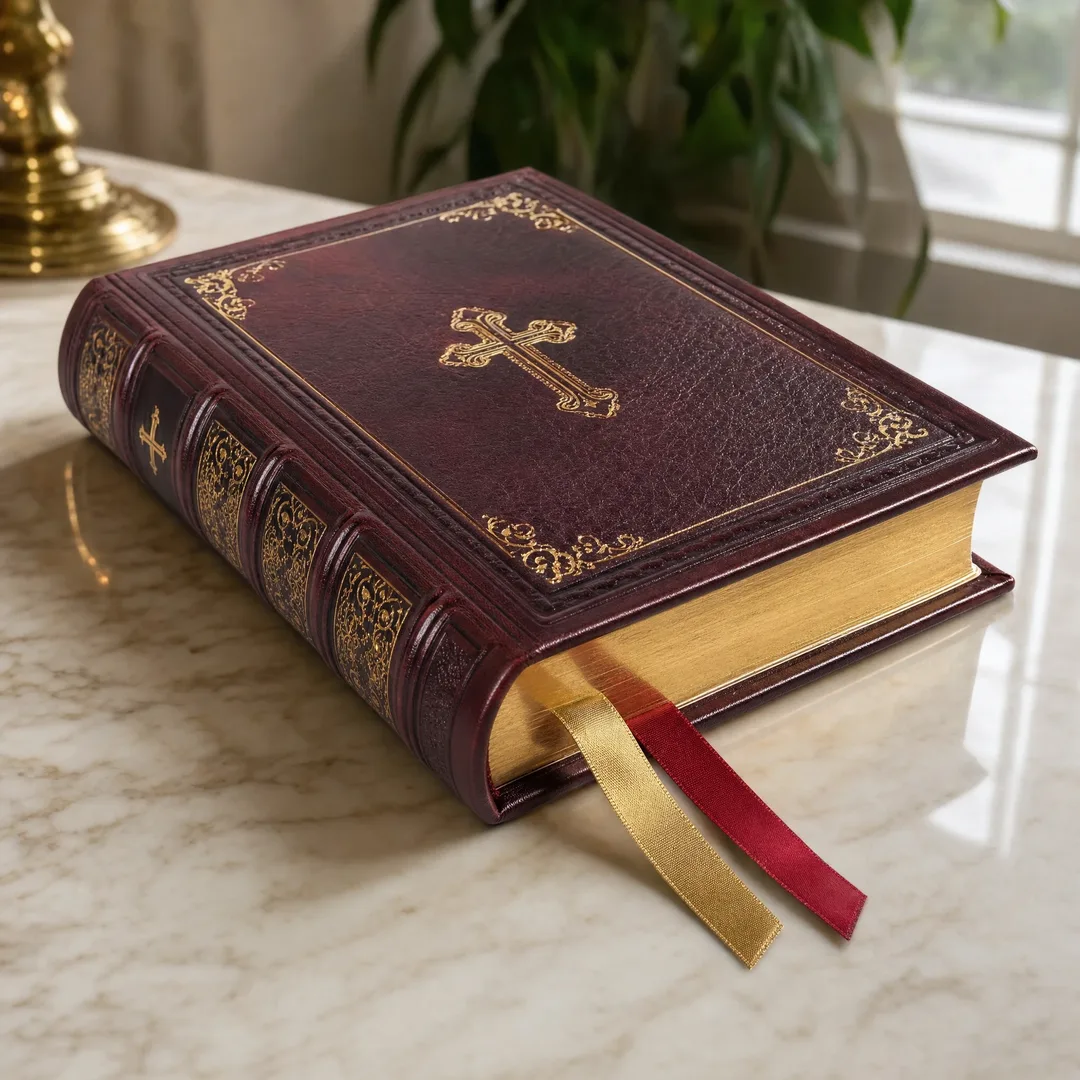
Pick up a hardcover book on your shelf. The stiff cover, the way it opens at slight resistance before settling into a comfortable reading angle, the small groove running down each side of the spine where the cover hinges: that is case binding. Case bound book printing, also called hardcover binding or edition binding, is the premium method of book construction where the interior pages (the book block) are manufactured separately from the cover (the case), then joined together in a final assembly stage called casing-in. The case consists of three pieces of greyboard—front cover, back cover, and spine strip—wrapped in printed paper, woven cloth, or leather. The book block sits inside this rigid shell, attached only at the endpapers that glue the first and last pages to the inside covers. Critically, the spine of the book block floats free of the case spine—a construction detail called “loose-back” or “hollow back”—which is what lets a properly made case bound book open without the cover warping or pages pulling away from the spine. Chinese printing factories now produce millions of case bound books annually for publishers across North America, Europe, and Australia. The combination of skilled handwork at the casing-in line, modern equipment, and labor costs that make Smyth-sewn hardcovers viable at quantities Western binderies abandoned years ago has positioned China as the default source for case bound book printing. This guide covers the process, materials, decisions, and numbers so you can spec your project correctly the first time.
The Three-Stage Process: How Case Bound Books Are Made
Case bound manufacturing divides into three stages: book block preparation, case making, and casing-in. Quality in the finished book depends on every sub-operation within each stage. Chinese factories that specialize in case binding run all three as a continuous line under one roof, cutting transit time and handling damage between operations.
Stage One: The Book Block
The book block is all printed pages gathered and bound together, minus the cover. It starts with offset printing on large parent sheets, arranged in imposition layouts accounting for trim size, binding method, and paper grain direction. Grain direction matters more for hardcovers than any other binding type—if the grain runs perpendicular to the spine, the block swells against the case in humidity and the cover bows outward. Chinese prepress teams who specialize in case binding check grain direction on every job.
Printed sheets pass through folding machines into signatures—typically 8, 16, or 32 pages each. The gathered signatures are Smyth-sewn: thread passes through the center fold of each signature, linking to adjacent signatures in an interlocked chain that flexes without breaking. A Smyth-sewn block opens flat, and pages will not fall out even if the spine glue deteriorates. For budget case bound jobs, adhesive (notch or burst) binding replaces sewing—the spine edge is roughened and hot melt PUR glue anchors the pages. Adhesive binding saves roughly $0.30–$0.50 per unit at scale but limits how flat the book opens and reduces long-term durability.
Endpapers are then tipped onto the first and last sections with a narrow adhesive strip along the binding fold. The block is compressed, trimmed on three sides, and spine-reinforced: flexible glue, then crash material (a gauze-like fabric also called super or mull) extending beyond the spine edges to later attach to the case boards. A paper liner smooths the surface. Optional decorative elements—headbands at the spine top and bottom, bookmark ribbons—are added at this stage. Headbands are purely decorative in modern binding but signal production quality.
Stage Two: Making the Case
The case is the hard cover—the three-piece board assembly that gives case bound books their name. Case dimensions derive from the book block: front and back boards are 3–6 mm larger on the top, bottom, and fore-edge sides (this overhang is the “square”), and the spine board width equals the block thickness plus both cover board thicknesses. A 1 mm error in spine board width produces a case that doesn’t fit—hinges too tight or too loose, cover not square.
The board material is greyboard—dense layered paperboard from 1.0 mm (about 600 gsm) to 3.5 mm (about 2,200 gsm). Trade hardcovers use 1.5–2.0 mm; photo books use 2.5–3.0 mm for heft. The cover material—pre-printed paper, book cloth, or leather—is adhesive-coated, and the three board pieces are positioned with a hinge gap of 7–10 mm between spine board and cover boards. This gap creates the joint groove—the depressed channel along each side of the spine. Without it, the cover cannot hinge open. Too narrow fights the reader; too wide lets the block rattle.
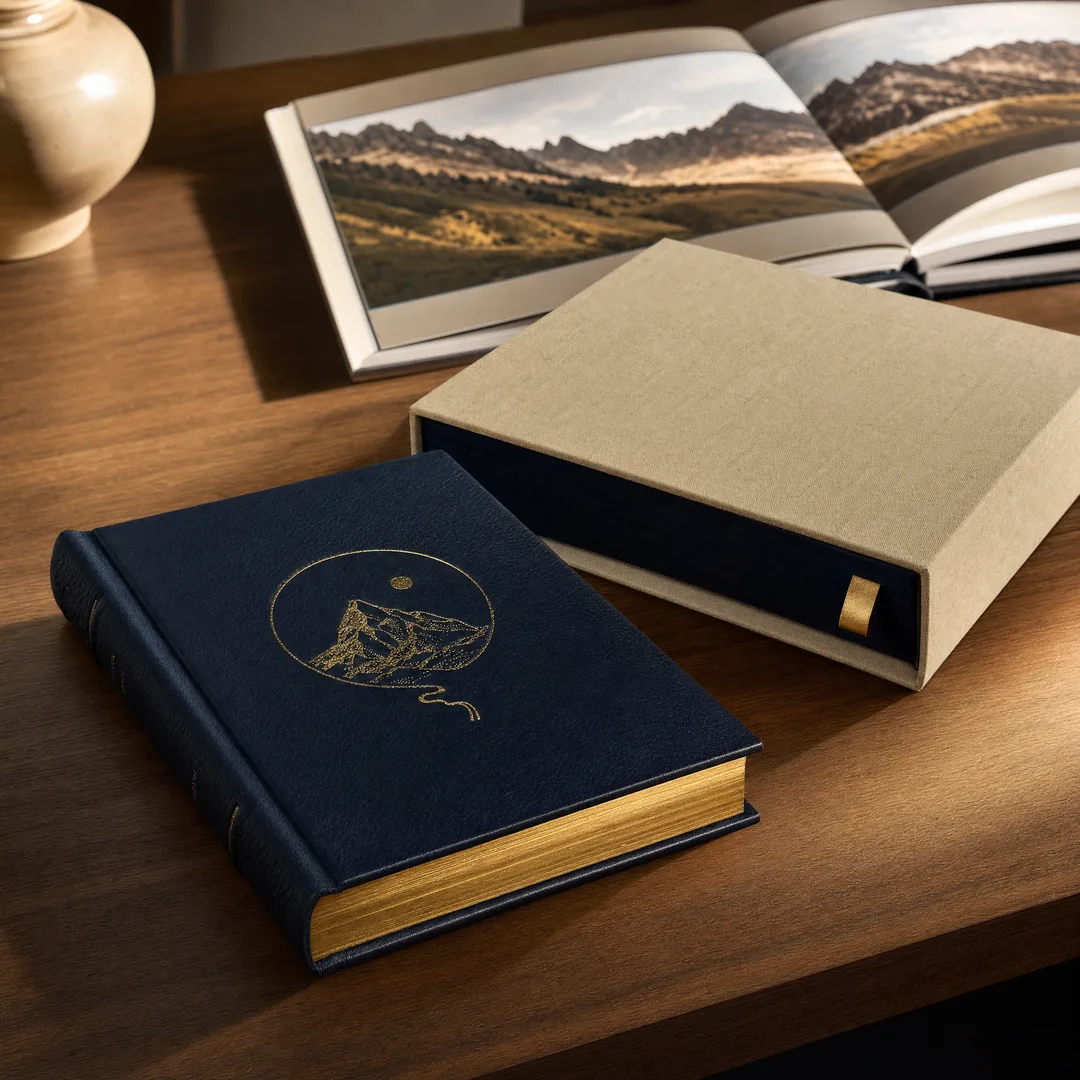
Once positioned, the cover material edges fold over the board edges (turn-ins) with mitered corners for clean 90-degree points. The case passes through a pressing station, then dries under controlled humidity. Finishing—foil stamping, embossing, debossing, spot UV—is applied to the dried case. Gold and silver foil are standard; metallic and holographic foils cost incrementally more. A case with foil stamping looks published. One without looks like a prototype.
Stage Three: Casing-In
Casing-in is where book block meets cover. Adhesive is applied to the outer endpaper surfaces (the paste-downs), and the case is positioned around the block. The crash material extending beyond the spine is pressed against the inside case boards, and the endpaper paste-downs are pressed flat. Immediately after, the book enters the building-in station: two heated metal blades press into the hinge gaps, pinching the cover material into the joint groove and setting the adhesive with heat and pressure. This forms the clean, sharp hinge crease you see on a well-made hardcover. Books that skip proper building-in have soft, rounded hinges that collapse inward—a telltale sign of rushed production. The cased book then passes through final pressing and drying. A well-run Chinese case binding line processes 1,500–3,000 books per shift, with operators checking alignment and adhesive coverage at every station.
Cover Materials: Paper, Cloth, and Leather
The cover material determines durability, printability, finishing options, and a significant portion of unit cost. Case bound books split into three material families.
Printed paper over board is the most common and cost-effective—the standard for trade hardcovers. The design is offset-printed onto 128–157 gsm coated paper, laminated (gloss for vibrancy, matte for sophistication), and glued onto greyboard. Lamination is mandatory—unlaminated paper scuffs and delaminates within days. Matte lamination with spot UV on the title is popular: matte surface for tactile feel, glossy spot UV for visual pop. Cost: $0.60–$1.00 per case at 1,000 copies from a Chinese supplier, including printing, lamination, and assembly.
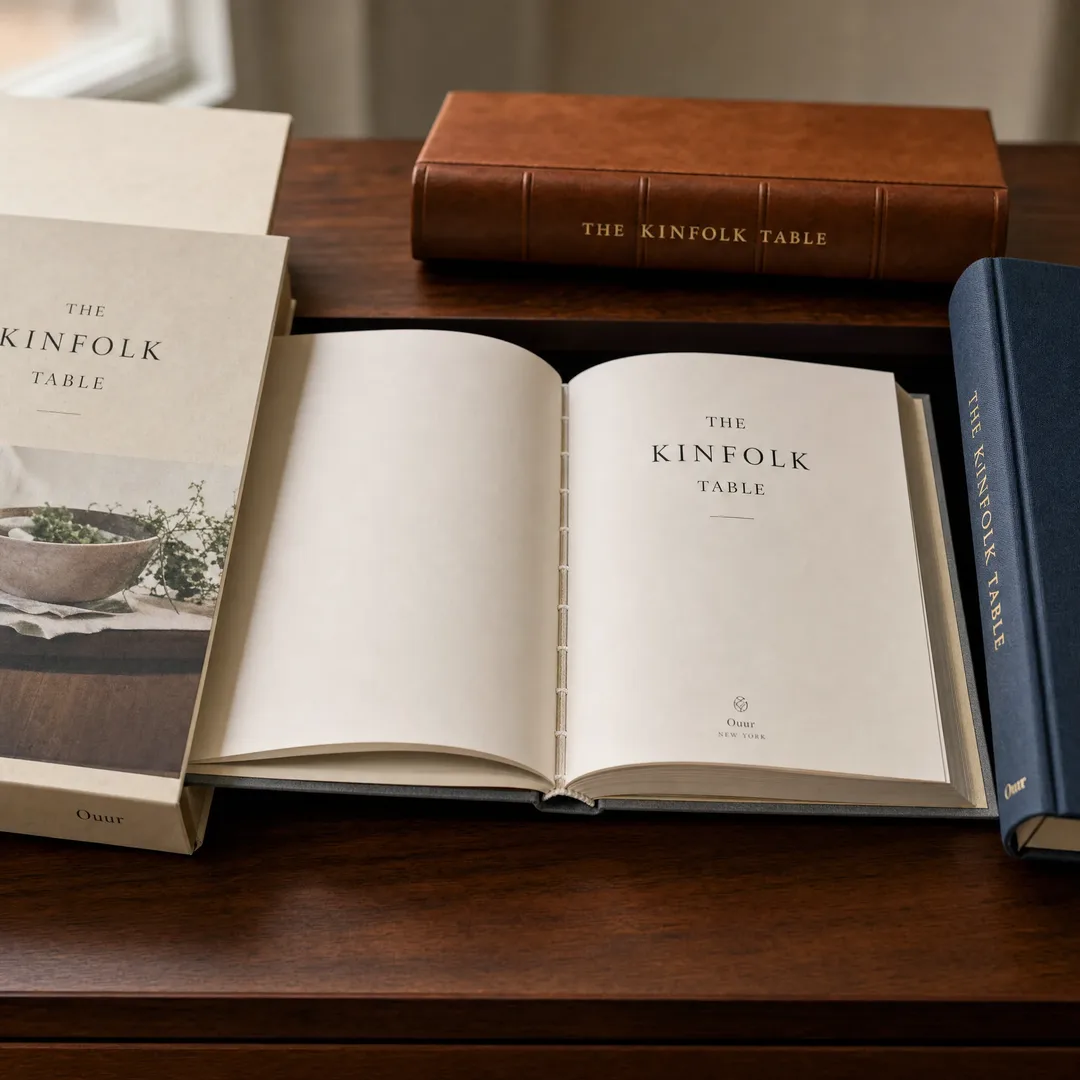
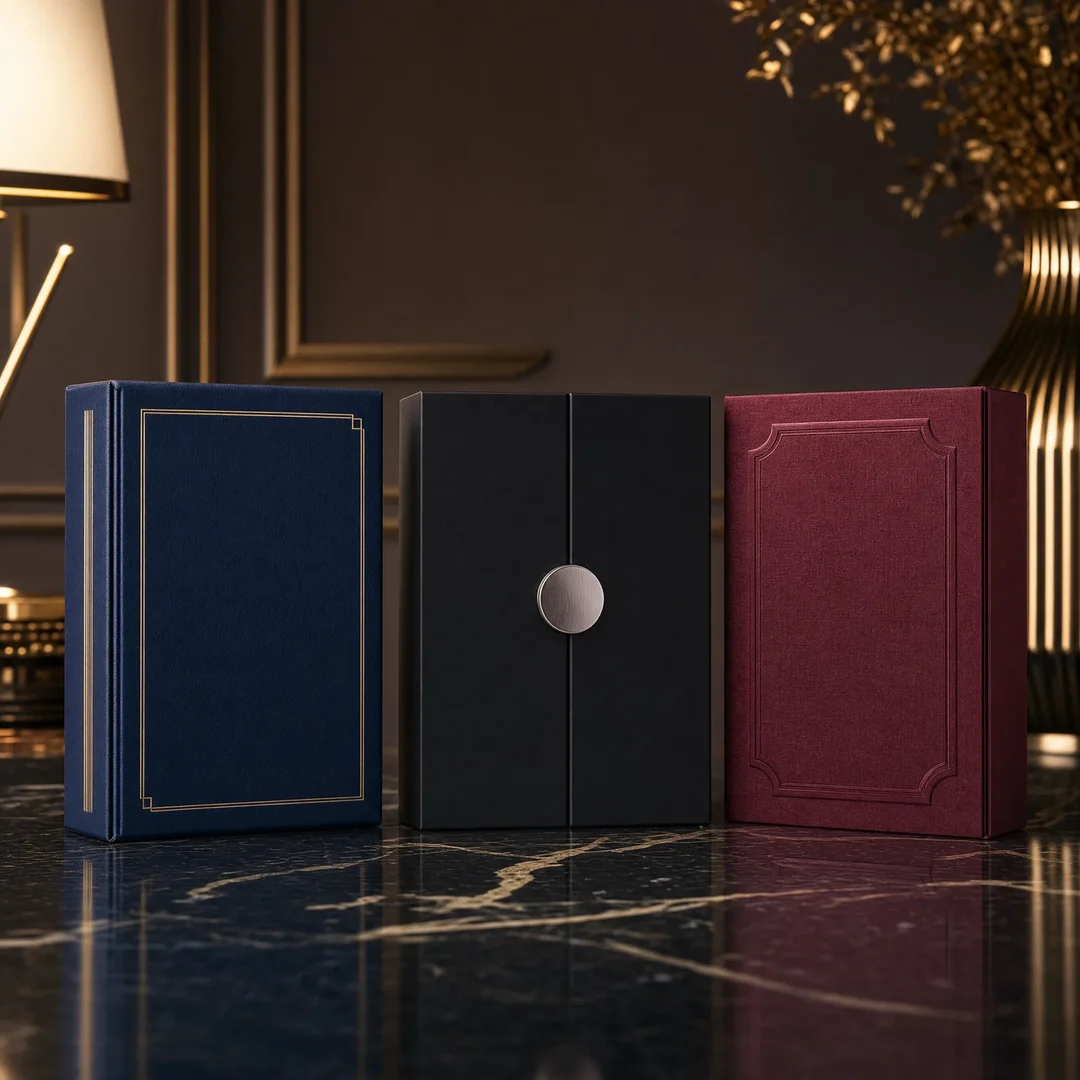
Book cloth—woven cotton, rayon, or polyester backed with paper—is standard for library bindings and premium editions meant to last decades. Cloth accepts foil stamping cleanly and communicates tactile seriousness. Chinese suppliers stock basic rayon cloth at $0.80–$1.20 per case and premium European-imported cloth (Winterbottom, Brillianta) at $1.50–$2.50. Fine-grain cloth holds fine-detail stamping; coarse grain blurs fine text. Black, navy, burgundy, and dark green are stock colors; custom Pantone-dyed cloth adds 10–15 days to procurement.
Leather sits at the top. Genuine leather (goatskin, calfskin) from Chinese binderies runs $4.00–$12.00 per case—leather is skived at turn-in edges and corners are hand-mitered. PU leather offers a consistent, color-fast alternative at $1.00–$2.50 per case with metallic and embossed options. The tradeoff: PU won’t develop patina and eventually cracks at hinge folds. For a 5–10 year trade hardcover, PU upgrades cloth. For a 50-year heirloom edition, genuine leather is the only choice.
Round Spine vs. Square Spine
Walk through a library and pull hardcovers at random. Some spines are flat, some curved. This is not cosmetic—round spine and square spine are different structural systems.
Square spine is the default for thinner hardcovers—up to about 20 mm of block thickness, roughly 200–250 pages of standard 100 gsm paper. Beyond that, inner pages buckle inward when opened because the flat spine cannot accommodate the opening arc. At 25 mm and above, a square spine hardcover cracks audibly at the hinge—the sound of endpaper adhesive separating from the case.
Round spine solves this by shaping the block spine into a convex curve before casing-in. Counter-rotating rollers compress the sewn block, forcing the spine outward into an arc. Backing irons then flare the outermost signatures to create the “joint” where cover boards rest. When opened, the rounded spine flattens slightly and returns to curve when closed. Stress distributes across the arc rather than concentrating at a single fold. Round spine books open flatter, last longer, and handle 30–80 mm thicknesses—dictionaries, encyclopedias, photo books with heavy stock.
At 500 copies, round spine costs $0.80–$1.20 more per unit than square. At 3,000 copies, the premium narrows to $0.40–$0.60. Below 500 copies, some binderies won’t run round spine—the rounding machine setup exceeds the job value. Rule of thumb: under 15 mm, square spine. 15–20 mm, either works. Above 20 mm, round spine is a structural requirement, not a luxury.
Endpapers: The Hidden Structural Heroes
Endpapers are the sheets of heavier paper—typically 120–180 gsm, versus 80–100 gsm for interiors—that attach the book block to the case. Each is a folded sheet: one half (the paste-down) glues to the inside cover board; the other half (the flyleaf) is free. The fold runs along the hinge. Open the book, the endpaper flexes. Close it, it returns flat. This single folded sheet absorbs all opening-and-closing stress for the book’s entire life.
White endpapers at 140–160 gsm are the most common and cheapest (under $0.03 per sheet). Printed endpapers—patterns, maps, illustrations, solid colors—transform the reading experience before page one. A dark grey endpaper on a photography book sets a gallery tone; a map endpaper on a fantasy novel pulls the reader in. Printing endpapers adds $0.05–$0.15 per book. The paper needs enough body that the paste-down reverse doesn’t show through—150 gsm with opacity above 94% is the floor for printed designs.
Endpaper attachment is where binderies reveal their quality. The glue strip should be no wider than 3–5 mm along the binding fold. Wider strips prevent free flexing at the hinge; too-narrow strips let the endpaper detach. Grain direction must parallel the spine, matching interior paper grain. And the paste-down must fully cover the board interior without overhanging. Binderies that treat endpapers as an afterthought produce books where the first thing the reader sees is a wrinkled, misaligned sheet glued crooked to the cover.
Case Bound vs. Perfect Bound: When Hardcover Earns Its Keep
The comparison isn’t about “better”—it’s about what your book needs to do, how long it needs to last, and what your buyer will pay. Perfect binding glues pages at the spine and wraps them in flexible cardstock—cover and book block are one unit. Case binding separates the two: when you open a case bound book, the block stays still while the case hinges independently at the joint groove.
The practical differences cascade from this structural distinction. Case bound books survive decades; perfect bound books show spine creases within the first few readings. Case bound books have a rigid shell that protects pages in transit and on shelves; perfect bound covers bend, crease, and delaminate at corners. Case bound books command 2–3× the retail price of the same content in paperback. Perfect bound books cost significantly less—$0.50–$1.50 per unit versus $2.00–$5.00 for case bound—and have faster lead times because there’s no case-making or casing-in stage. A $14.99 genre paperback uses perfect binding. A $29.99 trade hardcover uses case binding with a printed paper case. A $99.99 limited edition uses case binding with cloth, foil stamping, and a slipcase. Each step adds cost the retail price must support—and each step creates a product your buyer perceives as worth more before reading a single word.
MOQ and Cost: What Case Bound Book Printing from China Actually Costs
Cost depends on five variables: quantity, page count, trim size, cover material, and binding complexity. Here’s a realistic baseline: 240 pages, 6×9 inches, 100 gsm uncoated woodfree interior, printed paper case with matte lamination, 2 mm greyboard, square spine, Smyth sewn, white endpapers, headbands, no dust jacket.
At 500 copies: $3.50–$5.50 per unit FOB China. The cost breaks into roughly 35% printing and paper, 25% case making and materials, 20% binding, 10% finishing, and 10% packing. At 1,000 copies: $2.50–$4.00. At 3,000 copies: $1.80–$3.00. The curve flattens around 5,000 copies—material costs dominate beyond that point.
Upgrades change the numbers. Cloth cover: add $0.50–$1.00. Foil stamping: add $0.30–$0.60. Round spine: add $0.50–$1.00. Printed endpapers: add $0.10–$0.20. Dust jacket: add $0.40–$0.80. Ribbon bookmark: add $0.10–$0.15. A fully loaded premium package at 1,000 copies costs $5.00–$8.00 per unit—still well below domestic binderies.
MOQ by method: Smyth-sewn case bound starts at 300–500 copies. Adhesive-bound: 200–300. Round spine: 500 minimum. Cloth covers: 300–500, with custom colors needing additional mill minimums. Leather covers: 100–300. Digital POD hardcovers are available at 10–50 copies from specialty short-run binderies at $12–$25 per book—practical for Kickstarter fulfillments or launch events. Sea freight adds $0.60–$1.50 per book (25–40 days). Air freight triples logistics cost but delivers in 5–10 days. Factory production: 15–25 business days from proof approval. Door-to-door: 8–10 weeks by sea, 4–6 weeks by air.
Why Source Case Bound Book Printing from China
The case for China rests on three pillars: skilled labor for the handwork case binding demands, modern equipment matching Western binderies, and cost structures making Smyth-sewn hardcovers viable at quantities where domestic binderies quote “no bid.”
Case binding is not fully automatable. The casing-in station requires an operator judging alignment by eye, adjusting board spacing on the fly, catching misaligned endpapers before they become hundreds. Foil stamping on cloth needs an operator who knows the dwell time and temperature for specific cloth grain and foil type. Corner folding on cloth and leather needs hand mitering—machines fold turn-ins, but corners on anything thicker than 157 gsm paper need a human hand. In Shenzhen, Dongguan, and Wenzhou, workers have made case bound books for decades. A 15-year line supervisor knows your 2.5 mm textured cloth needs an 8 mm hinge gap, not 7 mm, because the extra millimeter prevents cloth bunching in the joint. That knowledge is embedded in the workforce.
On equipment: Chinese factories run Heidelberg, Komori, and Manroland presses—the same machines printing books in Germany and the US. Kolbus and Horauf case-makers. Smyth and Martini sewing lines. The machinery is not different; the operators are. Binding line operators in China earn $6,000–$10,000 annually versus $35,000–$55,000 in North America or Western Europe. A Smyth-sewn case bound book costing $3.00 at a Chinese factory costs $7.00–$9.00 at a US bindery. For a 2,000-copy run, that is $8,000–$12,000 saved on one title. A publisher running ten hardcover titles annually saves $80,000–$120,000 by sourcing from China.
Raw material access completes the picture. Chinese mills produce greyboard, book cloth, and paper below European and North American costs because the domestic market absorbs massive volumes. A Shenzhen bindery orders greyboard by the truckload from a mill 200 km away; an Ohio bindery orders the same board shipped across the Pacific with freight and duties on top. The material advantage is embedded in the supply chain. Success depends on clarity: a spec sheet with explicit board thickness, cloth grain, foil Pantone code, hinge gap, endpaper weight, and packaging requirements eliminates back-and-forth. Physical proofs are non-negotiable—a $40–$80 courier sample on production materials is the cheapest insurance against a container of books with wrong spine widths. And find a supplier where case binding is 70%+ of output, not a sideline. The specialty factory has equipment, skills, and QC calibrated for hardcover demands. The generalist factory produces a serviceable perfect bound book and a disappointing hardcover.
Frequently Asked Questions
How thick should the greyboard be for my case bound book?
For trade hardcovers at 5.5×8.5 or 6×9 inches with 200–400 pages, use 1.5–2.0 mm greyboard. For coffee table books and photo books at 9×12 inches with heavy coated paper, use 2.5–3.0 mm. For children’s picture books (32–48 pages, large format), use 2.0–2.5 mm. The board should feel substantial without making the book feel like a brick. Ask your supplier for blank case samples at different thicknesses—the difference between 2.0 mm and 2.5 mm is hard to describe but immediately obvious in your hands.
Do I need Smyth sewing or is adhesive binding enough?
Smyth sewing costs more but produces a book that opens flat and won’t shed pages—essential for reference works, textbooks, premium art books, and any title the buyer expects to keep for more than five years. Adhesive binding works for promotional hardcovers, short-run corporate publications, or budget editions where the price point drives sales. The middle ground—section-sewn with adhesive reinforcement—gives most sewing benefits at a slight cost savings.
What is the minimum order for case bound books from China?
MOQ starts at 300–500 copies for Smyth-sewn with printed paper cases. Adhesive-bound runs as low as 200 copies. Cloth covers and round spine require 500 minimum. Leather covers: 100–300 copies. For quantities under 200, digital POD hardcovers from short-run specialists are more practical than offset case binding, though unit costs run $12–$25 per book.
How do I prevent my case bound books from warping?
Cover warping has three causes. First, grain direction: paper grain must run parallel to the spine in both interior pages and cover material—cross-grain construction guarantees warp in humidity. Second, adhesive moisture imbalance between case material and paste-down endpaper; proper drying time under weight after casing-in prevents this. Third, environmental shock: books manufactured in humid southern China and shipped to dry climates need acclimation time. A reputable supplier shrink-wraps individual books or packs them tightly. Upon arrival, let books sit in cartons at the destination environment for 48–72 hours before unwrapping.
Getting Case Bound Right the First Time
Case bound book printing from China produces hardcovers that sit proudly on bookstore shelves and hold up to decades of reading—when the specification is right and the supplier knows their craft. The decisions that matter most happen before a single sheet is printed: square spine or round, paper case or cloth, Smyth sewn or adhesive, 2.0 mm board or 3.0 mm, white endpapers or printed, headbands or plain. Each choice has a cost and a consequence. The publishers who get the best results make these choices deliberately, communicate them in a written specification sheet with no ambiguity, request a physical proof on production materials before signing off, and work with a factory where case binding is the main event, not a sideline. Do that, and your hardcovers will arrive looking exactly like what they are: professionally published books manufactured to a standard that readers notice, even if they cannot name the binding method that made it possible.
Related Book Printing & Binding Guides
Book Printing in China — Complete Guide 2026 — the end-to-end process from quote to delivery for international print buyersPerfect Binding Guide — PUR vs. EVA, spine width calculation, and cover design tips for softcover booksSaddle Stitch Binding Guide — when stapled binding makes sense and how to set up your files correctlyBook Printing Cost 2026 Guide — up-to-date pricing benchmarks across trim sizes, page counts, and run quantitiesMinimum Order Quantity (MOQ) for Book Printing — how MOQ works across binding types and what small publishers should expectHow to Prepare Print-Ready Artwork — bleed, color space, resolution, and file format requirements explainedBook Printing Shipping Guide — air freight, ocean freight, customs, and delivery timelines from ChinaLeather Book Printing China Guide — premium hardcover binding with leather covers, foil stamping, and specialty finishes