The $9 to $28 Gap on the Same 10×12 Book
Two printers receive identical files for a 10×12 inch coffee table book with 200 pages. One quotes $9 per copy. The other quotes $28. A third comes in at $14 with freight listed separately. All three quotes are honest, and all three describe the same title.
The gap is not a markup trick. It lives in paper weight, plate count, case construction, handwork, and the shipping lane. Buyers who compare only the unit price miss this, because a quote is a bundle of decisions rather than one number.
Large format amplifies every decision. A 157 gsm sheet costs more per square inch than a 90 gsm novel stock, and this format uses far more square inches. Case binding adds board, cloth, and manual assembly. Freight adds another 15 percent or more. Therefore a $19 spread between two quotes is normal.
This breakdown covers cost structure only. If you need the production walkthrough, the coffee table book printing guide covers it step by step. For pricing decisions, keep reading. You can also review current capabilities on the coffee table book printing service page before collecting quotes.
The Six Cost Blocks Inside Every Quote
Every credible quote decomposes into six blocks. Ask suppliers to break their price down this way, and comparisons become fair. The percentages below reflect typical large-format hardcover work.
Paper
Paper runs 20 to 30 percent of unit cost. The block covers text stock, endpapers, case board, and jacket. Weight and coating drive the number more than page count, because art paper is priced by tonne and consumed by area.
Printing
Printing takes 25 to 35 percent and splits into fixed and variable parts. Plates, ink setup, and make-ready are fixed per title. Ink and machine time scale with run length, which explains the quantity curve later.
Binding
Case binding lands at 15 to 25 percent. It includes folding, collating, sewing, casing-in, and trimming. Sewn signatures cost more than glued ones, because thread and spine preparation add labor.
Handwork
Handwork covers 5 to 10 percent and appears only on premium builds. Headbands, ribbon markers, rounded spines, and debossing stay manual or semi-manual by nature.
Packaging
Packaging runs 3 to 5 percent. Heavy books need rigid cartons and corner protection. Skimping here is a false economy, because damaged corners cost more than the carton did.
Freight
Freight ranges from 5 to 20 percent and depends on destination, mode, and total weight. This block surprises first-time buyers most, so it gets its own section below.
Trim Size: The 8.5×11 to 11×14 Cost Ladder
Trim size is the first cost lever, and it works on three fronts at once: paper area, press imposition, and shipping volume. Most buyers understand the first and miss the other two.
Compare printed area. An 8.5×11 inch page covers 93.5 square inches. A 9×12 page covers 108, which is 15 percent more. A 10×12 page covers 120, or 28 percent more. An 11×14 page covers 154, a 65 percent jump over the smallest size. Paper is bought by area, so the material bill follows these ratios.
Imposition widens the gap. On a 28×40 inch press sheet, a 9×12 page fits eight up per side, which yields a 16-page signature. An 11×14 page falls to four up once gripper space and trim margins are counted, so a signature holds 8 pages. A 200-page book then needs 25 signatures instead of 13, which doubles plate count and every make-ready cycle.
Binding costs climb with spine length. Longer spines mean more thread per signature, more glue, and longer case boards. A taller book also fills cartons less efficiently, so you pay for air in the container.
Practical guidance: choose the smallest trim that serves the imagery. A 10×12 book handles full-bleed photography well. Moving to 11×14 buys 28 percent more area and usually adds 20 to 30 percent to unit cost. Photographers weighing that trade-off compare formats on the photo book printing page first.
Paper Weight and Coating: gsm, Show-Through, and Unit Price
Art paper is specified in grams per square meter, or gsm. The common ladder runs 128, 157, 170, and 200 gsm in matte art or gloss art. Each step up costs roughly 8 to 15 percent more for the text block.
Why does 157 gsm act as the floor? Three reasons. First, show-through. At 128 gsm, a dark full-bleed image shows through under raking light. Second, ink load. Solid areas and rich blacks lay down heavy ink film, and thin stock cockles. Third, feel. A coffee table book is handled, and 128 gsm reads as a magazine insert.
Coating changes the look more than the price. Matte art scatters light softly, which suits fine art, architecture, and muted palettes. Gloss art boosts contrast and saturation, which suits product and travel imagery. The price gap is small, usually under 5 percent. Choose by image character, not cost.
Bulk matters too. A 200 gsm sheet is stiffer, so the book gains spine width and shipping weight. For a substantial feel without the weight, ask about a higher-bulk matte grade instead.
Case Construction: Dust Jacket vs Printed Case vs Cloth
The cover decision moves unit cost by several dollars, which is significant on a large-format book. Three builds dominate the market.
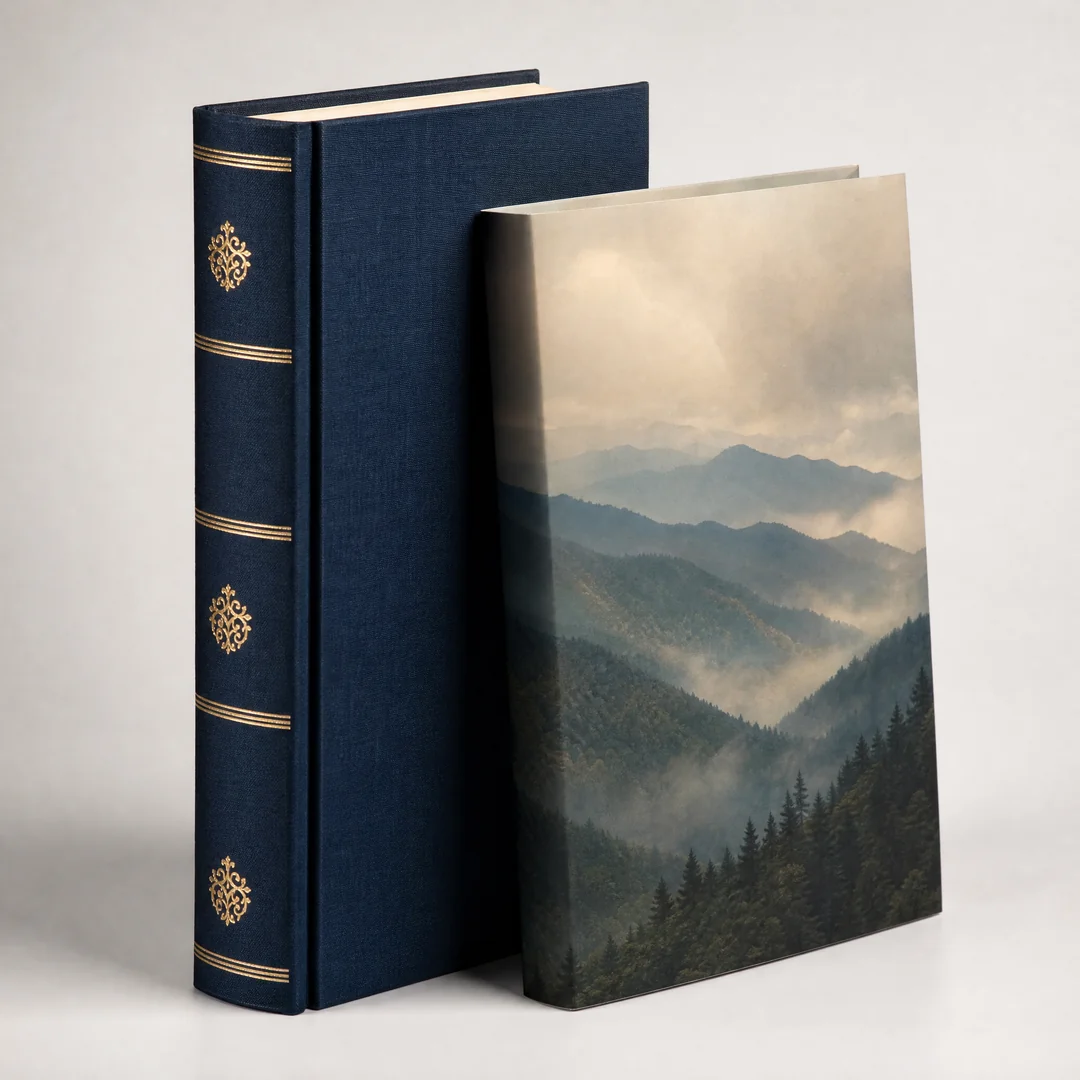
A dust jacket wraps a plain case. It costs least, because the case is a greyboard shell covered in paper and the jacket is a separate printed sheet. The trade-off is fragility, since jackets tear at the spine head.
A printed case prints artwork straight onto the case material and skips the jacket. Costs land 5 to 10 percent above a jacketed build on short runs and roughly level on long runs. The book also feels more permanent, with no loose wrapper to crease.
Cloth binding sits at the top. Woven cloth over greyboard, often with foil stamping, requires slower casing-in and careful grain alignment. A slipcase adds more. For a limited edition or brand object, cloth earns its premium. For a 1,000-copy trade release, it rarely does.
All three share a core: greyboard, endpapers, and a hinged spine. Board thickness of 2.0 to 3.0 mm sets rigidity, and endpaper choice sets how the book opens. Ask how the case is jointed, because that detail separates a book that lasts from one that cracks. Construction options appear on the hardcover book printing page.
Quantity: The 300-Copy Penalty and the Unit Price Curve
Print pricing behaves like a fixed-cost business with a variable tail. Plates, color approval, make-ready sheets, and binding setup do not care how many copies you print. Therefore the fixed block spreads across fewer units at low volume, and the unit price balloons.
On a 10×12 sewn hardcover, the first 300 copies carry nearly the entire setup burden. A run of 300 might land at $26 to $35 per copy. At 1,000 copies the same specification falls to $14 to $19. At 3,000 it reaches $10 to $13.50. The specification never changes. Only the denominator does.
Here is the counterintuitive part. Going from 300 to 500 copies often adds only 15 to 25 percent to the invoice. The extra 200 books cost far less than the first 300, because setup is already paid. Buyers who order 300 to test the water pay twice the unit price of a 1,000-copy run, then reorder at a worse rate.
Overprinting has its own cost. Storage, obsolescence, and freight on unsold stock are real. Print what you can sell in 18 months, then reprint if demand holds. Ask for a price break table at 500, 1,000, 1,500, 2,000, and 3,000 units.
Weight and Freight: The Hidden Cost of a Coffee Table Book
Freight is where large-format books quietly lose money. A 10×12 inch, 200-page book on 157 gsm stock weighs roughly 1.2 to 1.8 kg. The math is easy to check. One 10×12 sheet covers 0.0774 square meters, and at 157 gsm it weighs about 12 grams. One hundred sheets, or 200 pages, come to 1.2 kg. Case, endpapers, and jacket add 150 to 300 grams.
Multiply by run size and the tonnage appears fast. A 1,000-copy run at 1.5 kg per book is 1.5 tonnes before cartons. At 10 books per carton, that is 100 cartons at about 16 kg each and roughly 4.5 cubic meters. Those figures decide your freight mode.
Sea freight suits this weight well. A full container load makes sense above roughly 15 cubic meters. Less-than-container load works for smaller volumes but carries minimum charges and consolidation delays. Air freight prices on chargeable weight, which is the greater of gross weight and volume times 167 kg per cubic meter. For dense book cartons, gross weight usually wins, so air gets expensive fast. As an indicative comparison, air can cost several times the sea rate per kilo.
This is why a quote that looks cheaper can lose. If supplier A saves $1.20 per book on printing but ships from an inland city with a longer haul, the added freight can exceed the saving. Always compare landed cost: goods, freight, insurance, duty, and destination charges.
Two levers help. Ask for carton dimensions and weights in the quote, then compute cubic meters yourself. If freight dominates your total, consider a lighter stock or smaller trim. On a 5,000-copy order, a 15 percent weight reduction often saves more than the paper downgrade costs.
Proofing and Prepress: Digital Proof, Press Proof, Bleed, 300 dpi
Prepress is cheap insurance. A digital proof costs little and shows layout, color relationships, and text flow. It is a reference, not a contract. A press proof prints on the actual press with actual ink and stock, and it costs far more because it consumes machine time. Publishers use press proofs when color accuracy is contractual, such as brand colors or art reproduction.
For most coffee table books, a digital proof plus a contract proof on the chosen stock is enough. For a fine art title with critical color, pay for the press proof. Skipping it risks a whole run that misses the artist’s intent.
Spot colors change the math. A Pantone match needs its own plate, its own ink, and a washup between jobs. On 300 copies, that setup spreads across few books, so one spot color can add a dollar or more per copy. On 3,000 copies it costs cents. If your design uses two spot colors, expect a visible step in the unit price at low volume.
File preparation prevents surprises. Supply 3 mm, or 0.125 inch, bleed on every edge. Keep live text inside the safety margin. Set images at 300 dpi at final print size, not at screen size. Convert to CMYK, because RGB files shift when separated. Embed or outline fonts, then confirm the proof in writing. A preflight checklist is available in this guide to preparing print-ready files .
Indicative Price Ranges for 200-Page Sewn Hardcover
The table compares two common trims at five run lengths, all with 157 gsm matte art text, 4C+4C printing, sewn hardcover, and a printed case. Treat every figure as directional. Final quotes move with paper availability, spot colors, proofing level, packaging, and freight terms.
Trim
Quantity
Unit Price Range
Total Range
Notes
9×12 in
300
$22 – $30
$6,600 – $9,000
Set-up dominates; highest unit cost
9×12 in
500
$16 – $22
$8,000 – $11,000
Best entry point for a first run
9×12 in
1,000
$12 – $16
$12,000 – $16,000
Typical catalogue and gallery run
9×12 in
2,000
$9.50 – $13
$19,000 – $26,000
Paper bought at better tier
9×12 in
3,000
$8.50 – $11.50
$25,500 – $34,500
Freight planning becomes critical
10×12 in
300
$26 – $35
$7,800 – $10,500
Larger sheet area, same set-up load
10×12 in
500
$19 – $26
$9,500 – $13,000
Popular size for photo-led titles
10×12 in
1,000
$14 – $19
$14,000 – $19,000
Sweet spot for most publishers
10×12 in
2,000
$11 – $15
$22,000 – $30,000
Weight check needed before booking
10×12 in
3,000
$10 – $13.50
$30,000 – $40,500
Confirm pallet count and container fit
These ranges are indicative only, and final quotes depend on specifications. They exclude freight, duty, and local delivery unless stated. A Pantone color, cloth binding, or slipcase will push any line upward.
Seven Ways to Cut Cost Without Cheapening the Book
Cost reduction works best before the file is final. Once plates are made, options shrink. These seven levers preserve perceived quality while trimming real dollars.
1. Shrink the trim by half an inch
Moving from 10×12 to 9.5×11.5 cuts paper area by about 9 percent and can improve imposition. Readers rarely notice.
2. Drop one paper step, not two
Going from 170 to 157 gsm saves money and keeps show-through under control. Dropping to 128 gsm saves more but hurts image-heavy spreads.
3. Switch to a printed case
Removing the dust jacket eliminates a printed sheet and a wrapping step. On 1,000 copies, this often saves $0.60 to $1.20 per book.
4. Consolidate the run
Ordering 1,000 instead of 300 typically halves the unit price. If cash flow allows, buy the 18-month quantity.
5. Print in the low season
Press capacity tightens before book fairs and the fourth-quarter gifting season. Scheduling in slower months can improve price and lead time.
6. Limit spot colors to one
Each Pantone adds a plate and a washup. One accent color delivers most of the design benefit. Build secondary accents in CMYK.
7. Optimize cartons and pallets
Ask for carton dimensions that divide evenly into a pallet footprint. Better cube use can cut freight 5 to 10 percent with no change to the book.
What to Put in Your RFQ
A complete request for quotation gets you comparable numbers and fewer revisions. Send all ten items in one message, and ask each supplier to price the identical specification.
Trim size in inches or millimeters, closed book
Page count, including front and back matter, in multiples of four
Text paper weight and coating, for example 157 gsm matte art
Cover construction: dust jacket, printed case, or cloth bound
Binding method: sewn hardcover, glued, or wire bound
Print run quantity, plus break points at higher volumes
Number of spot colors, with Pantone references
Proofing level: digital proof, contract proof, or press proof
Delivery address and trade terms, such as FOB, CIF, or DDP
Target delivery date and acceptable transit mode
Add two optional lines that sharpen the comparison: endpaper choice and packaging requirements. Both affect cost more than buyers expect.
Next Step
Pricing a coffee table book is a specification exercise, not a negotiation. Fix the trim, paper, case, and quantity, then compare landed cost across suppliers who quoted the same brief. That removes the $9 to $28 noise and leaves a decision you can defend.
Ready to price a real project? Send your specification through the coffee table book printing page and request a quote with break points. If your title is image-led or a limited edition, the art book printing options cover heavier stocks and premium finishing.