The Freight Quote Is the Number You Actually Need to Understand
Here is a mistake that costs first-time book importers more money than any printing error ever will. They spend three weeks negotiating the printing unit price down by $0.15 per copy, save $450 on a 3,000-copy run, then accept whatever shipping quote the printer sends without reading it. The freight eats the entire printing savings and then some. I have seen it happen enough times to know it is a pattern, not an exception.
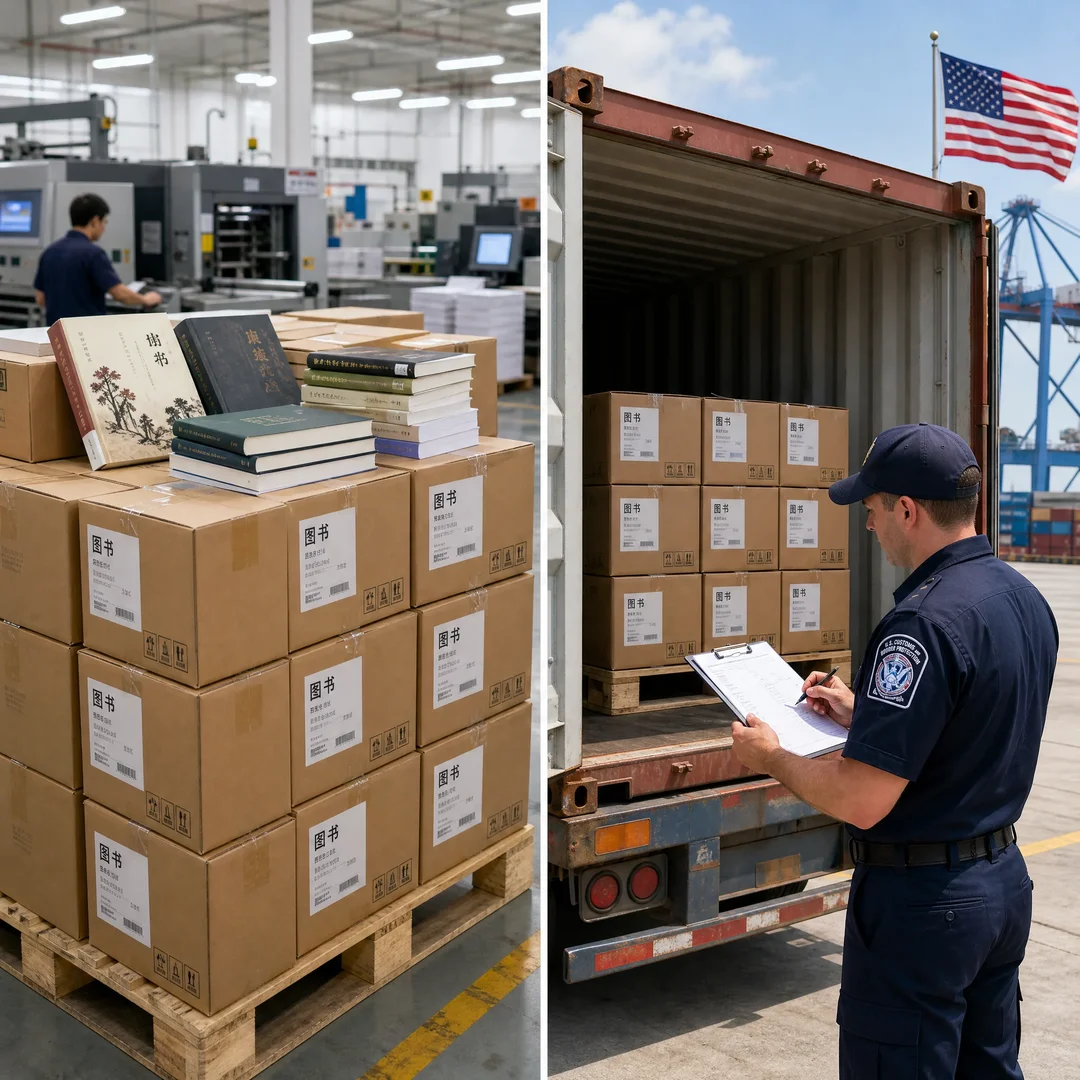
Printing a book in China is the easy part. Getting it from a factory in Guangdong Province to a warehouse in Los Angeles, a fulfillment center in Chicago, or a loading dock in New York — that is where the project gets either profitable or painful. The printer’s unit price is only half the cost equation. The other half lives in incoterms, freight modes, customs duties, brokerage fees, port charges, and trucking. If any one of those numbers surprises you on the invoice instead of on the spreadsheet, you lose money.
This guide walks through every logistics decision that sits between a finished book in a Chinese factory and a pallet arriving at your door. It covers how trade terms change who pays for what, when sea freight makes sense and when air freight is the only option, what customs actually charges on printed books entering the United States, how books get packed for ocean transit, and what a real landed cost looks like at 500, 1,000, and 3,000 copies. No theory. No vague ranges. Just the numbers and processes that determine whether your book printing shipping from China project lands in the black or the red.
DDP, FOB, EXW — Three Letters That Determine Who Pays for Everything
International shipping runs on incoterms, and the three you will encounter when printing books in China are DDP, FOB, and EXW. Each one draws a different line between what the printer handles and what you handle. Choose wrong and you are either overpaying for convenience or underestimating the complexity you just signed up for.
DDP (Delivered Duty Paid)
Under DDP terms, the printer or their freight forwarder handles everything: export clearance at the Chinese port, ocean or air freight to your destination country, import customs clearance, payment of all duties and tariffs, and final truck delivery to the address you specify. You pay one price and the books show up at your door. You do not file customs paperwork. You do not hire a customs broker. You do not even know what port the container went through unless you ask.
For a first-time book importer, DDP is worth the premium. The printer’s forwarder has existing relationships with customs brokers at major US ports. They clear books under HTS code 4901 every week. Their paperwork does not get flagged for review because they have done it ten thousand times. When a customs officer asks for a commercial invoice breakdown, the forwarder already has it formatted exactly how CBP wants it.
The DDP premium over FOB is typically 15% to 30% on the total freight cost. On a shipment of 1,000 books, that might be $200 to $400. Against the cost of a single customs delay, a warehousing charge at port, or a misclassified tariff that triggers an audit, that premium is cheap insurance. If you have never imported anything before, start with DDP. Graduate to FOB later, once you have seen how a clean shipment looks from start to finish.
FOB (Free On Board)
FOB means the printer delivers your books to the named port of departure — typically Shenzhen, Yantian, or Shanghai — and clears them for export. At that point, the books are yours. You arrange ocean or air freight from China to your destination, you clear customs on arrival, you pay duties, and you arrange trucking from the port to your warehouse.
FOB gives you control over the freight forwarder. You can shop rates. You can choose between carriers. You can negotiate better terms on the destination side because you are the importer of record. The downside: you are now the importer of record, which means you need a customs bond, a broker, and enough working knowledge of the process to not make an expensive mistake.
FOB makes sense when you are importing regularly — say four or more shipments per year — and the volume justifies building a relationship with a freight forwarder. For a single shipment of 500 books, the administrative overhead of FOB typically outweighs the savings. For 3,000 books quarterly, FOB is where the margin lives.
EXW (Ex Works)
Under EXW, the printer’s obligation ends at their factory gate. The books are yours the moment they are packed into cartons. You arrange pickup from the factory, trucking to the port, export clearance, freight, import clearance, duties, and final delivery. EXW gives you maximum control and maximum responsibility.
For book printing, EXW is rarely the right choice unless you already have a freight forwarder with a China-based office that handles factory pickups. The savings over FOB are marginal — typically $200 to $400 on the inland trucking and export clearance leg — and the coordination complexity is significant. A truck that arrives late to the factory means the container misses the vessel cutoff, which means the books sit at the port for a week waiting for the next sailing. That delay costs more than the EXW savings.
For most self-publishers and small publishers printing books in China, the practical choice is DDP for the first shipment and FOB once you have a freight forwarder you trust.
Sea Freight vs Air Freight — The Cost and Time Tradeoff Nobody Likes Making
Books are heavy. A single 6×9 paperback with 200 pages on 70-lb cream paper weighs roughly 0.35 kg. Multiply by 1,000 copies and you have 350 kg of product — plus cartons, pallets, and packing materials that add another 15% to 20%. That weight is the variable that makes air freight expensive and sea freight necessary for any print run above a few hundred copies.
Sea Freight: Slow, Cheap, and the Default for Book Printing
Ocean freight from major Chinese ports — Shenzhen, Yantian, Shanghai, Ningbo — to US West Coast ports takes 14 to 18 days of sailing time. Add 5 to 7 days for port handling, customs clearance, and trucking, and the total door-to-door timeline is typically 25 to 35 days from the day the container leaves the factory.
To the US East Coast — New York, Savannah, Norfolk — add another 10 to 14 days of transit through the Panama Canal or overland rail from the West Coast. Door-to-door to the East Coast runs 35 to 45 days.
There are two ways to ship by sea: FCL (Full Container Load) and LCL (Less Than Container Load).
FCL: You book an entire 20-foot or 40-foot container. A 20-foot container holds roughly 28 to 30 cubic meters (CBM) of cargo. At 0.03 CBM per export carton, that is about 900 to 1,000 cartons — far more than any single book title needs unless you are printing tens of thousands of copies. FCL makes sense only for very large print runs, typically 10,000 copies or more for a standard paperback, or when you are combining multiple titles into one shipment. FCL rates as of mid-2026 run approximately $4,300 to $5,300 for a 20-foot container to the US West Coast and $5,000 to $6,100 for a 40-foot container.
LCL: You pay only for the space your cargo occupies, sharing a container with other shippers’ goods. LCL is the standard choice for book print runs between 200 and 8,000 copies. The rate is priced per cubic meter, typically $80 to $150 per CBM to the West Coast, plus origin and destination CFS (Container Freight Station) charges of $15 to $40 per CBM on each end. A shipment of 1,000 paperbacks — roughly 1.0 to 1.2 CBM — costs about $120 to $200 in pure ocean freight under LCL terms.
The catch with LCL is the consolidation delay. Your cartons sit at the origin CFS waiting for the consolidator to fill a container before it sails. This adds 5 to 10 days to the timeline compared to FCL. If your shipment is small and arrives at the CFS right after a container closed, you wait for the next one.
Air Freight: Fast, Expensive, and the Emergency Exit
Air freight from China to the US takes 5 to 10 days door-to-door. The flight itself is 12 to 16 hours. The rest is ground handling, customs clearance, and delivery.
Air freight is priced by chargeable weight — the greater of actual weight and volumetric weight, where volumetric weight equals (length × width × height in cm) ÷ 6,000. Books are dense, so actual weight usually governs. Rates run $3 to $8 per kilogram depending on volume, route, and season.
For a shipment of 1,000 paperbacks weighing 350 kg net (roughly 420 kg with packaging), air freight costs approximately $1,300 to $3,400 in freight alone — before customs clearance, brokerage, and delivery. That is 5 to 15 times the ocean freight cost for the same shipment.
Air freight makes sense in exactly two scenarios. One: you missed your print deadline and have a launch event, trade show, or Amazon restock date that cannot move. Two: you are printing a small quantity — under 200 copies — where the absolute cost difference between air and sea is under $1,000 and the faster timeline matters more than the money. For everything else, plan ahead and use sea freight.
Cost Comparison Table
All figures are estimates for door-to-door DDP shipping from Shenzhen to Los Angeles. Actual quotes will vary by forwarder, season, and fuel surcharges.
Quantity
Weight (kg)
CBM
Sea Freight (DDP)
Air Freight (DDP)
Sea Transit
Air Transit
500 copies
~210
~0.6
$650–900
$1,400–2,200
25–35 days
5–8 days
1,000 copies
~420
~1.2
$850–1,200
$2,300–3,600
25–35 days
5–8 days
3,000 copies
~1,260
~3.6
$1,500–2,200
$6,000–9,500
25–35 days
6–10 days
Customs Duties on Printed Books — Section 301 and What You Actually Owe
The customs treatment of printed books imported from China into the United States is a surprisingly complicated topic because it sits at the intersection of two different policy frameworks: the standard Harmonized Tariff Schedule (HTS) classification, which sets the base duty rate, and the Section 301 tariffs, which layer additional duties on top.
HTS Classification: 4901
Printed books, brochures, and similar printed matter fall under HTS heading 4901. The base duty rate for most printed books from countries with normal trade relations — including China — is free . That is right: in the ordinary HTS, there is no tariff on printed books. This is true of HTS subheadings 4901.10.00 (printed books in single sheets), 4901.91.00 (dictionaries and encyclopedias), and 4901.99.00 (other printed books).
If the world ran on HTS alone, importing books from China would incur zero customs duty. But the world also runs on trade policy, and that is where Section 301 enters.
Section 301 Tariffs: 7.5% on Most Printed Books
Under the Section 301 actions that began in 2018, most goods imported from China are subject to an additional ad valorem duty. For printed books under HTS 4901, the Section 301 rate is 7.5% of the declared customs value. This applies to virtually all printed books — trade paperbacks, hardcovers, photography books, yearbooks, cookbooks, art books.
There are two notable partial exemptions. Children’s picture books classified under HTS 4903.00.00 are not subject to Section 301 duties. Religious texts — Bibles, prayer books, hymnals — classified under HTS 4901.99.0092 also carry a 0% Section 301 rate. If your book falls into either category, confirm the classification with your customs broker before the shipment sails. Classification errors that result in underpaid duties can trigger CBP audits and penalties months after the books have already sold.
In addition to the 7.5% Section 301 duty, a customs brokerage fee of $75 to $150 per entry applies, plus the Merchandise Processing Fee (MPF) at 0.3464% of declared value, with a minimum of $29.66 and a maximum of $575.35 per entry. On a shipment of 1,000 books with a declared value of $3,000, the total customs costs look like this: Section 301 duty at $225, brokerage at $100, MPF at $29.66 — total customs cost of roughly $355.
The declared value for customs purposes is typically the printing invoice value — what you paid the printer. It does not include the freight cost, though CBP has the right to examine whether the declared value reflects a genuine arm’s-length transaction. This is another reason to work with a printer who issues accurate commercial invoices: a suspiciously low declared value that triggers a CBP valuation review costs far more in legal and warehousing fees than any duty savings.
How Books Get Packed for Ocean Transit — Cartons, Pallets, and Why It Matters
A book that arrives with a crushed corner, a scuffed cover, or a moisture-warped text block is not a sellable product. The packaging between the binding line and the shipping container determines whether your books survive the journey intact.
Standard Export Carton Specifications
Chinese book printers use corrugated export cartons rated for 5-ply or 7-ply construction — substantially heavier than domestic shipping boxes. A standard book export carton measures approximately 42 cm × 32 cm × 26 cm (external), giving a volume of roughly 0.035 CBM per carton. The cartons are waterproofed with a polyethylene lining or shrink-wrapped before palletizing.
How many books fit per carton depends on the trim size and page count. For a standard 6×9 paperback at 200 pages, a carton holds approximately 28 to 36 copies. A 6×9 hardcover with a dust jacket at the same page count fits 16 to 20 copies per carton because of the thicker spine and the need for protective dividers between copies. An 8.5×11 coffee table book at 120 pages fits 8 to 12 copies per carton — the larger format cuts the pack density significantly.
The cartons are stacked on standard 120 cm × 100 cm export pallets, approximately 4 to 5 cartons per layer, 4 to 5 layers high, for roughly 16 to 25 cartons per pallet. The pallets are stretch-wrapped, strapped, and labeled with handling instructions, consignee information, and carton count.
For LCL shipments, the printer or forwarder builds pallets that maximize volume efficiency. For FCL shipments, the cartons are floor-loaded directly into the container to maximize space, with dunnage air bags placed between pallets to prevent shifting during ocean transit.
The Pallet Math for Planning
If you are estimating shipping costs yourself — which you should, even if your printer quotes DDP — start with the carton count, convert to CBM, and apply the LCL rate per cubic meter. Here is a quick reference:
Book Format
Copies per Carton
CBM per Carton
500 Copies
1,000 Copies
3,000 Copies
6×9 Paperback (200pp)
32
0.035
16 ctns / 0.56 CBM
32 ctns / 1.12 CBM
94 ctns / 3.29 CBM
6×9 Hardcover (200pp)
18
0.035
28 ctns / 0.98 CBM
56 ctns / 1.96 CBM
167 ctns / 5.85 CBM
8.5×11 Landscape (120pp)
10
0.045
50 ctns / 2.25 CBM
100 ctns / 4.50 CBM
300 ctns / 13.50 CBM
For a complete breakdown of how printing costs scale with quantity across different formats, see our book printing cost guide . For binding and format decisions that affect carton density, our hardcover vs paperback comparison covers weight and thickness differences by binding type.
Real Landed Cost Examples — 500, 1,000, and 3,000 Copies to Los Angeles and New York
Here is what it actually costs to get books from a factory in Shenzhen to a door in the United States, assuming DDP sea freight, standard 6×9 paperback, 200 pages, 70-lb cream paper, perfect bound with gloss laminate cover. Printing cost of $2.80 per copy at 500, $2.20 at 1,000, and $1.70 at 3,000 — realistic mid-2026 pricing for a quality export printer. All figures in USD.
500 Copies to Los Angeles
Line Item
Cost
Printing (500 × $2.80)
$1,400
Sea freight DDP (LCL, 0.56 CBM)
$700
Section 301 duty (7.5% × $1,400)
$105
Customs brokerage + MPF
$130
Total landed cost $2,335
Per-copy landed cost $4.67
1,000 Copies to Los Angeles
Line Item
Cost
Printing (1,000 × $2.20)
$2,200
Sea freight DDP (LCL, 1.12 CBM)
$1,000
Section 301 duty (7.5% × $2,200)
$165
Customs brokerage + MPF
$140
Total landed cost $3,505
Per-copy landed cost $3.51
3,000 Copies to Los Angeles
Line Item
Cost
Printing (3,000 × $1.70)
$5,100
Sea freight DDP (LCL, 3.29 CBM)
$2,000
Section 301 duty (7.5% × $5,100)
$382
Customs brokerage + MPF
$160
Total landed cost $7,642
Per-copy landed cost $2.55
New York Surcharge
East Coast shipments add approximately $400 to $700 to the DDP freight line because of the longer transit — either an all-water route through the Panama Canal or a West Coast discharge followed by rail to an East Coast warehouse. The duty and brokerage figures remain the same. Add roughly $0.15 to $0.25 per copy to the landed cost estimates above for delivery to New York, Savannah, or Norfolk.
For domestic delivery logistics after the books clear customs, and for questions about minimum order quantities that affect your per-unit printing cost, our MOQ guide walks through how print run size cascades through every cost line item.
The Complete Timeline — From Order Confirmation to Books at Your Door
Here is the end-to-end timeline for a typical book printing and shipping project from China, assuming sea freight DDP to the US West Coast. Adjust for your book’s complexity and your printer’s specific production schedule.
Stage
Duration
What Happens
1. File Submission & Prepress
3–5 days
You submit print-ready PDFs. Printer checks bleeds, resolution, fonts, color profiles. Any issues bounce back to you for correction. For detailed prepress requirements, see our print-ready file preparation guide .
2. Proof Production & Approval
7–10 days
Printer produces a physical proof on production paper and stock. You review it — this is your last chance to catch color shifts, trim issues, binding problems. Once approved, the clock starts.
3. Printing & Binding
15–20 days
Full production run. Offset printing of text signatures and covers, binding, trimming, lamination, packing into export cartons.
4. Export Clearance & Trucking
2–3 days
Cartons move from factory to port. Chinese customs processes export declaration. Container is loaded onto vessel.
5. Ocean Transit
14–18 days
Vessel sails from Shenzhen/Yantian to Los Angeles/Long Beach. Your forwarder provides the vessel name and container number for tracking.
6. Import Clearance
3–5 days
Container arrives at US port. Customs broker files entry, CBP reviews, duties are paid, container is released. CBP may select the shipment for examination — add 3–7 days if flagged.
7. Final Delivery
2–4 days
Truck delivers to your specified address. Books arrive on pallets. You count cartons against the packing list, inspect for transit damage, and sign off.
Total Timeline 46–65 days From file submission to books at your door.
The timeline assumes nothing goes wrong. It almost always does — a late proof approval, a port congestion warning, a customs exam flag, a trucking delay. Build a two-week buffer into your planning. If your launch date is December 1, your files should be at the printer by September 15. A yearbook printing project has an even tighter deadline structure — worth reviewing if your project has a hard event date.
FAQ — Shipping and Customs for Books from China
Do I need a customs broker to import books from China?
Not if you ship DDP — the forwarder handles everything, including customs brokerage. Under FOB or EXW, yes, you need a US-licensed customs broker to file the entry with CBP. Most freight forwarders can either provide brokerage services or recommend a broker. Expect to pay $75 to $150 per entry for the brokerage fee, plus the MPF.
Are all printed books subject to the 7.5% Section 301 tariff?
Most printed books under HTS 4901 are subject to the 7.5% Section 301 duty. Children’s picture books (HTS 4903) and religious texts (HTS 4901.99.0092) are exempt. Some educational materials may qualify for reduced rates. Always confirm your specific classification with a customs broker before shipment — a misclassification can trigger penalties months later.
Can I track my shipment while it is on the ocean?
Yes. Your freight forwarder provides the vessel name, voyage number, and container number. MarineTraffic.com and most carrier websites offer free vessel tracking. You will not get real-time GPS updates, but you can see the vessel’s last reported port and estimated arrival at the destination port. Once the container is discharged, your forwarder updates you on customs status and trucking ETA.
What happens if my books arrive damaged?
Document the damage with photos before moving the cartons. Note the condition on the delivery receipt before signing. Notify your freight forwarder and the printer immediately. Insurance typically covers the declared value, but the claims process requires documented proof. Most export book printers include transit insurance in DDP terms — confirm this in your contract. Our book printing FAQ covers damage claims and other common scenarios in detail.
How do I calculate the CBM for my specific book?
Measure the finished book dimensions (length × width × spine thickness in centimeters), multiply by the number of books per carton, add 15% for carton walls and packing material, and convert to cubic meters (divide by 1,000,000). Your printer should provide the exact carton count and total CBM in the shipping estimate. For trim size selection that affects CBM and freight costs, see our book size guide .
What if my shipment gets flagged for a CBP exam?
A CBP examination adds 3 to 7 days to the clearance timeline. Most exams on book shipments are non-intrusive — an X-ray scan or a tailgate inspection where CBP opens the container doors and looks at the first few pallets. A small percentage go to intensive exam, where CBP physically unloads and inspects every carton. Intensive exams are rare for book shipments from established printers. They are more common for first-time importers, shipments with unusually low declared values, or cargo from printers with a history of classification issues. This is another reason to use a printer with a clean CBP record — your forwarder knows which printers get flagged.