Pick up any paperback off your shelf. Flip it open to the middle. Does it crack? Do the pages fight back, refusing to stay open? That’s standard perfect binding for you — glue holding sheets by a fraction of a millimeter along the spine edge. It works. Until it doesn’t.Now picture a book that opens flat on your desk, stays open without you holding it down, and survives years of daily abuse without shedding a single page. That book was almost certainly bound with sewn perfect binding — a hybrid technique that combines the clean square-backed look of perfect binding with the mechanical strength of thread sewing.At EcoPrinting, we’ve produced thousands of sewn perfect bound books for publishers, self-published authors, and brands across the globe. We’ve seen firsthand how a binding choice — something most readers never think about — makes or breaks a book’s lifespan and reading experience. In this guide, I’ll walk you through everything you need to know about sewn perfect binding: how it works, why it’s different, when to choose it, and what actually happens on the production floor.
What Is Sewn Perfect Binding?
Sewn perfect binding is a bookbinding method that combines two binding techniques: the pages are first sewn together in groups (called signatures) using durable thread, then the sewn book block is glued into a softcover wrapper — the same way a standard perfect bound book gets its cover. The result is a softcover book with the internal strength of a sewn hardcover.
You’ll hear this binding called by several names in the industry: thread sewn perfect binding , Smyth sewn perfect bound , sewn softcover binding , or simply Smyth sewn . The “Smyth” name comes from the Smyth sewing machine — the workhorse piece of equipment invented in the late 19th century by David McConnell Smyth that revolutionized bookbinding by mechanically stitching folded signatures together. Before the Smyth machine, all sewing was done by hand. A single skilled bookbinder might sew a few dozen books in a day. Today, a modern Smyth sewing line can process thousands.
Here’s the key distinction: in standard perfect binding (as we covered in our Perfect Binding guide ), individual loose pages are roughened along the spine edge and held together purely by adhesive. In sewn perfect binding, folded groups of pages are physically stitched through the fold line with thread before any glue touches them. Thread provides the mechanical lock; glue provides the cover attachment. You get the square spine and clean profile of a perfect bound book with the page-level durability of a sewn book.
The thread passes through the center fold of each signature — not through the edge of individual sheets. This matters because the fold is structurally the strongest part of any paper section. Sewing through the fold creates a hinge that lets pages open freely without stressing the adhesive bond at the spine. It’s the same principle behind why a sewn hardcover book can open 180 degrees while a glue-only paperback cracks open at 120 degrees.
The Advantages of Sewn Perfect Binding
If sewn perfect binding costs more and takes longer to produce than standard perfect binding, why bother? Because in the right applications, the advantages are dramatic — and often exactly what determines whether your book gets read once and recycled, or kept and referenced for years.
1. Exceptional Durability
The number one reason publishers choose sewn perfect binding is simple: the pages stay in. Standard perfect binding relies entirely on a thin glue line penetrating the roughened paper fibers at the spine edge. Over time, especially with repeated opening, the adhesive can become brittle, crack, and release individual pages. I’ve seen perfectly-printed catalogs start shedding pages within six months of heavy use.
Sewn perfect binding changes the equation entirely. Each signature is physically locked together with thread — typically 3-ply or 4-ply cotton or polyester thread with a tensile strength far exceeding what any book will experience in normal use. The thread doesn’t degrade. It doesn’t dry out. It doesn’t care about humidity. Even if the glue bond at the spine loosens over decades, the pages remain mechanically connected to each other. For textbooks that get opened hundreds of times, reference manuals on workshop benches, or cookbooks that live in steamy kitchens, this is a night-and-day difference.
2. Superior Lay-Flat Ability
Try this with a standard perfect bound book: open it to the center spread and let go. It snaps shut, right? That’s because the glue along the spine resists bending, and individual pages have almost no range of motion at the binding edge.
With sewn perfect binding, each signature opens independently along its sewn fold. The thread acts as a flexible hinge, letting each 16-page or 32-page section open nearly flat. The cumulative effect is dramatic — a sewn perfect bound book can open to 180 degrees (or very close to it) and actually stay open on a flat surface. For cookbooks (imagine trying to follow a recipe with flour-covered hands while holding a book open), music scores on a stand, instruction manuals on a workbench, or any reference material you need hands-free access to, this feature alone justifies the upgrade.
3. Professional and Premium Appearance
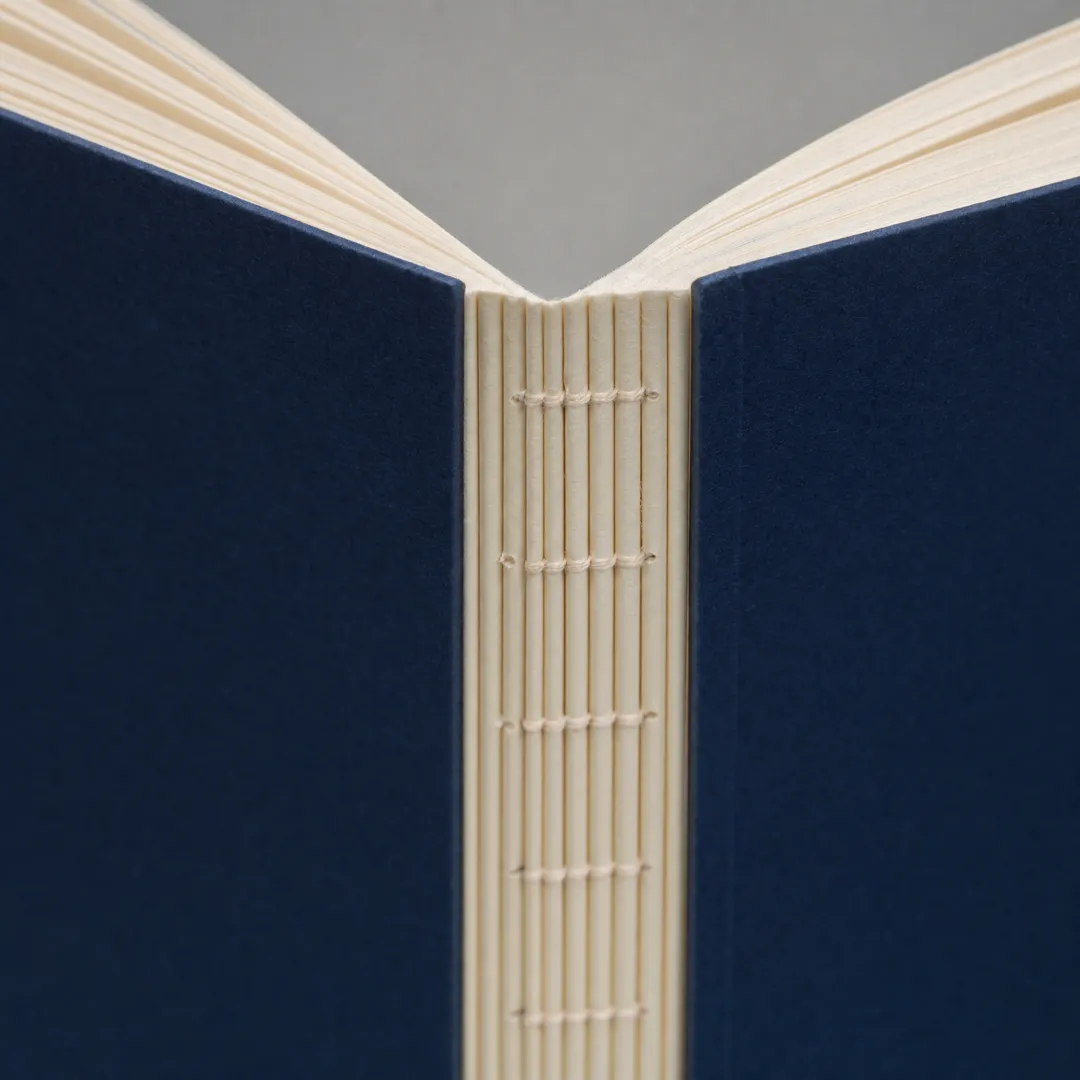
Open a sewn perfect bound book and look at the inside spine area between signatures. You’ll see neat rows of stitching running vertically along the center folds. Some designers lean into this — exposed spine designs or intentionally visible thread in contrasting colors can turn the binding into a design feature.
But even in standard covered formats, the sewn structure gives the book a different tactile quality. The book block has a slight flexibility that feels more substantial than the rigid glue block of standard perfect binding. Pages turn with less resistance. The spine doesn’t crack when you open it for the first time. For brands publishing high-end catalogs, artist portfolios, or corporate publications, these subtle quality cues communicate attention to detail before the reader consciously notices them.
4. Lightweight and Portable
Sewn perfect bound books are still softcover books. They’re significantly lighter than hardcover case-bound books with rigid greyboard covers. This makes them practical for textbooks students carry all day, travel guides, and reference books that move between desk and shelf. And unlike spiral or wire-o binding, the square spine lets you print the title, author name, or branding right on the spine edge — essential for books that live on retail shelves or in libraries.
5. Accommodates a Wide Range of Page Counts
Some binding methods have hard page-count limits. Saddle stitching tops out around 64 pages before the spine bulge becomes unmanageable. Standard perfect binding struggles below about 20 pages because there simply isn’t enough spine surface area for glue to hold effectively.
Sewn perfect binding handles an impressively wide range — from around 20 pages (thin enough to sew a single signature) up to well over 1,000 pages. The thread stitching scales with the book block size; you just add more signatures. For publishers producing both slim catalogs and thick reference volumes within the same series, maintaining consistent binding quality across the entire product line is a major practical advantage.
The 7-Step Sewn Perfect Binding Production Process
The production of a sewn perfect bound book adds one critical step — thread sewing — compared to the standard perfect binding workflow we detailed in our Perfect Binding guide . Each step matters because quality at one stage compounds (or unravels) at the next. Here’s how a professional print shop like EcoPrinting builds a sewn perfect bound book from start to finish.
Step 1: Printing
The process starts with offset or digital printing, depending on the print run size. Pages are printed on large parent sheets, not individual book pages — this is more efficient and ensures color consistency across a run. For most trade books, sheets are printed with multiple pages per side in an imposition layout designed specifically so that when the sheet is folded, all pages appear in the correct reading order. High-quality offset presses deliver the sharp text and accurate color reproduction that professional publications demand.
Step 2: Folding into Signatures
Printed sheets are fed through folding machines that create signatures — groups of pages folded together as a unit. A typical signature might contain 16 pages (four sheets folded once each, then nested) or 32 pages. The exact count depends on the paper thickness and the final book size. The fold line is what the thread will sew through in Step 4, so clean, precise folds are essential. A sloppy fold means the sewing needle misses the center line, which weakens the stitch and creates uneven page margins.
Step 3: Collating
Folded signatures are gathered in sequential order. A book with 256 pages printed in 16-page signatures needs 16 signatures, gathered 1 through 16. This step is deceptively important — if one signature is out of order, the reader will find page 33 suddenly jumping to page 49, then back to page 41. Modern collating lines use automated gathering machines, but quality-focused printers still perform spot checks because a collation error renders the entire copy unusable.
Step 4: Thread Sewing (The Smyth Machine)
This is the defining step that separates sewn perfect binding from everything else. Each signature is fed into a Smyth sewing machine , where a needle passes thread through the center fold. The thread locks through the fold and links to the adjacent signature, creating a chain stitch that connects all signatures in sequence.
A Smyth machine is a precision piece of engineering. It opens each signature at the center, registers it against guides, drives a needle through the fold line, and ties the stitch — all in a continuous motion that processes thousands of signatures per hour. The thread tension has to be exact: too loose and the signatures wobble apart; too tight and the paper tears at the stitch holes. Experienced operators adjust tension based on paper weight and signature thickness. Thin Bible paper needs dramatically different settings than thick coated art paper.
After sewing, all signatures are linked together into what’s called a book block — a complete, sewn-together text block that already feels like a book before the cover is even attached. At this stage, the spine side of the book block has visible thread stitching along the folds and a slightly uneven texture from the layered signatures.
Step 5: Gluing the Spine
The sewn book block moves to a perfect binding line, where the spine edge receives a layer of adhesive. This step serves two purposes: it locks the signatures together at the spine edge (supplementing the thread), and it provides the adhesive surface for attaching the cover.
Most quality-focused printers, including EcoPrinting, use PUR adhesive (polyurethane reactive) rather than standard EVA hot melt for sewn perfect binding. PUR creates a stronger, more flexible bond that doesn’t become brittle over time. It also withstands temperature extremes better — important for books shipped through hot containers or stored in unconditioned spaces. The trade-off is curing time: PUR needs about 24 hours to fully set, while EVA is ready in minutes. For more on this, see the Thread Types and Adhesive section below.
Step 6: Cover Attachment
The printed cover — typically a heavier cardstock, often with lamination or specialty coating — is wrapped around the glued spine and pressed firmly into place. The cover stock for sewn perfect bound books is usually 250-300 gsm, thicker than the interior paper, providing both protection and a premium feel. The cover is scored (creased) along the spine edge to create a clean hinge that opens smoothly without cracking.
One detail worth noting: because the sewn book block is slightly thicker at the spine due to the thread and folded signatures, the cover needs a precisely calculated spine width. Too narrow and the cover puckers; too wide and it looks sloppy. This calculation accounts for paper bulk, number of signatures, and thread thickness — variables that experienced estimators handle, but that can trip up less experienced operations.
Step 7: Trimming
The final step is three-knife trimming, where the top, bottom, and fore-edge (open side) are cut to final size. After trimming, the book has clean, even edges and a professional square profile. The trim must be precise — typically within ±0.5 mm tolerance — because uneven edges are immediately visible and feel wrong in the hand. After trimming, every book goes through a quality inspection: spine alignment, page sequencing, cover adhesion, and trim quality all get checked before packing.
Sewn Perfect Binding vs. Standard Perfect Binding
Choosing between these two methods is one of the most common decisions publishers face. They look similar on the shelf — both have square spines and soft covers. But under the cover, they’re fundamentally different structures. Let’s break it down.
Feature
Standard Perfect Binding
Sewn Perfect Binding
Binding Method
Adhesive only — glue bonds to roughened spine edge of individual pages
Thread sewing through folded signatures + adhesive spine gluing
Durability
Moderate. Adhesive can degrade over 3-5 years with heavy use
High. Thread mechanically secures pages; 10+ year lifespan typical
Lay-Flat Ability
Limited. Spine resists opening; requires pressure to hold open
Excellent. Opens near-flat or fully flat; stays open unassisted
Cost
Lower — simpler process, faster production, cheaper materials
Higher — 15-30% more expensive due to sewing labor and equipment
Production Time
Faster — 5-8 days typical
Slower — 12-18 days typical (sewing step + PUR curing)
Minimum Page Count
~16 pages with thin paper
~20 pages (minimum one signature)
Maximum Page Count
~600 pages (adhesive-only limits)
1,000+ pages (thread scaling)
Spine Appearance
Flat, printable square spine
Flat, printable square spine (slightly more flexible)
Best Use Cases
Mass-market paperbacks, magazines, disposable publications, short-run reports
Textbooks, cookbooks, manuals, high-end catalogs, reference books, art books
Beyond the Table: What the Numbers Don’t Tell You
The production time and cost differences are real, but they aren’t the whole story. If your book needs to survive a semester in a student’s backpack, five years on a kitchen counter, or a decade on a reference shelf, the per-copy cost premium of sewn binding — often just $0.50 to $1.50 per unit at scale — is trivial compared to the cost of a book that falls apart.
There’s also a reader experience dimension the comparison table can’t capture. A lecturer holding a textbook open on a podium, a chef referencing a recipe with both hands occupied, a musician reading from a score on a stand — these are real-world scenarios where lay-flat capability isn’t a nice-to-have; it’s the difference between a usable book and a frustrating one.
As we discussed in our Perfect Binding guide , standard perfect binding is an excellent choice for many projects — especially high-volume trade paperbacks where cost efficiency is the primary concern. Sewn perfect binding is the upgrade you make when longevity, usability, and perceived quality move to the top of the priority list.
When to Choose Sewn Perfect Binding
Not every book needs thread sewing. But certain projects benefit from it so dramatically that the additional cost becomes an investment rather than an expense. Here’s where sewn perfect binding shines brightest.
Textbooks and Educational Materials
Textbooks endure a specific kind of abuse: jammed into backpacks, opened flat on desks for hours, flipped back and forth between chapters, highlighted and annotated. A glue-only binding under these conditions might last a semester. A sewn binding lasts the full curriculum cycle and well beyond. Many universities and school districts now specify Smyth sewn binding as a minimum standard for core textbooks because the total cost of ownership — factoring in replacement frequency — favors sewn books over cheaper glue-bound alternatives.
Cookbooks
Cookbooks face a unique combination of challenges: they need to lay flat on a counter, they’re used in humid environments, and they’re often handled with wet or messy hands. Standard perfect bound cookbooks are notorious for cracking at the spine when pressed flat, and moisture accelerates adhesive degradation. Sewn perfect binding solves both problems — the thread hinge lets pages open and stay open, and the mechanical page connection isn’t compromised by kitchen humidity.
Manuals and Technical Guides
Think about how a repair manual gets used: open on a workbench, pages held down with a wrench or a coffee mug, referenced repeatedly over years. A sewn bound manual stays open where you need it without fighting the spine. For industrial equipment manuals, aviation guides, or any technical documentation where accuracy matters and hands are busy, the lay-flat advantage becomes mission-critical.
High-End Catalogs and Brand Publications
When a brand invests in a catalog or lookbook, they want it to communicate quality. A sewn perfect bound catalog feels weightier and more substantial in the hand. Pages turn more smoothly. The book opens more generously, showing full-spread images without gutter loss. For luxury fashion brands, premium furniture manufacturers, or high-end real estate portfolios, the binding quality reinforces the brand message before the reader processes the content.
Art Books and Photography Books
Full-bleed images that span two pages are a staple of art and photography books. Standard perfect binding creates a “gutter loss” problem — the inner portion of each page disappears into the spine, breaking the image continuity. Sewn perfect binding dramatically reduces gutter loss because pages can open more fully, letting readers see more of the image across the spread.
Thread Types and Adhesive: The Materials Behind the Binding
The quality of a sewn perfect bound book depends as much on material choices as on process. Let’s look at the two key material decisions that affect binding quality: thread selection and adhesive type.
Cotton Thread vs. Polyester Thread
The thread in sewn perfect binding does the heavy lifting — it’s the mechanical backbone of the book. Choosing the right thread isn’t trivial.
Cotton thread is the traditional choice, and for good reason. Natural cotton fibers are soft, which means they don’t abrade paper fibers at the stitch holes over time. Cotton also expands and contracts with humidity at roughly the same rate as paper, so the thread and the book block move together through environmental changes. Mercerized cotton — treated with sodium hydroxide to increase strength and luster — is the grade typically used in bookbinding. The downside? Cotton thread is about 30% weaker than polyester of equivalent thickness and can degrade faster when exposed to moisture or acids in certain paper stocks.
Polyester thread offers superior tensile strength — roughly 30% stronger than cotton of the same weight — and is essentially immune to moisture, mildew, and chemical degradation. It doesn’t shrink, doesn’t rot, and maintains its integrity essentially forever under normal storage conditions. The trade-off: polyester is slightly more abrasive than cotton, and its dimensional stability means it doesn’t move with the paper through humidity cycles. For books printed on coated or specialty papers, this difference is negligible in practice. For archival-quality books on uncoated acid-free paper, some conservators still prefer cotton.
Cotton-wrapped polyester core thread splits the difference — a polyester filament core for strength, wrapped in cotton for surface compatibility with paper. It’s increasingly common in commercial Smyth sewing because it offers the best of both materials.
In practice, at EcoPrinting, we default to high-quality polyester or cotton-core polyester thread for most commercial sewn perfect binding projects. The strength advantage matters for books that will see real use, and modern polyester threads have improved dramatically in softness and paper compatibility over the past two decades.
PUR Adhesive vs. EVA Adhesive
Once the signatures are sewn, they still need glue at the spine for cover attachment and additional structural integrity. The adhesive choice here makes a measurable difference in book performance.
EVA (Ethylene Vinyl Acetate) is the standard hot-melt adhesive used in most perfect binding. It’s inexpensive, cures almost instantly on cooling, and works well for most general-purpose books. The downsides: EVA can become brittle over time, especially in cold temperatures, and doesn’t bond as aggressively to coated or varnished papers. It also loses strength in high-heat environments — a book left in a hot car can experience EVA softening and page slippage.
PUR (Polyurethane Reactive) adhesive cures through a chemical reaction with ambient moisture rather than simply cooling. The result is a bond that’s dramatically more flexible, more durable across temperature extremes, and stronger on coated or specialty papers. PUR-bound books lay flatter, resist spine cracking, and maintain their integrity in conditions that would compromise EVA. The trade-offs: PUR costs more, requires specialized application equipment, and needs about 24 hours to fully cure before the book is ready for handling.
For sewn perfect binding specifically, we strongly recommend PUR. The thread already handles the mechanical page retention, so the adhesive’s job is primarily cover attachment and supplemental spine stability. PUR’s flexibility complements the sewn structure beautifully — the spine bends with the book rather than fighting it. The result is a binding that feels cohesive, not stiff.
Frequently Asked Questions About Sewn Perfect Binding
Q: Is sewn perfect binding suitable for all types of books?
Sewn perfect binding works for a remarkably wide range of book types — novels, catalogs, children’s books, manga, graphic novels, textbooks, manuals, and more. The main limiting factor is page count: you need at least enough pages to form one signature (roughly 20 pages minimum). For books under 20 pages, saddle stitching or stapling may be more appropriate. For extremely thick books over 1,200 pages, you may need to consult with your printer about spine reinforcement options. The paper type matters too — very stiff, thick paper stock (like heavy card) doesn’t fold into signatures cleanly, making sewn binding impractical for those materials.
Q: Can sewn perfect binding be used for small print runs?
Yes, absolutely. Sewn perfect binding scales from a few dozen copies to hundreds of thousands. For very small runs (under 100 copies), the setup cost for Smyth sewing becomes a larger proportion of the per-unit cost, so you’ll want to weigh the durability benefit against the budget. But technically, there’s no minimum that prevents sewn binding. At EcoPrinting, we handle sewn perfect binding for runs as small as 50 copies and as large as 50,000+.
Q: Can sewn perfect bound books lay flat when opened?
Yes — and this is one of the primary reasons to choose sewn perfect binding over standard perfect binding. The thread-sewn signatures act as individual hinges, letting the book open much wider and stay open without constant hand pressure. A sewn perfect bound book can typically open to 170-180 degrees, whereas a standard perfect bound book will resist opening past about 120-140 degrees before the spine glue starts cracking.
Q: Can the cover of a sewn perfect bound book be customized?
Absolutely. The cover of a sewn perfect bound book can be fully customized with full-color printing, graphics, branding, and a range of specialty finishes — matte or gloss lamination, soft-touch coating, spot UV, foil stamping, embossing, and debossing. The softcover wrapper is the same cover stock used for standard perfect binding, so all the same finishing options are available. The spine can also be printed with title text, author name, and branding for shelf identification.
Q: How long does sewn perfect binding production take?
Typical production time for sewn perfect binding is 12-18 working days, compared to 5-8 days for standard perfect binding. The extra time comes from the thread sewing step itself and the longer curing period required if PUR adhesive is used (recommended). Factors that affect production time include order quantity, page count, paper type, and any special finishing requirements. Rush production is sometimes available for an additional fee — check with your printing partner for current lead times on your specific project.
Q: How much more does sewn perfect binding cost compared to standard perfect binding?
The premium varies by print run size and specifications, but as a rough guide, expect sewn perfect binding to cost 15-30% more than standard perfect binding for the same book. On a per-unit basis for a typical 200-page trade book in a run of 1,000 copies, the difference might be $0.50 to $1.50 per book. The premium comes from the additional labor and machine time for sewing, plus the cost of thread materials and (if specified) PUR adhesive. For long-lasting, heavily-used books, this per-unit premium is almost always justified by the extended lifespan.
Q: What’s the difference between Smyth sewn and sewn perfect binding?
They’re essentially the same thing. “Smyth sewn” (or “Smyth sewing”) refers to the specific machine and technique used for the thread sewing step — a Smyth sewing machine stitching through the center fold of each signature. “Sewn perfect binding” describes the complete binding method: Smyth-sewn signatures + perfect-bound softcover. In practice, when someone says a book is “Smyth sewn,” they’re describing the sewing technique; when they say “sewn perfect bound,” they’re describing the finished binding style.
Q: Does sewn perfect binding work with coated paper?
Yes, and in some ways it’s actually better for coated papers than standard perfect binding. Coated papers (gloss or matte) have a smooth surface that standard EVA glue doesn’t penetrate as effectively as it does with uncoated paper, which can lead to weaker glue-only bindings. Because sewn perfect binding relies on thread for the primary page retention, the reduced glue penetration on coated stock is much less of a concern. When paired with PUR adhesive, sewn perfect binding handles coated papers extremely well.
Is Sewn Perfect Binding Right for Your Book?
Sewn perfect binding sits in a sweet spot between the affordability of softcover books and the durability of sewn hardcovers. It gives you the clean, lightweight, shelf-ready profile of a perfect bound book with the mechanical integrity that makes a sewn book last.
The decision comes down to three questions:
How will readers use this book? If they’ll reference it frequently, open it flat, or use it hands-free, sewn binding is worth the upgrade.How long does this book need to last? For a mass-market paperback with a 12-month retail shelf life, standard perfect binding is fine. For a textbook that needs to survive five years of daily use, sewn binding pays for itself in avoided replacements.What does quality communicate for this project? For brands, institutions, and premium publications, the binding quality is part of the message. A sewn perfect bound book tells the reader this content is worth keeping.
At EcoPrinting , we produce sewn perfect bound books for publishers, educational institutions, brands, and self-published authors worldwide. We use modern Smyth sewing equipment paired with PUR adhesive binding lines, and our production team brings decades of combined binding experience to every project. Whether you’re printing 100 copies or 100,000, we can help you choose the right paper, thread, adhesive, and cover finish for your specific book.
Ready to get started? Contact our team for a custom quote on your sewn perfect binding project, or request a sample kit to see and feel the difference between our binding methods firsthand.