Why Choosing the Right Book Printing Size Matters
Picture this: you have spent months writing a manuscript. The cover design is ready. The interior layout is polished. Then, right before hitting print, someone asks — “What trim size are we using?” — and you freeze.
It happens more often than you would think. Book size is one of those details that can sneak up on even experienced authors and publishers. Yet it touches nearly every aspect of your project: production cost, reader comfort, shelf presence, shipping weight, and even how retailers categorize your book. Get it right, and your book feels like it belongs. Get it wrong, and readers notice — maybe not consciously, but they notice.
This guide walks you through popular book printing sizes across four major markets: North America, Europe, Australia, and China. You will find clear dimension tables, practical tips for choosing the right trim, and notes on when a custom size might be your best move. Whether you are printing a pocket novel, a full-color cookbook, a corporate catalog, or a deck of playing cards, the right size starts here.
The ISO 216 Standard: The Global Paper Size System
Before diving into regional specifics, it helps to understand the foundation most of the world builds on. ISO 216 is the international standard that defines the A-series, B-series, and C-series paper sizes. It was first adopted in 1975 and is now used in every country except the United States, Canada, and a handful of others.
The genius of the A-series lies in its mathematical consistency. Each size has an aspect ratio of 1:√2 (roughly 1:1.414). When you fold an A0 sheet in half, you get A1. Fold A1 in half, you get A2. This continues all the way down through the series. This self-similar property means artwork scaled from one A-size to another always fits perfectly — a designer’s dream.
For book printing, the most commonly referenced A-sizes are A4 through A7, though understanding the full range gives you context when dealing with posters, flyers, or large-format inserts.
Here is the complete A-series reference table, from A0 (the base size, exactly 1 square meter in area) down to A7:
ISO 216 A-Series Paper Sizes
Size
Width × Height (mm)
Width × Height (inches)
Common Book/Print Use
A0
841 × 1189
33.1 × 46.8
Large posters, architectural plans
A1
594 × 841
23.4 × 33.1
Posters, large wall calendars
A2
420 × 594
16.5 × 23.4
Posters, art prints
A3
297 × 420
11.7 × 16.5
Calendars, large coffee-table books
A4
210 × 297
8.3 × 11.7
Textbooks, catalogs, magazines
A5
148 × 210
5.8 × 8.3
Paperbacks, novels, notebooks
A6
105 × 148
4.1 × 5.8
Pocket books, small notebooks
A7
74 × 105
2.9 × 4.1
Mini notebooks, small cards
Why ISO matters for your printing project: If your book is destined for readers in Europe, Australia, or most of Asia, sticking to A-series dimensions keeps you compatible with local printing equipment, standard paper stocks, and even envelope sizes for mailing. It also tends to keep per-unit costs lower because printers buy A-series paper in bulk.
North America Standard Book and Print Sizes
North America — primarily the United States and Canada — uses an inch-based system that developed independently from the ISO standard. The familiar 8.5″ × 11″ Letter size anchors the ecosystem, with sizes scaling up and down from there. For authors and publishers targeting the U.S. and Canadian markets, understanding these dimensions is essential because major platforms like Amazon KDP, IngramSpark, and Barnes & Noble Press are built around them.
North American Book Trim Sizes
Book trim sizes in North America are shaped by decades of publishing tradition, reader expectations, and printing economics. Different genres tend to cluster around specific dimensions — a mass-market thriller rarely shares the same trim as a cookbook or a textbook.
Popular North American Book Printing Sizes
Size Name
Dimensions (inches)
Dimensions (mm)
Best For
Pocket Book
4.25 × 6.87
108 × 175
Mass-market paperbacks, travel guides
Digest
5.5 × 8.5
140 × 216
Trade paperbacks, memoirs, general fiction
US Trade
6 × 9
152 × 229
Hardcover fiction, self-published novels, nonfiction
Portrait
8 × 10
203 × 254
Children’s picture books, photography books
Square
8.5 × 8.5
216 × 216
Art books, gift books, board books
Letter
8.5 × 11
216 × 279
Workbooks, manuals, textbooks
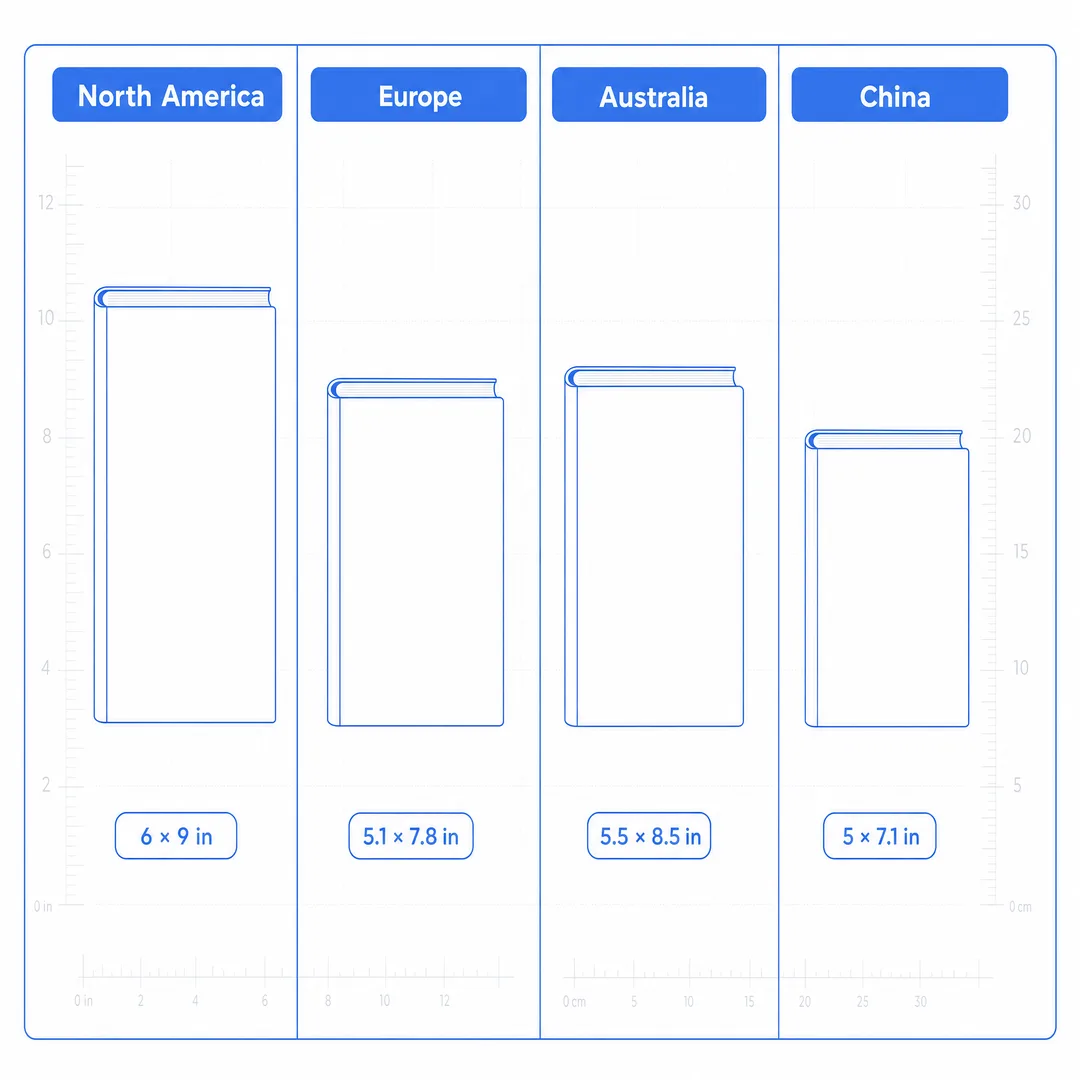
The 6 × 9 inch US Trade size deserves special attention. It is far and away the most popular trim for self-published books on Amazon KDP and IngramSpark. It offers a comfortable reading experience, looks professional on a shelf, and maximizes your page count efficiency on standard printing presses. If you are publishing your first book and feel overwhelmed by choices, 6 × 9 is rarely a wrong answer for the North American market.
Catalogs, Magazines & Booklets
Businesses printing catalogs, product booklets, or magazines in North America typically default to two sizes: the Digest format at 5.5″ × 8.5″ and the full Letter size at 8.5″ × 11″. The smaller Digest size works well for product lookbooks, event programs, and company handbooks that need to fit inside a shipping envelope alongside the products they describe. The larger Letter size suits full-catalog layouts where big product photography and detailed spec tables demand room to breathe.
Notebooks, Calendars, Playing Cards & Posters
Beyond books, print projects cover a wide range of product types. Here is how North American standard sizes break down for each category:
North American Print Sizes by Product Type
Product Type
Standard Sizes (inches)
Notes
Notebooks
8.5 × 11, A4, A5
Letter and A4 dominate; A5 for pocket journals
Calendars
12 × 12, 8.5 × 11
Square calendars are popular for wall display
Playing Cards
2.5 × 3.5
Standard poker-size deck (also called bridge size)
Tarot Cards
2.75 × 4.75
Larger format with room for detailed artwork
Posters
8.5 × 11, 11 × 17, 18 × 24, 24 × 36
Scales from flyer-sized to full wall display
European and Australian Standard Sizes
Europe and Australia share the ISO-based metric system, which makes cross-border printing surprisingly straightforward. If you design a book for the UK market, the same A5 file generally works for Germany, France, Spain, Australia, and New Zealand without modification — a significant logistical advantage if you plan to distribute across multiple countries.
European & Australian Book Trim Sizes
European book publishers rely heavily on the A-series, with A5 standing as the dominant paperback novel format and A4 reserved for textbooks and larger illustrated works. Beyond the pure A-sizes, two intermediate dimensions — 152 × 230 mm and 210 × 210 mm — have carved out their own niches. The 152 × 230 mm size (roughly 6″ × 9″ in imperial) bridges the gap between A5 and the North American Trade size, making it a popular choice for books with trans-Atlantic distribution. The 210 × 210 mm square format is a favorite for children’s board books and art monographs.
European & Australian Book Printing Sizes
Size
Dimensions (mm)
Dimensions (inches)
Best For
A4
210 × 297
8.3 × 11.7
Textbooks, manuals, large catalogs
A5
148 × 210
5.8 × 8.3
Novels, trade paperbacks, general nonfiction
152 × 230
152 × 230
6.0 × 9.1
Cross-market fiction, self-published titles
210 × 210
210 × 210
8.3 × 8.3
Square-format gift books, children’s books
Catalogs, Notebooks & Calendars
European catalogs and magazines almost always stick to A4 for full-page layouts and A5 for digest editions. Notebooks follow the same A-series logic, with A5 dominating the journal and notepad market, A6 serving as the pocket-sized companion, and A4 reserved for larger workbooks. Wall calendars in Europe commonly use A3 (297 × 420 mm) for the large-format kitchen calendar, A4 for desk calendars, and A6 for compact planners.
Playing Cards & Regional Poster Variations
European playing cards use two standard sizes: 59 × 92 mm and 63 × 89 mm, both slightly different from the North American poker format. This distinction matters if you are printing card games destined for European retail — using the North American dimensions can make your deck feel off in the hands of European players.
Poster sizes reveal one of the few meaningful splits between Europe and Australia. European poster printers reference DIN B-series sizes: 11″ × 17″ corresponds to DIN A3, 18″ × 24″ maps to B2 (500 × 707 mm), and 24″ × 36″ equals B1 (707 × 1000 mm). Australia, meanwhile, simply scales the A-series upward: A3, A2, A1, and A0 for progressively larger displays.
European & Australian Print Sizes by Product Type
Product Type
Europe
Australia
Catalogs/Magazines
A4, A5
A4, A5
Notebooks
A5, A6, A4
A5, A6, A4
Calendars
A3, A4, A6
A3, A4, A6
Playing Cards
59 × 92 mm, 63 × 89 mm
59 × 92 mm, 63 × 89 mm
Posters
DIN A3, B2, B1
A3, A2, A1, A0
China Standard Book and Print Sizes
China’s printing industry has grown into the world’s largest, and its size standards reflect a pragmatic mix of ISO adoption and domestic customization. While A-series sizes are widely used, several uniquely Chinese dimensions appear in catalogs, magazines, and calendars — and knowing them can save you from ordering a print run that looks subtly wrong to the Chinese reader.
Chinese Book Sizes
Chinese book printing primarily relies on A3, A4, and A5 formats. A4 serves textbooks and reference works, while A5 is the go-to for trade paperbacks and literary fiction — mirroring global patterns. A3 is less common for standard books and more frequently reserved for large-format illustrated works, art reproductions, and educational posters bound as booklets.
Catalogs, Magazines & the B5 Factor
One size you will encounter frequently in Chinese commercial printing is B5 (176 × 250 mm). It sits between A5 and A4 — larger than a standard paperback but more compact than a full-textbook format — and has become the default for many Chinese business catalogs, corporate brochures, and magazines. Two other common catalog dimensions are 210 × 285 mm and 142 × 210 mm. The 210 × 285 mm size is particularly popular because it uses paper efficiently on Chinese printing presses and offers a generous layout area without the full bulk of an A4 page.
Chinese Standard Book & Print Sizes
Product Type
Standard Sizes
Notes
Books
A3 (297 × 420 mm), A4 (210 × 297 mm), A5 (148 × 210 mm)
A5 dominates for fiction; A4 for textbooks
Catalogs/Magazines
210 × 285 mm, 142 × 210 mm, B5 (176 × 250 mm)
210 × 285 mm is the workhorse commercial size
Notebooks
A5 (148 × 210 mm), A4 (210 × 297 mm), B5 (176 × 250 mm)
B5 notebooks are widely available in stationery stores
Calendars
340 × 480 mm, A3 (297 × 420 mm), A4 (210 × 297 mm)
340 × 480 mm is a unique large format not seen elsewhere
Playing Cards
57 × 87 mm
Distinct from both North American and European card sizes
Posters
B2 (500 × 707 mm), B1 (707 × 1000 mm), B0 (1000 × 1414 mm)
B-series dominates Chinese poster printing
Notice the playing card dimensions: China uses 57 × 87 mm, which is narrower than both the North American 2.5″ × 3.5″ (63.5 × 89 mm) and the European 59 × 92 mm formats. If you are printing a card game for the Chinese market, this difference matters — Chinese consumers are accustomed to this slimmer feel, and cards that do not match local expectations can feel bulky in hand.
Global Book Size Quick Comparison Chart
If you are printing the same title for multiple markets — or simply want to understand how book sizes stack up across the world — this comparison chart puts the most common book trim sizes from all four regions side by side.
Popular Book Printing Sizes — Global Comparison
Region
Most Common Novel/Paperback
Most Common Textbook/Large Format
Compact/Pocket Size
North America
6″ × 9″ (152 × 229 mm)
8.5″ × 11″ (216 × 279 mm)
4.25″ × 6.87″ (108 × 175 mm)
Europe
A5 (148 × 210 mm)
A4 (210 × 297 mm)
A6 (105 × 148 mm)
Australia
A5 (148 × 210 mm)
A4 (210 × 297 mm)
A6 (105 × 148 mm)
China
A5 (148 × 210 mm)
A4 (210 × 297 mm)
A6 (105 × 148 mm)
A few things stand out immediately from this table. First, the North American 6″ × 9″ Trade size is slightly wider and taller than the A5 paperback standard used across Europe, Australia, and China — so a layout designed for A5 will need reflowing if you plan to offer a US edition. Second, the large-format standard is remarkably consistent across regions: A4 in metric markets and 8.5″ × 11″ Letter in North America, which differ by only about 6 mm in width and 18 mm in height — close enough that many layouts can adapt with minimal adjustment.
How to Choose the Right Book Size for Your Project
Selecting a trim size is part math, part art, and part market psychology. Here is a practical, step-by-step framework to help you decide.
Step 1: Know Your Genre
Readers have deep-seated expectations about how a book should feel in their hands, and those expectations are shaped by genre. A mass-market thriller that arrives in a large-format 8″ × 10″ trim feels odd — like a textbook pretending to be a page-turner. Conversely, a cookbook crammed into a 5″ × 8″ pocket size frustrates readers who need space for ingredient lists and step-by-step photos.
Here is a quick genre-to-size mapping based on what dominates bookstore shelves:
Recommended Trim Sizes by Genre
Genre
North America
Europe/Australia/China
General fiction (novels)
5.5″ × 8.5″ or 6″ × 9″
A5 (148 × 210 mm)
Mass-market thriller/romance
4.25″ × 6.87″
A6 (105 × 148 mm)
Memoir / narrative nonfiction
5.5″ × 8.5″
A5 or 152 × 230 mm
Cookbooks
7.5″ × 9.25″ or 8″ × 10″
210 × 210 mm or A4
Children’s picture books
8″ × 10″ or 8.5″ × 8.5″
210 × 210 mm or A4
Textbooks / academic
8.5″ × 11″
A4 (210 × 297 mm)
Workbooks / journals
8.5″ × 11″
A4
Art / photography books
8.5″ × 8.5″ or 10″ × 10″
210 × 210 mm or A4
Step 2: Consider Your Reader — and Where They Read
Think about the physical context in which someone will read your book. A travel guide needs to slide into a jacket pocket. A textbook sits open on a desk. A coffee-table book is displayed flat, never carried. If your reader will hold the book one-handed on a crowded subway, err toward smaller, lighter formats. If they will sit at a table with a highlighter in hand, give them the full page real estate.
Step 3: Calculate Your Printing Costs
Trim size directly impacts your page count, and page count — not cover dimensions — drives most of your per-unit printing cost. A manuscript that fills 250 pages at 6″ × 9″ might balloon to 380 pages at 5″ × 8″, because the same amount of text requires more pages. More pages mean more paper, more ink, more binding material, and higher shipping weight. Before committing to a trim size, lay out a sample chapter in two or three candidate sizes and compare page counts. The difference can be hundreds of dollars on a medium print run.
Step 4: Match Your Distribution Channel
If you are selling through Amazon KDP, your trim size must be one of their supported formats (16 paperback sizes plus 5 hardcover sizes as of 2025). IngramSpark offers slightly different options. For offset printing, check with your printer about which sizes run most efficiently on their specific presses — an unusual trim can force them to use a larger parent sheet with more waste, and that waste shows up on your invoice. At EcoPrinting, we help clients navigate these trade-offs by mapping their trim choices to the most cost-effective press configurations available.
Step 5: Test in the Real World
Before approving a full production run, print one copy at your chosen trim size. Hold it. Read from it. Hand it to three people and ask what they think. Pay attention to whether the spine cracks awkwardly, whether the margins leave enough thumb room on the outer edge, and whether the font size feels natural (or strained) at the resulting text block width. A single printed proof can surface issues that look invisible on a screen.
Custom Printing Sizes: When Standard Sizes Are Not Enough
Standard sizes cover roughly 90% of print projects, but sometimes a book simply needs to break the mold. Square art books, oversized photography collections, pocket-sized prayer books, oddly-proportioned children’s board books, corporate annual reports with premium dimensions — these projects demand custom trim sizes that off-the-shelf templates cannot provide.
Custom sizes give you complete creative freedom but come with practical considerations. They typically require custom cutting dies, may limit your choice of binding styles, and almost always carry a higher per-unit cost because the printer cannot gang-run your job alongside other orders on standard-sized paper stock. That said, for premium or highly differentiated products, the incremental cost is often justified by the impact.
EcoPrinting offers custom trim sizes across book, catalog, card, and poster projects. Our production team works with you to confirm that your chosen dimensions are achievable on the most efficient press configuration, keeping waste low and turnaround times predictable. Contact us with your specifications for a no-obligation quote — we will walk you through the cost and technical implications before you commit.
Frequently Asked Questions
What is the most popular book printing size overall?
Globally, A5 (148 × 210 mm) is the most widely used paperback format, covering novels, trade nonfiction, and general interest books across Europe, Asia, Australia, and Africa. In North America, the 6″ × 9″ (152 × 229 mm) US Trade size holds the top spot for self-published and traditionally published titles alike. These two sizes alone account for a significant majority of fiction and nonfiction books printed each year.
Does book size affect Amazon KDP royalties?
Yes — indirectly. KDP royalties are calculated based on list price minus printing costs, and printing costs vary by trim size because different sizes consume different amounts of paper and ink. Larger trims with higher page counts cost more to produce, which reduces your royalty per sale unless you adjust your list price accordingly. Amazon provides a printing cost calculator inside your KDP dashboard so you can compare costs across trim sizes before uploading your final files.
What size should I use for a children’s picture book?
For North American markets, 8″ × 10″ and 8.5″ × 8.5″ (square) are the most popular children’s picture book sizes. Square formats have surged in popularity over the past decade, especially for board books aimed at toddlers. For European and Australian markets, 210 × 210 mm (square) and A4 landscape are common.
Can I use the same interior file for different trim sizes?
Not without reformatting. Changing the trim size shifts your text block width, margin requirements, and page count. A 6″ × 9″ interior file dropped into an A5 template will require margin adjustments, re-kerning in some cases, and a full page-number reflow. Always budget time — and design cost — for a proper reformat when switching between trim sizes, especially across inch-based and metric-based standards.
Are Chinese book sizes compatible with ISO paper stock?
Mostly. China uses the ISO A-series for books and notebooks, so standard A4, A5, and A6 trim sizes print without issue on globally available ISO paper stock. The B5 size (176 × 250 mm) and the unique 210 × 285 mm catalog format are Chinese domestic standards that may require special paper sourcing outside of Asia. If you plan to print in China for export, your printer can advise on the most cost-effective stock to match your target trim.
What if my desired size falls between two standard dimensions?
This is more common than you might think, especially for authors who want a book that feels unique on the shelf. In most cases, the nearest standard size is the practical choice — it keeps production costs manageable and avoids the need for custom cutting. If the in-between dimension is important to your design concept, EcoPrinting can quote a custom trim. The key is to understand the cost difference before you commit: the premium for custom sizing can range from modest (when your trim happens to fit efficiently on a standard press sheet) to significant (when it does not).
Summary: The Right Size Makes the Right Impression
Book size might seem like a footnote in the long list of publishing decisions, but it shapes everything from production economics to how your reader experiences your content. A well-chosen trim size makes your book feel intentional and professional. It respects genre conventions, suits your reader’s hands, and works efficiently on a printing press.
Whether you are printing a single proof copy or ordering thousands of units for global distribution, taking the time to settle on the right size — and consulting with a printer who understands the trade-offs — is one of the smartest investments you can make in your project.
Need help choosing the right size for your next print run? Contact EcoPrinting today for a free consultation. Our team will review your manuscript, discuss your distribution plans, and recommend the trim size that balances aesthetics, cost, and reader experience.