What Actually Goes Into Printing a Pop-Up Book That Works
Most people see a pop-up book and think about the artwork. Publishers and brand owners see something else entirely: a manufacturing puzzle where paper engineering, material strength, die-cutting precision, and hand assembly all have to line up perfectly. One miscalculated fold angle, and the mechanism jams. One wrong paper weight, and the structure collapses after a dozen opens. If you are researching pop up book printing in China, you already know the basics. What you probably need is a clear, no-fluff picture of how the production chain actually works—from the board stock that holds the mechanisms to the safety certifications your target market demands.
This guide walks through the entire process: the mechanism types that define your design, the materials that keep everything standing, the die-cutting and assembly workflow, safety compliance across markets, realistic MOQ expectations, cover finishing options, and how prototyping fits into the timeline. Whether you are printing a children’s novelty title, an educational STEM book, or a premium promotional edition, you will find the technical details that matter at the production stage.
Pop-Up Mechanism Types
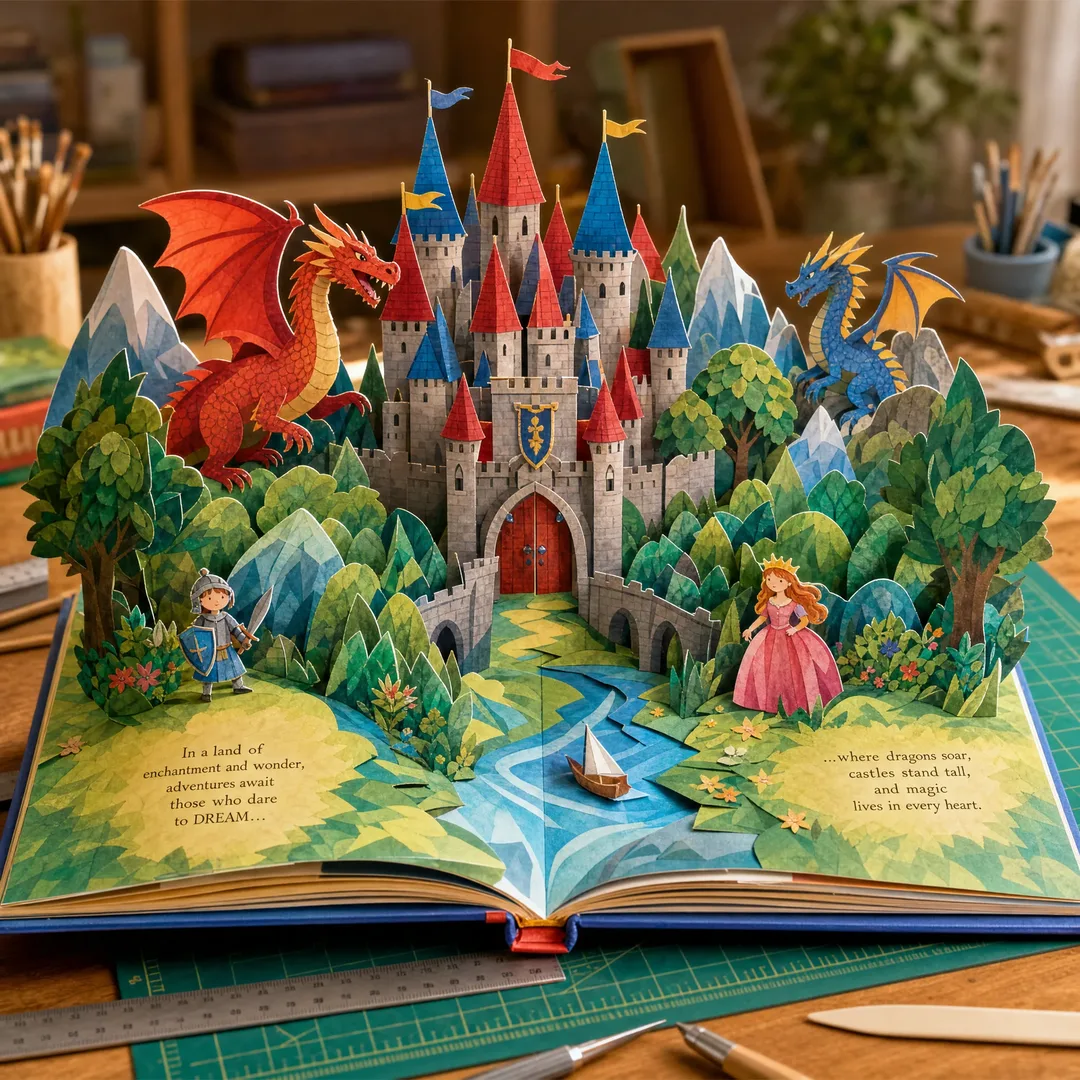
Every pop-up spread is a system of folds, cuts, and glue points that convert the opening motion of a page into three-dimensional movement. Choosing the right mechanisms early determines your material requirements, assembly complexity, and ultimately your per-unit cost. Here are the core types used in commercial pop-up book production.
What is a V-fold and when should you use it?
The V-fold is the most fundamental pop-up mechanism. A piece of paper is scored with a central valley fold and two glue tabs, then attached diagonally across the gutter of a spread. When the book opens, the V-shaped piece lifts upward from the page surface. By adjusting the angle and the length of the arms, paper engineers control how high the element rises and at what point in the opening arc it reaches full extension.
V-folds are the workhorse of pop-up design because they are simple to manufacture and highly adaptable. They appear in nearly every commercial pop-up book as character pop-ups, central focal elements, and surprise reveals. A well-designed V-fold requires only one die-cut piece and two glue points, making it one of the most cost-efficient mechanisms for mass production. The trade-off is that V-folds are less stable under repeated use than box-fold constructions, so they are often paired with reinforcing layers in books aimed at younger children.
What are parallel folds and box folds?
Parallel folds—often called step folds or box folds—create platforms and architectural structures that rise parallel to the page surface. Unlike V-folds that angle inward, parallel folds lift straight up, forming flat surfaces that can support buildings, stages, vehicles, and layered scenery with significant structural integrity.
Box folds are a subset of parallel folds where the mechanism forms a closed rectangular volume when opened. These are the strongest pop-up structures available and can carry the weight of additional glued elements on top of them. The manufacturing cost is higher because box folds require more material per mechanism and more precise scoring to ensure the walls rise evenly. However, for spreads where the pop-up needs to withstand hundreds of opens—think library editions or classroom-use books—box folds are the standard choice.
How do pull tabs, sliders, and rotary wheels work?
Pull tabs and sliders add motion that the reader controls. A tab extends beyond the page edge, and when pulled, it slides a paper component along a track to reveal hidden artwork, move a character, or change a scene. The mechanism relies on a sandwich construction: two layers of board create a channel, and the moving piece rides between them. Die-cutting precision is critical here because a track that is too tight catches, and one that is too loose lets the slider fall out.
Rotary wheels, also called volvelles, use a central rivet or paper pivot to let a circular disk rotate against a fixed background. These are common in educational pop-up books where turning the wheel reveals different facts, phases, or illustrations. The challenge in production is maintaining enough friction to hold the wheel in position while keeping rotation smooth. Most manufacturers use a reinforced center point with a grommet or paper washer to achieve this balance.
What are layered pop-ups and tunnel structures?
Layered pop-ups stack multiple die-cut panels one behind another so that each layer unfolds at a different distance from the reader, creating depth and perspective. Think of a forest scene where trees in the foreground, middle ground, and background rise to different heights. The effect is theatrical and immersive, but the assembly is labor-intensive because each layer must be glued to spacer tabs at precise positions.
Tunnel books take the layered concept further by connecting the layers with accordion-fold side panels, forming a box-like structure that the reader looks through. These are a niche format often used for art editions and collectible projects. Tunnel books require the most hand assembly of any pop-up format and are typically produced in very small runs.
Material Selection for Sturdy Pop-Ups
The difference between a pop-up book that lasts five years and one that fails after a week comes down to board stock. Standard text-weight paper cannot support three-dimensional mechanisms. Every component—the base spread, the pop-up pieces, and the cover—needs material chosen specifically for the stresses it will endure.
Why C1S board is the industry standard for interior pages?
Coated One Side (C1S) board dominates pop-up book manufacturing because it delivers the right combination of print quality and structural strength. The coated side takes crisp, vibrant offset printing for the artwork, while the uncoated reverse side provides a good gluing surface for mechanisms. Most pop-up spreads are built by laminating two sheets of C1S together—typically in the 250 gsm to 350 gsm range—to form a rigid board that will not warp or sag under the weight of glued elements.
A single sheet of 300 gsm C1S measures approximately 0.41 mm thick. When two sheets are glued together, the resulting board reaches roughly 0.85 mm to 0.95 mm depending on adhesive weight. For spreads with heavy mechanisms or large V-folds, manufacturers often step up to 350 gsm sheets or add a third lamination layer. The key is balancing thickness against the fold—boards that are too thick resist creasing at the gutter, which makes the book hard to open and puts strain on the binding.
When does grey board make sense for the cover?
For hardcover pop-up books, grey board (also called chipboard or binder’s board) provides the rigid foundation. Standard thicknesses range from 1.5 mm to 3 mm, with 2 mm being the most common for children’s titles. The grey board is wrapped in 157 gsm coated art paper that carries the cover design, then the wrapped board is attached to the book block via endpapers.
Some manufacturers offer an alternative self-cover construction where the cover board is the same C1S lamination used for interior pages. This approach saves cost and produces a lighter book, but it lacks the premium feel and long-term durability of a grey board hardcover. The choice between the two usually depends on the target retail price point and the age of the intended reader.
What paper weight holds pop-up mechanisms best?
The mechanism pieces themselves—the V-fold arms, box-fold walls, pull-tab sliders—are typically printed on the same C1S stock as the base spread, then die-cut and glued into position. For small, lightweight mechanisms on less complex spreads, 250 gsm may be sufficient. For anything with a vertical rise above 50 mm or mechanisms that the reader actively pulls and pushes, 300 gsm to 350 gsm provides the necessary stiffness. Some high-wear moving parts, such as pull-tab levers, get an extra reinforcement layer of unprinted board glued to the back after die-cutting.
Die-Cutting and Assembly: Where the Cost Lives
Pop-up book manufacturing splits into two distinct stages: printing and die-cutting the flat components, then assembling them into functional three-dimensional spreads. The first stage is largely automated. The second stage is not—and that is why pop-up books cost what they do.
How does die-cutting work for pop-up mechanisms?
After the artwork is printed on large offset sheets, those sheets go to a die-cutting press. A custom steel-rule die—essentially a cookie-cutter shaped to the exact outlines of every mechanism piece, glue tab, and fold line—is mounted on the press. The die stamps through the printed sheet in one stroke, cutting the parts free while simultaneously creasing the fold lines. Modern die-cutting uses laser-positioned dies for accuracy within 0.1 mm, which is essential because even a small misalignment at this stage will cause mechanisms to bind during assembly.
For a typical pop-up spread with four to six separate mechanism pieces, the die-cutting cost includes both the die fabrication (a one-time tooling cost) and the per-sheet cutting charge. Die costs range from roughly USD 80 to USD 300 per spread depending on complexity and the number of individual cutting rules. These are one-time expenses amortized across the print run.
Why is hand assembly still the dominant method?
Despite advances in automation, commercial pop-up book assembly remains overwhelmingly manual. Each mechanism piece must be folded along its crease lines, positioned on the base spread at the correct angle, and glued in place—often with two or three glue points that dictate the movement geometry. A trained assembler can complete a spread in 60 to 120 seconds depending on the number of mechanisms, but the work cannot be rushed without compromising quality.
Semi-automated lines exist for simple, repetitive mechanisms like single V-folds, where a jig holds the base spread and a pneumatic applicator places glue dots at fixed positions. However, any spread with more than three mechanisms or with non-standard angles typically requires full hand assembly. This is the single largest cost driver in pop-up book production. A 10-spread book with an average of five mechanisms per spread might involve over 100 individual glue-and-place operations per copy.
How does assembly complexity affect unit cost?
The relationship between mechanism count and cost is not linear. A spread with two simple V-folds might take 40 seconds to assemble. A spread with two V-folds plus three pull-tab mechanisms plus a layered background could take four minutes. The labor cost per spread becomes the dominant factor once a book exceeds roughly six active mechanisms across all spreads. This is why commercial pop-up books aimed at price-sensitive markets tend to limit themselves to three to five spreads with two to four mechanisms each. Premium and collector editions, by contrast, may pack eight or more mechanisms into a single spread and price accordingly.
Safety Standards and Child-Safe Compliance
If your pop-up book is destined for children under 14, you need to navigate two major safety frameworks. Compliance is not optional—retailers in the EU and North America require passing test reports before they will stock the product.
What does EN71 require for paper-based children’s books?
EN71 is the European standard for toy safety, and pop-up books fall under its scope because their interactive mechanisms classify them as toys. Part 1 covers mechanical and physical properties, which means the book must survive drop tests, tension tests on moving parts, and torque tests on small components without producing sharp edges or small parts that could become choking hazards. Part 3 covers migration of certain elements, setting limits on heavy metals in the inks, coatings, and board stock.
In practice, meeting EN71 means using rounded corners instead of sharp square corners on every page, reinforcing pull-tab mechanisms so they cannot detach when pulled with up to 90 Newtons of force, and sourcing board and ink from suppliers who provide EN71 Part 3 compliance certificates. Most Chinese manufacturers serving the European market maintain EN71-certified material supply chains as standard.
How does ASTM F963 differ from EN71?
ASTM F963 is the United States equivalent, administered by the Consumer Product Safety Commission (CPSC). The mechanical testing requirements are broadly similar to EN71, but the chemical requirements differ in their specific limits for lead in surface coatings (90 ppm under ASTM vs. varying limits under EN71) and the list of restricted phthalates. A book that passes EN71 testing does not automatically pass ASTM F963, so if you need both markets, specify dual compliance up front rather than assuming one covers the other.
Both standards also require age grading. A pop-up book labeled for ages 3 and up faces stricter small-parts requirements than one labeled for ages 8 and up. The labeling itself must follow specific formatting rules, including the warning statement text and its placement on the packaging.
MOQ, Cost Structure, and Production Volume
Pop-up books sit at the high end of the printing cost spectrum. Understanding the numbers before you commit to a design can save you from building a product that is beautiful on paper but impossible to manufacture at your target price.
What is a realistic MOQ for pop-up book printing?
Minimum order quantities for pop-up books in China typically start at 500 copies for relatively simple designs with straightforward V-fold and box-fold mechanisms. For books with high complexity—multiple pull tabs, rotary wheels, layered constructions, or more than six spreads—most factories set MOQ at 1,000 to 2,000 copies. Some specialized pop-up manufacturers go as high as 3,000 copies for heavily engineered titles.
The reason for the higher MOQ compared to standard book printing is the hand assembly labor. Setting up an assembly line, training workers on the specific mechanisms of your book, and building assembly jigs all carry fixed costs that only make sense when spread across a minimum volume. Below 500 units, the per-unit labor cost rises sharply, and many factories will decline the job or quote a price that reflects the inefficiency of a short run.
What drives the cost of a pop-up book print run?
Five factors determine the unit cost. First, the number of spreads: each spread requires its own die, its own printing plates, and its own assembly station. Second, mechanism count and type per spread: pull tabs and layered pop-ups take longer to assemble than simple V-folds. Third, board thickness: heavier stock costs more per sheet and increases shipping weight. Fourth, cover finishing: foil stamping, embossing, and spot UV each add a separate production step with setup charges. Fifth, the print run size: larger runs amortize fixed costs more efficiently, but the labor component cannot be reduced beyond a certain point because hand assembly does not scale the way offset printing does.
As a rough industry benchmark, a 5-spread pop-up book with moderate complexity, printed offset on 300 gsm C1S with a grey board hardcover, might land in the USD 4 to USD 8 per unit range at 2,000 copies. Adding foil stamping, more spreads, or complex pull-tab mechanisms pushes the number up. Very elaborate 10-spread collector editions can exceed USD 15 per unit even at quantities of 3,000 or more.
Cover Finishing and Hardcover Construction
The cover is the first thing a buyer touches. For pop-up books, it also needs to protect the fragile mechanisms inside during shipping and shelf life.
What cover binding works best for pop-up books?
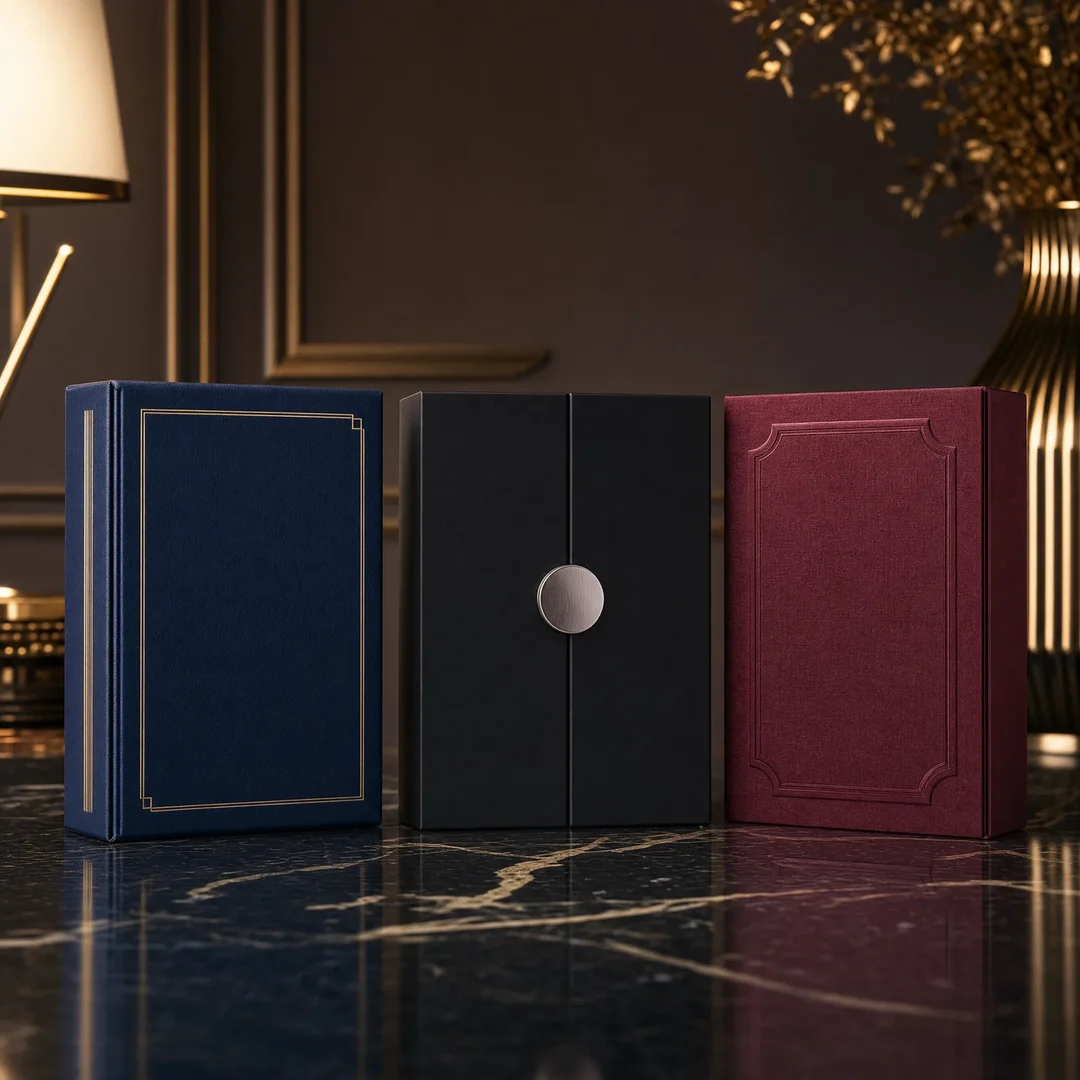
Case-bound hardcover is the default choice for almost all commercial pop-up books. The rigid grey board cover protects the interior mechanisms from compression damage, and the hinge construction allows the book to open flat enough for the pop-ups to deploy fully—typically 170 to 180 degrees. The endpapers that connect the cover to the book block are usually 140 gsm to 157 gsm coated paper, chosen to withstand the repeated flexing at the hinge without tearing.
Board book (self-cover) binding is an alternative for very young children’s titles where every page—including the cover—is the same laminated C1S thickness. This format is less common for pop-ups because the stiff, non-hinged spine limits how flat the book opens, which can prevent mechanisms from reaching their designed position. It works best for books with only one or two simple pop-up spreads and a target age under 3.
Which finishing techniques add value to pop-up book covers?
Foil stamping applies a metallic or pigment foil to the cover surface using a heated die, creating a reflective, premium highlight on the title or key artwork. It is the most common cover upgrade for pop-up books because the visual impact is immediate and the per-unit cost at quantity is modest—roughly USD 0.15 to USD 0.40 per cover depending on the foil area.
Spot UV coating applies a high-gloss varnish to selected areas of the cover, creating a contrast between shiny and matte surfaces. This technique works well for making illustration details pop against a matte laminated background. Embossing and debossing add tactile texture by pressing the board from behind or in front to raise or recess design elements. These techniques are often combined—for example, foil stamping a title and then embossing it so the letters are both shiny and raised.
Prototyping and the Sampling Workflow
No one gets a pop-up book right in the first round of files. The gap between a flat dieline on a screen and a functioning three-dimensional spread is large enough that prototyping is not optional—it is a required stage in the production timeline.
What is a white dummy and why does it matter?
A white dummy is an unprinted prototype assembled from the actual board stock that will be used in production. There is no artwork—just blank white board—but every mechanism is die-cut, folded, and glued exactly as the final book will be. The purpose is purely structural: does every mechanism open smoothly? Do the fold lines hit the right positions? Does the book close flat without crushing any elements? Does anything catch or tear?
White dummies cost roughly USD 150 to USD 400 per spread to produce, depending on die complexity. That may sound steep for an unprinted prototype, but catching a mechanism failure at this stage costs a fraction of what it costs to fix after 5,000 copies have been printed and assembled. Most experienced publishers budget for one to two rounds of white dummy revisions before approving the final structure.
How do printed prototypes fit into the timeline?
Once the white dummy is approved, the factory produces a printed prototype—sometimes called an advance copy or color proof—that combines the final artwork with the validated mechanism construction. This is the last checkpoint before the full production run begins. The printed prototype lets you verify color accuracy, check that artwork aligns correctly with die-cut edges, and confirm that the fully finished book looks and feels the way you intended.
Producing the printed prototype typically takes 7 to 14 days after white dummy approval. The full production run then takes 30 to 45 days from prototype sign-off, depending on the number of spreads, mechanism complexity, and current factory workload.
Frequently Asked Questions About Pop-Up Book Printing
Can I self-publish a pop-up book through a Chinese manufacturer?
Yes. Many self-publishers and independent creators produce pop-up books through Chinese manufacturers. You will need to provide the completed artwork and mechanism design files with dielines. If you do not have a paper engineer, some factories offer in-house paper engineering services, though this adds to both cost and timeline. Expect to budget 4 to 8 weeks for mechanism development if starting from a concept rather than finished files.
How long does the full production cycle take?
From finalized design files to delivery at a warehouse, plan on 10 to 14 weeks. This breaks down roughly as: 2 to 4 weeks for white dummy production and review, 1 to 2 weeks for the printed prototype, 4 to 6 weeks for mass production and assembly, and 2 to 4 weeks for ocean freight to major Western ports. Air freight can cut shipping to 5 to 7 days but multiplies the freight cost by roughly three to five times.
What file formats do factories need for pop-up dielines?
Most manufacturers accept Adobe Illustrator (.ai) or PDF files with the dieline on a separate clearly labeled layer. Each mechanism piece needs to be on its own artboard or page, with cut lines, crease lines, and glue zones marked in distinct colors—typically red for cut, blue for crease, and green for glue area. Providing properly layered files reduces pre-press time and minimizes the risk of misinterpretation.
Are pop-up books from China compliant with international safety standards?
Reputable manufacturers maintain material supply chains that comply with EN71 and ASTM F963 as standard practice. However, compliance is not automatic across all factories. You should request the specific test reports for the materials being used in your project. If your book carries a brand that will be sold through major retailers, budget for independent third-party testing through a lab like SGS, Intertek, or Bureau Veritas, which typically costs USD 300 to USD 800 per test standard.
Can I mix pop-up spreads with regular printed pages?
Yes, and this is a common strategy to control costs while still delivering an interactive experience. A book might have six spreads total, with three containing pop-up mechanisms and three being standard printed pages. The binding remains the same throughout, and the non-pop spreads use lighter paper stock—typically 157 gsm to 200 gsm coated paper—which reduces both material cost and weight. The sequencing of pop-up and non-pop spreads needs to account for the different thicknesses so the book block remains even when closed.