Your Guide to Getting Custom Cards Printed in China — Without the Guesswork
You have artwork ready, a card game idea that keeps you up at night, or a brand that needs a tactile product customers will actually hold onto. What you do not have is clarity on where to start with manufacturing. That is completely normal. The world of card printing mixes paper science, finishing chemistry, and packaging engineering into a process that can feel overwhelming the first time around.
Here is the short version: China has spent decades building the most complete card printing supply chain on the planet. From raw paper mills to die-cutting workshops to foil-stamping specialists, the entire ecosystem sits within a few hundred kilometers. This guide walks you through every decision you will face — paper types, core materials, surface finishes, corner punching, foil stamping, packaging, and minimum order quantities — so you can approach your printing project with confidence instead of confusion.
Playing Cards, Trading Cards, and Game Cards — Three Different Worlds
People toss these terms around as if they are interchangeable. They are not. Each category has its own audience, its own tactile expectations, and its own production requirements. Getting the category right before you spec anything else saves you from expensive reprints.
What Exactly Are Playing Cards?
Playing cards are the classic 52-card deck you see in poker rooms, magic performances, and family game nights. Standard sizes are poker (2.5″ × 3.5″) and bridge (2.25″ × 3.5″), and the expectation is simple: these cards must shuffle smoothly, fan evenly, and survive thousands of deals without dog-earing. The feel is everything. A playing card that sticks to its neighbor mid-shuffle ruins the experience instantly.
What Makes Trading Cards Different?
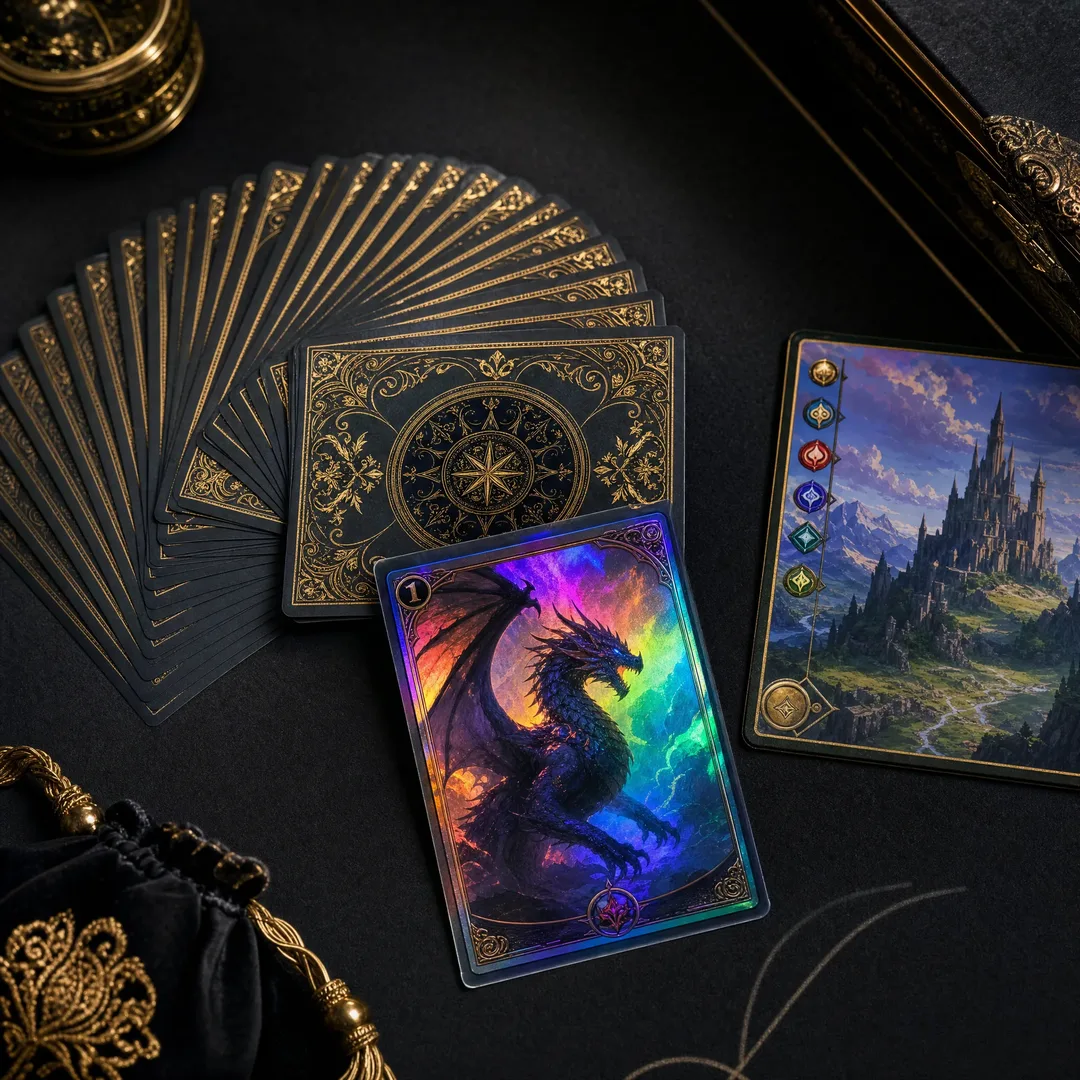
Trading cards — also called TCGs (Trading Card Games) or CCGs (Collectible Card Games) — are built for a different purpose entirely. Think Magic: The Gathering, Pokémon, or Yu-Gi-Oh!. These cards are collected, sleeved, traded, and occasionally graded for resale value. The surface must hold crisp, saturated artwork. Rarity tiers often call for specialty treatments like holographic foil, cold foil, or spot UV on individual cards within the same set. A TCG card that looks washed out under sleeve lighting has failed, regardless of how well it shuffles.
Where Do Game Cards Fit?
Game cards live inside board game boxes. They are the action cards, resource cards, event cards, and character cards that drive tabletop gameplay. Unlike standalone decks, game cards are one component among many — alongside boards, tokens, dice, and miniatures. They need to be durable enough for repeated handling but do not usually require the premium hand-feel of a casino deck or the collectible sheen of a rare TCG card. Cost efficiency often matters more here, because the card set is part of a larger bill of materials.
How the Three Categories Compare Side by Side
The table below captures the most important distinctions at a glance. Keep it handy when you brief a printer — it helps them understand your priorities immediately.
Playing Cards: Poker or bridge size, 52–54 cards per deck. Blue or black core paper at 280–330 gsm. Linen or smooth finish for shuffle performance. Tuck box packaging. Tactile handling feel is the top priority.Trading Cards: Standard TCG size (2.5″ × 3.5″), variable set sizes. Black core 310–330 gsm or thicker. Glossy, holographic, or foil-accented surfaces. Booster boxes or collector tins. Artwork fidelity and rarity effects are paramount.Game Cards: Custom sizes common, quantity varies by game design. Blue core 280–300 gsm or C2S art paper. Matte or gloss lamination. Packaged inside the game box. Durability and cost balance lead the brief.
Paper and Core Selection
The paper you choose determines how your cards feel, how long they last, and whether anyone can see through them when held up to a light. This is not a cosmetic decision — it is a structural one. Card stock is typically measured in GSM (grams per square meter), with higher numbers meaning thicker, heavier cards. Most playing and trading cards land between 280 and 350 gsm, though specialty stocks push beyond that range.
Blue Core Cardstock — The Industry Workhorse
If you have ever riffled through a standard deck of Bicycle cards, you have handled blue core stock. The name comes from the thin blue adhesive layer sandwiched between the front and back paper layers. This blue middle is not just decorative — it blocks light transmission, so opponents cannot read your cards by holding them up to a window. Blue core typically runs 280–300 gsm and delivers solid shuffle performance at a reasonable price point. For most playing card projects and board game cards, blue core is the default choice for good reason: it works, it is affordable, and every factory in China knows how to print on it.
Black Core Cardstock — Casino-Grade Performance
Black core stock uses a dark adhesive layer that provides even better opacity than blue core. Casino-grade cards almost always use black core, and for the same reason — zero transparency under any lighting condition. The weight range starts at 310 gsm and goes up to 330 gsm or higher, giving these cards a more substantial, premium feel in the hand. Black core also tends to be stiffer, which improves snapping and spring-back during shuffles. If your product competes in a market where perceived quality determines whether someone buys or scrolls past, black core is worth the incremental cost. The difference is immediate — anyone who touches a black core card next to a standard stock card can tell which is the higher-end product.
PVC and Plastic Cards — When Water Resistance Matters
Some use cases demand cards that survive poolside splashes, bar counter condensation, or toddlers who explore the world with their mouths. Paper, even the best paper, has limits. PVC cards at 0.3–0.4 mm thickness are fully waterproof, tear-resistant, and can be wiped clean with a damp cloth. The trade-offs are real: PVC cards do not have the same snap and shuffle feel as paper, and they cost more per unit. But for outdoor games, kids’ products, bar promotions, or any environment where liquid damage is a genuine risk, plastic cards earn their premium. They can also be printed with vibrant, scratch-resistant graphics that hold up through years of abuse.
Surface Finishes That Define the Experience
Surface finish is where functional printing crosses into sensory design. The right finish changes how a card slides across a table, how it resists fingerprints, and how the artwork reads under different lighting conditions. The wrong finish can make gorgeous artwork look flat, or make a perfectly good deck stick together like a brick. Here are the main options and when to choose each one.
Glossy Finish — Bright, Bold, and Reflective
Gloss lamination or gloss varnish creates a shiny, reflective surface that makes colors jump off the card. Artwork with high contrast and saturated palettes benefits most from gloss treatment. The downside is glare — under bright overhead lights or direct sunlight, glossy cards can be harder to read. They also show fingerprints more readily. For trading cards meant to live inside protective sleeves, gloss is often the right call, because the sleeve mitigates the glare while the gloss amplifies the visual pop.
Matte Finish — Understated and Readable
Matte lamination produces a smooth, non-reflective surface that eliminates glare entirely. Cards feel soft to the touch and text stays readable from any angle. The trade-off is slightly less color vibrancy compared to gloss, and some people find matte cards harder to shuffle because they lack the slick glide of a gloss-coated deck. Game cards that carry a lot of text — rule cards, reference cards, ability descriptions — are prime candidates for matte treatment, because readability trumps flash.
Linen Finish — The Premium Tactile Standard
Linen finish (also called air-cushion finish or embossed texture) is the gold standard for high-end playing cards. A textured pattern is pressed into the card surface using metal rollers, creating microscopic peaks and valleys that trap tiny pockets of air. The result: cards slide past each other with less friction, shuffle more smoothly, and resist sticking even in humid conditions. The texture also gives the deck a satisfying, professional feel that instantly signals quality. Most casino-grade decks and premium custom playing cards use linen or air-cushion finishes. If your project involves any kind of card handling performance — magic, cardistry, competitive poker — this finish is not optional.
Holographic Finish — Eye-Catching and Collectible
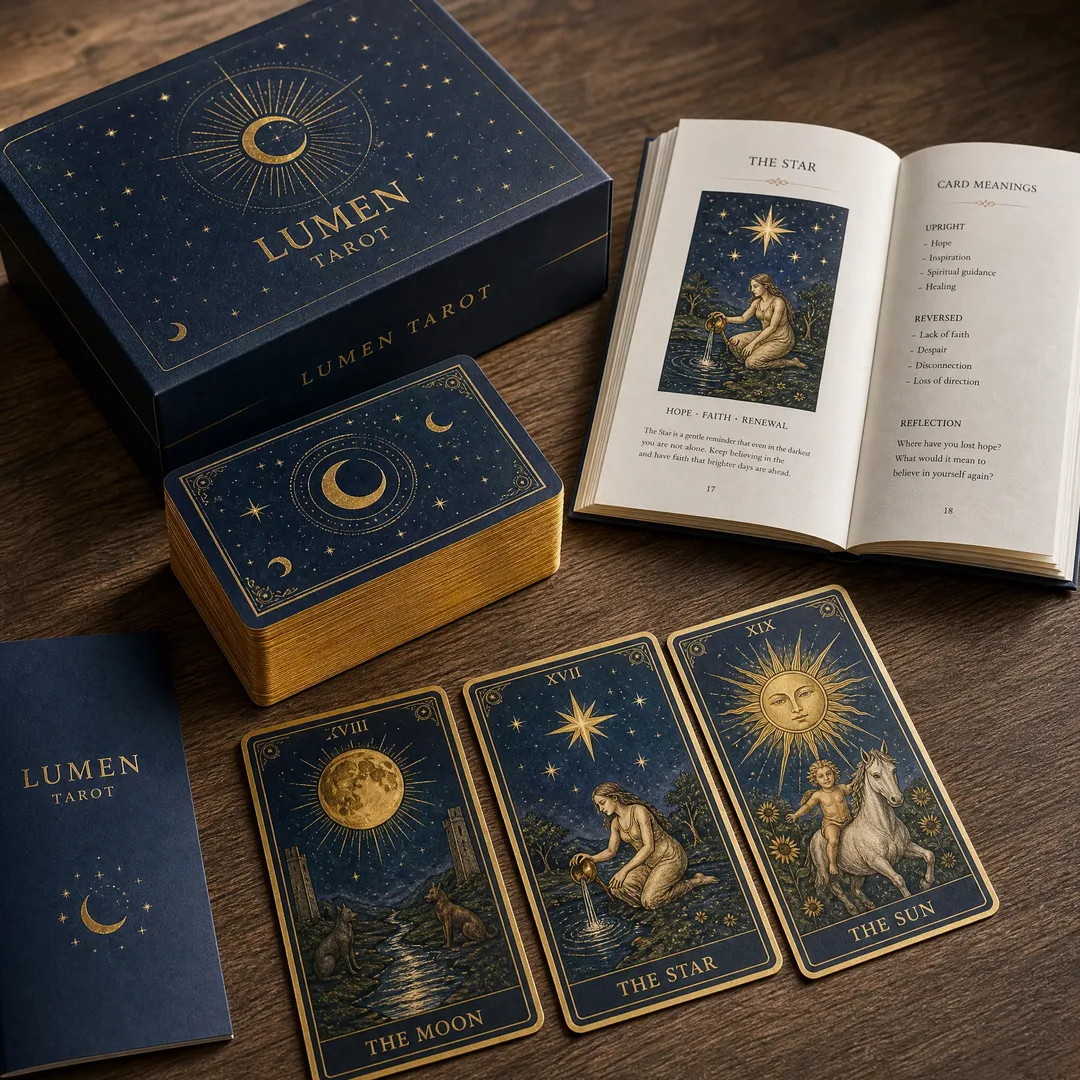
Holographic card stock has a metallic, light-bending surface that shifts colors as the card tilts. It is not a coating applied on top — the holographic effect is embedded in the paper itself, and CMYK printing goes on top of it. This creates a shimmering, dimensional look that is impossible to achieve with standard lamination. Holographic cards are most common in limited-edition TCG sets, collector’s boxes, and premium tarot decks where visual spectacle is part of the value proposition. The cost is higher and the effect is polarizing — some audiences love it, others find it distracting — but when it matches your brand, nothing else compares.
Corner Punching, Foil Stamping, and Box Packaging
Once the cards are printed and finished, three downstream processes determine how professional the final product looks and how well it sells on a shelf or in an unboxing video. These are not afterthoughts — they are part of the cost and lead-time conversation from day one.
Rounded Corner Punching — Small Detail, Big Impact
Every playing card and trading card you have ever handled has rounded corners. That is not an aesthetic choice — sharp corners catch on sleeves, chip easily, and stab fingers during shuffles. The standard corner radius is 3.5 mm, though some projects call for custom radii depending on card size and design preference. Corner punching happens after the printed sheets are cut into individual cards, using a die-cutting machine that rounds all four corners simultaneously. Quality control at this stage matters: inconsistent radius or rough edges signal amateur production. Ask your printer about their die maintenance schedule. Worn dies produce ragged cuts.
Hot Foil Stamping — Adding Metallic Prestige
Foil stamping applies a thin metallic film — gold, silver, copper, rose gold, or holographic foil — to specific areas of a card or its packaging. The process uses heat, pressure, and a custom metal die to bond the foil to the surface with precision. On cards, foil accents might highlight a title, a logo, or a rarity symbol. On tuck boxes, foil transforms an ordinary package into something people pick up and turn over in their hands. The catch: foil stamping requires a dedicated die for each design, which adds a one-time setup cost and extends lead time by several days. Small runs do not always justify it, but for mid-to-large orders, the perceived value increase usually outweighs the tooling expense.
Tuck Boxes and Rigid Boxes — Packaging That Sells
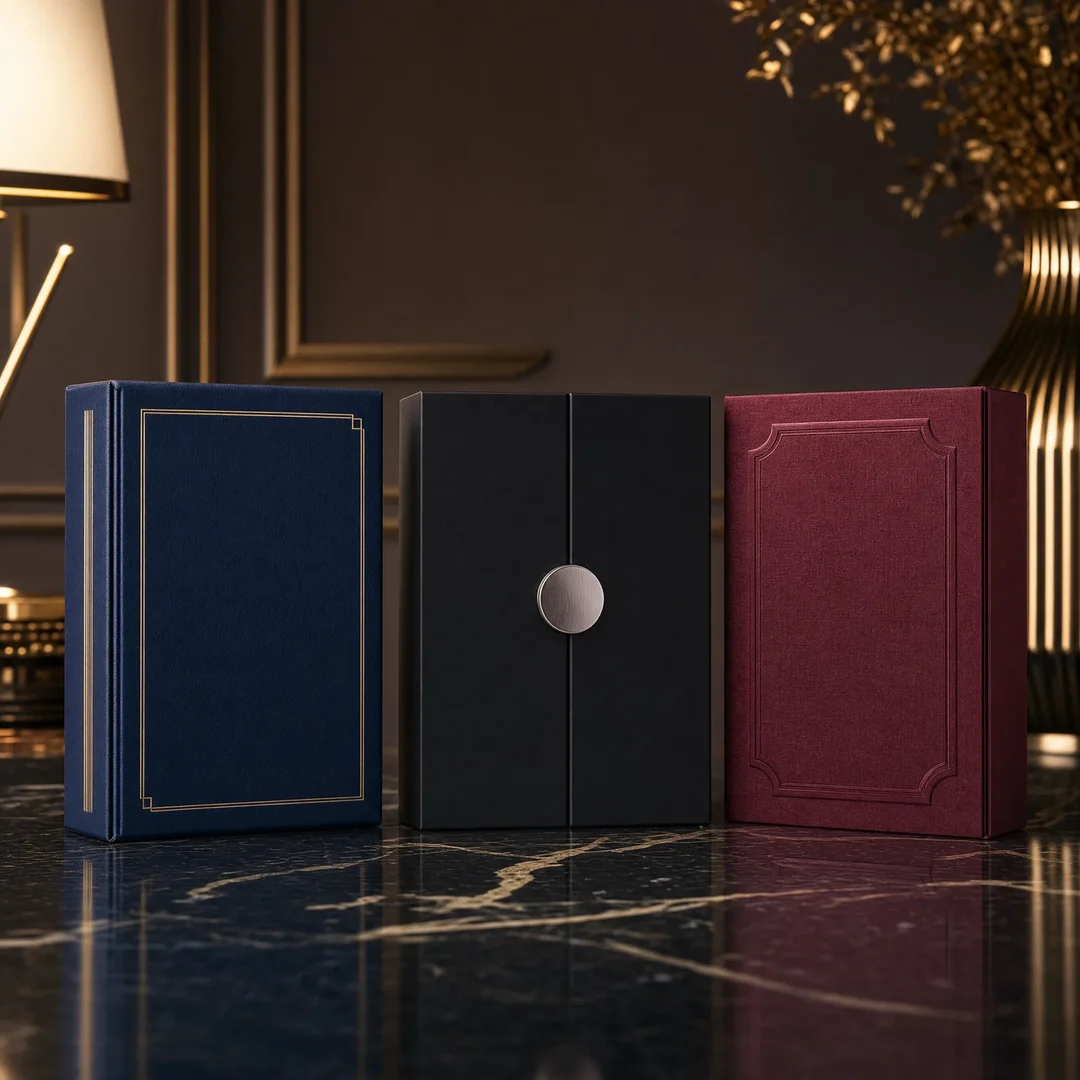
The box matters as much as the cards inside it. A standard tuck box — the familiar flap-closure box that holds a poker deck — is the most economical option and works well for most playing card projects. Printed on 300–350 gsm C1S or C2S paper with matte or gloss lamination, tuck boxes can also receive foil stamping, embossing, or spot UV for extra shelf appeal. For premium sets — deluxe tarot decks, collector’s edition TCGs, luxury playing card gift sets — a two-piece rigid box with magnetic closure creates an entirely different unboxing experience. Rigid boxes use 2–3 mm greyboard wrapped in printed paper or cloth, and they practically demand to be displayed rather than tucked away in a drawer. The cost difference is significant, but so is the perceived value.
MOQ and Production Realities
Minimum order quantity is the first number most buyers look at, and for good reason — it determines whether your project is feasible at your current scale. The good news is that Chinese card printers offer more flexibility than most newcomers expect.
What MOQ Should You Expect?
For offset-printed paper cards, the typical MOQ across Chinese factories is 500 decks. That is the point where the economics of plate-making, sheet setup, and production efficiency make sense for both buyer and printer. Digital printing has changed the game for smaller runs — many factories now accept orders as low as 100 decks, and some specialized short-run printers will do 50 or even fewer. The per-unit cost on digital runs is higher because you are not amortizing setup costs across thousands of units, but for prototypes, market tests, or niche indie projects, digital short-run printing is exactly what makes the project possible at all.
How MOQ Affects Unit Cost
The cost curve is steep at the low end and flattens dramatically as volume increases. A 500-deck order of standard poker cards with a tuck box might run $1.50–$2.50 per deck. Scale that to 2,000 decks and the unit price drops to $0.80–$1.50. At 5,000 decks or more, per-unit costs can fall below $0.70. Specialty treatments — foil stamping, holographic stock, rigid boxes, spot UV — add incremental costs that scale with complexity more than volume. The smart approach is to ask your printer for tiered quotes at 500, 1,000, 2,000, and 5,000 units so you can see exactly where the breakpoints fall for your specific specifications.
Why Source Card Printing from China
At this point you might wonder why so many independent creators, game publishers, and even established Western brands route their card production through China. The answer is not simply cost — though cost is certainly part of it. The deeper reasons explain why China has become the global hub for card manufacturing.
A Supply Chain That Has Evolved Over Decades
China’s card printing industry did not appear overnight. It grew alongside the country’s broader printing sector, which has been serving global publishing markets for more than thirty years. Today, specialized card printing clusters exist in Guangdong, Zhejiang, and Shanghai, where paper mills, coating facilities, die-making workshops, and finishing specialists operate within tight geographic proximity. A printer in Shenzhen or Ningbo can source blue core stock from a mill two hours away, have dies cut by a workshop across town, and send finished decks to a port that ships worldwide within a day. That density of suppliers means shorter turnaround times and fewer supply chain bottlenecks than fragmented markets.
Cost Efficiency Without Sacrificing Quality
The cost advantage is real and substantial — typically 30–60% below equivalent Western production — but it comes from structural factors rather than corners cut. Labor rates in China’s manufacturing sector remain lower than in North America or Europe, though the gap has narrowed over the past decade. More importantly, the volume of card production flowing through Chinese factories means equipment, materials, and expertise are amortized across thousands of projects. A Heidelberg or Komori offset press running card projects daily produces better results at lower cost than the same press running occasional card jobs in a general commercial print shop. Add to that the fact that many Chinese printers have invested in the latest generation of equipment — UV coaters, automatic die-cutters, digital foil stamping machines — and the quality equation tilts further in their favor.
Flexibility and Customization Depth
Western print shops often treat card projects as niche deviations from their core business. Chinese card printers treat them as the core business. That difference shows up in the range of options available: blue core, black core, PVC, holographic, foil, linen, spot UV, gilded edges, custom-shaped cards, specialty tuck boxes, rigid magnetic boxes — a comprehensive menu that a general commercial printer simply cannot match. The factories that specialize in cards have the tooling, the trained operators, and the quality control protocols calibrated specifically for card production. For a project that needs multiple finish types on the same sheet or complex packaging that integrates with the card set, this specialization matters.
Making Your Card Project Happen
By now you have a clear picture of the decisions ahead: which card category fits your project, what paper stock and core type to specify, which finish will give you the feel and look you want, whether foil stamping and rigid packaging justify their cost for your market, and what MOQ tier your budget can support. The remaining step is execution.
Start by preparing print-ready artwork files with proper bleed (typically 3 mm beyond trim), CMYK color mode, and at least 300 DPI resolution at actual size. Request physical samples from printers before committing to a production run — a digital proof on screen cannot tell you how the linen texture feels under your thumb or whether the black core truly blocks light. Build lead time into your project plan: standard production runs 15–25 working days, with an additional 5–10 days for sea freight or 3–7 days for air courier delivery, depending on your location.
Ask specific questions when you request quotes. Instead of “How much for 1,000 decks?”, try: “Can you quote 1,000 poker-size decks on 310 gsm black core with linen finish, standard 3.5 mm rounded corners, a matte-laminated tuck box, and gold foil stamping on the box logo, shipped DDP to Austin, Texas?” The more detail you provide upfront, the more accurate and comparable your quotes will be.
The card printing industry in China has matured to the point where small indie creators and large established publishers can access the same production quality. The difference between a smooth project and a stressful one comes down to knowing what to ask for — and now you do.