Why Music Publishers Are Printing Scores in China
Walk through any conservatory library and pull a stack of scores off the shelf. The Henle Urtext editions have a specific weight—the cover opens without resistance, the paper reflects just enough light without glare, and the staff lines stay crisp even in the footnotes where the font drops to 6pt.
Every detail you notice, and every one you don’t, was decided by someone on the production side. Music score printing is not the same as book printing. It is not even the same as illustrated book printing. It sits at an awkward intersection of fine-art reproduction, industrial binding, and user experience governed by the physical demands of a performer.
Someone who needs the book to stay open on a music stand while playing with both hands. Who will mark articulation changes in pencil and erase them three rehearsals later. Who will toss the part into a gig bag and pull it out weeks later expecting the pages to still turn cleanly.
Chinese printing factories have spent the last decade building specialized departments for exactly these requirements. Publishers from Germany, Japan, and the United States now route substantial portions of their catalog through Guangdong and Zhejiang. The cost advantage draws them in. The quality keeps them there.
But getting music score printing right from a Chinese supplier is not just uploading a PDF and waiting for a box to arrive. It demands understanding of trim sizes, paper behavior, binding physics, and prepress specificity that general book printing never has to worry about. This guide covers what you need to know.
Trim Sizes and Paper Selection for Music Scores
Standard Trim Sizes for Scores and Parts
If you have ever held a full orchestral score next to a piano reduction, you know music publishing uses a family of trim sizes rather than one standard. The Major Orchestra Librarians’ Association (MOLA) publishes guidelines that most professional publishers follow.
Full scores—the conductor’s copy with every instrument on every system—come in three standard sizes:
9×12 inches (229×305 mm) — The de facto standard for most new publications. Fits on a standard music stand and prints on 12×18 parent sheets for saddle-stitched construction.10×13 inches (254×330 mm) — Used when larger notation is needed.11×14 inches (279×356 mm) — Rare, requires oversized presses.
Octavo-sized scores at 7.25×10.25 inches (184×260 mm) serve the choral market, where reduced page count and compact format matter more than staff size. Instrumental parts typically land at 9×12 inches for large ensembles and 8.5×11 inches (216×279 mm) for smaller groups.
European publishers often default to B4 (250×353 mm) for parts, while A4 (210×297 mm) is common for smaller scores in Asian and European markets. Chinese printers stock all of these as standard because they service a global client base.
Need custom dimensions? A landscape-format score, a square piano book, or an oversized conductor’s score that opens to 17×22 inches—most medium and large Chinese factories can accommodate without a premium beyond material waste. The real limiting factor is the binding line: if your custom size exceeds the maximum throat size of the Wire-O or coil binding machine, you’ll need to switch methods or find a supplier with larger equipment.
Paper Weight and Type: What Musicians Actually Need
The paper inside a music score does more than hold ink. It needs to resist show-through—the ghost of notes printed on the reverse side bleeding through when backlit on a music stand. It needs enough opacity that a pianist can read measure 64 on the recto without the verso’s dense chord clusters distracting their eye.
It needs enough body to stand upright on a music stand without curling forward, but enough flexibility that page turns happen with a single swift motion rather than a two-handed wrestling match.
Chinese printers serving the music publishing market offer uncoated woodfree paper from 80 gsm to 140 gsm. Here’s what each weight actually means for musicians:
80 gsm — Acceptable for instrumental parts that are replaced frequently. Orchestra librarians sometimes prefer lighter parts because the weight difference across a 60-page violin part versus a 6-page timpani part is noticeable.100 gsm — The floor for any score intended to be kept, sold, or used for more than one season. At 90–94 ISO brightness and 92%+ opacity, you get a readable page without excess thickness.120 gsm — Noticeably more substantial. Ideal for piano scores that receive heavy use, library reference copies, and editions where the publisher cares about hand-feel.
The German Urtext publishers—Henle, Bärenreiter, Wiener Urtext—print on cream-tinted uncoated papers around 100–110 gsm with a slight tooth that holds pencil markings without smudging. Chinese mills produce stock that matches these specifications.
For covers, 250–300 gsm coated or uncoated card stock laminated with gloss or matte film provides the stiffness and durability scores need. A 9×12 score with 100 gsm interior and 300 gsm matte-laminated cover feels like a professional publication. Skip the cover lamination on a score that gets daily use, and the corners will be dog-eared within a month.
Binding Options for Music Scores
Wire-O Binding: The Musician’s Choice for Lay-Flat Performance
Ask any pianist, organist, or conductor what they actually want from a score binding, and the answer is the same: it must lie completely flat. Not “fairly flat when you press down on the spine.” Not “mostly flat after you break it in.” Completely flat.
The musician’s hands are occupied. They cannot hold a page open with one hand while the other plays. They cannot stop mid-phrase to force a stubborn score to cooperate.
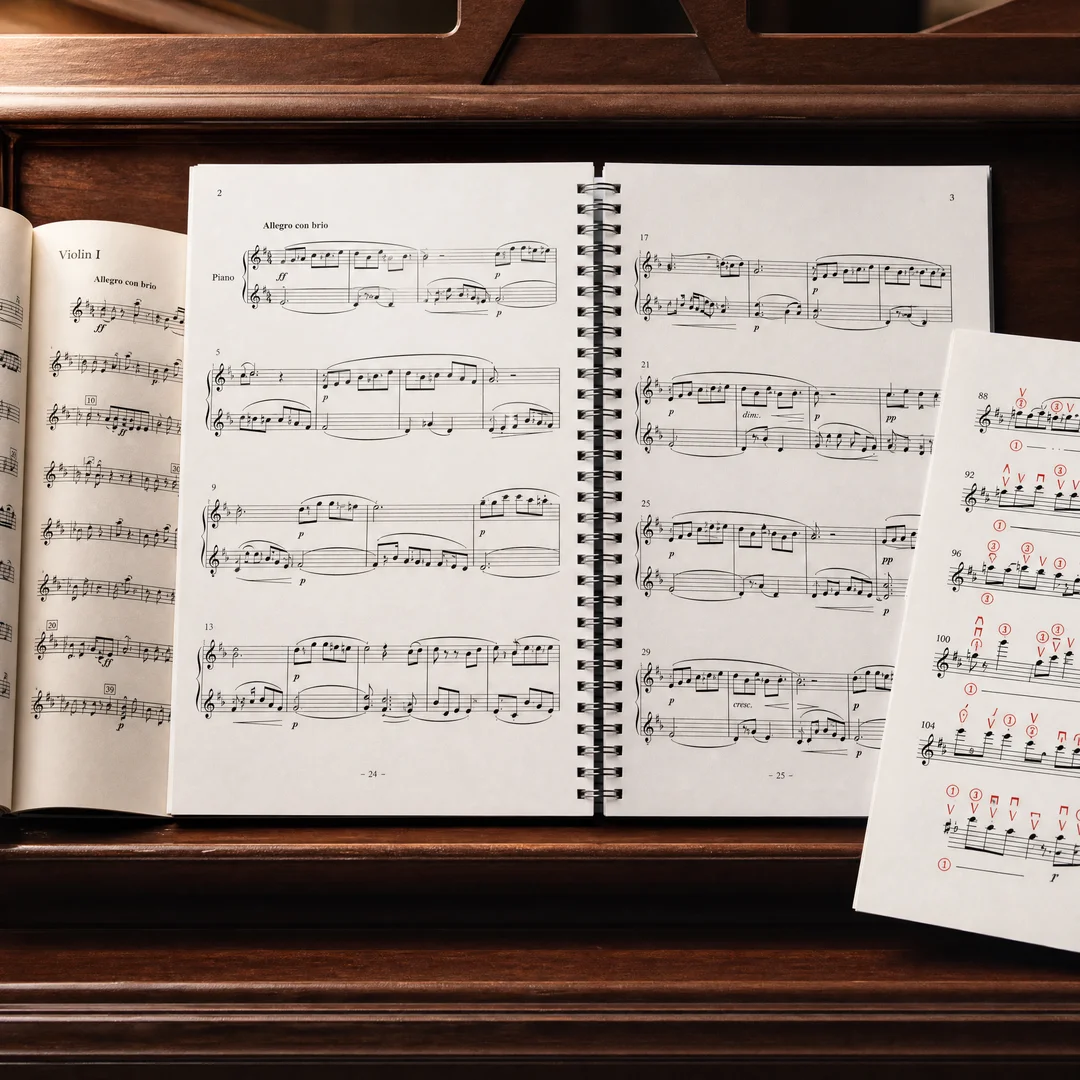
Wire-O binding—also called twin-loop or double-O binding—is the most reliable solution. It uses a continuous double-loop wire threaded through punched holes along the binding edge. Every page rotates 360 degrees around the binding axis. Open it on a music stand and it stays on the exact page you set. Fold it all the way back and it sits flat without damaging the spine.
This is not a luxury feature. For scores used in performance, it is table stakes.
Chinese Wire-O manufacturers offer wire diameters from 3/16 inch (5 mm) to 1 1/4 inch (32 mm), handling page counts from 20 to 350+. Wire comes in black, white, silver, and occasionally bronze or custom colors. The standard 3:1 pitch (three holes per inch) works for sheets up to about 120 pages; for thicker books, 2:1 pitch with larger wire handles the additional bulk.
Cost: roughly $0.40–$0.80 per book at 500–1,000 units, dropping to $0.25–$0.50 at 5,000+. Compare this to US or European binders charging $2–$5 per book for the same operation.
Practical constraints: the wire loops add about 3–4 mm of protrusion from the spine, so stacked Wire-O scores take more shelf width. The wire can deform if dropped on its spine. And because pages separate completely at the binding edge, Wire-O books cannot be printed as standard signatures—every page is a single leaf. Your supplier’s prepress team handles this automatically if you specify the binding type upfront. Switch to Wire-O at the proof stage, and someone will need to redo the imposition. That costs time and money.
Other Binding Methods and When to Use Them
Saddle stitching—two or three staples through the spine fold—is the standard for thin scores and instrumental parts up to about 64 pages. It is the least expensive method ($0.10–$0.30 per unit), produces a lightweight book, and the fold at the spine means pages lie reasonably flat. For individual parts—a 4-page flute part or a 12-page viola part—saddle stitching is the right answer.
Perfect binding produces a square spine that can display the title and publisher name. This matters for retail shelf presence. A perfect-bound score with a printed spine can be identified at a glance in a sheet music store. The trade-off: the glued spine resists staying open, and aggressive use cracks the glue.
Some publishers combine perfect binding with a softcover lay-flat construction—the cover is scored and creased parallel to the spine so the book can open flat without damaging the glue joint. Chinese suppliers skilled in photo book printing often excel at this technique.
Spiral binding (plastic coil) is Wire-O’s cheaper cousin. The plastic coil costs about half as much and comes in more colors, but coil spacing is less precise—pages can catch and snag during turns. For practice-room scores where cost matters more than longevity, spiral works. For a published edition you expect to sell through retailers, Wire-O or saddle stitching communicates higher production values.
Hardcover binding serves special editions, complete-works volumes, and library copies. It adds $2–$4 per unit at quantities above 500 and pushes lead times by 7–10 days, but the archival stability justifies it for reference copies and premium product lines.
Staff Precision and Notation Quality
What Resolution and Accuracy Standards Mean for Sheet Music
A misprinted word in a novel is annoying. A misprinted note in a score is a disaster—one fat fingering mark mistaken for a sharp sign, one ledger line that blends into the staff line below it, and a musician plays the wrong pitch in front of two thousand people.
Music score printing demands precision that falls between commercial offset and fine-art reproduction. The staff—five parallel lines forming the foundation of Western notation—needs to be printed at consistent weight with perfectly parallel lines. A staff printed at 0.12 mm line weight with a tolerance of ±0.01 mm is normal. A staff that varies from 0.11 mm to 0.14 mm within the same system is noticeable.
Chinese music score printing relies on offset lithography for the vast majority of production. Heidelberg or Komori presses running at 2,400–2,540 DPI plate resolution at 175–200 LPI screen ruling produce notation sharp under magnification and free of the microscopic fuzz that laser or digital presses leave around fine lines.
The variable comes from prepress, not press hardware. If the engraving file—typically exported from Sibelius, Dorico, Finale, or LilyPond—is exported at low resolution or with improper font embedding, the print will be soft regardless of press quality.
Experienced Chinese prepress teams know to check: that notation fonts (Maestro, Opus, Bravura) are embedded; that staff line weights are consistent across the file; that hairpins haven’t broken across system breaks; and that page imposition accounts for the binding method’s gutter loss. Teams that don’t specialize in music printing will miss these things. Ask your supplier how many music score titles they printed last year.
Two-Color Printing for Music Scores
Most sheet music is black ink on white or cream paper. But some editions use a second color—historically red, occasionally blue or green—for editorial markings, fingering suggestions, and phrase annotations. In German Urtext editions, composer’s original markings appear in black while editorial additions appear in gray.
In pedagogical editions like Suzuki or Alfred’s instructional series, finger numbers and bow markings often appear in red or blue. Two-color printing in music scores is not a design flourish; it is a functional communication layer.
Chinese offset printers handle two-color work in two ways:
Dedicated two-unit press run — Paper passes through the first unit for black and immediately through the second for the spot color. Both plates are registered to tight tolerances. This produces clean, sharp output with no registration drift. Adds roughly 15–25% to the printing cost.Two-pass approach — Black printed on one run, spot color on a second after sheets have dried. Saves setup costs but introduces registration risk of ±0.5 mm or more—visible on hair-thin staff lines. Adds 25–40% due to extra handling.
The key prepress requirement: the spot color layer must be a separate page in your PDF, clearly labeled with the Pantone or CMYK value, and registered to the exact dimensions of the black plate. Missing registration marks on the spot color layer is the most common cause of two-color music score rejects at the proof stage.
Small Batch Music Score Printing: When You Need 100 Copies
The classic music publishing model requires thousands of copies to amortize offset setup costs. But the market has shifted. Independent composers self-publish. University music departments print editions for their ensembles. Small specialty publishers serve niche repertoires where the audience numbers in the hundreds, not thousands.
Chinese factories have adapted. Custom music score printing with low minimums is now a standard service rather than a specialty request.
Digital printing bridges the gap for runs under 300 copies. High-end digital presses using toner or inkjet technology now produce output nearly indistinguishable from offset for black-and-white scores at standard reading distance. Staff lines are clean, solids are dense, and paper handling is consistent.
The cost structure flips between digital and offset around 300–500 copies:
Below 300 copies — Digital wins. No plate cost, no makeready time, no minimum press sheet waste. A 100-copy run of a 32-page saddle-stitched 9×12 score runs roughly $4–$7 per book landed.Above 500 copies — Offset becomes cheaper per unit as setup costs spread across more sheets. The breakeven depends on page count, color, and binding, but 500 is the rough pivot point.
For two-color scores, the digital-to-offset breakeven shifts higher—800 to 1,000 copies—because digital two-color printing is less common and often requires specialty equipment.
Cost Breakdown and MOQ for Music Score Printing from China
Here is a realistic cost range for a standard spec: 48-page score, 9×12 inches, 100 gsm uncoated interior, 300 gsm matte-laminated cover, Wire-O binding, single-color black.
500 copies: $3.50–$6.00 per unit FOB China2,000 copies: $2.00–$3.50 per unit (fixed costs spread thinner)100 copies (digital POD): $4.50–$8.00 per unit
Cost breakdown: roughly 40% printing and paper, 25% binding, 20% cover and lamination, 10% prepress and proofing, 5% packing.
Freight adds $0.80–$2.00 per book depending on weight and destination. Air freight lands books in 5–10 days but doubles logistics cost. Sea freight takes 25–40 days and is the standard for production runs.
MOQ guidelines from Chinese music score printers:
Offset single-color: 200–500 copies
Wire-O binding: 300–500 copies (setup cost worth ~200 books just to thread)
Digital POD with saddle/perfect binding: 100 copies
Two-color offset: 500 copies minimum
Pro tip: batch multiple titles or parts books into a single manufacturing run. A publisher printing three 40-page scores and six 8-page instrumental parts as separate saddle-stitched booklets can combine them into one production order, share prepress costs, fill a pallet efficiently, and negotiate a lower unit price across every SKU.
File Preparation and Prepress for Music Scores
The files you send to a Chinese music score printer determine final quality far more than the press hardware. Start with print-ready PDF files—not notation software project files.
Export directly from your notation software (Sibelius, Dorico, Finale, MuseScore, LilyPond) to PDF with:
All fonts embedded
Final trim size, no scaling
At least 0.125 inches (3 mm) of bleed on all sides
1,200 DPI output resolution (minimum 600 DPI—300 DPI produces visibly soft staff lines)
The bleed is not optional. If your score has a full-bleed cover or a staff system running too close to the page edge, the trim blade will expose an unprinted sliver of white that screams “self-published.”
For two-color scores, export the black plate and spot color plate as separate pages in the same PDF. Label the file clearly, and include color swatches with specified Pantone or CMYK values on the first page of the spot color section.
The cover file should be a separate PDF from the interior. Include the spine width calculation if using perfect binding. For Wire-O binding, leave 10–12 mm of clear margin on the bound side—punched holes and wire loops will obscure anything in that zone.
Submit a written specification sheet alongside the PDFs. The more explicit your spec sheet, the fewer rounds of clarification emails delay your proof.
Frequently Asked Questions
What trim size should I use for a piano score?
9×12 inches is the industry standard. It provides enough page real estate for two grand staves per system on most compositions, fits any standard music stand, and is compatible with Wire-O binding at all common wire diameters. Dense repertoire like Chopin études benefits from 10×13, but 9×12 handles the vast majority of piano music comfortably.
How do I ensure my Chinese printer gets staff line quality right?
Send a physical sample of a published score whose quality you want to match. Written specs are helpful, but the sample tells the prepress team what their eyes should see. Request a printed proof on the actual production paper stock before signing off. Do not accept a digital PDF proof as final—paper absorbs ink differently, and what looks sharp on a monitor can look soft or filled-in on uncoated stock.
What is the minimum order for Wire-O-bound scores?
Most Chinese printers set MOQ at 300–500 copies for Wire-O due to binding machine setup time. Below 300, some suppliers accommodate at a higher per-unit cost. At 50–100 copies, digital POD with saddle stitching or perfect binding is usually more practical unless lay-flat opening is specifically required.
Can I print a music score with both black notation and red editorial markings?
Yes. Two-color offset printing is standard at Chinese music score printers. Provide the spot color as a separate PDF layer, specify the exact Pantone or CMYK value, and expect a 15–25% cost premium. At digital POD quantities, two-color printing is harder to arrange and may require switching to offset at a higher minimum.
How long does music score printing take from a Chinese supplier?
Standard production lead time is 15–25 business days from proof approval to FOB. Add 5–7 days for proof preparation and courier delivery. Add shipping: 25–40 days by sea, 5–10 days by air. A realistic end-to-end timeline is 8–10 weeks by sea, 4–6 weeks by air. Rush production (7–10 days) is available at roughly 30–50% surcharge, but physical drying, binding, and curing processes cannot be safely accelerated beyond their material limits.
Getting the Score Right
Music score printing from China succeeds or fails on preparation. A publisher who sends clean PDFs with explicit specs, requests a physical proof on production stock, and works with a supplier that regularly prints music scores will get a product that matches or exceeds domestic printers—at roughly 40–60% of the cost.
The publisher who treats it like a general book printing job, submits a single flattened PDF with no bleed, and never asks about staff line tolerances will open boxes of disappointment six weeks later.
The gap between those two outcomes is not luck. It is a spec sheet, a proof round, and a supplier conversation. Get those three things right, and your scores will do exactly what they are supposed to do: lie flat on the stand, stay sharp under the baton, and render every note exactly as the composer wrote it.