Why Smart Brands Source Card Printing from China
Walk into a boutique stationery store, browse the top-selling greeting card listings on Etsy, or flip through a funeral home’s memorial card catalog, and you are looking at products that were very likely printed in China. This is not speculation — it is the reality of an industry where Chinese printing factories have spent decades perfecting card manufacturing at a cost base that domestic printers in North America and Europe cannot match.
The numbers illustrate the point. A custom greeting card that costs USD 1.50 to print domestically in a run of 500 units might cost USD 0.40 to USD 0.60 from a Chinese factory, with comparable or better finishing. For note cards, prayer cards, and scratch-off products, the margin is similar. But cost is only part of the story. What draws stationery brands, Etsy sellers, church suppliers, and event organizers to card printing china factories is the depth of finishing options — foil stamping, embossing, spot UV, textured lamination — that would be prohibitively expensive through a local commercial printer.
This guide covers five card categories, each with distinct material requirements, size conventions, and production economics. Whether you are launching a line of greeting cards, printing funeral prayer cards for a church, or producing promotional scratch-off cards for a retail campaign, you will find the specifications and practical advice needed to brief a factory and get accurate quotes.
Greeting Card Printing
Paper Stock, Sizes, and Envelope Pairing
The most common stock for greeting card printing is 300gsm to 350gsm coated art paper (C2S). It reproduces color beautifully, holds fine detail, and gives cards that crisp, professional snap. For a softer, more tactile feel, uncoated offset paper at 250gsm to 300gsm offers a warmer, more natural surface that takes writing well on the inside. Premium lines often use textured stocks — linen, felt, or laid finish — which add sensory appeal before anyone reads the message. Recycled and FSC-certified stocks are widely available from Chinese mills now, and more factories stock them as demand grows from eco-conscious brands.
The A7 size (5 × 7 inches folded) is the industry standard — it is what you see on every drugstore card rack and fits standard A7 envelopes. The A6 size (4.5 × 6.25 inches folded) works well for invitations and shorter messages. Square formats like 5 × 5 and 6 × 6 inches have grown in popularity for art-forward designs, though they require slightly pricier square envelopes. Envelope pairing is straightforward: match A7 cards with A7 envelopes, A6 with A6, and square cards with square-flap envelopes about 0.25 inches larger than the card. Most greeting card printing china factories offer envelope printing as part of the package, and it is almost always cheaper than sourcing envelopes separately.
Surface Finishing Options
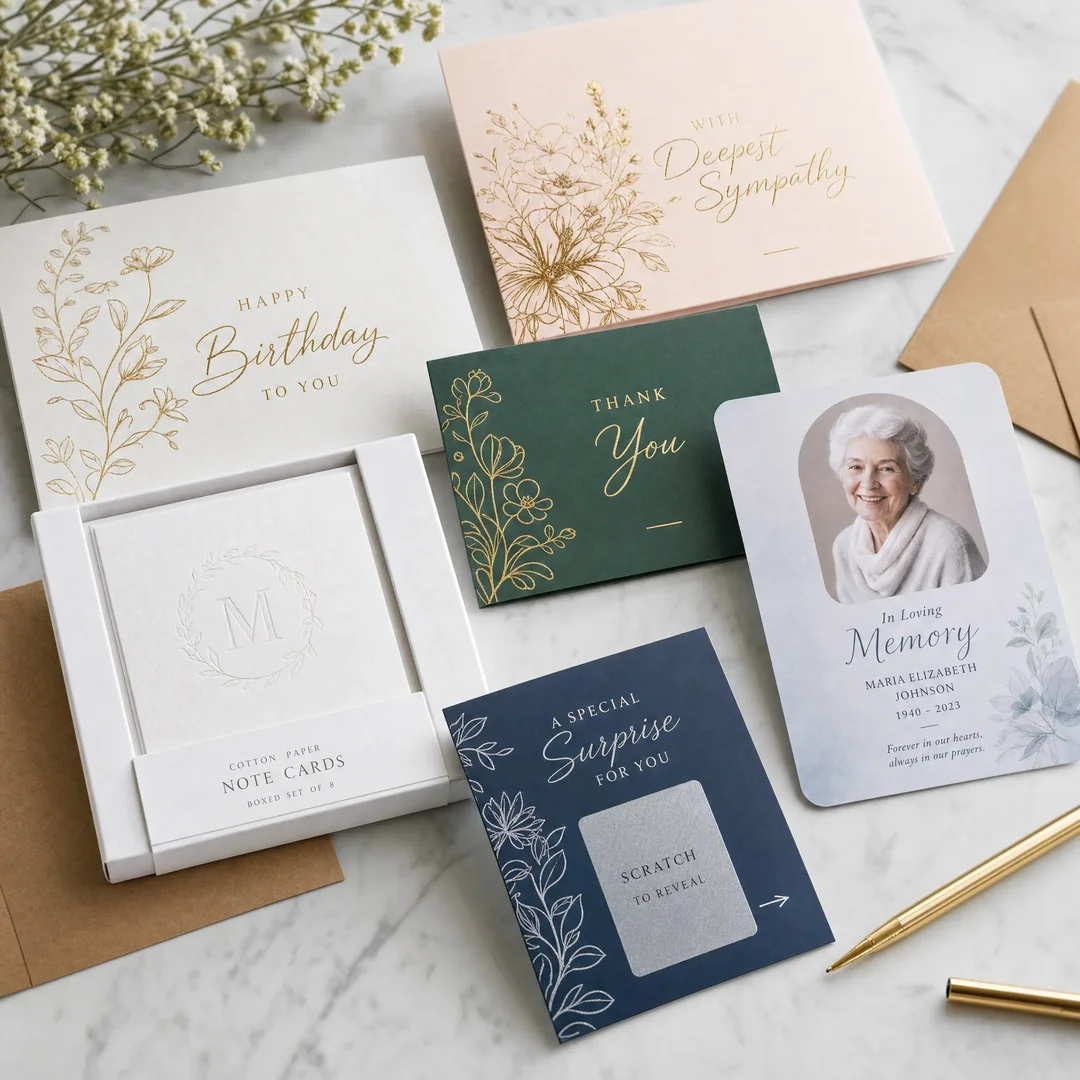
Gloss lamination makes colors pop and resists fingerprints — important for retail display. Matte lamination is softer and more sophisticated, the go-to for modern minimalist designs. Spot UV creates a selective glossy highlight on specific elements like a logo against an otherwise matte background. Foil stamping in gold, silver, or rose gold signals premium positioning and consistently drives higher retail prices. Embossing and debossing add three-dimensional texture that photographs beautifully for online listings. Most Chinese factories offer all of these finishes in-house, eliminating the markup you would pay a domestic printer subcontracting to a specialty finisher.
MOQ, Cost Structure, and Print Methods
Minimum order quantities for custom greeting card production start at 500 pieces per design for offset printing, with some factories accepting 300 for digital runs. At 1,000 pieces, unit costs drop noticeably. A ballpark figure for a standard A7 greeting card printed full color both sides on 300gsm art paper with matte lamination and matching envelopes at 1,000 units runs USD 0.35 to USD 0.55 per set. Foil stamping adds roughly USD 0.08 to USD 0.15 per card depending on coverage.
Offset printing delivers the best color accuracy and lowest per-unit cost above 1,000 pieces. The plate-making setup cost makes short runs expensive, which is where digital printing shines — no setup cost, ideal for 100 to 500 cards, and capable of variable data for personalized messages. A practical rule: under 500, go digital. Over 1,000, offset will almost always give better color consistency and lower unit pricing.
Note Card Printing
Paper Stock, Sizes, and Envelope Compatibility
Note card printing sits at the intersection of stationery and personal correspondence. Unlike greeting cards that prioritize visual impact, note cards must perform well as a writing surface. This makes uncoated paper the dominant choice — 300gsm uncoated stock with a smooth or lightly textured surface accepts ink from any pen without smudging. For premium custom note card lines, cotton-blend papers with 25% to 50% cotton content add a distinctive softness and subtle translucency that elevates perceived value. Laid and wove finishes are traditional choices that convey old-world quality. For eco-conscious brands, 100% post-consumer recycled stocks from Chinese mills now print well, with the natural fleck in the paper becoming a design feature rather than a flaw.
The standard folded note card size is 4.25 × 5.5 inches (A2), fitting A2 envelopes. The slightly larger 4.625 × 6.25 inches (A4) format offers more writing space while staying personal. Flat note cards — heavyweight correspondence cards — are commonly 4 × 6 or 5 × 7 inches paired with A6 or A7 envelopes. A popular configuration for brands is a boxed set of flat 4 × 6 inch cards with matching A6 envelopes, often with a monogram or logo on each card face. Note card printing china factories handle card printing, envelope production, and box assembly under one roof.
Finishing, MOQ, and Print Economics
Note cards carry less finishing than greeting cards by convention — the aesthetic is quieter. Blind debossing of a monogram is the most popular upgrade, adding a tactile mark without shininess. For higher-end lines, edge painting or gilded edges turn a simple stack into a luxury product. Letterpress-style printing, where the design is physically impressed into the paper, is available from select Chinese factories that have invested in the equipment.
MOQs for note cards follow a similar pattern to greeting cards — 500 pieces per design for offset, with digital available from 100 pieces. A folded A2 note card with matching envelope on 300gsm uncoated stock at 1,000 units runs roughly USD 0.25 to USD 0.40 per set. Box packaging adds USD 0.30 to USD 0.80 per set. For correspondence card sets of 10 to 20 cards per box, total landed cost at 500 boxed sets often lands between USD 2.50 and USD 4.50 per box — a healthy margin for brands selling at USD 18 to USD 28 retail. Digital printing handles short runs cost-effectively; offset takes over above 1,000 for better consistency and pricing.
Prayer Card Printing
Paper Stock, Sizes, and Envelope Options
Prayer card printing serves a fundamentally different purpose from commercial greeting cards. These are keepsakes distributed at funerals, memorial services, and church events that people keep in Bibles, wallets, and photo albums for years. Durability and dignity are the priorities. The standard stock is 250gsm to 300gsm cardstock with matte or soft-gloss lamination that protects against handling, moisture, and natural yellowing.
For custom prayer card projects, paper must render skin tones naturally — most cards feature a portrait alongside a verse or prayer. Coated stock with a matte or satin finish handles photographic reproduction best. Uncoated stock is sometimes chosen for saint prayer cards and religious icon cards where the aesthetic leans toward classical art. Laminated cards are the standard for funeral memorial cards because families expect them to last.
The memorial wallet card at 2.5 × 4.25 inches is the most common format, small enough for a wallet and typically paired with A2 or specialty wallet-card envelopes. The 4 × 6 inch format serves as both a program and keepsake, fitting A6 envelopes. Folded prayer cards at 4.25 × 5.5 inches folded provide space for a photo on the front, a prayer or poem inside, and service details on the back. Rounded corners are a standard request for prayer card printing china orders — they soften the card visually and reduce corner wear. Most factories include rounded corner die-cutting as a standard option with no extra charge.
Finishing, MOQ, and Cost Factors
Prayer card finishing is subdued and respectful. Soft-touch matte lamination is the most requested finish — warm and substantial without the high shine of gloss. Gold or silver foil stamping for a cross, name, or short verse adds a reverential quality on higher-end cards. Spot UV is used sparingly, typically to highlight a small religious symbol.
Because funeral prayer cards are often time-sensitive, digital printing dominates — it eliminates plate-making and allows same-day production in urgent cases. MOQs start at 100 pieces. Offset printing handles larger church orders at 1,000 to 10,000 pieces, reducing per-unit cost from roughly USD 0.30 digitally to USD 0.08 to USD 0.15 offset. Lamination adds about USD 0.03 to USD 0.05 per card. The digital-vs-offset decision here is driven by turnaround time as much as cost: if you need cards in three days, digital is the only realistic choice.
Scratch Off Card Printing
Card Stock, Scratch Panel Technology, and Sizes
Scratch off card printing china is a specialized category built around one defining feature: an opaque, removable coating that conceals a code, number, or prize message underneath. The base card stock is 300gsm to 350gsm coated paper, chosen for its smooth surface that allows the scratch-off foil to adhere uniformly. The scratch panel is applied via heat-transfer foil stamping — a custom-shaped die presses silver or gold scratch-off foil onto the card. Quality factories run adhesion and scratchability tests on every batch because a panel too hard to remove frustrates users, while one too fragile reveals information during shipping.
For scratch off card projects involving PIN codes or monetary values, factories add a security confusion layer — a dense printed pattern behind the panel that prevents reading concealed information by holding the card up to light. Business card size (3.5 × 2 inches) is common for promotional discount cards that fit in wallets. Postcard-sized formats (4 × 6 or 5 × 7 inches) provide more room for branding alongside scratch panels. Jumbo formats at 6 × 9 inches suit in-store displays where the scratch mechanic needs visibility from a distance. Envelopes are optional — many promotional scratch-off cards are distributed loose, though gift-card-style versions pair with matching envelopes or carrier cards.
Finishing, Security, MOQ, and Pricing
Gloss lamination over non-scratch areas protects printed graphics from handling. For higher-security applications — loyalty cards with monetary value, raffle entries with unique codes — sequential numbering, QR code printing, and tamper-evident design features are standard factory add-ons. Some manufacturers integrate variable data printing with scratch-off application so each card carries a unique identifier under its panel.
MOQs for scratch-off cards are higher than standard cards because the scratch panel requires specialized equipment — most factories set a minimum of 1,000 pieces, though some accept 500 for simple single-panel designs. Per-unit cost at 1,000 pieces ranges from USD 0.15 to USD 0.35 for a business-card-sized scratch-off, increasing for multiple panels, variable data, or security features. Offset printing handles base card printing above 1,000; the scratch panel application is a separate post-print process with a fixed per-card cost regardless of volume. For small runs with variable codes, digital plus scratch panel is the standard workflow, costing USD 0.40 to USD 0.80 per card at 500 pieces.
Scratch Off Ticket Printing
Ticket Stock, Dimensions, and Perforation Formats
Scratch off ticket printing china applies scratch panel technology to event tickets, raffle entries, and fundraising tickets that endure more demanding handling. Ticket stock is heavier — 350gsm to 400gsm — because tickets are torn at perforations and handled repeatedly. The paper must resist tearing except at perforation lines and hold up through printing, numbering, scratch panel application, and perforation without warping. For outdoor events, synthetic paper offers a tear-resistant, water-resistant alternative at 2 to 3 times the cost of paper stock but eliminates the risk of ruined tickets in rain.
The most common format is the stub-and-body design with a perforated tear-off portion. Typical dimensions are 5.5 × 2 inches or larger formats like 8.5 × 5.5 inches folded for events needing space for branding, rules, and sponsor logos. The stub is 1.5 to 2 inches wide with clean micro-perforation. For raffle tickets with scratch-off panels, the ticket measures roughly 2 × 5.5 inches with the panel on either the stub or main body depending on who reveals the result. Chinese ticket printers can produce perforation in any direction and combine sequential numbering on both stub and body for reconciliation.
Finishing, Security, MOQ, and Production Economics
Gloss or matte lamination protects the ticket body. Sequential numbering — often in red ink on both stub and body — serves as the primary audit trail. For charity raffles with significant prizes, factories add anti-counterfeiting layers: microtext borders, UV-reactive ink, holographic foil stamps, and tamper-evident patterns. These features increase per-ticket cost but are essential for any ticket representing cash value.
MOQs for scratch-off tickets are typically 1,000 to 2,000 pieces per design due to setup complexity. Offset production at 5,000 pieces brings unit cost to USD 0.10 to USD 0.25 per ticket depending on size, panel count, and security features. The perforation die is a one-time USD 30 to USD 80 setup charge amortized across the run. Digital printing can go lower for simple designs but at 500 pieces costs USD 0.50 to USD 1.00 per ticket. Lead times run 15 to 25 production days — add an extra week for variable data, custom die shapes, or multiple security layers.
How to Choose the Right Card Printing Partner in China
With so many factories offering card printing, choosing well comes down to four questions. First, does the factory handle your specific card category regularly? A plant printing 100,000 greeting cards a month may have no experience with scratch-off panels. Second, always request physical samples — not photos, not PDFs, but actual printed cards. A sample reveals more about print quality, paper feel, and finishing accuracy than any catalog description.
Third, clarify the proofing process. Most factories provide a free digital proof and a physical hard-copy proof for USD 20 to USD 50, refundable against the production order. Do not skip the hard proof on your first order. Color on screen does not match color on paper. Fourth, ask the factory to describe their QC checkpoints. A reputable operation should articulate at least three: pre-press file check, in-line print monitoring, and post-finishing spot checks. If they cannot, treat that as a red flag.
At EcoPrinting, we produce all five card types covered in this guide under one roof — greeting cards, note cards, prayer cards, scratch-off cards, and scratch-off tickets. Our production floor runs offset and digital lines side by side, with in-house foil stamping, embossing, spot UV, scratch panel application, and perforation. If you are sourcing card printing for the first time, we can walk you through paper selection, size specs, and finishing options based on what has worked for other brands in your category.
Frequently Asked Questions About Card Printing in China
What is the smallest order I can place?
Digital printing allows runs as low as 100 pieces for greeting cards, note cards, and prayer cards. Scratch-off cards and tickets have higher minimums — typically 500 to 1,000 pieces — due to specialized scratch panel equipment. Very small runs carry a much higher per-unit cost, so if you are testing a design, printing 500 digitally rather than 100 brings the unit economics closer to viable retail margins.
How long does production and shipping take?
Production runs 10 to 18 days for standard card orders and 15 to 25 days for scratch-off products with variable data. Sea freight to North America or Europe adds 25 to 40 days. Air freight cuts shipping to 5 to 10 days but costs significantly more — typically only worthwhile for time-sensitive funeral prayer cards or last-minute event tickets. Budget 6 to 8 weeks door-to-door with sea freight.
Can Chinese factories supply envelopes with card orders?
Yes, nearly all card printing factories in China offer matching envelope printing as part of the package. Sourcing both from one factory is more cost-effective and logistically simpler. Confirm envelope paper stock, flap style, and whether you need peel-and-seal or gummed closure before your factory quotes the envelope portion.