Why Source Custom Stickers and Labels from China?
Walk into any retail store and count how many products carry a sticker or label. The number will surprise you. From the barcode on a shampoo bottle to the brand decal on a laptop, stickers and labels do heavy lifting in modern commerce. They identify products, communicate brand values, seal packaging, and sometimes become the product itself—think sticker packs sold by independent artists.
Businesses that need custom stickers at scale face a familiar dilemma: pay premium prices from local printers or navigate international sourcing. A growing number of brands, packaging buyers, and e-commerce sellers choose the second path—specifically, sticker printing in China . The reason is straightforward. Chinese printing factories have spent decades building infrastructure that combines industrial-grade equipment with labor cost advantages that domestic printers in North America and Europe simply cannot match.
At EcoPrinting, we see this pattern every day. A skincare startup needs 10,000 waterproof product labels. A streetwear brand wants 5,000 holographic die-cut stickers for a product launch. A food manufacturer requires 50,000 roll labels for automated filling lines. All three cases share the same answer: source from China, save 40–60% on unit costs, and get professional results that match or exceed local quality.
This guide walks through everything you need to know before placing a sticker printing order in China. We cover sticker types, label formats, material choices, printing technologies, surface finishes, and the practical steps that separate a smooth order from a costly mistake.
Sticker Types: Which Format Matches Your Use Case?
Not all stickers work the same way. The cut style, material, and adhesive determine whether a sticker ends up on a water bottle, a product box, or a car bumper. Choosing the wrong type wastes money and frustrates customers. Here is how each option stacks up.
Die-Cut Stickers
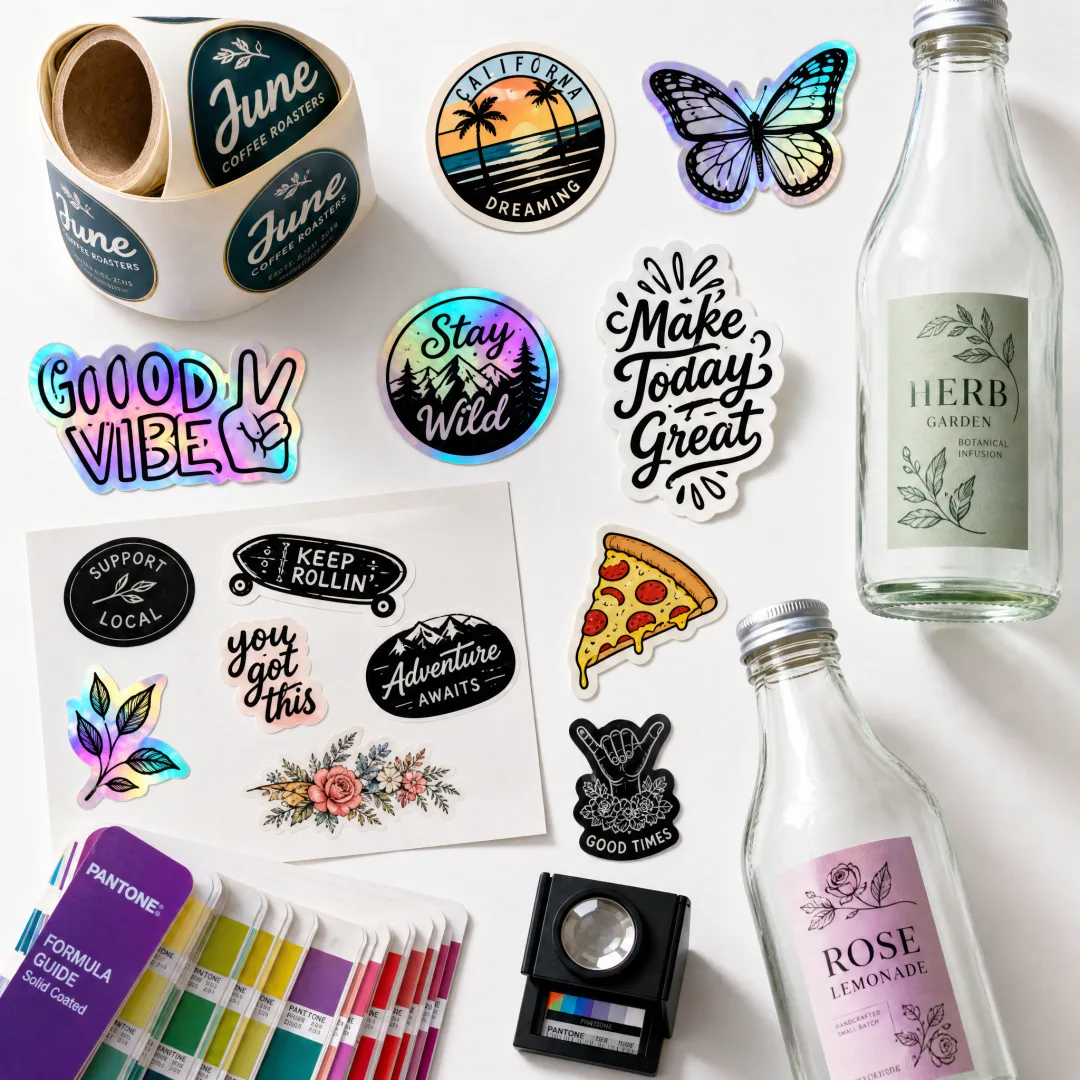
Die-cut stickers follow the exact contour of your design. A metal die—essentially a custom-shaped blade—punches through the material and backing, delivering individual stickers with no excess border. The result: a sticker shaped like your logo, character, or illustration, ready to peel and stick.
These work best for brand giveaways, product inserts, and merchandise. When someone receives a neatly die-cut sticker of your logo, the tactile experience alone communicates quality. The trade-off? Die-cut stickers cost more per unit than kiss-cut alternatives because creating the custom die adds a one-time tooling fee, usually $30–$80 depending on complexity.
Most Chinese sticker factories keep client dies on file for reorders. Pay the die fee once, and repeat orders skip that cost entirely.
Kiss-Cut Stickers
Kiss-cut stickers use a laser or blade that cuts only through the sticker layer—not the backing. The result is a sticker sheet or roll where each design sits on intact backing material. Peel one off, and the backing stays behind.
This format dominates the sticker-sheet market. Artists selling on Etsy, brands creating sticker packs, and companies producing multi-design sheets all rely on kiss-cut production. Because the backing remains whole, kiss-cut stickers handle intricate, delicate shapes that would tear during die-cutting. Think fine typography, thin outlines, or designs with floating elements.
Kiss-cut also costs less for small-quantity custom shapes since no metal die is required. Factories use digital laser cutting paths generated directly from your artwork file.
Clear Stickers
Clear stickers print on transparent vinyl or BOPP film, letting the surface underneath show through. Applied to a glass bottle or window, the design appears to float on the surface—no white border, no opaque backing.
Cosmetic brands love clear stickers for minimalist product labels. Tech companies use them for laptop branding. The catch? Clear stickers demand high-contrast artwork. Light colors on transparent material disappear against dark surfaces, and vice versa. Many printers solve this with a white ink underlay—a separate pass that prints opaque white behind colored areas, making the design pop regardless of the application surface.
Ask your Chinese supplier explicitly about white ink capability before ordering clear stickers. Not every factory runs a white ink channel on their digital presses.
Holographic Stickers
Holographic stickers shift color as the viewing angle changes. The rainbow-like shimmer comes from a micro-embossed metallic film laminated to the sticker surface—not from printed ink. This material catches light and attention in ways flat printing never can.
Streetwear labels, limited-edition product drops, and authentication seals use holographic stickers to signal exclusivity. The material itself carries a premium feel that plain paper or vinyl cannot replicate. Expect to pay roughly 30–50% more per unit compared to standard vinyl stickers, and minimum order quantities often start higher—typically 500–1,000 pieces.
EcoPrinting sources holographic material in silver, gold, and rainbow variants. The rainbow option produces the most dramatic effect and remains the top seller for promotional sticker runs.
Vinyl Stickers
Vinyl (PVC) sits at the top of the durability pyramid for sticker materials. It laughs at water, shrugs off UV exposure, and stays stuck through temperature swings from -40°F to 176°F. Car bumper stickers, outdoor signage, laptop skins, and water bottle decals almost always use vinyl.
The material comes in two grades: calendared vinyl (economy, 3–5 year outdoor life) and cast vinyl (premium, 7–10 year outdoor life). Calendared vinyl costs less but shrinks slightly over time. Cast vinyl stretches and conforms to curved surfaces without lifting at the edges. For most commercial sticker applications, calendared vinyl with a UV laminate delivers excellent results at a reasonable price point.
Chinese vinyl sticker printing typically runs $0.03–$0.12 per unit at quantities of 1,000+, depending on size and finish. Compare that to $0.25–$0.80 from US-based printers for equivalent specifications.
Paper Stickers
Paper stickers cost the least and work perfectly for indoor, short-term applications. Think price tags, event badges, envelope seals, and packaging labels that will not face moisture. The surface accepts ink beautifully—colors look rich and sharp on coated paper stock.
The limitation is obvious: paper and water do not mix. A single rain drop or splash of condensation turns a paper sticker into pulp. For dry, indoor use only.
Kraft paper stickers deserve a special mention. The brown, textured surface gives an earthy, handmade aesthetic that suits organic food brands, artisanal products, and eco-conscious packaging. Many Chinese factories now offer FSC-certified paper stocks for brands that need to back up their sustainability claims with documentation.
Bumper Stickers
Bumper stickers demand specific materials and adhesives. They live outdoors, face direct sunlight, survive car washes, and need to adhere to painted metal surfaces with slight texture. Standard vinyl with a strong permanent adhesive and UV-resistant lamination handles these conditions. The adhesive matters as much as the material—bumper stickers use aggressive acrylic adhesives rated for exterior automotive use.
Size expectations differ too. Bumper stickers typically run 3″×11″ or 4″×6″, larger than standard promotional stickers. Chinese factories producing bumper stickers usually print on 4–6 mil thick vinyl with a glossy laminate overlay for maximum weather protection.
Single Stickers vs. Sticker Sheets
Single stickers arrive as individual pieces—each one separated and ready to use. Sticker sheets group multiple designs (or multiple copies of one design) on a shared backing sheet.
Single stickers work for brand giveaways, event handouts, and product inserts where you want people to grab one and go. Sticker sheets make sense for retail products—the kind sold on Etsy, at conventions, or through brand merch stores. Sheet format also fits shipping better; a flat sheet slides into an envelope without the risk of individual stickers getting bent or lost.
Most Chinese sticker printers offer both formats from the same artwork file. The price difference comes down to cutting method and packaging, not printing.
Label Formats for Products and Packaging
Labels serve a different purpose than promotional stickers. They carry product information, barcodes, ingredient lists, and brand identification—often in regulated environments where legibility and durability carry legal weight.
Roll Labels
Roll labels wind onto a cardboard or plastic core, ready to feed into automatic labeling machines or handheld dispensers. Production lines in food manufacturing, beverage bottling, cosmetics filling, and pharmaceutical packaging all use roll labels for speed. A single filling line can apply 200+ labels per minute from a roll—try doing that with individual stickers.
Chinese roll label production runs on narrow-web flexographic presses or high-speed digital roll-to-roll printers. The key specification to nail down: unwind direction. Labels can unwind from the outside or inside of the roll, and the orientation (top-first, bottom-first, left-first, right-first) must match your labeling machinery. Wrong unwind direction = production line stoppage. Get this detail right before confirming your order.
Core size also matters. Standard cores are 1″, 3″, or 6″ diameter. Check your labeling equipment manual and communicate the requirement clearly to your Chinese supplier.
Product Labels
Product labels attach directly to the item being sold. Wine bottle labels, candle jar labels, supplement container labels, cosmetic tube labels—each application brings unique requirements for material, adhesive, and finish.
Bottle labels for beverages need cold-temperature adhesive that stays stuck in refrigeration. Oil-based product labels (essential oils, cooking oils, CBD tinctures) require oil-resistant materials like BOPP or polyester—paper labels will stain and peel within days. Squeeze-tube labels demand flexible materials that stretch with the tube without wrinkling.
EcoPrinting recommends starting with a material sample kit before committing to a full production run. Test the label on your actual product in real conditions—refrigerated, handled, squeezed, exposed to the product contents—before approving mass production. Chinese factories happily send sample packs; ask for them.
Packaging Labels
Packaging labels go on boxes, mailers, bags, and shipping containers. The job is identification and branding at the point of unboxing. These labels face abrasion during transit, so scuff-resistant lamination matters. Size runs larger than product labels—a packaging label might be 4″×6″ or bigger, while a product label might be 2″×3″.
Custom packaging label printing in China often combines with other print products from the same factory. If you are already ordering custom boxes, adding matching labels to the same production batch reduces total shipping cost and keeps brand colors consistent across materials.
Waterproof Labels
Waterproof labels use synthetic materials—vinyl, BOPP, or polyester—with permanent acrylic adhesives. The combination resists water, oil, chemicals, and temperature extremes. Bathroom products, outdoor equipment, beverage bottles, and industrial equipment all need waterproof labeling.
Do not confuse “water-resistant” with “waterproof.” Water-resistant paper labels (coated paper with a light varnish) survive a quick splash but will fail under sustained moisture. Waterproof synthetic labels can sit submerged without degrading. If your product lives in wet conditions, specify synthetic material and permanent adhesive. The price difference—roughly 20–30% more than paper—buys you the confidence that your label will not peel off halfway through the product’s life.
Choosing the Right Material
Material selection makes or breaks a sticker project. The four main options each serve different needs.
Coated Paper
Coated paper prints beautifully and costs the least. The clay-coated surface holds ink precisely, producing sharp text and vivid colors. Best for: indoor stickers, price tags, envelope seals, event badges, short-term packaging labels. Limitations: no water resistance, tears easily, fades under UV exposure. Cost: $0.01–$0.04 per unit at volume.
Vinyl (PVC)
Vinyl dominates outdoor and durable applications. It stretches, resists tearing, and handles weather that destroys paper. Two sub-types matter: white vinyl (opaque, covers whatever is underneath) and clear vinyl (transparent base with printed graphics). Best for: bumper stickers, car decals, outdoor signage, water bottle stickers, laptop skins, heavy-duty product labels. Cost: $0.03–$0.12 per unit at volume.
BOPP (Biaxially Oriented Polypropylene)
BOPP fills the gap between paper and vinyl. It costs less than vinyl, outperforms paper on water and tear resistance, and prints with excellent clarity. The material is thinner than vinyl—roughly 2–3 mil vs. 3–4 mil for standard vinyl—which makes it ideal for labels on curved surfaces and squeezable containers. Best for: food packaging labels, beverage bottle labels, cosmetic labels, any application needing moisture resistance without the full cost of vinyl. Cost: $0.02–$0.06 per unit at volume.
Polyester (PET)
Polyester handles the toughest conditions. It resists chemicals, oils, solvents, and extreme temperatures that would destroy vinyl and BOPP. Industrial equipment labels, chemical container labels, automotive under-hood labels, and outdoor electronics labeling all use polyester. The material costs more—expect a 40–60% premium over vinyl—but in harsh environments, nothing else survives. Cost: $0.05–$0.18 per unit at volume.
Material Selection Quick Reference
Ask yourself three questions before picking a material:
1. Where will the sticker live? Indoor, dry environment → paper works. Outdoor, wet, or handled frequently → vinyl or BOPP. Chemical exposure or extreme temperatures → polyester.
2. How long should it last? Days to weeks → paper. Months to a few years → BOPP or calendared vinyl. 5+ years outdoors → cast vinyl with UV lamination. 10+ years in harsh conditions → polyester.
3. What surface does it stick to? Smooth glass or plastic → standard permanent adhesive. Textured or low-energy surfaces (powder-coated metal, some plastics) → high-tack adhesive. Surfaces where residue is unacceptable → removable adhesive.
EcoPrinting stocks all four material types with multiple adhesive options. Send us your application details, and we match the material to the job—no guesswork needed.
Printing Technologies: Digital, Offset, and Flexo
The printing method affects color accuracy, per-unit cost, minimum order quantity, and turnaround time. Chinese sticker factories typically offer three approaches.
Digital Printing
Digital presses print directly from digital files—no plates, no setup time. HP Indigo, Epson, and Konica Minolta digital label presses dominate Chinese sticker factories. Advantages: zero plate costs, fast turnaround (2–4 days), unlimited colors at no extra charge, viable for runs as small as 50–100 pieces. Disadvantages: higher per-unit cost at large quantities (5,000+), slightly less color consistency across long runs compared to offset.
Digital printing shines for small businesses, startups testing designs, and multi-SKU orders where each design prints in small quantities. Most sticker orders under 1,000 pieces run digitally.
Offset Printing
Offset (lithography) uses metal plates to transfer ink to the substrate via a rubber blanket. The setup cost runs higher—plate fees of $20–$50 per color—but per-unit costs plummet at volume. Offset delivers the sharpest text and smoothest color gradients of any printing method.
For sticker orders above 5,000 pieces, offset usually beats digital on total cost. The break-even point depends on sticker size and color count, but Chinese factories typically recommend offset for quantities of 10,000+ where the plate costs spread thin across the run.
Flexographic Printing
Flexo printing uses flexible photopolymer plates on a rotary press. It is the workhorse of roll label production—fast, efficient, and capable of printing on virtually any substrate including films, foils, and synthetic materials.
Flexo excels at long-run roll label orders (50,000+ linear meters). The plates cost more than offset plates ($50–$150 each) but last for millions of impressions. For a food brand running the same label design month after month, flexo delivers the lowest per-label cost in the industry.
Most Chinese label factories run a mix of digital and flexo equipment, choosing the method based on order size. The best suppliers maintain facilities with all three technologies, so the printing method matches the job requirements rather than the factory’s limitations.
Surface Finishes: The Details That Define Quality
Surface finishing transforms a printed sticker from flat to professional. The right finish adds durability, changes the tactile experience, and communicates brand positioning.
Glossy Finish
Gloss lamination or varnish creates a shiny, reflective surface that makes colors appear richer and more saturated. Light bounces off the surface, giving images extra depth. Product photos and vibrant illustrations benefit most from gloss. The downside: glossy stickers show fingerprints and scratches more visibly than matte alternatives.
Matte Finish
Matte lamination or varnish produces a non-reflective, smooth surface. Colors look more subdued, but the sticker feels premium to the touch. Matte finishes also reduce glare, making text-heavy labels easier to read under varied lighting conditions. Luxury brands gravitate toward matte for its understated elegance.
UV Coating
UV coating adds a thin, clear protective layer cured under ultraviolet light. It can be applied as a spot treatment (highlighting specific design elements) or as a flood coat (covering the entire surface). UV coating provides moderate scratch and moisture resistance at a lower cost than full lamination. Spot UV creates a striking contrast when applied selectively—a glossy UV logo on a matte background, for example.
Lamination
Lamination bonds a thin plastic film to the sticker surface. Gloss lamination amplifies color vibrancy. Matte lamination softens the appearance and adds a velvety texture. Soft-touch lamination—a specialty option—creates a rubbery, suede-like feel that screams luxury. Lamination also provides the best physical protection against scratches, moisture, and UV fading.
For outdoor stickers, lamination is not optional—it is essential. Unlaminated vinyl stickers fade and crack within 6–12 months of sun exposure. A UV-resistant laminate extends outdoor life to 3–5 years minimum.
Other Finishing Options
Hot foil stamping presses metallic foil (gold, silver, copper, holographic) onto specific areas of the sticker using heat and pressure. The result catches light in ways that printed metallic inks cannot match. Embossing raises the sticker surface for a three-dimensional texture. Debossing presses the design into the material. Both techniques add tactile interest that flat printing cannot achieve.
These specialty finishes cost extra and extend production time by 3–5 days, but for premium product labels and luxury packaging, the return on investment justifies every penny.
Why Source Sticker Printing from China?
Global brands do not source from China by accident. The country’s printing industry has specific structural advantages that translate to better value for sticker buyers.
Cost Advantage
Chinese sticker printing typically costs 40–60% less than equivalent US or European production. A 3″×3″ die-cut vinyl sticker that costs $0.45 from a domestic printer often costs $0.08–$0.15 from a Chinese factory at comparable quantities. Roll labels show similar economics—$0.02–$0.06 per label from China versus $0.08–$0.20 domestically.
The savings come from three sources: lower labor costs, efficient raw material supply chains (China produces much of the world’s vinyl, BOPP, and adhesive stocks), and high factory utilization rates. Chinese printing factories run 24/7 shifts; equipment rarely sits idle.
Flexible Minimum Order Quantities
Contrary to the stereotype of Chinese factories demanding massive orders, many sticker printers now accept MOQs as low as 100–500 pieces for digital production. Roll label MOQs start around 1,000–2,000 linear meters. Sheet sticker MOQs range from 50–200 sheets.
EcoPrinting regularly handles orders from 100-piece sample runs to 100,000-piece bulk production. The key variable is printing method: digital printing keeps MOQs low; flexo and offset require larger minimums to justify plate and setup costs.
Production Speed
Standard sticker orders ship within 5–10 business days from file approval. Rush orders leave the factory in 3–5 days. This speed comes from integrated production—prepress, printing, cutting, and finishing all happen under one roof, eliminating handoffs between separate facilities.
Shipping to North America adds 3–7 days by air express (DHL, FedEx, UPS) or 15–30 days by sea freight. Factor shipping time into your project timeline, but even with air freight added, the total cost usually beats domestic pricing.
Quality Control
Reputable Chinese sticker factories maintain ISO 9001 quality management systems and use G7 Master color calibration. They print to Pantone color standards, run spectrophotometer checks on production batches, and provide pre-production proofs for client approval before starting the full run.
The gap between “cheap Chinese printing” (the outdated stereotype) and professional-grade Chinese printing (the current reality) depends entirely on supplier selection. Work with established exporters who serve international brands, not trading companies with no factory oversight. Look for suppliers who conduct factory audits, sample evaluations, and trial orders as part of their vendor qualification process.
Frequently Asked Questions
What file format should I send for sticker printing?
Vector files produce the best results. Submit artwork in AI (Adobe Illustrator), PDF, EPS, or CDR (CorelDRAW) format. Convert all text to outlines. Set color mode to CMYK, not RGB. Include at least 0.125 inches (3mm) of bleed beyond the cut line. Resolution for any raster elements: 300 DPI minimum at actual print size.
How do I handle shipping and customs for sticker orders from China?
Most factories ship via DHL, FedEx, or UPS for small to medium orders—3 to 7 days door-to-door. Larger orders ship by sea freight (15–30 days) or air freight (5–10 days). Customs clearance for printed stickers is straightforward in most countries; stickers classify under general printing tariff codes with low or zero duty rates. Your Chinese supplier handles export documentation; you or your customs broker handle import clearance.
Can I get samples before placing a full order?
Yes. Most Chinese sticker factories offer two types of samples: a free stock sample pack showing material types and finish options (you pay shipping), and a paid custom sample run of your actual design (typically $30–$80 including shipping). Order custom samples if color accuracy matters for your project. Stock samples show material quality but cannot verify color matching on your specific artwork.
What is the difference between permanent and removable adhesive?
Permanent adhesive bonds strongly and resists removal—attempting to peel it off tears the sticker or leaves residue. Removable adhesive allows clean removal without residue for months to years after application, depending on the surface. Choose permanent for product labels that should stay put and removable for promotional stickers, window decals, or temporary signage where clean removal adds value.
Do Chinese sticker factories offer eco-friendly options?
Yes. Many factories now stock FSC-certified paper, recycled paper stocks, biodegradable films, and PVC-free synthetic alternatives. Specify your sustainability requirements during the quoting process—factories can usually accommodate them but need to know upfront to source the right materials.
How do I avoid common mistakes when ordering sticker printing from China?
Five mistakes trip up most first-time buyers:
1. Sending RGB files. Colors shift when converted to CMYK for printing. Design in CMYK from the start.
2. Skipping the proof. Always request a digital or physical proof before production. A 10-minute proof review prevents a thousand-dollar mistake.
3. Ignoring unwind direction on roll labels. Labels wound the wrong direction will not feed through your labeling machine. Specify unwind direction explicitly.
4. Choosing material by price alone. The cheapest material that fails in your application costs more than the right material ordered once.
5. Underestimating shipping costs. Stickers weigh more than you expect in bulk. Request a shipping estimate alongside the production quote to see the true landed cost.
Start Your Sticker Printing Project
Custom sticker and label printing does not need to be complicated. The formula works like this: define your application, pick the right material, choose a format that fits your distribution, send print-ready artwork, approve a proof, and let production run.
EcoPrinting has helped hundreds of brands—from solo entrepreneurs launching their first sticker pack to established manufacturers ordering millions of roll labels per year—navigate sticker printing in China. Our team handles artwork review, material matching, factory selection, quality inspection, and logistics coordination so you focus on your business, not on supply chain details.
Ready to get a quote? Visit ecobookprinting.com and send us your sticker or label specifications. Include the size, material preference, quantity, and finish requirements, and we will return a detailed quotation within one business day. Whether you need 100 holographic die-cut stickers for a product launch or 50,000 waterproof roll labels for a filling line, we have the production capacity and expertise to deliver.