Why Children’s Interactive Books Are Exploding — and Why Publishers Source From China
The global interactive children’s book market hit an estimated USD 2.4 billion in 2024 and is projected to surge past USD 5 billion by 2033. Parents want screen-free engagement. Educators want hands-on learning tools. Retailers are stocking more activity books, sticker books, and sound books than ever before.
If you are a children’s book publisher, an educational brand, or a toy company buying manager, you have probably already noticed the shift. The question is not whether to launch an interactive book line — it is where to produce it at a cost that leaves room for healthy margins without sacrificing quality or safety.
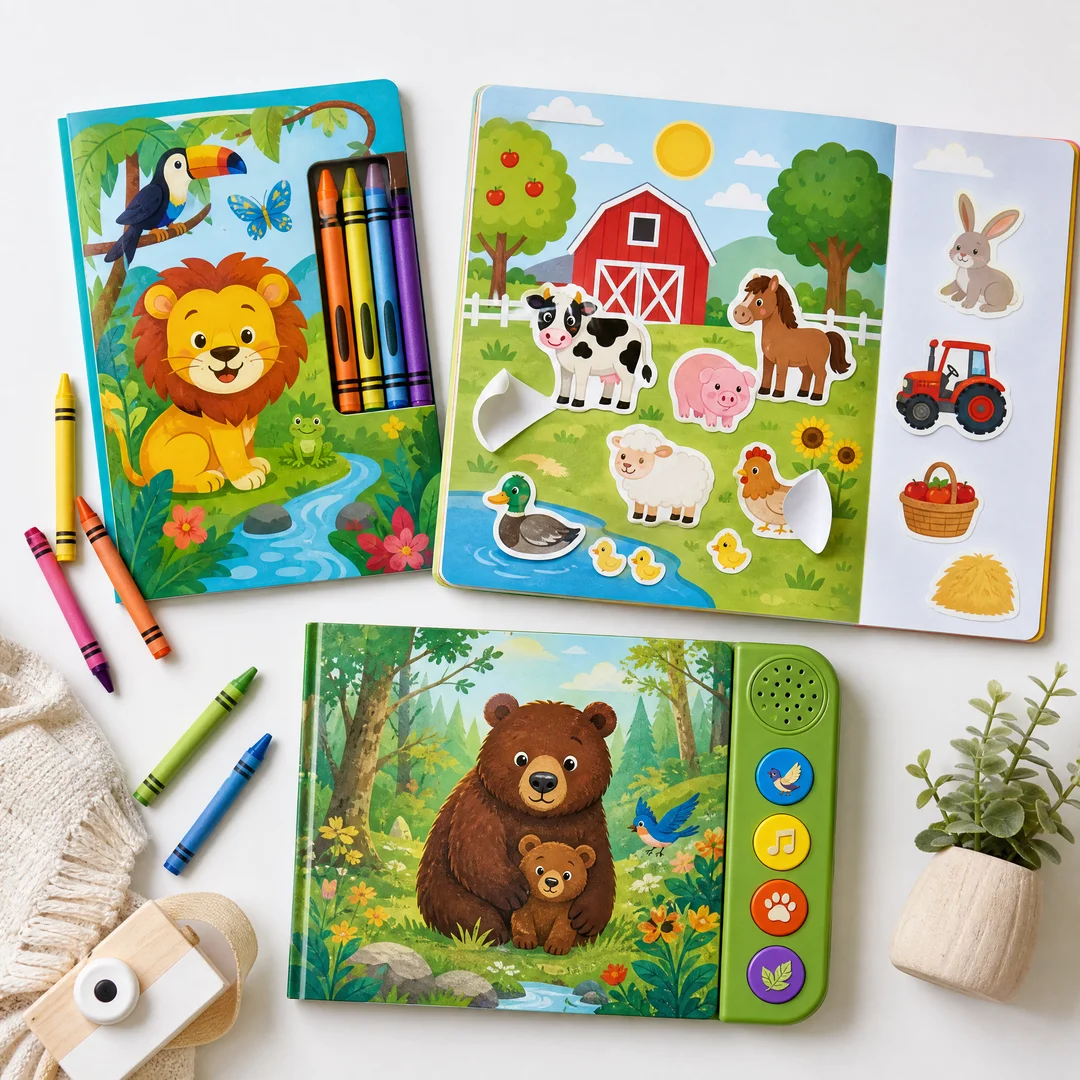
That is where China comes in. Over the last decade, a specialized ecosystem has emerged around custom children’s interactive book printing in China — one that handles complex assembly, electronics integration, and safety testing that generic book printers simply cannot manage. Activity books with tracing pages and maze puzzles. Sticker books with repositionable adhesive and release liners. Sound books with embedded modules and battery compartments. All produced under one roof, at scale, with full compliance documentation.
This guide walks you through each category — from paper selection and binding methods to safety certifications, MOQ realities, quality control protocols, and supplier vetting. By the time you finish, you will know exactly what to ask for when you send your next RFQ to a China-based printer like EcoPrinting.
Activity Book Printing: Mazes, Coloring Pages, Tracing, and Puzzle Formats
Activity books are the workhorses of children’s publishing. They show up in airport gift shops, museum stores, subscription boxes, and school supply catalogs. Unlike a picture book that a child reads once or twice, a well-designed activity book gets used until every page is filled in — and sometimes bought again in a new edition.
When you print activity books in China, a few design decisions make or break the final product. The first is paper weight. If a child will press hard with a crayon or marker, you need at least 100 gsm uncoated woodfree paper. Anything thinner and the ink bleeds through to the next page, which frustrates both kids and parents. For premium activity books — the kind sold at museum gift shops for $12.99 and up — many publishers spec 120 gsm or even 140 gsm offset paper.
The second decision is the binding. Activity books that lie flat are easier for small hands. Saddle stitch binding works for thinner titles, typically 48 pages or fewer. For anything thicker, Wire-O binding or spiral coil binding is the better option — the book opens flat on a table and stays open, which is critical for coloring and tracing activities.
The third factor is the activity type. Maze books need crisp, thin lines — so the printer’s plate-making and registration accuracy matter. Dot-to-dot and tracing books require precise alignment between the instruction page and the activity page. Puzzle books with cut-out pieces need die-cutting stations, which not every printer has in-house. When you work with a factory like EcoPrinting that handles both offset printing and die-cutting on the same floor, you eliminate the logistical headache of shipping semi-finished goods between facilities.
If your activity book includes an answer key, print it on tinted pages or a different paper stock. This makes the answer section visually distinct and harder for kids to flip to accidentally. Most experienced China printers can accommodate this at no significant cost increase.
Sticker Book Printing: Release Liners, Repositionable Adhesive, and Page Design
Sticker books are deceptive. They look simple — just printed stickers on glossy paper with a backing sheet, right? But getting the peel experience right takes real manufacturing precision. If a sticker tears when a three-year-old tries to peel it, or if the adhesive leaves residue on the page, the product gets returned.
The core of any custom sticker book printing project is the release liner. This is the silicone-coated backing paper that the sticker sits on before it is peeled off. There are two main approaches. The first uses a full-page release liner: the entire page is printed as one large sticker sheet, and the shapes are kiss-cut so the sticker peels off while the surrounding matrix stays on the liner. The second approach — often used for repositionable sticker books aimed at preschoolers — prints individual stickers directly onto the book page, with a coated surface that allows the sticker to be peeled off and re-stuck multiple times.
Repositionable adhesive is where things get interesting. Standard permanent adhesive dries out after one or two repositions. A quality repositionable sticker uses a microsphere adhesive that can be peeled and re-applied dozens of times without losing tack or leaving residue. This is the technology behind brands like Melissa & Doug’s reusable sticker pads. Not every China printer sources this grade of adhesive, so you need to ask specifically. When you request a quote from EcoPrinting for repositionable sticker books, we flag this in the material specification so there are no surprises.
Page substrate matters too. For sticker book pages, coated art paper (C2S) gives stickers a better grip during repeated repositioning. Uncoated paper works for one-time-use sticker books, but the surface fibers degrade faster with repeated peeling. For premium reusable sticker books, many publishers spec 157 gsm C2S art paper or even synthetic paper for the base pages.
Format-wise, popular sticker book sizes for the Western market are A4 (210 × 297 mm) and 8.5 × 11 inches. A5 (148 × 210 mm) works for travel-sized sticker packs. Page count typically ranges from 8 to 24 pages, with 4 to 8 carrying stickers and the rest carrying scenes where stickers are placed.
Sound Book Printing: Modules, Batteries, and the Hidden Complexity
Sound books are a different animal from standard book printing. They are as much an electronics manufacturing project as a printing project — and finding a factory that does both well is harder than it sounds. Many publishers who have tried custom sound book printing in China with a general book printer have ended up with frustrating results: misaligned buttons, dead-on-arrival modules, or battery compartments that pop open during shipping.
The sound module is the heart of the product. Most children’s sound books use a PCB with an embedded sound chip, a small speaker, and push-button switches or membrane touch sensors. The module is sandwiched between the back cover and the last page, with button locations die-cut through the board book pages above it. When a child presses a picture of a cow on page 3, their finger travels through a foam spacer layer and activates the corresponding switch on the PCB — and the speaker plays a moo sound.
This is where precision matters. The vertical stack-up — page thickness, foam spacer density, button travel distance — all need to be calibrated so the button activates reliably but does not fire by accident when the book is closed. Experienced sound book manufacturers like EcoPrinting build a verification module before mass production: a functional prototype that confirms every button position, sound file mapping, and speaker volume level. Skipping this step is the most common cause of costly rework.
Battery safety is the other major consideration. Sound books destined for the US market must use battery compartments that require a tool to open — typically a small Phillips screwdriver — to comply with child safety regulations around button cell batteries. For the EU market, similar requirements apply under the Toy Safety Directive. Lithium coin cells (CR2032 is most common) must be secured in a compartment a child cannot access without a tool. Rechargeable modules with sealed lithium-polymer batteries and USB-C charging eliminate the battery-access concern but add roughly 15-25% to the unit cost.
On the creative side, sound books often feature 6 to 10 triggers per title. Sound quality depends on speaker size — a 28 mm or 30 mm diameter speaker produces richer audio than a 20 mm one, especially for music and animal sounds. For phonics content, a 23 mm speaker is usually sufficient. Memory capacity for the sound chip typically ranges from 30 to 180 seconds of total audio, covering 6 to 10 clips of 5 to 20 seconds each.
Material and Binding Options: Paper Types, Covers, and Construction
Paper types and binding determine whether your book survives in a child’s hands. Material selection is not just about aesthetics — it is about durability under real-world abuse.
Paper types for interior pages:
For activity books, 100-140 gsm uncoated woodfree (offset) paper is standard — it absorbs pencil, crayon, and marker ink well with a pleasant tactile feel. For sticker books, 128-157 gsm coated art paper (C2S) provides the smooth surface that works best with repositionable adhesive. For sound books, interior pages are almost always board — typically 350-400 gsm C1S grey board or white board, laminated together to create rigid pages that house button cavities.
Cover options:
Most activity books use a 250-300 gsm C2S art paper cover with a matte or gloss lamination. The lamination adds durability and a premium feel while protecting against spills. For sound books, the cover is usually the same board stock as the interior pages, often with an additional 157 gsm art paper wrap printed with the cover design and laminated over the board. Hardcover sound books are growing in popularity for the premium segment — they use a 2.5-3.0 mm grey board case wrapped with printed art paper.
Binding comparison for interactive books:
Saddle stitching works for activity books under 48 pages — cheap, clean, lightweight. Wire-O and spiral coil bindings lay completely flat, ideal for workbooks and coloring books. Board book binding is the only viable option for sound books, because pages need the structural thickness for button cutouts and spacer layers.
Safety Certifications: CPSIA, EN 71, and ASTM F963 Compliance
If there is one area where you cannot cut corners, it is safety compliance. Interactive children’s books — especially sound books with electronic components — fall under some of the strictest product safety regulations in the world. A failed compliance test does not just delay your shipment. It can trigger a recall, which for a small or mid-sized publisher can be existential.
CPSIA (Consumer Product Safety Improvement Act) — United States:
The CPSIA governs all children’s products sold in the US market. For printed books, the key requirements are lead content limits in substrate materials (total lead content must not exceed 100 ppm), phthalate restrictions, and mandatory third-party testing by a CPSC-accepted laboratory. Every shipment requires a Children’s Product Certificate (CPC) that lists the applicable safety rules and the test results confirming compliance.
Sound books have additional requirements under ASTM F963, the US toy safety standard. Because sound books contain electronic modules, they are classified as toys and must pass drop tests, torque and tension tests (verifying buttons and small parts do not detach), and battery compartment security testing.
EN 71 — European Union:
EN 71 is the harmonized European toy safety standard. Part 1 covers mechanical and physical properties. Part 2 covers flammability — critical for paper-based products. Part 3 covers migration of heavy metals. Children’s books with interactive features that classify them as toys under the EU Toy Safety Directive need CE marking supported by an EN 71 test report.
The good news is that experienced China-based children’s book printers like EcoPrinting maintain relationships with accredited third-party testing labs — SGS, Intertek, Bureau Veritas, TÜV Rheinland — and can manage the testing process end-to-end. The factory should handle lab submissions and deliver test reports alongside your production samples.
What you should ask for: a copy of the lab’s accreditation certificate (to verify it is CPSC-accepted or EU-notified), the full test report (not just the cover page), and a sample Children’s Product Certificate so you can review the format before mass production.
MOQ and Cost Factors: What Drives the Price of Interactive Books
If you have printed standard paperback novels before, the cost structure for interactive children’s books will look very different. The assembly labor, electronic components, and specialized binding processes add cost layers that do not exist in conventional book printing.
MOQ benchmarks:
For standard activity books (no electronics), the minimum order quantity at most China printers starts around 500 copies for digital printing and 1,000 to 3,000 copies for offset printing. For sticker books, the MOQ is similar — 1,000 copies is a common starting point. For sound books, the MOQ jumps significantly because of the electronics component. The sound module supplier typically requires a minimum batch of 2,000 to 5,000 units per module design, which sets the floor for the overall print run. EcoPrinting offers a minimum of 1,000 copies for sound books by maintaining stock of common module configurations, but fully custom module designs typically start at 3,000 copies.
Cost breakdown by category:
An activity book’s cost is driven primarily by page count, paper weight, and binding type. A 48-page saddle-stitched activity book printed in full color on 100 gsm offset paper costs roughly $0.80 to $1.50 per unit at 3,000 copies, excluding freight. The same book with Wire-O binding might cost $1.20 to $2.00 per unit because of the additional binding labor.
Sticker books add the cost of the release liner material, kiss-cutting dies, and repositionable adhesive if specified. A 16-page sticker book with 6 sticker pages, printed at 3,000 copies, typically lands between $1.00 and $2.50 per unit depending on the adhesive type and page substrate.
Sound books are the most expensive per unit — and the most variable. The sound module alone can range from $0.80 to $3.00 per unit depending on the number of triggers, speaker size, memory capacity, and whether it uses a disposable coin cell or a rechargeable battery. The board book body adds $1.00 to $2.50 per unit. Total unit cost at 3,000 copies typically falls between $3.00 and $7.00 per book.
Freight costs vary with volume and shipping method. Sea freight from China to a US West Coast port typically adds $0.15 to $0.40 per unit. Air freight adds $0.50 to $1.50 per unit but cuts transit time from 25-35 days to 5-7 days. Many publishers use sea freight for the bulk and air freight a small quantity ahead of a launch deadline.
Quality Control: What to Inspect Before Your Shipment Leaves the Factory
Quality control for interactive children’s books goes far beyond checking print registration and color accuracy. You are inspecting a product that combines paper, adhesive, and electronics — and that a child will physically interact with. Every failure mode needs a corresponding inspection checkpoint.
Pre-production inspection checklist:
Before the press starts running, confirm the paper stock matches the spec. GSM can vary by ±5% between batches, and for activity books where bleed-through matters, even a 5% variance is noticeable. For sound books, verify the sound module verification sample: every button should activate with moderate pressure (not a light tap and not a hard press), and the audio should be clear with no static or clipping.
During-production inspection (DUPRO):
Pull samples from the production line at 30% completion. For activity books, check registration accuracy on maze and dot-to-dot pages — misalignment of even 1 mm can ruin a puzzle. For sticker books, peel-test every sticker type on every sample. For sound books, activate every button and confirm the correct audio clip plays. Industry-standard AQL for children’s books is typically 2.5 for major defects and 4.0 for minor defects.
Pre-shipment inspection (PSI):
When production is 100% complete and at least 80% packed, draw a random sample based on AQL tables. Check binding integrity, cover lamination adhesion, sticker peel force, sound module activation (every button on every sampled unit), battery compartment security, and packaging integrity with appropriate choking hazard warnings.
If the product is destined for Amazon FBA, add a carton drop test (ISTA 1A or similar). A book that arrives with a crushed corner or a rattling sound module earns a customer complaint before it earns a sale.
How to Choose a China Supplier for Interactive Children’s Books
There are thousands of printing companies in China. Most can print a standard paperback. Very few can handle the full scope of custom activity book printing, sticker book printing, and sound book printing under one roof. Choosing the wrong supplier means your project gets subcontracted to factories you never approved.
Step 1: Verify in-house capabilities.
Ask for a production line tour video. You want to see offset printing presses, die-cutting machines, lamination lines, and — for sound books — an electronics assembly workstation on the same premises. If the factory cannot show you these in one location, they are almost certainly subcontracting the electronics. Ask directly: “Do you assemble sound modules in-house, or do you buy completed modules from a third party?” Either answer is fine — what matters is that you know, so you can assess risk accurately.
Step 2: Check safety certification experience.
A competent supplier should be able to name the testing labs they work with (SGS, Intertek, Bureau Veritas) and provide sample test reports for previous children’s book projects — with client names redacted for confidentiality, which is standard. If they hesitate or give vague answers about “we can arrange testing,” they probably have never done it.
Step 3: Request samples of similar work.
Do not just ask for a sample kit of their best work. Ask for a sample that matches the product category you are producing. If you are making a sound book, ask for a sound book sample — ideally one that is in current production so you can see what their active quality level looks like. Pay attention to the details: the peel feel of sticker books, the button press resistance of sound books, the paper thickness of activity books.
Step 4: Test communication.
How a supplier handles the quoting process reveals how they will handle production. Do they ask clarifying questions about your specifications, or do they quote a generic price within 24 hours? The supplier that asks about paper weight, binding method, safety certification, and target market is thinking about production, not just the sale.
EcoPrinting has spent over 15 years building in-house capabilities for the children’s book market. From die-cutting and lamination to sound module integration and third-party lab coordination, the process keeps your project under one roof from file prep to finished carton.
Frequently Asked Questions
What is the typical lead time for custom children’s interactive book printing?
For activity books and sticker books without electronics, production takes 15 to 25 working days after artwork approval. Sound books take longer — typically 25 to 35 working days — because of the extra steps: module verification, button cavity die-cutting, and electronics assembly. Sea freight to the US adds 25 to 35 days; air freight adds 5 to 7 days.
Can I print a small test batch before committing to a full order?
Yes. For activity books and sticker books, most China printers offer digital sample runs of 50 to 100 copies — more per unit than offset but ideal for market testing and design refinement. For sound books, a pre-production sample of 5 to 10 functional units is standard to verify the module and assembly before mass production.
Do I need to provide print-ready files, or can the factory handle design?
Most China printers expect print-ready PDF files — with bleeds, crop marks, and fonts outlined. If you have a design concept but lack production files, some factories (including EcoPrinting) offer in-house design services for an additional fee. However, the fastest and most cost-effective route is to deliver production-ready artwork.
How do I ensure colors match across the entire print run?
Request a press check or at minimum a printed proof on the actual production paper stock before mass production. During the run, ask for color density bar readings — experienced printers monitor these to keep color variation within a Delta E of 3 or less.
What happens if the sound modules arrive with defects?
Reputable manufacturers test every module individually before assembly — 100% function testing — and again after assembly into the book. AQL sampling during final inspection should catch any remaining defects. If defective units reach you, contract terms should specify the remedy — typically replacement or a credit against the next order.
Bring Your Interactive Children’s Book to Life
Printing interactive children’s books is more complex than most people realize — but that complexity is manageable when you work with a supplier who has built their operation around it. Activity books need the right paper weight and binding. Sticker books need the right release liner and adhesive chemistry. Sound books need precision electronics and rigorous safety testing. Get any one wrong, and the product disappoints. Get them right, and you build a title that sells for years.
The China printing industry has evolved well beyond the stereotype of cheap, low-quality production. The factories that serve the Western children’s book market today are ISO-certified, lab-tested, and staffed by engineers who understand both print manufacturing and product safety compliance. The key is knowing what to ask before you place the order.
Whether you are launching your first activity book or scaling an established children’s brand, EcoPrinting brings 15+ years of interactive book printing experience to your project. Reach out for a free consultation and sample kit — we will walk you through material options, cost estimates, and a production timeline that fits your launch schedule.