Introduction — The Rise of Spiral Coil Binding Printing in China
Spiral coil binding has become one of the most popular bookbinding methods in the world. Publishers, stationery brands, and self-publishers choose it for notebooks, calendars, manuals, and cookbooks. The reason is simple — coil-bound books open flat, rotate 360 degrees, and handle daily wear with ease.
Over the past decade, China has emerged as the global leader in spiral coil binding printing . Factories in Guangdong, Zhejiang, and Shanghai provinces now produce millions of spiral-bound books every year. Their combination of skilled labor, advanced machinery, and competitive pricing makes them the first choice for buyers worldwide.
In this complete guide, you will learn everything about spiral and coil binding printing in China. We compare plastic coil vs Wire-O, explain pitch specifications, break down material options, and walk through the production process. You will also discover why sourcing from China can cut your printing costs by 30% to 50% without sacrificing quality.
Plastic Coil vs Wire-O — Key Differences
At first glance, plastic coil binding and Wire-O binding look similar. Both use loops of material threaded through holes along the book’s spine. However, the differences run deeper than appearance. Understanding these differences helps you choose the right binding for your project.
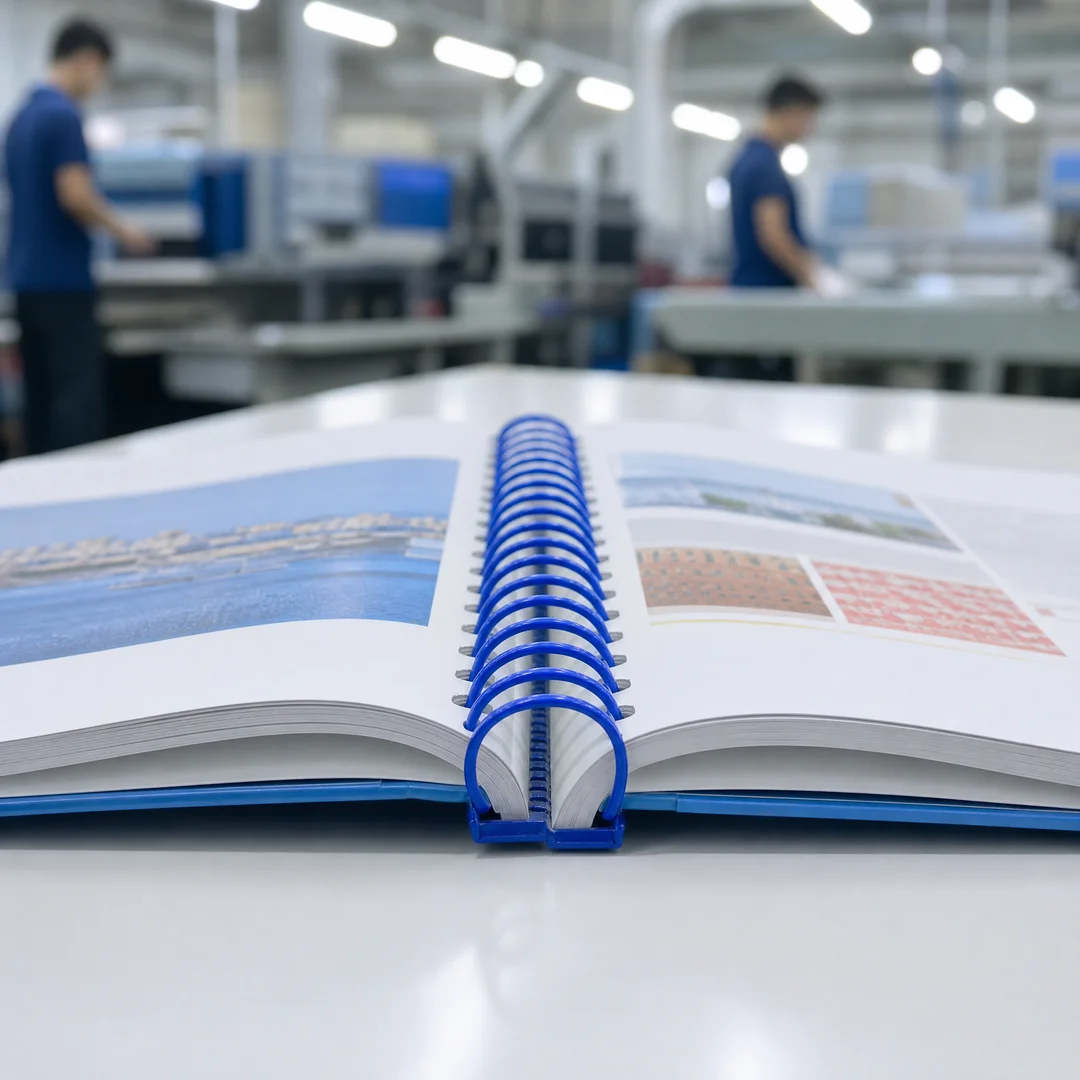
Plastic coil binding uses a single continuous spiral of PVC or POM plastic. The coil winds from top to bottom through round or oval holes. It is flexible, lightweight, and surprisingly durable. Unlike metal alternatives, plastic coils bounce back when crushed. They do not bend out of shape during shipping or daily use.
Wire-O binding , also known as twin-loop or double-loop wire binding, uses metal wire shaped into parallel double loops. Each loop pair attaches to a metal spine running the full length of the book. Wire-O offers a refined, professional appearance. It works well for corporate reports, premium portfolios, and presentation materials.
The key practical difference lies in page alignment. When you open a Wire-O-bound book flat, facing pages align perfectly. This makes Wire-O the better choice for two-page image spreads. With plastic coil binding, the diagonal nature of the spiral means facing pages shift slightly. The shift is small — but it matters for photo books and design portfolios.
Here is a quick comparison of the two methods:
Material : Plastic coil uses PVC or POM; Wire-O uses coated steel wireDurability : Plastic coil resists crushing and springs back; Wire-O can bend permanently if crushedPage alignment : Wire-O offers perfect alignment; plastic coil has a slight diagonal offsetThickness capacity : Plastic coil handles books up to 1 inch; Wire-O handles up to 1.125 inchesAppearance : Wire-O looks more premium; plastic coil offers more color optionsCost : Plastic coil costs less — typically 15% to 25% cheaper than Wire-O
Coil Specifications — Understanding Pitch (4:1 vs 3:1)
Pitch is the most important — and most misunderstood — term in coil binding. Simply put, pitch tells you how many holes are punched per inch along the binding edge. The two most common pitches are 4:1 and 3:1. Each serves a different purpose.
4:1 pitch means four holes per inch. This is the industry standard in North America and much of Asia. The tighter hole spacing creates a clean, compact look. It works best for slim to medium books — think notebooks, workbooks, and marketing brochures. Most plastic coil binding machines use 4:1 as their default punch pattern.
3:1 pitch means three holes per inch. The wider spacing makes it easier to thread larger-diameter coils through thicker books. If your project exceeds 200 pages, a 3:1 pitch often makes more sense. The fewer holes also mean faster insertion on the production line — a small but real efficiency gain for large print runs.
You will also encounter other pitch variations. The 6mm pitch (popular in Europe) and the .2475-inch pitch (a hybrid that centers perfectly on letter-size paper) each have their niche. When sourcing from a Chinese factory, always confirm which pitch standard they use. Most Chinese manufacturers default to 4:1 for export orders unless you specify otherwise.
Coil diameter is equally important. Standard plastic coils range from 6mm to 50mm. Choose a diameter slightly larger than your book block thickness. For example, a 12mm book block needs a 14mm coil for smooth page turning. Your factory partner can recommend the exact size based on your page count and paper weight.
PVC vs POM — Coil Material Options & Color Choices
Most plastic coils are made from PVC (polyvinyl chloride). It is affordable, widely available, and takes color extremely well. Chinese factories source PVC compounds with impact modifiers that boost durability. These additives keep the coil flexible and prevent cracking, even after thousands of page turns.
However, not all PVC is created equal. Lower-grade PVC compounds may contain fillers that bulk up the product without adding strength. They can also include phthalates — plasticizers that some markets regulate tightly. When you order spiral coil binding printing china , ask your supplier about lead-free and phthalate-free certification. This is especially important for children’s books, educational materials, and products destined for the EU market.
POM (polyoxymethylene) offers a premium alternative to PVC. POM coils feel smoother to the touch and have higher tensile strength. They resist heat and chemicals better than PVC. The trade-off is higher cost — POM coils typically cost 30% to 50% more than PVC equivalents. Most projects do not need POM, but if durability is your top priority, ask your factory about this option.
Color is where plastic coil binding really shines. Standard colors include black, white, clear, blue, red, green, and yellow. Custom Pantone matching is available for larger orders. Many brands use colored coils as a design element — matching the coil to their logo or using contrasting colors for visual impact. The minimum order quantity for custom coil colors usually starts at 5,000 to 10,000 units.
Custom Spiral Bound Applications
Spiral coil binding serves a remarkably wide range of applications. Each use case has its own requirements for paper, cover, coil type, and finishing. Here are the four most common applications for spiral-bound products sourced from China.
Notebooks & Journals
Notebooks are the single largest category for spiral binding. A typical spiral notebook uses 60 to 120 sheets of 70-80 gsm paper, a 250-350 gsm cardstock cover, and a 4:1 pitch plastic coil. Many Chinese factories now offer premium features like perforated pages, elastic closure bands, pen holders, and inner pockets. Custom-printed notebooks remain a high-margin product for stationery brands worldwide.
Calendars & Planners
Wall calendars and desk planners rely on spiral binding for one critical feature — they must hang flat against a wall or sit open on a desk. A Wire-O coil with a built-in hanging hook makes wall calendars easy to mount. Desk planners often use plastic coils with extra diameter to accommodate thick paper stock and tab dividers. Chinese calendar factories run dedicated production lines from June through October to meet global holiday-season demand.
Manuals & Training Materials
Technical manuals, employee handbooks, and training guides need to withstand frequent reference. Plastic coil binding handles this well. The books open flat on a desk, leaving both hands free for note-taking or operating equipment. Many companies choose clear plastic covers for the front and black vinyl for the back — a combination that protects the pages while keeping the cover page visible.
Cookbooks & Recipe Books
Cookbooks might be the perfect application for spiral binding. They lay completely flat on a kitchen counter. Pages turn easily — even with messy hands. The 360-degree rotation lets cooks fold the book back to show a single recipe. Many cookbook publishers add a clear plastic splash guard or a built-in easel stand. These value-added features are specialties of experienced Chinese binding factories.
China’s Manufacturing Advantage — Cost & Quality
The economics of printing in China are compelling. Industry data shows that Chinese factories offer 30% to 50% cost savings compared to North American or European printers. For a typical 5,000-copy spiral-bound book order, the savings can reach thousands of dollars — even after accounting for international shipping and import duties.
What drives these savings? Three factors stand out. First, labor costs in China are significantly lower than in the US or Europe. Coil binding still involves manual steps — threading coils, crimping ends, and quality inspection. These labor-intensive processes benefit directly from wage differences.
Second, China has built a vertically integrated supply chain for printing. Paper mills, ink manufacturers, coil extrusion factories, and binding equipment makers all cluster in the same industrial regions. A printer in Shenzhen or Dongguan can source all materials within a 50-kilometer radius. This proximity slashes logistics costs and lead times.
Third, many Chinese factories now operate state-of-the-art equipment . Heidelberg and Komori offset presses, fully automated coil insertion lines, and digital quality control systems are standard in export-oriented plants. The combination of modern machines and experienced operators produces quality that matches — and sometimes exceeds — Western standards.
But cost savings mean nothing without quality. The best Chinese printing factories hold ISO 9001, FSC, and BSCI certifications. They test every batch of coil for tensile strength and color consistency. They welcome third-party inspections before shipment. Do your due diligence — request samples, check certifications, and if possible visit the factory floor.
The Production Process — From Prep to Finished Product
Understanding how a spiral-bound book moves through a Chinese factory helps you communicate better with your supplier. It also reveals where quality issues can arise — and how to prevent them.
The process begins with prepress . Your print-ready PDF files go through a preflight check. The factory verifies bleed settings, color profiles, and spine margin. For spiral binding, the inner margin needs extra space — at least 12mm from the binding edge — to accommodate the punched holes. Missing this detail is one of the most common file preparation mistakes.
Next comes printing . Most spiral-bound books use offset printing for the cover and interior pages. Digital printing is an option for short runs under 500 copies. After printing, sheets go through lamination — glossy or matte film applied to the cover for protection and a premium feel.
Binding is the heart of the process. The printed sheets are collated, jogged, and loaded into the punching machine. Oval holes are punched along the binding edge. Then the coil is threaded through — either by automated insertion machines for high-volume orders or by hand for smaller runs. The ends are crimped and cut to prevent unraveling. Finally, each book undergoes a quality check — pages counted, coil inspected, cover alignment verified.
The last stage is packing and shipping . Books are shrink-wrapped individually, packed in corrugated cartons, and loaded into containers. For sea freight, the total production-to-delivery timeline for a standard order runs 4 to 6 weeks. Air freight cuts delivery to 7-10 days but costs significantly more.
Special Binding Types — C-Ring, Twin-Wire & More
Beyond standard plastic coil and Wire-O, several specialty binding options deserve attention. These less common methods solve specific problems that standard coils cannot address.
C-Ring binding uses C-shaped metal rings that snap together to form a complete circle. The big advantage? You can open and close the rings to add or remove pages. This makes C-Ring perfect for swatch books, sample catalogs, and training binders that need regular updates. Chinese factories produce C-Ring components in diameters from 12mm to 40mm.
Twin-wire binding is essentially a double-loop wire system — similar to Wire-O but with two parallel wire spines instead of one. The twin spine structure provides extra rigidity for large-format books. Architects’ portfolios and oversized art books often use twin-wire binding to prevent sagging.
Color-coated Wire-O adds a decorative layer to standard metal binding. The steel wire receives a nylon or epoxy coating in custom colors. The result combines the premium appearance of metal with the color flexibility of plastic. This option costs more than standard Wire-O but less than full custom metal finishing.
There is also comb binding (GBC binding), which uses a plastic comb with multiple tines inserted into rectangular slots. Comb binding allows easy page addition and removal, similar to C-Ring. However, the combs are less durable than coils — the tines can work loose over time. Comb binding typically costs less than coil binding and works for internal documents and low-budget projects.
Coil Binding vs Other Methods — A Complete Comparison
Spiral coil binding is not always the right choice. Other binding methods each have their strengths. Here is how coil binding compares to the main alternatives.
PUR binding uses polyurethane reactive adhesive to glue pages to a spine. It creates a strong, flexible bond that handles temperature extremes better than standard perfect binding. PUR-bound books have a professional paperback look. However, they do not lay flat and cannot fold back on themselves. Choose PUR for novels, trade paperbacks, and premium catalogs. Choose coil for anything that needs hands-free reading.
Saddle stitch binding uses staples through the fold of the pages. It is the cheapest binding method by far. Saddle stitch works well for booklets under 64 pages — event programs, newsletters, and thin catalogs. The limitation is thinness. Saddle stitch cannot handle the page counts that coil binding handles easily.
Perfect binding is the standard for paperback books. Pages are glued to a wrap-around cover at the spine. The result looks clean and book-like. But perfect-bound books resist lying flat — especially when new. They also do not allow 360-degree rotation. For manuals, workbooks, and reference materials, coil binding offers better usability even though perfect binding looks more traditional.
Here is a summary of when each method makes sense:
Choose spiral coil binding for notebooks, workbooks, manuals, cookbooks, calendars, and any book that must lay flat during useChoose PUR binding for trade paperbacks, high-end catalogs, and books that need a traditional spine with printed title textChoose saddle stitch for thin booklets, event programs, and short-run promotional materials under 64 pagesChoose perfect binding for paperback novels, annual reports, and publications where appearance matters more than lay-flat functionality
Frequently Asked Questions
What is the minimum order quantity for spiral coil binding in China?
Most Chinese factories set a minimum order quantity (MOQ) of 500 to 1,000 copies for custom spiral-bound books. Some smaller workshops accept orders as low as 200 copies, but the per-unit cost increases significantly. For wire coil notebooks with full customization, expect an MOQ of 1,000 to 3,000 copies depending on the complexity of your design.
How long does spiral coil binding production take in China?
A standard order of 3,000 to 5,000 copies typically takes 15 to 25 business days for production. Add 2 to 3 weeks for sea freight to the US or Europe. With air freight, you can receive your order in 7 to 10 days after production finishes. Rush production is available at many factories for an additional fee — sometimes cutting production time to 7-10 days.
Can Chinese factories match custom coil colors?
Yes. Most coil suppliers in China offer Pantone color matching for orders of 5,000 to 10,000 units or more. Standard colors are always in stock. For smaller orders, you can choose from a catalog of pre-manufactured colors — typically 20 to 30 options ranging from basic black and white to bright neons and metallic finishes.
Is plastic coil binding environmentally friendly?
It depends on the material and the manufacturer. PVC coils can be recycled through specialized programs, though curbside recycling rarely accepts them. POM is technically recyclable but requires industrial facilities. Many Chinese factories now offer phthalate-free PVC and lead-free formulations. If eco-friendliness is critical for your brand, ask your supplier about their compliance with EU REACH and RoHS regulations before placing your order.
What file format should I send to a Chinese printing factory?
Print-ready PDF files with embedded fonts and CMYK color profiles are the industry standard. Include 3mm bleed on all sides and maintain at least a 12mm inner margin on the binding edge. Most Chinese factories also accept Adobe InDesign and Illustrator files if you need them to make adjustments. Always confirm the specifications with your account manager before sending final artwork.
Ready to Start Your Spiral Binding Project?
Spiral coil binding offers a unique combination of durability, usability, and visual appeal. Whether you are launching a notebook brand, printing a company manual, or creating a custom cookbook, the right binding makes all the difference. Sourcing your spiral coil binding printing china project from an experienced factory gives you quality results at a price that makes business sense.
The key is choosing the right partner. Look for factories with relevant certifications, transparent pricing, and a track record of export orders. Request physical samples before committing to a large run. Ask about their coil material specifications, pitch standards, and quality control processes. A good factory welcomes these questions — they signal a serious buyer.
Ready to get started? Contact our team today for a free consultation and quote. We will help you select the right coil type, diameter, material, and finishing options for your specific project. Your spiral-bound books deserve the best — and you deserve a partner who delivers.