Introduction: Why Print Children’s Books in China?
China has become the world’s largest hub for children’s book printing, and for good reason. Publishers, self-publishing authors, and educational brands from the United States, the United Kingdom, Australia, and across Europe consistently choose Chinese manufacturers for their children’s book projects. The combination of advanced production technology, skilled craftsmanship, and competitive pricing creates a compelling value proposition that domestic printers in Western markets struggle to match.
When you choose children’s book printing in China, you gain access to offset printing facilities that produce 30–40% lower unit costs compared to equivalent quality in the US or Europe. This cost advantage becomes especially meaningful for illustrated picture books, board books, and novelty formats that require special finishing — foil stamping, embossing, die-cutting, hand-assembled pop-ups, and textured elements. Many of these techniques involve labor-intensive handwork that remains readily available and affordable in China’s mature printing ecosystem.
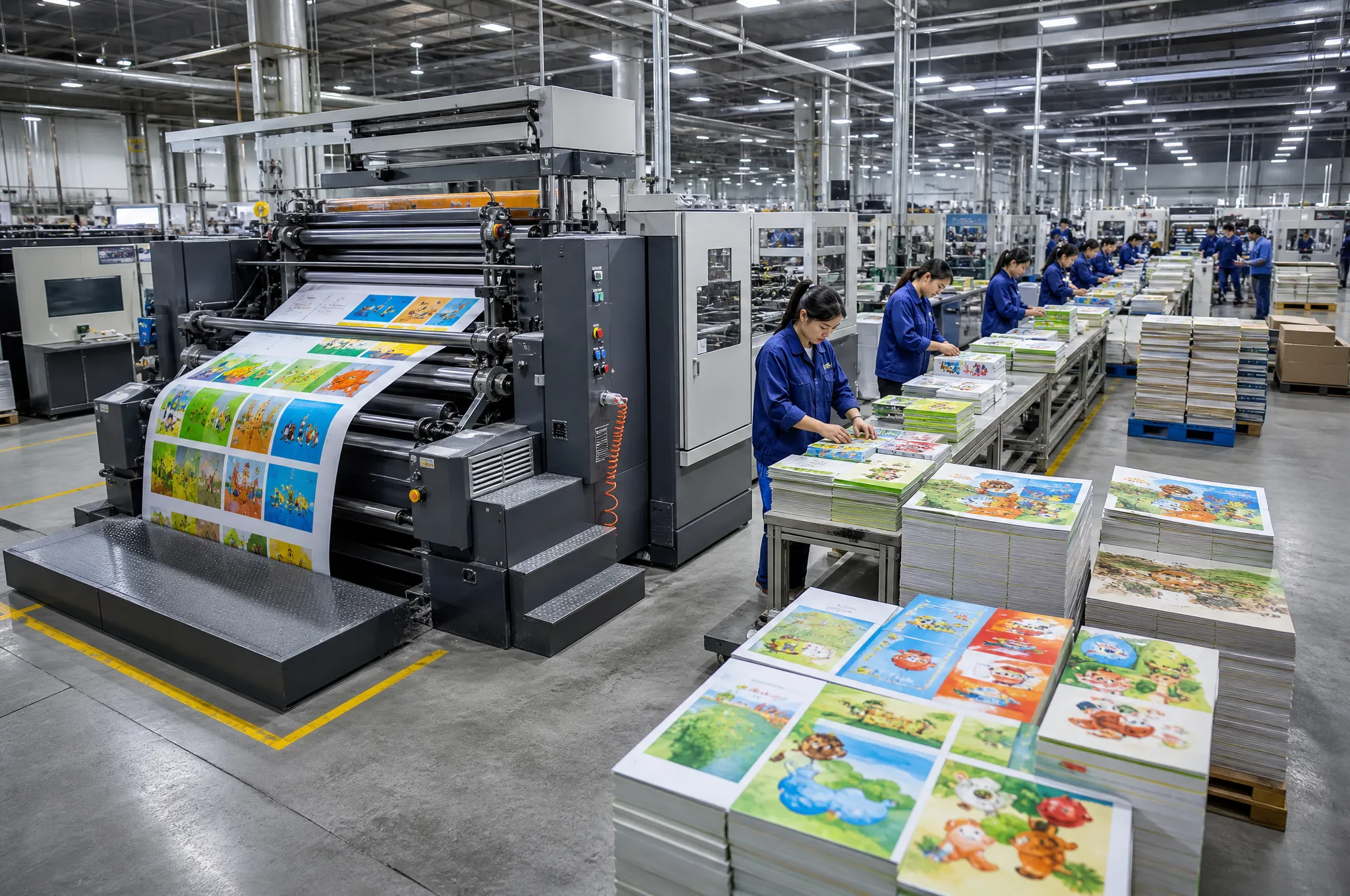
Beyond cost, Chinese children’s book printers have invested heavily in Heidelberg, Komori, and other industry-leading offset presses. They maintain comprehensive in-house capabilities — from pre-press color management to post-press binding and assembly — which means your entire project stays under one roof. This integrated workflow reduces turnaround time and quality-control risks. At EcoPrinting, for example, the production base spans 20,000 square meters with over 100 advanced machines, serving more than 6,000 clients worldwide.
This guide covers every aspect of children’s book printing in China — from choosing the right format and understanding safety standards to navigating costs and selecting a reliable printing partner. Whether you are publishing your first board book or scaling a series of interactive children’s titles, the following sections will equip you with the knowledge you need to make informed decisions.
Types of Children’s Books You Can Print in China
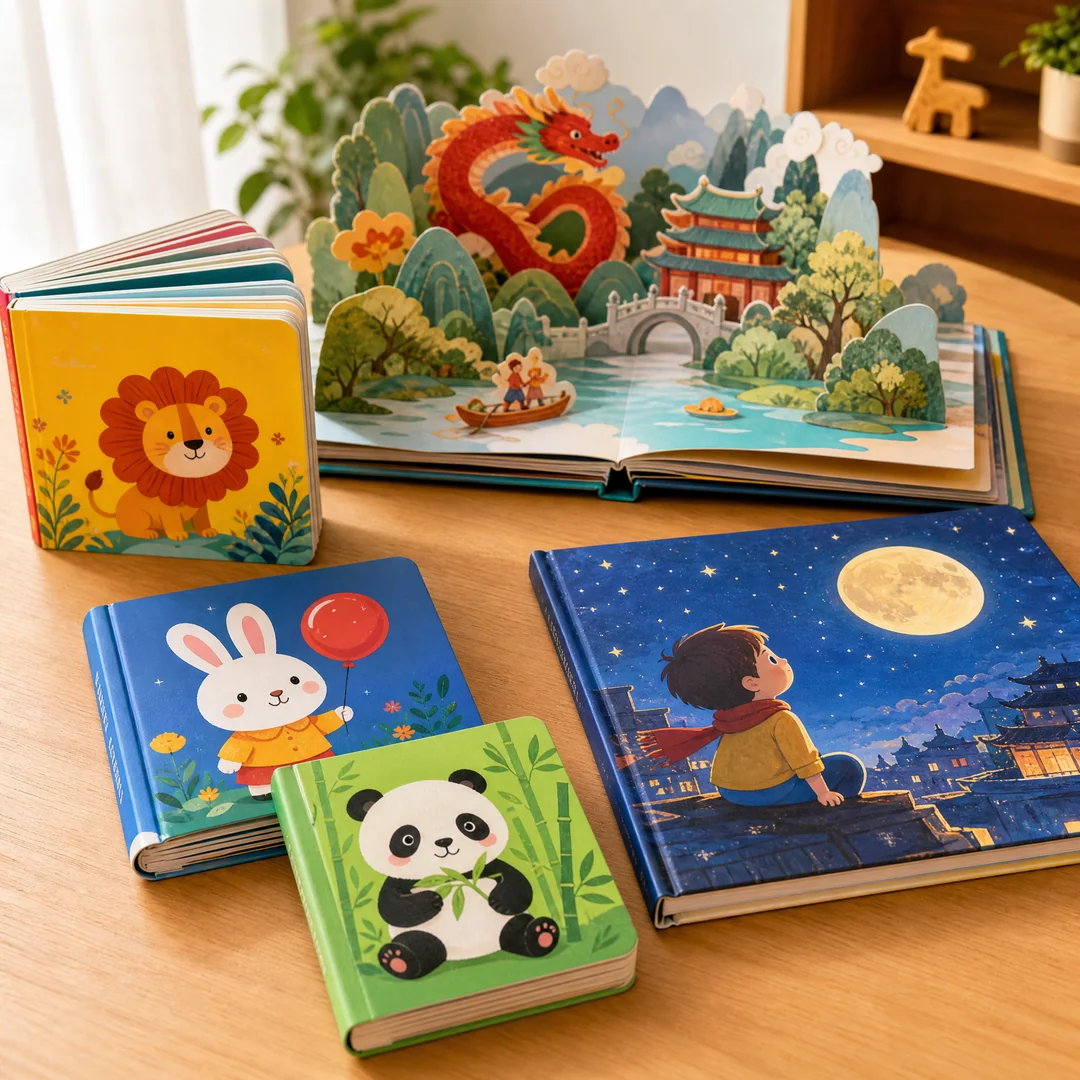
Chinese printing manufacturers support a remarkably wide range of children’s book formats. Understanding the options available helps you match your manuscript to the right production method from the start. Here are the most common types of children’s books printed in China today:
Board Books
Board books are the standard format for babies and toddlers aged 0–3. Each page consists of thick paperboard — typically 350 gsm C1S (Coated One Side) with two sheets mounted together for rigidity. Pages resist bending, tearing, and moisture, making them virtually indestructible in the hands of young children. Common sizes include 6×6, 7×7, and 8×8 inches, with page counts in multiples of 2, usually ranging from 12 to 32 pages. Chinese board book printing facilities offer both self-cover (economical, single-material construction) and hardcover (gray-board case wrapped in printed art paper) formats.
Picture Books
Picture books serve children aged 3–8 and rely on full-color illustrations to tell stories. These are typically printed on 128–170 gsm coated or uncoated art paper, with hardcover or paperback binding. Chinese printers excel at color fidelity for illustrated content, using 4-color offset printing with precise color management systems. Standard picture book sizes range from 8×10 to 11×8.5 inches, with 24–48 pages being the most common range.
Coloring and Activity Books
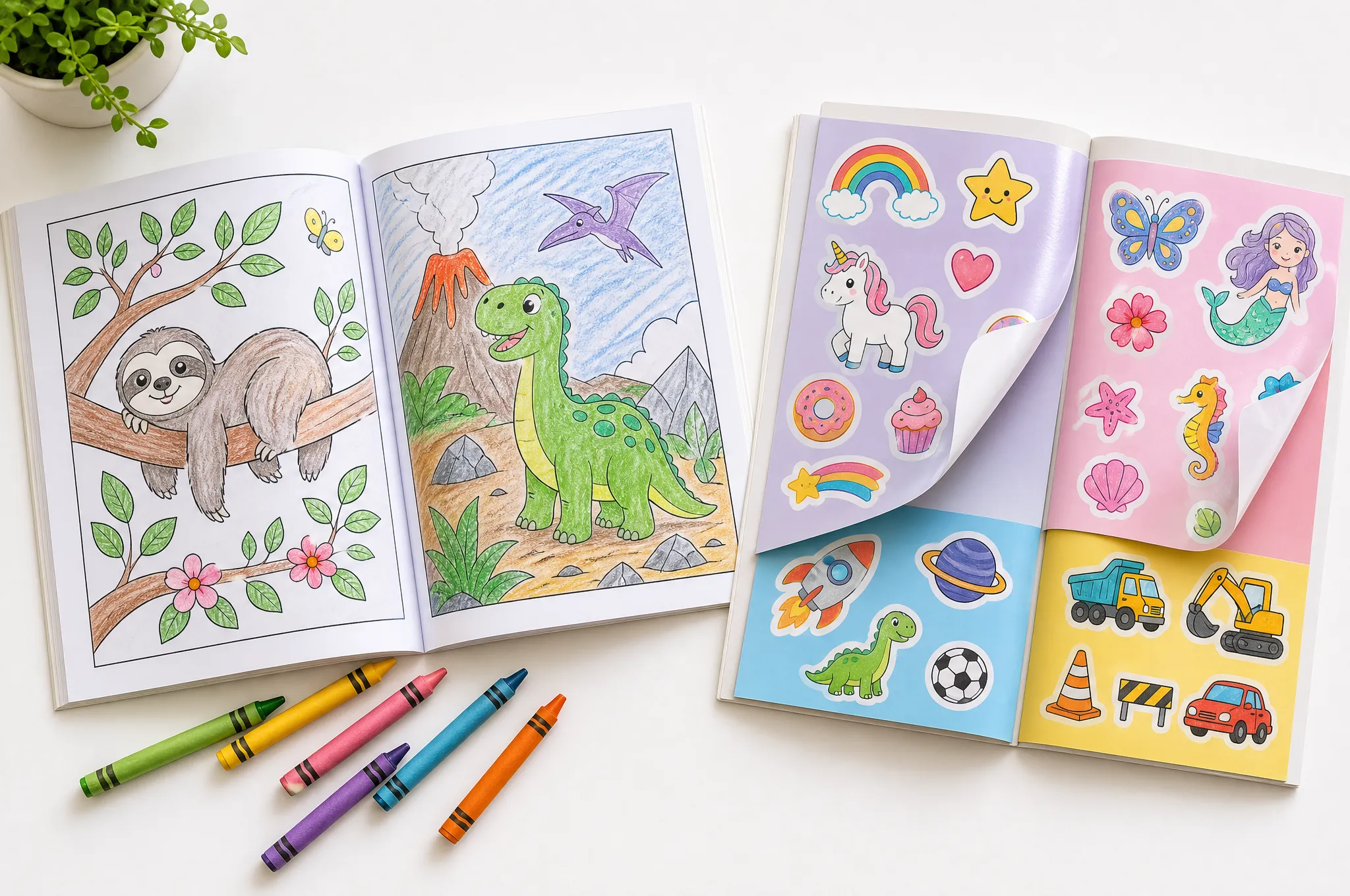
Coloring books and activity books represent a massive segment of children’s book printing in China. These books typically use uncoated paper (80–100 gsm) that accepts crayons, colored pencils, and markers without smudging. Activity books may include puzzles, mazes, connect-the-dots, and other interactive paper-based games. Binding options include saddle stitching for thinner books (up to 48 pages) and perfect binding for thicker volumes.
Sticker Books
Children’s sticker books combine printed pages with repositionable sticker sheets. Chinese printers produce both the book component and the die-cut sticker sheets in-house, ensuring perfect registration between sticker positions and page layouts. Sticker books often use coated paper for the sticker backing and semi-gloss paper for the book pages, with popular sizes including 8×10 and 8.5×11 inches.
Pop-Up and Novelty Books
Pop-up books feature three-dimensional paper engineering that unfolds as children turn each page. This category also includes lift-the-flap books, pull-tab books, carousel books, and tunnel books. Chinese manufacturers employ skilled hand-assembly teams — a labor advantage that keeps pop-up book production economically viable for print runs as low as 1,000 copies.
Sound Books and Interactive Books
Sound books integrate electronic sound modules into printed pages, playing music, sound effects, or narrated text when children press buttons. Chinese factories source and integrate these electronic components alongside the book printing, streamlining what would otherwise require separate vendors. Interactive books may also include touch-and-feel textures, mirror inserts, finger puppets, or magnetic pieces embedded directly into the pages.
Safety Standards and Materials for Children’s Books
Safety is the single most important consideration in children’s book manufacturing. Books intended for children — especially those for children under 12 — must comply with rigorous safety regulations in their destination markets. Printing children’s books in China does not mean compromising on safety; the best Chinese manufacturers operate to international standards and can provide full compliance documentation.
CPSIA and CPC Compliance for the US Market
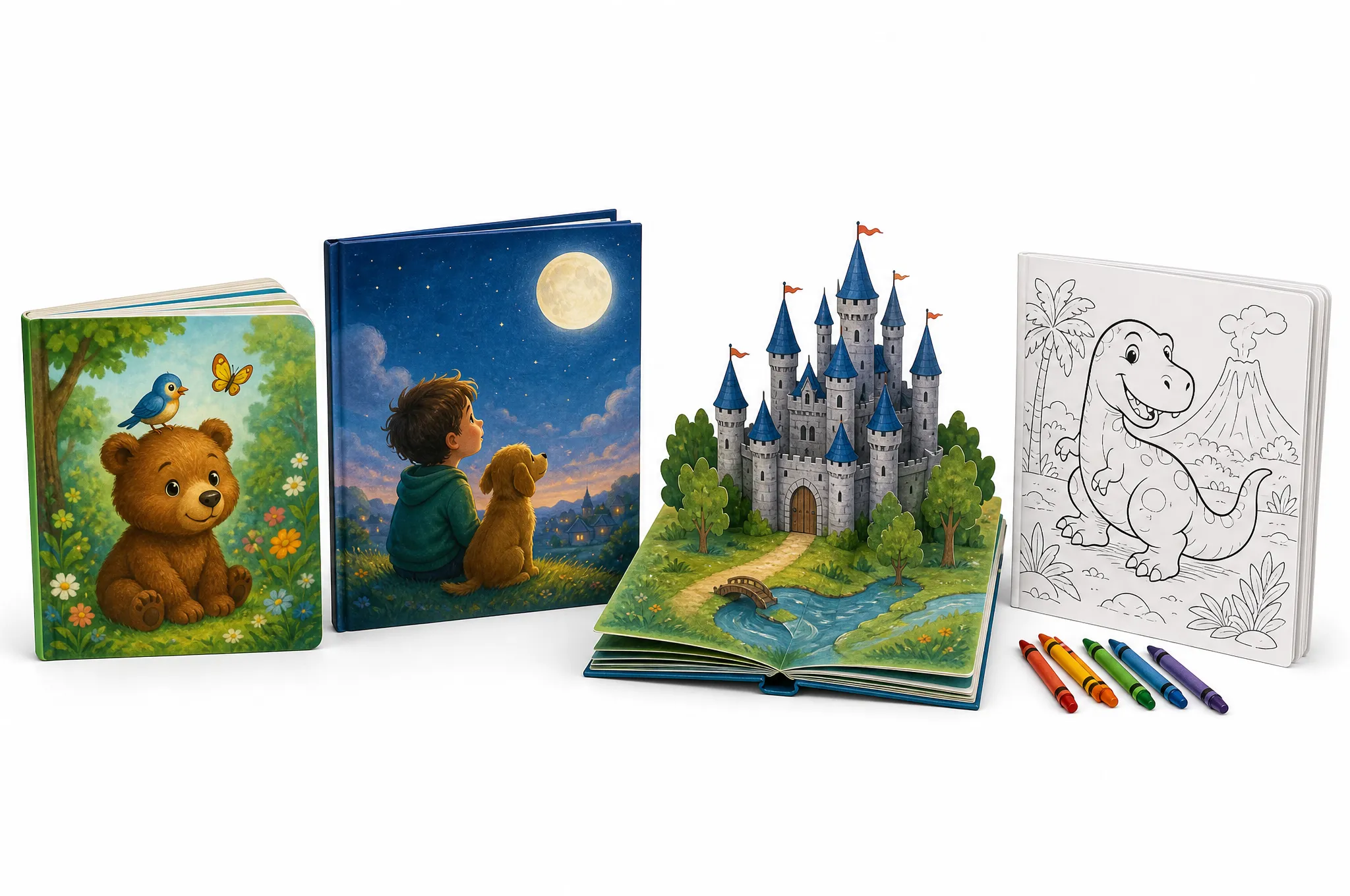
Under the Consumer Product Safety Improvement Act (CPSIA) of 2008, any publisher selling children’s books in the United States must provide certification that the product meets all applicable safety standards. This includes limits on lead content (100 ppm in substrates, 90 ppm in surface coatings) and restrictions on eight specific phthalates. A Children’s Product Certificate (CPC) must be issued based on third-party laboratory testing from a CPSC-accepted lab. Reputable Chinese children’s book printers coordinate this testing through partner laboratories, using soy-based non-toxic inks and lead-free paper as standard production materials.
European Safety Standards: EN71 and CE Marking
For the European market, children’s books must comply with EN71, the European standard for toy safety. Since books for children under 3 are often classified as toys under EU regulations, they require CE marking and must pass EN71-1 (mechanical and physical properties), EN71-2 (flammability), and EN71-3 (migration of certain elements) testing. Chinese printers serving European publishers routinely produce to EN71 specifications, with testing coordinated through recognized European labs.
Materials That Keep Children Safe
The materials used in children’s book printing directly affect both safety and quality. Professional Chinese printers use FSC-certified paper from sustainable forestry, soy-based vegetable inks that are non-toxic and biodegradable, and water-based or UV-cured coatings rather than solvent-based finishes. Rounded corners on board books eliminate sharp edges that could injure toddlers. For books with electronic components, battery compartments are secured with screws to prevent access by small children. These material choices are standard at quality-focused manufacturers like EcoPrinting, not premium add-ons.
International Certifications to Look For
When evaluating a Chinese children’s book printer, ask about their certification portfolio. Key certifications include ISO 9001 (quality management), FSC (sustainable forestry), BSCI (ethical manufacturing and social compliance), and ISO 14001 (environmental management). These certifications indicate that the factory operates under audited systems rather than improvised processes. A reputable printer should provide copies of current certificates on request.
Board Book Printing: Specifications and Options
Board book printing requires specialized production knowledge beyond standard book manufacturing. The thickness, durability, and child-safe construction of board books demand particular attention to materials, binding methods, and finishing techniques. Chinese printers have developed deep expertise in this format because board books represent one of the largest segments of children’s book printing exported from China.
Paper Stock and Construction
The standard material for board book pages is 350 gsm C1S (Coated One Side) paperboard. Two sheets are mounted together — coated sides facing outward — to create a single rigid page approximately 1.5–2.0 mm thick. For books with 40 or more pages, some printers recommend 210 gsm C1S to keep the overall book weight manageable. The mounting process uses water-based adhesives that remain flexible and odor-free after curing. All materials should be lead-free and meet CPSIA substrate requirements.
Self-Cover vs. Hardcover Board Books
Self-cover board books use the same C1S material for both the cover and interior pages, creating a seamless, uniform appearance. This is the most common and economical format, accounting for approximately 95% of the board book market. The entire book receives either gloss or matte lamination for protection. Hardcover board books add a gray-board case wrapped in printed art paper, mounted to the interior block. While 25–35% more expensive per copy, hardcover board books offer a premium retail presentation suitable for gift editions and higher-price-point titles.
Page Count and Size Options
Board books typically contain 12–32 pages in multiples of 2. The most popular sizes are 6×6 inches (ideal for small hands), 7×7 inches, and 8×8 inches. However, Chinese printers can accommodate custom dimensions — square formats dominate the market, but rectangular shapes such as 5×7 or 6×9 inches are also available. Larger format board books exceeding 10×10 inches require thicker board stock to maintain structural rigidity.
Interactive Elements in Board Books
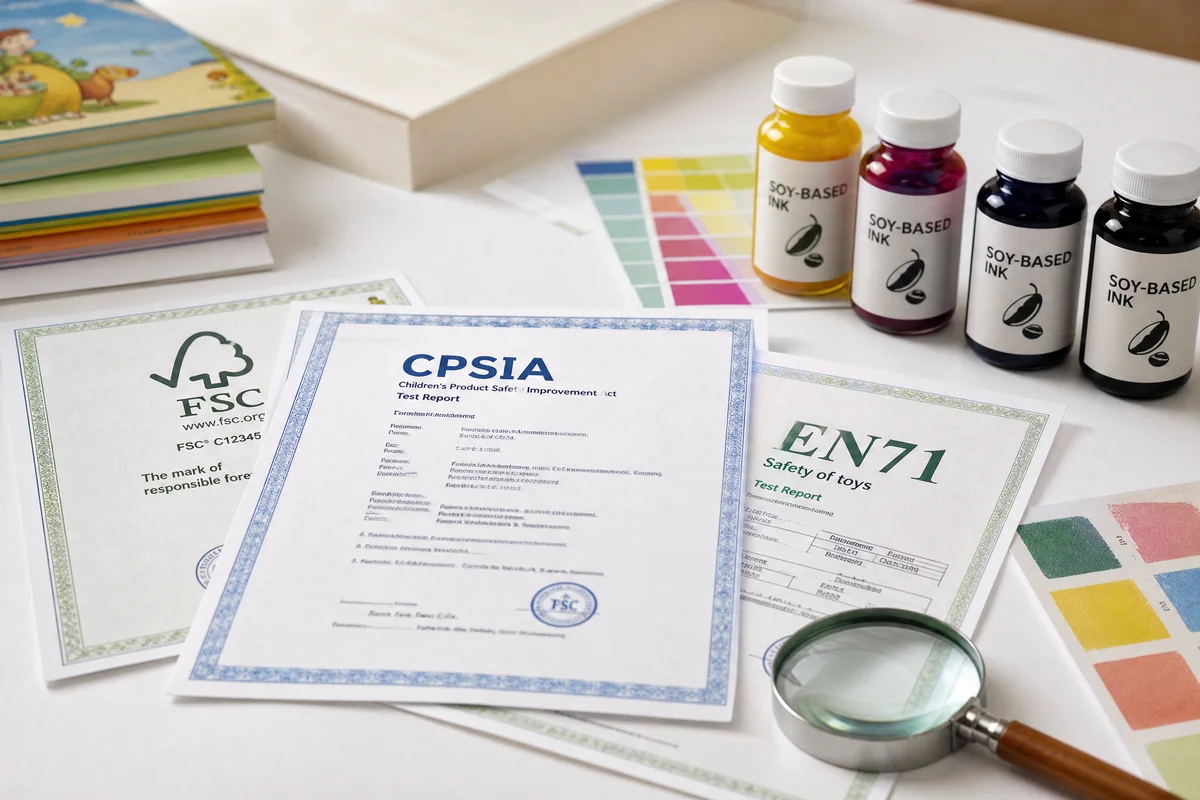
Modern board books frequently incorporate interactive features that engage young readers. Lift-the-flap designs hide images or text beneath die-cut flaps attached to the page. Slide-and-pull tabs move characters or reveal hidden elements. Touch-and-feel textures introduce sensory learning through fabric patches, embossed patterns, or flocked surfaces. Die-cut shapes create peek-through windows and shaped book outlines. These elements require precision manufacturing — flap alignment must be perfect, tabs must slide smoothly without catching, and textured inserts must remain securely attached through repeated use. Experienced Chinese board book printers produce all these features in-house.
Customization: Shapes, Sizes, and Interactive Elements
One of the strongest advantages of children’s book printing in China is the breadth of customization options available. Unlike digital print-on-demand services that restrict you to standard templates, offset printing factories in China can produce virtually any shape, size, or interactive configuration you can design. This section covers the customization possibilities that make your children’s book stand out on bookstore shelves.
Custom Shapes and Die-Cutting
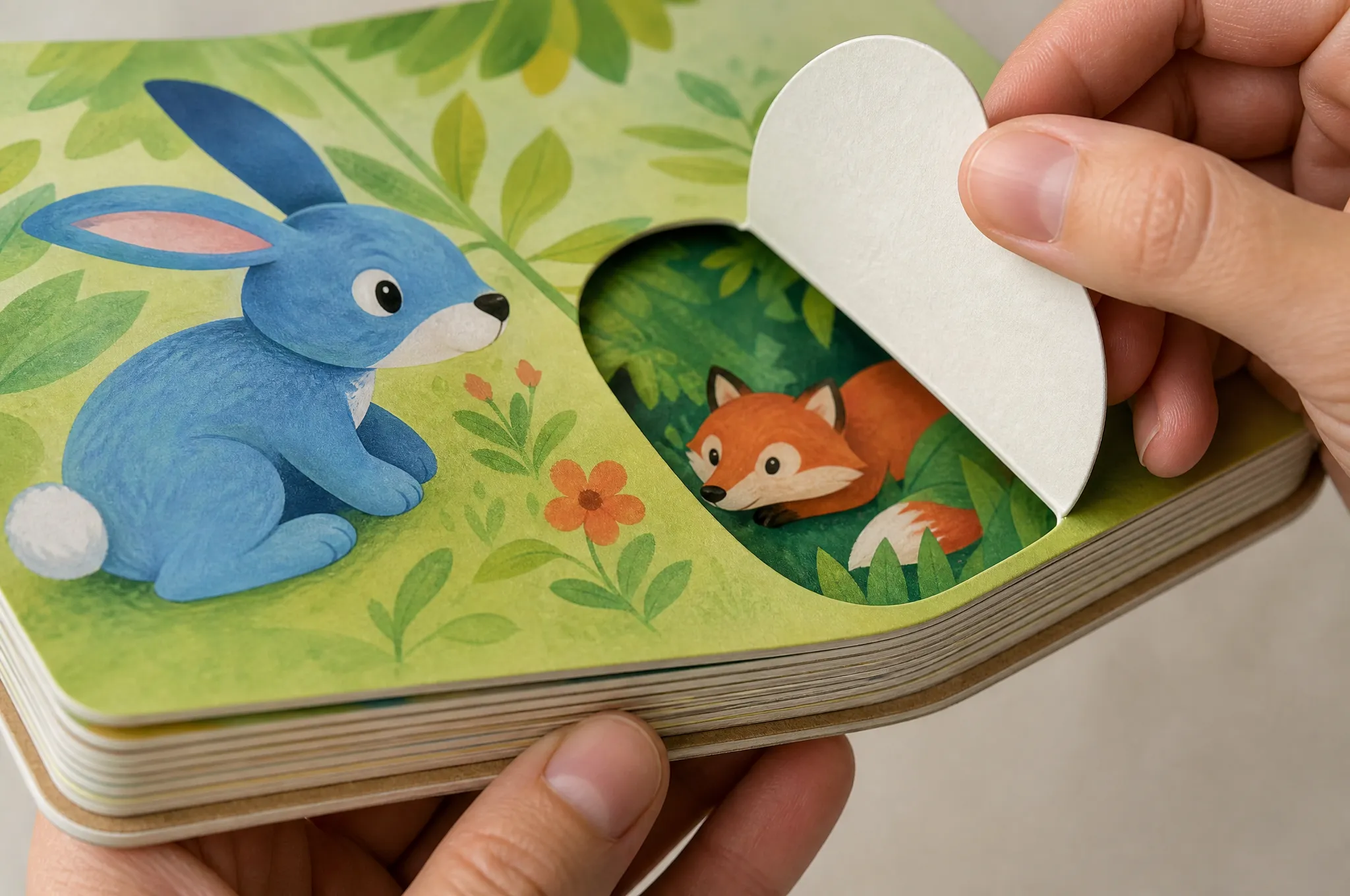
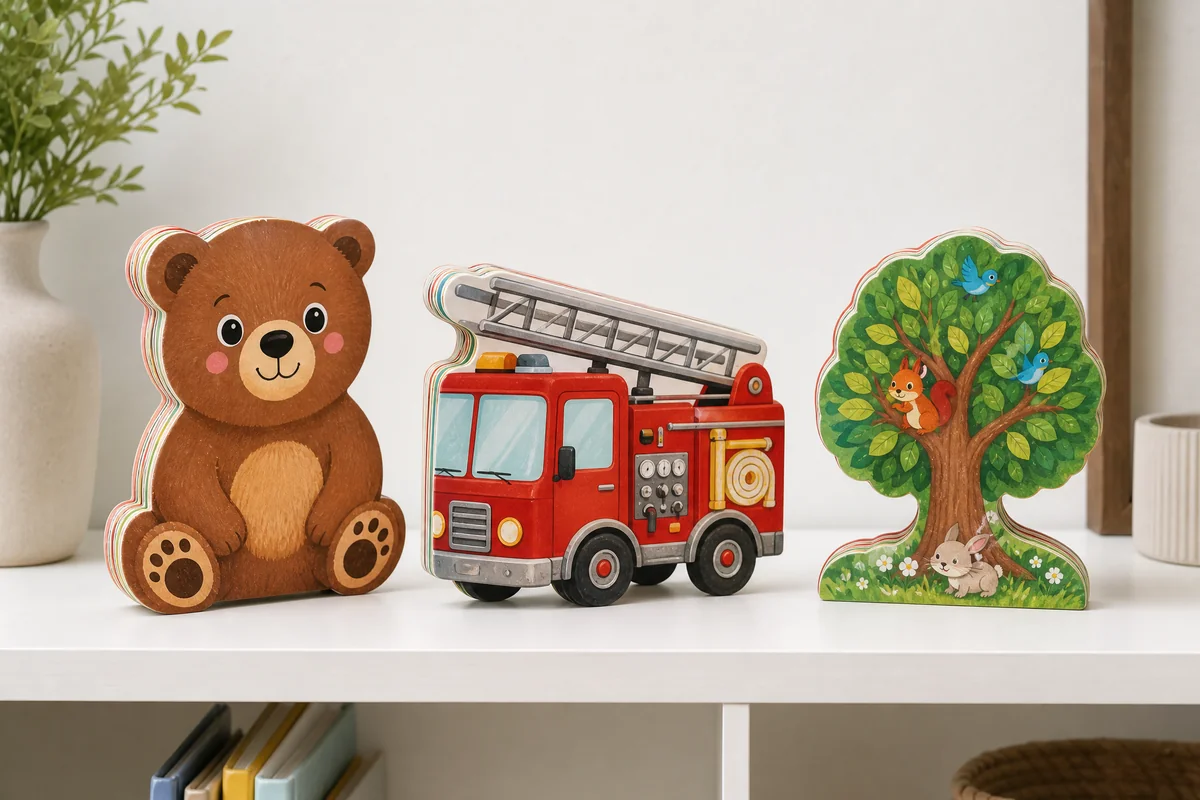
Die-cutting transforms a standard rectangular book into a shaped product that follows the contours of the illustrations — a book shaped like a bear, a car, a tree, or any silhouette that complements your story. Chinese printers create custom steel-rule dies for each project, cutting through the entire book block in a single pass for perfect edge-to-edge registration. Shaped board books are especially popular for baby and toddler titles. The die charge is a one-time setup cost, typically ranging from $50 to $200 depending on complexity, after which the per-unit cost is only marginally higher than a standard rectangular book.
Custom Sizes Beyond Standard
While standard sizes offer cost efficiency by minimizing paper waste, Chinese offset printers can produce children’s books in any dimensions you specify. Vertical formats (portrait), horizontal formats (landscape), and square formats are all equally feasible. Some publishers choose unusual sizes — 9×6 inches for a horizontal picture book, 5×5 inches for a travel-sized board book, or 12×12 inches for a large-format gift book — to differentiate their titles in the market. The key consideration is that custom sizes may increase the cost-per-page if they do not optimize the press sheet layout.
Interactive and Sensory Elements
Beyond the lift-the-flap and slider mechanisms covered in the board book section, Chinese manufacturers offer an extensive range of interactive elements. These include rotating wheels that change images as children spin them, pop-up structures that create three-dimensional scenes, musical sound chips triggered by button presses, light-up modules integrated into story sequences, mirror inserts for self-recognition play, fabric patches with varied textures, magnetic closure flaps, and attached plush components. Each element adds production complexity and cost, but the result is a distinctive reading experience that commands higher retail prices and creates lasting brand impressions.
Special Finishes and Embellishments
Finishing techniques add tactile and visual appeal to children’s books. Spot UV coating creates selective gloss highlights over specific illustration elements. Foil stamping applies metallic gold, silver, or colored foil to titles and design accents. Embossing and debossing create raised or recessed textures on the cover. Glitter varnish adds sparkle to fantasy and fairy-tale illustrations. Scented coatings can even introduce fragrance elements tied to the story. Chinese printing factories offer all these finishing options with experienced operators who understand how to achieve consistent results across production runs.
Coloring and Activity Book Printing
Coloring books and activity books are among the most popular categories in children’s book publishing, and China is the world’s leading producer of these formats. The category encompasses traditional coloring books, puzzle and maze books, dot-to-dot books, sticker activity books, and educational workbooks. Each sub-type has specific paper, binding, and printing requirements that Chinese manufacturers handle with established production workflows.
Paper Selection for Coloring Books
The paper choice for a coloring book directly affects the user experience. Uncoated offset paper in the 80–100 gsm range provides the ideal surface for crayons, colored pencils, and most markers. Heavier 120 gsm uncoated paper prevents bleed-through for books designed for marker or watercolor use. For double-sided coloring books, the paper must be opaque enough to prevent show-through from the reverse side. Chinese printers stock a wide range of uncoated paper stocks and can provide samples before production begins. Some publishers choose a cream or natural white shade rather than bright white to reduce eye strain for younger children.
Binding Methods for Activity Books
Saddle stitching works well for coloring and activity books up to 48 pages, providing a lay-flat opening that makes it easy for children to draw across the full page. For thicker activity books, perfect binding with a flexible glue provides durability while still allowing reasonable page opening. Spiral and wire-o binding are premium options that deliver complete lay-flat functionality — children can fold the book completely open to a single page, which is especially valuable for right-handed and left-handed users alike. Chinese printers offer all these binding methods, with spiral and wire-o binding typically adding $0.30–$0.80 per copy depending on book size and page count.
Sticker Integration in Activity Books
Many activity books include sticker sheets that children peel and place on designated pages. Chinese children’s book printers produce the entire product — printed book plus die-cut sticker sheets — under one roof. Sticker sheets are printed on coated label stock with a release liner, then die-cut to the required sticker shapes. The sheets are inserted at the appropriate pages during the binding process or packaged in a sealed envelope attached to the inside cover. Registration between sticker shapes and their intended page positions requires careful pre-press coordination between the sticker artwork and the book page layout.
Full-Color vs. Black-and-White Printing
Coloring books are typically printed in black and white using single-color (1/1) offset printing, which keeps production costs low. However, many publishers now produce hybrid activity books with full-color (4/4) instruction pages and black-and-white activity pages. Chinese printers can mix color and monochrome signatures within a single book, printing the color sections on coated paper and the activity sections on uncoated paper, then collating everything during binding. This approach maximizes visual appeal for the instructional content while keeping the coloring pages practical and affordable.
Pop-Up and Novelty Book Printing
Pop-up books represent the pinnacle of paper engineering in children’s publishing. These books transform two-dimensional pages into three-dimensional scenes through intricate folding mechanisms that deploy as the reader turns each page. China’s position as the global leader in pop-up book printing stems from its unique combination of advanced die-cutting equipment and skilled hand-assembly labor — a combination that few other countries can match at a competitive price point.
How Pop-Up Books Are Made
The production of a pop-up book begins during the design phase. Every pop-up mechanism — V-folds, parallel folds, angle folds, rotary mechanisms, and pull-tab activators — must be engineered in the design file before printing. Chinese pop-up book printers offer paper engineering services, converting flat artwork into functional pop-up templates. Once the design is finalized, the components are printed on C1S paper (typically 250–350 gsm for structural pieces and 157–200 gsm for decorative overlays), then die-cut to precise shapes using custom steel-rule dies.
After die-cutting, skilled hand-assembly teams fold and glue each mechanism according to detailed assembly instructions. This is the most labor-intensive phase of pop-up book production. A complex pop-up book with 5–7 spreads may involve over 100 individually die-cut and folded pieces, each requiring precise placement and adhesive application. Chinese factories maintain dedicated pop-up assembly lines where workers specialize in specific mechanism types, achieving both speed and consistency.
Common Pop-Up Book Formats
Standard children’s pop-up books typically contain 5–7 pop-up spreads (10–14 pages) with 1–3 mechanisms per spread. Popular sizes include 8×8, 7.5×9.5, and 10×10 inches. However, pop-up books are not restricted to standard dimensions — many publishers commission custom sizes that suit their specific content. Carousel books open 360 degrees and tie closed with ribbons to create a freestanding display. Tunnel books use layered cut-paper scenes viewed through an aperture. Panorama books unfold horizontally to reveal extended landscapes. Chinese printers produce all these formats.
Quality Control for Pop-Up Mechanisms
Pop-up books require rigorous quality control because any misalignment in the mechanism causes it to catch, tear, or fail to deploy properly. Professional Chinese pop-up printers conduct 100% functional testing — every single book is opened, all mechanisms are checked, and any defective copies are rejected. This is followed by batch-level sampling audits. When ordering pop-up book printing from China, you should confirm that the printer performs full functional testing rather than statistical sampling, as pop-up mechanisms have a higher defect rate than standard printed pages.
Lead Times and MOQs for Pop-Up Books
Due to the hand-assembly requirement, pop-up book production takes longer than standard book printing. Typical lead times range from 6–10 weeks from file approval to shipment, depending on the complexity of the mechanisms and the order quantity. Minimum order quantities for pop-up book printing in China typically start at 500–1,000 copies, with per-unit costs decreasing significantly at 3,000, 5,000, and 10,000+ copy thresholds. The die costs — usually $80–$300 per mechanism depending on complexity — represent a one-time setup charge amortized across the print run.
The Printing Process for Children’s Books
Understanding the children’s book printing process helps you communicate effectively with your printer, anticipate lead times, and identify where quality issues might arise. Here is a step-by-step walkthrough of how a children’s book moves from digital files to finished product in a Chinese offset printing facility.
Step 1: File Preparation and Pre-Press
The process begins when you submit print-ready PDF files to the printer. Pre-press technicians check your files for common issues: resolution below 300 DPI, fonts not embedded or outlined, color space set to RGB instead of CMYK, bleed areas missing or insufficient, trim marks incorrectly placed, and image overprint settings that could cause unexpected results. At EcoPrinting, the pre-press team provides a detailed file-check report within 24–48 hours, flagging any issues and offering correction recommendations before proceeding.
Step 2: Digital Proofing and Color Calibration
Once files pass pre-press checks, the printer produces a digital proof — either a soft proof (PDF for on-screen review) or a hard proof (printed sample on the actual paper stock). For children’s picture books where color fidelity is critical, always request a hard proof printed on production paper. Chinese printers calibrate their presses to ISO 12647-2 color standards, but requesting a press check (either on-site or via live video) adds an additional layer of quality assurance for color-critical projects.
Step 3: Plate Making and Press Setup
After proof approval, the printer creates aluminum printing plates — one plate per color (Cyan, Magenta, Yellow, Black) per press form. Modern Chinese printing facilities use computer-to-plate (CTP) technology that transfers digital files directly to plates without intermediate film, preserving image sharpness. Press operators then mount the plates on Heidelberg or Komori offset presses, calibrate ink density across the sheet, and run make-ready sheets until color registration and density match the approved proof.
Step 4: Offset Printing
The actual printing happens at speeds of 10,000–15,000 sheets per hour on modern offset presses. For children’s books, the press configuration matters: 4-color presses print CMYK in a single pass, while 5-color or 6-color presses can add spot colors, coatings, or special inks inline. Sheet-fed offset presses handle paper sizes up to 28×40 inches, with multiple book pages imposed onto each sheet in an arrangement that optimizes paper usage and ensures correct page order after folding.
Step 5: Post-Press — Folding, Gathering, and Binding
Printed sheets move to the bindery, where folding machines create signatures (groups of pages folded together). Gathering machines collate signatures in the correct sequence. The binding method depends on the book type: saddle stitching for thin books, perfect binding (PUR or EVA adhesive) for paperbacks, and case binding (sewn signatures glued into a hard case) for hardcover books. Board books use a mounting process where printed C1S sheets are glued back-to-back to create rigid pages, with the entire block trimmed to final size.
Step 6: Finishing and Quality Inspection
The final stage includes lamination (gloss or matte film applied to covers), any specialty finishing (foil stamping, embossing, spot UV), and three-knife trimming to final trim size. Each book then passes through quality inspection — Chinese printers committed to international standards inspect for binding strength, page alignment, color consistency, lamination adhesion, and overall appearance. Defective copies are removed before packing. Books are then shrink-wrapped in bundles, packed in export-grade corrugated cartons, palletized, and prepared for shipping via sea freight or air freight.
Cost Guide for Children’s Book Printing in China
Cost is one of the primary reasons publishers choose children’s book printing in China, but understanding the full cost structure — not just the unit price — is essential for accurate budgeting. This section breaks down the components that determine your total project cost and provides realistic benchmarks for common children’s book formats.
Key Cost Drivers
Several factors determine the cost of printing children’s books in China. The print run quantity has the largest impact — offset printing has high setup costs but low marginal costs, so unit prices drop dramatically as quantity increases. A board book costing $2.50 per copy at 1,000 units might cost $1.20 at 5,000 units and $0.70 at 10,000 units. Page count and book dimensions affect paper consumption, which is the largest material cost. Full-color (4/4) printing costs more than single-color (1/1) because it uses four ink stations and four plates per form. Binding complexity ranges from simple saddle stitching (least expensive) to hardcover case binding (most expensive). Special finishes and interactive elements — foil stamping, die-cutting, hand assembly for pop-ups — each add incremental cost and extend production time.
Realistic Price Benchmarks (FOB China, 2025–2026)
The following benchmarks provide a realistic starting point for budgeting. Actual quotes will vary based on specific specifications, paper choices, and current material prices. Board books (6×6 inches, 24 pages, 4/4 color, self-cover, gloss lamination) range from approximately $1.50–$2.50 per unit at 1,000 copies, dropping to $0.60–$0.90 at 5,000 copies and $0.40–$0.60 at 10,000+ copies. Hardcover picture books (8.5×8.5 inches, 32 pages, 4/4 color, case bound with dust jacket) range from $3.00–$5.00 at 1,000 copies to $1.50–$2.20 at 5,000 copies. Coloring books (8.5×11 inches, 48 pages, 1/1, saddle stitched) start at $0.70–$1.20 at 1,000 copies, falling to $0.25–$0.40 at 5,000 copies. Pop-up books (8×8 inches, 5 spreads, 4/4 color) are the most variable, ranging from $4.00–$8.00 at 2,000 copies depending on mechanism complexity.
Beyond Unit Cost: Freight, Duties, and Landed Cost
The FOB price only tells part of the story. Sea freight from Chinese ports (Shenzhen, Shanghai, Ningbo) to major Western ports (Los Angeles, Rotterdam, Felixstowe) typically adds $0.10–$0.30 per book for a full-container shipment, with transit times of 25–35 days. Air freight delivers in 5–7 days but costs 3–5 times more — only recommended for small, urgent orders. Customs duties vary by destination country: the United States applies a 7.5% Section 301 tariff on children’s books from China, while the European Union and the United Kingdom generally impose 0% duties on printed books. Customs brokerage, port handling, and inland trucking add approximately $300–$600 per shipment for LCL (less-than-container-load) and $800–$1,500 for FCL (full-container-load). The most accurate cost metric is your DDP landed cost — the all-inclusive price delivered to your warehouse door.
Sample Landed Cost Calculation
Consider a 5,000-copy children’s board book project: 6×6 inches, 24 pages, 4/4 color, self-cover. At $0.80 FOB per copy, the printing cost is $4,000. Sea freight with customs clearance and duties via DDP shipping might add $1,100, bringing the landed cost to $5,100 — approximately $1.02 per copy delivered to your US warehouse. The same book printed domestically in the US might cost $1.60–$2.40 per copy, representing savings of 35–55% by printing in China.
For detailed pricing on your specific project, request a quote with your book specifications, desired print quantity, and delivery destination. Most Chinese printers provide quotes within 24–48 hours.
How to Choose a Children’s Book Printer in China
With thousands of printing companies operating in China, selecting the right partner for your children’s book project requires a structured evaluation process. Price matters, but it should not be your only criterion — quality consistency, communication capability, compliance knowledge, and reliability are equally important for a successful outcome.
Evaluate Communication and English Proficiency
Clear communication prevents costly mistakes. Your printer’s sales and project management team should communicate fluently in English, respond to emails within one business day, and proactively clarify any ambiguities in your files or specifications. During your initial interactions, assess whether they ask thoughtful questions about your project or simply quote a price. The best printers serve as consultative partners — they will point out potential production issues, suggest cost-saving alternatives, and explain trade-offs before you commit. A printer who only talks about price and never about quality is a red flag.
Verify Certifications and Factory Credentials
Request copies of current certifications: ISO 9001 for quality management systems, FSC for sustainable paper sourcing, BSCI or SMETA for ethical manufacturing and social compliance. If your books will contain electronic components (sound modules, lights), ask about ISO 14001 environmental certification and RoHS compliance. Legitimate printers provide these documents without hesitation. Consider requesting a factory video tour or scheduling a live video walkthrough to confirm that the facility matches what they claim. A print broker who cannot or will not disclose the actual factory is another warning sign.
Request Production Samples Relevant to Your Project
Always ask for samples of children’s books similar to what you plan to produce — board books if you are printing a board book, pop-up books if your project includes mechanisms. Review the samples carefully: check lamination adhesion at the corners, binding strength, color consistency across pages, alignment of die-cut shapes, and overall tactile quality. Production samples reflect the printer’s typical output better than carefully selected showroom samples. Pay special attention to the interior paper stock — it should feel substantial in hand, not flimsy.
Understand Safety Compliance Capabilities
For books sold in the US or EU, your printer must understand and support the relevant safety standards. Ask specifically about their experience with CPSIA/CPC (US) and EN71/CE (EU) compliance. A knowledgeable printer will explain their testing process, recommend accredited third-party labs, and coordinate sample submission. Be wary of printers who claim their products “always pass” without explaining how — safety compliance requires documentation, not assertions.
Compare Total Landed Cost, Not Just Unit Price
When comparing quotes from multiple printers, always request DDP pricing that includes printing, freight, customs clearance, and import duties delivered to your specified address. A printer quoting $0.70 FOB might end up more expensive than one quoting $0.85 DDP once freight and customs costs are added. Also verify payment terms, production timelines, and what happens if the shipment arrives damaged or with quality defects. A slightly higher per-unit price from a printer with strong quality guarantees and responsive after-sales support often delivers better value than the lowest bid.
If you are ready to start your children’s book project, EcoPrinting’s book printing team can provide a detailed quotation, production samples, and a guided walkthrough of the printing process tailored to your specific requirements.
Frequently Asked Questions
Is it safe to print children’s books in China?
Yes, when you work with a reputable, certified printer. Professional Chinese children’s book manufacturers use non-toxic soy-based inks, lead-free paper, and FSC-certified materials. They coordinate third-party safety testing through CPSC-accepted labs for US CPSIA/CPC compliance and through recognized labs for EU EN71/CE requirements. The key is to verify your printer’s certifications and testing process rather than assuming all Chinese printers maintain the same standards. Ask for documentation before placing your order.
What is the minimum order quantity for children’s book printing in China?
Minimum order quantities (MOQs) vary by book type and printer. Standard board books and picture books typically start at 500–1,000 copies. Coloring and activity books may start at 300–500 copies due to simpler production. Pop-up and novelty books usually require 500–1,000 copies minimum because of the hand-assembly labor involved. Some printers offer lower MOQs (100–300 copies) at higher per-unit prices for self-publishing authors testing the market. Always confirm the MOQ during the quotation process, as it directly affects your per-unit cost.
How long does children’s book printing in China take?
Production timelines range from 4–8 weeks depending on the book type. Standard board books and picture books typically require 4–5 weeks for production. Pop-up books and books with extensive interactive elements need 6–10 weeks due to hand-assembly. Shipping adds 25–35 days for sea freight or 5–7 days for air freight. A complete timeline from file submission to delivery at your US warehouse averages 8–12 weeks for sea freight shipments. Rush production (3–4 weeks) is available from some printers at a 15–25% surcharge.
Can I get a sample before committing to a full print run?
Absolutely. Most Chinese children’s book printers offer two types of pre-production samples. A digital proof or printed hard proof shows color and layout accuracy before production begins and costs $30–$80 including courier delivery. A pre-production sample (PPS) is a single copy produced on the actual production line using the final materials — it represents exactly what you will receive in the full print run. PPS costs $100–$300 depending on the book’s complexity but provides the highest confidence before committing to a large order. Always request a PPS for complex books, especially pop-ups or books with multiple interactive features.
How do I ship children’s books from China to my country?
Most publishers use sea freight for cost efficiency. A full container (20-foot or 40-foot) offers the lowest per-unit shipping cost but requires enough volume to fill it — typically 5,000–15,000+ books depending on size. Smaller orders ship via LCL (less-than-container-load) sea freight or express air freight. DDP shipping services handle the entire logistics chain — factory pickup, export documentation, ocean freight, customs clearance, import duties, and final delivery to your address — for a single all-inclusive price. DDP eliminates the complexity of managing logistics across multiple countries and is the recommended shipping method for first-time importers.
What file format should I use to submit my children’s book artwork?
Submit print-ready PDF files in the PDF/X-1a or PDF/X-4 format. All images must be at least 300 DPI at the print size. Fonts should be embedded or outlined to text. Color mode must be CMYK, not RGB. Include 3 mm (0.125 inch) bleed beyond the trim edge on all sides. Define the trim, bleed, and safety margins clearly. For board books, provide separate files for the cover and interior spreads, with spreads arranged in reader order. For pop-up books, provide both the flat artwork and a die-line file showing cut and fold positions. Your printer’s pre-press team will review your files and notify you of any issues before production begins.
Do I own the copyright to books printed in China?
Yes. The copyright and intellectual property of your book content remain entirely yours. Printing in China is a manufacturing service — the printer produces physical copies of your intellectual property but does not acquire any ownership rights. Reputable printers include IP protection clauses in their contracts and will sign non-disclosure agreements (NDAs) on request. For additional protection, register your copyright in your home country before sending files to any printer, and keep dated records of file transfers.
Making the Right Choice for Your Children’s Book
Children’s book printing in China offers a compelling combination of quality, customization, and cost efficiency that has made it the default choice for publishers worldwide. From board books that survive toddler handling to intricate pop-up books that inspire wonder, Chinese printing manufacturers have the technology, materials, and expertise to bring your creative vision to life at a competitive price.
The key to a successful project lies in choosing the right partner. Look for a printer with relevant certifications, strong English communication, demonstrated experience with your book type, and a transparent approach to safety compliance. Insist on pre-production samples for complex books. Compare total landed costs, not just unit prices. And build a relationship that treats your printer as a production partner rather than a transactional vendor — the best results come from collaborative working relationships that span multiple titles.
Whether you are a self-publishing parent, an independent author, or an established publisher expanding your children’s list, printing in China can reduce your production costs by 30–55% while maintaining or exceeding the quality standards of domestic printing. Start by requesting samples and quotations from several certified printers, and compare them carefully against the criteria in this guide. For personalized guidance on your children’s book project, contact EcoPrinting’s team for a free consultation and detailed quotation tailored to your specifications.
Related Guides