Three Products, One Supply Chain: Why Businesses Source Invoice, Coupon, and Scratch-Off Books from China
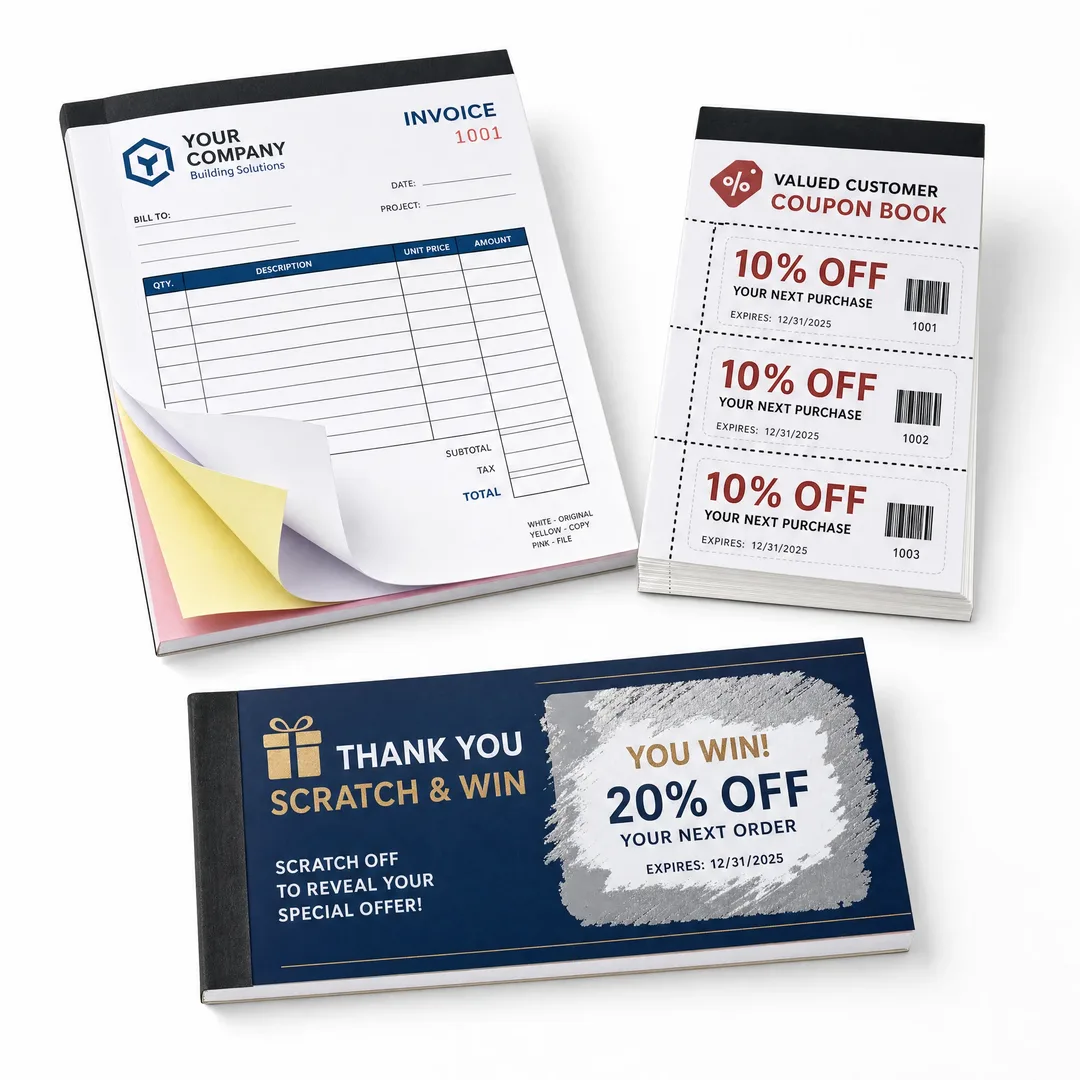
Invoice books, coupon books, and scratch-off books look like separate product categories. Walk through a mid-size printing factory in Shenzhen, though, and you will see all three running on the same floor, often on the same presses. They share the same core competencies: carbonless paper handling, perforation technology, sequential numbering, and specialized binding. A factory that prints 50,000 3-part NCR invoice books this month probably ran perforated coupon booklets last month and scratch-off quiz books the month before. The Chinese printing supply chain can handle all three under one roof—but each product carries its own technical pitfalls. Knowing the difference between “cheap enough” and “built right” saves you from a warehouse full of unusable stock. This guide covers materials, processes, binding methods, and cost levers so you can brief a supplier with confidence.
Invoice Book Printing: Carbonless Paper, Numbering, and the Details That Matter
How NCR Carbonless Paper Actually Works
NCR stands for “no carbon required,” and the name tells the story. Before NCR paper existed in the 1950s, duplicate forms used a sheet of carbon paper sandwiched between two sheets of plain bond—messy, smudge-prone, and wasteful. NCR paper eliminates the carbon sheet by building the transfer chemistry directly into the paper. Each sheet is coated on the back with microscopic capsules of colorless dye dissolved in oil. When you write on the top sheet, the pressure from the pen tip ruptures those capsules, releasing the dye onto the front of the sheet below. That second sheet has a clay-based coating on its front surface that reacts with the dye and develops the color instantly. A 2-part NCR set is a coated-back (CB) sheet on top and a coated-front (CF) sheet underneath. A 3-part set adds a middle sheet that is coated on both sides (CFB). A 4-part set stacks CB, CFB, CFB, CF. Each extra part reduces image clarity slightly—by the fourth or fifth copy, the bottom sheet will be noticeably lighter than the top. For most business use, 2-part and 3-part invoice books are the sweet spot. Chinese mills produce 45–55 gsm NCR stock for multi-part books (lighter weight improves image transfer between layers) and 60–80 gsm for single-layer books where durability matters more.
Ply Count and Color Sequence
The standard color sequence in a 3-part invoice book is white on top, canary yellow in the middle, and pink on the bottom. This is not arbitrary—the contrasting colors make it immediately obvious which copy is the customer copy, which goes to accounting, and which stays in the book as the office record. Most Chinese printers offer this exact sequence as their default, but you can specify custom colors for any position. A distribution company in Texas I spoke with uses white-green-blue for their 3-part delivery notes so the warehouse, driver, and customer each get a distinct color. The only limitation is that darker base colors produce fainter image transfer—a navy blue sheet on the bottom will show handwriting less clearly than pink or canary. Standard ply counts range from 1 to 6, though going beyond 4 parts requires heavier writing pressure and tends to frustrate users with ballpoint pens. For invoices that need more than four copies, many businesses now pair a 2-part or 3-part NCR book with a digital scan-and-email workflow rather than pushing the physical carbonless technology to its limit.
Binding and Adhesive Options for Invoice Books
Invoice books need to strike a balance between keeping pages together and letting them tear out cleanly. The most common binding method is edge gluing—a flexible adhesive applied along the top, left, or right edge of the pad. Top-edge glue is standard for countertop pads and receipt books where you need to pull one set upward. Left-edge glue suits landscape-format books. Right-edge glue is the classic choice for portrait-format books that sit on a desk. Most Chinese factories use a rubber-based or hot-melt adhesive that holds the pad together during storage and transit but releases individual sheets with a clean tear. The glue bead is typically applied 3–5 mm deep along the edge—too shallow and sheets detach in shipping, too deep and the stub left behind is unsightly. Side wire binding (stitching) is the other common option, which punches holes and uses metal wire staples along the side, then wraps the assembly in a heavy cardstock cover. Wire binding costs more per unit but produces a book that lies flat and holds up to years of shelf storage. For invoice books stored in filing cabinets or used by field technicians who toss them in a truck cab, wire binding with a protective cover beats glue every time. Expect to pay $0.08–$0.25 more per unit for wire binding versus glue, with the premium shrinking at quantities above 2,000.
Sequential Numbering and Custom Features
Every invoice book needs unique identifiers. Sequential numbering—usually printed in red ink in the top-right corner of each form—is the standard. Most Chinese printers run numbering jobs on letterpress numbering machines that increment automatically as the press feeds. You can specify the starting number, the number of digits (typically 4 to 8), the ink color (red is standard, black is available), and whether the numbering repeats on every ply of a multi-part set. The number on each ply should be printed individually, not transferred through the carbonless coating—a shortcut some low-cost suppliers take that produces blurry, unreadable numbers on the lower copies. Additional customization includes perforation lines for clean tear-out, drill holes for 3-ring binder storage (typically punched at 8.5-inch centers for US letter-size forms), chipboard backing (250–300 gsm greyboard glued to the back of the pad for writing support), and full-color printed covers in kraft or coated paper. A 3-part A5 invoice book with 50 sets, sequential numbering, top-edge glue, chipboard back, and a printed kraft cover costs roughly $0.65–$1.20 per book at 1,000 units from a mid-tier Chinese supplier.
Coupon Book Printing: Perforation, Portability, and Promotional Punch
Formats and Binding Styles
Coupon books split into two broad families: booklet-style and pad-style. Booklet-style coupon books use perfect binding or saddle stitching to assemble multiple pages into a cover, like a thin magazine that happens to contain tear-out coupons. These work well for fundraiser coupon books (think “Entertainment Books” that schools sell), multi-vendor promotional booklets, and tourism discount packages where you need 20–50 coupons in one bound piece. Pad-style coupon books are simpler—a stack of individual coupons glued along one edge, often with a chipboard back and a cover sheet. Pad-style is the go-to for single-business coupon pads (hair salons, car washes, pizzerias) where every coupon in the pad is identical. The third format gaining traction is the spiral-bound coupon book, which uses plastic coil or Wire-O binding and stays open to the current coupon page on a counter or clipboard. Spiral binding adds about $0.30–$0.60 per unit at runs of 500 but eliminates the irritation of pads that curl closed. Most Chinese coupon book orders fall between 200 and 5,000 units, with MOQs around 200–300 for simple pad binding and 500 for perfect-bound booklets.
Perforation: The Engineering Behind the Tear
A coupon is only as good as its perforation. Too shallow, and customers rip jagged edges. Too deep, and coupons detach during shipping. Perforation is created by a toothed metal rule punching tiny slits at defined intervals. The key spec is the tie-to-cut ratio: 3:1 (three millimeters uncut per one cut) produces a firm hold with a clean tear—standard for most coupon applications. A 2:1 ratio tears more easily and suits lighter paper stocks below 100 gsm; 4:1 holds tighter for heavier cardstock above 200 gsm. Chinese factories use rotary perforation for jobs above 2,000 sheets and flatbed for smaller runs. The perforation rule wears down over time—a supplier running a worn die on sheet 8,000 of a 10,000-sheet run produces coupons that tear differently than sheet 100. You cannot catch this from a photo sample. You need a physical production sample pulled from mid-run.
Scratch-Off Integration on Coupons
Adding scratch-off panels to coupon books is where the product categories in this guide start to overlap. A coupon book with scratch-off sections combines perforation for the tear-out and scratch-off coating for the reveal—two distinct production steps that must be sequenced correctly. The scratch-off layer goes on after the base printing but before any folding, collating, or binding. The coating is screen-printed onto designated areas and cured under UV or heat. Silver metallic is the standard scratch-off color for coupons and promotional use—it is opaque enough to fully conceal underlying text or codes, scratches away cleanly with a coin, and is the finish customers recognize and trust from lottery tickets. Chinese suppliers typically charge $0.03–$0.08 per scratch-off panel depending on size and quantity, with minimum setup fees around $50–$100 for the silk screen. The hidden content beneath the scratch-off must be designed with at least 1.5 mm of clearance on all sides so that minor registration shifts during screen printing do not expose edges of the hidden text or code.
Variable Data: Barcodes, QR Codes, and Serial Numbers
Promotional coupon books often require each coupon to carry a unique code—for tracking redemption rates, preventing duplicate use, or personalizing offers by customer segment. This is variable data printing (VDP), and most established Chinese printers now handle it with digital inkjet heads mounted on their offset presses. Each coupon in the run gets a unique barcode, QR code, or alphanumeric serial. The per-unit cost for VDP is minimal—typically $0.01–$0.03 per coupon—but the setup and data management require more coordination than a static print job. You need to supply a CSV or Excel file with the variable data mapped to each page position, and the printer needs to verify that every code scans correctly before the books are bound. A common failure mode: the printer runs VDP correctly but then collates the sheets out of order during binding, so coupon #001 in the book does not match the expected sequence. Ask your supplier how they track collation during variable-data jobs. The answer should involve barcode verification at the binding station, not just “we are very careful.”
Scratch-Off Book Printing: The Interactive Layer That Drives Engagement
The Three-Layer Construction
Scratch-off printing is deceptively simple to describe—you print something, cover it with an opaque coating, and the user scratches it off. The execution involves three distinct layers, and any one of them going wrong ruins the whole product. Layer one is the hidden content: text, an image, a code, or a graphic printed in standard CMYK or spot colors. This layer determines everything about how the book functions—if the hidden answer in a quiz book is misprinted, no amount of perfect scratch-off coating can fix it. Layer two is the release layer: a clear, smooth varnish or UV coating applied precisely over the hidden content area. The release layer is what makes the scratch-off coating removable. Without it, the opaque coating bonds directly to the paper fibers and tears the surface when scratched, leaving an ugly, illegible mess underneath. Chinese printers typically use a water-based or UV-cured release varnish applied through silk screen. Layer three is the scratch-off coating itself—a pigmented, opaque material screen-printed on top of the release layer and cured to a durable finish. The coating must be opaque enough to fully obscure the hidden content (no ghosting visible through the silver) but soft enough to scratch away without excessive force. Getting these three layers to register perfectly—aligned to within 0.5 mm of each other—is a screen-making and press-registration challenge that separates experienced scratch-off printers from general commercial printers who offer it as an afterthought.
Coating Types: Silver, Gold, Black, and Beyond
Silver metallic is the default and still accounts for roughly 80% of all scratch-off printing. It is the finish people instinctively recognize as “scratch to reveal”—the same coating used on lottery tickets and prepaid phone cards for decades. Gold metallic reads as more premium and pairs well with higher-end promotional pieces, limited-edition game components, and luxury brand coupon books. Black scratch-off coating has gained traction in the last few years, especially for adult quiz books, challenge books, and products targeting a more sophisticated or edgy demographic. Black coating scratches away to reveal bright underlying content, creating a dramatic reveal effect that photographs well on social media. Most Chinese scratch-off printers stock silver as standard and can produce gold or black with a 3–5 day lead time extension and a modest surcharge of $0.02–$0.05 per panel. Custom colors—brand-matched red, blue, green—are technically possible but require minimum order volumes of 5,000–10,000 panels to justify the custom pigment mixing. For most projects, silver, gold, or black covers the creative brief.
Hardness and User Experience
Not all scratch-off coatings feel the same. Firm coatings (lottery-ticket grade) require a coin and protect hidden content from accidental reveal during shipping. Soft coatings scratch with a fingernail—ideal for quiz books, activity books, and children’s products. A third category exists for scratch-off art books: a coarser, grittier coating that creates a satisfying tactile sensation as users scratch away large areas. Hardness is adjusted through the binder-to-pigment ratio, and a good supplier can provide samples at different levels. One children’s publisher switched suppliers after discovering their panels required so much force that six-year-olds gave up halfway—a problem a single user test of a production sample would have caught.
Design File Setup for Scratch-Off Books
Scratch-off books need more precise file preparation than standard print jobs. You need at least two layers in your design file: the artwork layer containing everything visible on the page (including the hidden content, which should be at full opacity as if nothing is covering it), and a scratch-off layer where every area to be coated is filled with a solid spot color (typically 100% magenta or a named spot color like “SCRATCH”). The scratch-off layer tells the screen-making department exactly where to position the coating. The position of each scratch-off panel must stay at least 20 mm away from the binding edge and from any trim edges—coating applied too close to the spine will crack when the book is opened, and coating that bleeds off the trim edge can gum up the cutting blade. Allow an additional 1.5 mm of clearance around the hidden content so that minor registration shifts do not expose edges of the concealed text or graphic. For books with scratch-off on interior pages, think about which side of the spread the coating sits on. Scratch-off applied on a right-hand page facing a blank left-hand page avoids the problem of the coating rubbing against the opposite page during shipping and transferring residue.
Binding Compatibility with Scratch-Off
The binding method you choose for a scratch-off book directly affects which pages can carry scratch-off panels and how the coating survives the production process. Spiral and Wire-O binding are the most scratch-off-friendly because the pages are punched and assembled after printing and coating are complete—the coating stays flat and never enters a folding or gluing station. Board books handle scratch-off well for the same reason: each spread is a flat board that gets coated before assembly. Perfect binding and hardcover case binding are trickier. During perfect binding, the spine edge of each signature is roughened and glued—if a scratch-off panel sits too close to the spine (within 20 mm), the grinding process can delaminate the coating and ruin the panel. For case-bound hardcover books, the signature folding and sewing process exerts pressure along the fold line, and scratch-off coating applied across a fold will crack. Saddle-stitched booklets have the tightest restrictions: the folding and stapling process means scratch-off panels should be placed only on the outer pages of each signature, not near the staple line. A reliable Chinese printer will flag these conflicts during pre-press file checking. If they do not mention it, ask them specifically which pages they recommend for scratch-off placement based on the chosen binding method.
Binding Methods Across All Three Categories
Edge-glued pads are the workhorse for invoice books and coupon pads—the cheapest option at $0.05–$0.15 per book at volume. The glue is water-based acrylic or hot-melt EVA applied in a thin bead. Glue pads do not handle humidity well during ocean freight; specify moisture-resistant packaging or switch to wire binding for shipments crossing the Pacific.
Wire stitching (side or saddle) creates a more durable book. Side-stitched invoice books with a wrap-around cardstock cover survive years in a filing cabinet. Saddle-stitched booklets work for thin coupon books up to about 48 pages, with hidden staples in the spine fold for a clean look.
Perfect binding uses hot glue along the spine for square-backed books—suited for thicker coupon booklets (48–96 pages) and scratch-off activity books. PUR glue adds about 15–20% to binding cost but creates a bond 50–60% stronger than standard EVA hot-melt, resisting temperature swings and repeated opening. For any perfect-bound book opened hundreds of times, the PUR upgrade is worth it.
MOQ, Pricing, and the Real Cost Drivers
Invoice books typically start at 100–200 units. Coupon pads and booklets start at 200–300. Scratch-off books have the highest floor at 500 units because screen setup is a fixed cost. Price drops sharply with quantity: a 3-part A5 invoice book with 50 sets, numbering, and top-edge glue at $1.20 per unit at 200 units drops to roughly $0.45 at 2,000 units and $0.28 at 10,000 units. The steepest discount sits between 200 and 1,000 units—that is where setup costs get spread across enough copies.
Key cost drivers: ply count in invoice books (a 4-part book costs about 60% more than a 2-part); number of scratch-off panels per page (each panel position requires a separate screen registration stop); perforation setup ($30–$80 for the die plus $0.02–$0.05 per unit); sequential numbering setup ($20–$50 per position plus $0.01–$0.03 per unit); and cover complexity (full-color printed covers add $0.10–$0.30 per unit over plain kraft). Ocean freight on a pallet of 2,000 invoice books from Shenzhen to Los Angeles runs $180–$350 depending on volumetric weight; air freight costs $400–$800 and delivers in 5–7 days versus 25–35 days by sea.
File Preparation: Common Mistakes and How to Avoid Them
For NCR invoice forms, the most frequent mistake is failing to offset the layout for the binding edge. A signature line 5 mm from the left edge becomes unusable when 5 mm gets buried in glue. Add a 10 mm binding margin to whichever edge will be glued or bound. For coupon books, mark the perforation line clearly as a separate spot color or layer labeled “PERF”—never use a dashed line in artwork and assume the printer will perforate there. For scratch-off books, provide the scratch-off layer as a separate PDF with a named spot color (100% magenta works as an unambiguous signal to prepress). Label it “SCRATCH-OFF COATING” in both the file name and layer name.
Across all types: export at 300 dpi minimum in CMYK, include 3 mm bleed, embed or outline all fonts, and send print-ready PDFs (PDF/X-1a if possible). For files above 25 MB, provide a download link rather than emailing. Most Chinese printers accept InDesign and Illustrator source files, but print-ready PDFs eliminate font substitution errors and version conflicts entirely.
Shipping and Lead Times
Production takes 7–14 business days for standard invoice and coupon books, and 10–18 days for scratch-off books due to coating and curing. Add 2–3 days for digital proofing and 1–2 days for packaging. Express shipping (DHL, FedEx, UPS) takes 3–7 days to the US and Europe for shipments under 30 kg. Air freight takes 5–10 days door-to-door for heavier pallets. Sea freight takes 25–40 days depending on port and whether you use LCL or FCL. For a first order with a new supplier, budget 6–8 weeks total from artwork to delivery by sea—do not book a promotional campaign that depends on the books arriving before that window closes.
Supplier Vetting Checklist
A specialist supplier asks about ply sequence and numbering position for invoice books, tie-to-cut ratio for coupon perforation, and which scratch-off hardness level you need. A generalist asks for your file and a deposit. Here is a short vetting sequence:
Request in-production photos of a recent matching job—showing the numbering machine, perforation station, or scratch-off screen setup. Get a physical sample pack with at least one of each product type to test paper weight, perforation tears, and coating. Ask how they track perforation consistency across long runs and verify numbering during collation—you want specific QC checkpoints and sampling intervals, not “we check everything.” Confirm payment structure: 30% deposit / 70% before shipping is standard. Full upfront payment is a red flag above $1,000. Agree on a pre-production sample policy in writing—3–5 units from actual materials costs $50–$150 including courier shipping and is the best investment you can make on a first order.
Invoice books, coupon books, and scratch-off books share a common printing DNA. Understand the materials, ask the right technical questions, and you can source all three from one factory floor in China with consistent quality and better pricing than splitting your order across multiple suppliers.