What Every Children’s Book Author Should Know Before Printing in China
You have spent months writing and illustrating your picture book. Now comes the part most first-time authors find overwhelming: turning that digital manuscript into a physical book that feels right in a child’s hands.
Picture book printing is not like printing a novel. Paper weight, binding style, color fidelity, and safety certifications all matter in ways that do not apply to text-heavy books. And if you are printing in China — which most serious self-publishers eventually do — there is an entire layer of decisions around MOQs, shipping logistics, and quality control that you need to get right.
This guide walks through every major decision point, from selecting your trim size to understanding CPSIA certification requirements. Whether you are printing 500 copies for a Kickstarter campaign or 5,000 for retail distribution, the principles here will help you make informed choices.
Picture Book Sizes and Paper Choices
What are the most common picture book trim sizes, and which one fits your project?
Picture books do not have a single “standard” size, but the industry has settled on a handful of trim sizes that retailers expect. Square formats dominate: 8 × 8 inches and 8.5 × 8.5 inches are the most popular choices for books aimed at ages 3 to 5. These proportions give illustrators a balanced canvas and make the book easy for small hands to hold.
The 10 × 10 inch square works well for books with highly detailed illustrations — the kind where children spend time exploring every corner. It costs more to print and ship, but the visual impact can justify the premium. Portrait-oriented sizes like 8 × 10 inches and 8.5 × 11 inches are also common, particularly for books that blend storytelling with educational content.
If you are publishing through Amazon KDP or IngramSpark alongside an offset run, note that these platforms have their own supported size lists. The 8.5 × 8.5 inch square works across both POD platforms and traditional offset printing, making it a practical choice for multi-channel distribution. Landscape formats like 10 × 8 inches are less common in retail and may not be supported by every POD platform.
Your trim size decision has a ripple effect on everything downstream: illustration aspect ratios, page count, paper consumption on press, shipping carton dimensions, and ultimately per-unit cost. Lock this in before your illustrator draws a single sketch.
Coated art paper: weight, finish, and what actually holds up in a children’s book
Walk through any bookstore and pick up a handful of picture books. The pages almost certainly feel smooth and slightly glossy under your fingertips. That is coated art paper — known in the trade as C2S (coated two sides). It is the industry default for picture book interiors because the clay-coated surface locks ink on top of the sheet rather than letting it absorb into the fibers, producing sharper dots, richer color, and far better illustration reproduction than uncoated offset paper.
The weight decision comes down to three options. At the lighter end, 157 gsm coated art paper is widely used for standard picture books with 32 to 40 pages — it keeps the book light and the per-unit cost manageable. Moving up to 200 gsm adds noticeable heft and opacity, reducing show-through from the reverse side. This is popular when illustration quality is the primary selling point. For premium projects and board books, 250 gsm provides a thick, almost card-like page that stands up to repeated handling.
The finish choice between glossy and matte is partly aesthetic and partly practical. Glossy coated paper produces the highest contrast and vivid color — reds pop, blues feel deep, photographs look crisp. The trade-off is glare under certain lighting. Matte coated paper diffuses light, producing slightly softer colors but a gentler reading experience, and fingerprints are far less visible. For bedtime reading under a lamp, matte is often the better choice. For maximum visual impact, glossy wins.
One practical note: if your book mixes full-bleed illustrated spreads with pages of white space and text, the paper must be heavy enough to prevent the reverse-side illustration from ghosting through. This is where 200 gsm becomes the sweet spot — enough opacity for most illustration styles without driving the cost too high.
Hardcover Case Bound and Board Book Binding
What is hardcover case bound binding, and why is it the gold standard for picture books?
Hardcover case bound binding is what most people picture when they think of a “real” picture book. Interior pages are printed on large sheets, folded into signatures (groups of 8 to 16 pages), and sewn together through the fold with thread. The sewn book block is then glued to endpapers, which are glued to the inside of a rigid cover board wrapped in printed paper or cloth.
This binding method matters for picture books in several ways. First, sewn construction lets the book open flat — essential for double-page spread illustrations. A glued-only binding cannot achieve the same lay-flat opening without eventually cracking. Second, the hardcover case protects pages from bending and tearing — important when your reader might chew on the corners. Third, the finished product communicates quality. A case bound hardcover feels substantial and gift-worthy in a way that a paperback does not.
The standard construction uses 2.5 mm to 3.0 mm grey board for front and back covers, wrapped with 157 gsm coated art paper. The spine is typically square for books under 60 pages; thicker books may use a rounded spine. Endpapers are usually 120 to 140 gsm stock, serving both a structural and aesthetic function — they are the first thing a reader sees, so many authors use them for a color wash, a repeated pattern, or a subtle illustration that sets the tone.
Board books for toddlers: how they are built and when to choose this format
Board books are a different animal entirely. Instead of paper pages bound into a case, each page is a thick board — typically 700 to 1000 gsm grey board or white board — printed directly on the surface and laminated for durability. The individual pages are assembled and bound edge-to-edge, creating a book that can survive being dropped, chewed, and generally abused by readers under age three.
The board book process starts with printing on coated paper (usually 157 gsm), which is then mounted onto the thick board substrate. Each page is die-cut to final trim size before assembly. The pages are bound with specialized adhesive at the spine edge, and the finished book is trimmed flush. Rounded corners are standard to eliminate sharp edges that could scratch a toddler.
Board books have a lower page count than paper picture books — typically 10 to 24 pages rather than 32. The thick pages would make a longer book unwieldy, and board books are designed for the attention span of very young children. If your book is aimed at ages 0 to 3 and the story works in a shorter format, board book binding is the right choice. If your story needs 32 pages with a narrative arc, stick with case bound hardcover.
Color Management for Children’s Book Illustrations
Why CMYK is non-negotiable and how to handle the RGB-to-CMYK conversion without losing your colors
Every picture book illustrator works in RGB. Computer screens emit light and use an additive color model where red, green, and blue combine to create the full spectrum. Printing presses use ink on paper — a subtractive model where cyan, magenta, yellow, and black (CMYK) inks absorb certain wavelengths and reflect others. The two color spaces do not overlap perfectly. Some bright, saturated screen colors simply cannot be reproduced with ink, no matter how good the press is.
This is the single most common source of disappointment for first-time picture book authors. The neon green that looks electric on an iPad will print as muted sage. Deep violet on a calibrated monitor will shift toward muddy brown. The solution is not to avoid bright colors — it is to understand the CMYK gamut’s limits before you finalize your illustrations, and to work in a color-managed workflow from the start.
Professional printers in China typically use FOGRA39 or GRACoL 2006 profile standards, depending on whether the press targets Asian or North American markets. These ICC profiles define exactly how each CMYK value renders on a specific paper-ink-press combination. If you convert your RGB files to CMYK using the correct target profile, what you see in a properly calibrated soft proof will be very close to the final printed result. If you skip this and send RGB files, the conversion happens automatically on the printer’s end — and you lose control over what gets clipped or shifted.
Spot colors, Pantone matching, and when it is worth the extra cost
For most picture books, standard four-color CMYK printing delivers excellent results on coated art paper. But there are situations where spot colors — pre-mixed inks that print as a single solid color rather than a halftone dot pattern — make sense.
The most common scenario is a brand color that must be absolutely consistent across every copy. If your main character is a specific shade of orange that anchors a planned series, printing it as a Pantone spot color guarantees it will look identical in every book, regardless of press variations. Spot colors also enable effects CMYK cannot achieve: metallic gold or silver inks, fluorescent colors, and white ink on dark or kraft paper stock.
The trade-off is cost. Each spot color requires an additional printing unit on the press — an extra plate, extra ink, extra setup, and extra wash-up. For a four-color job, adding a single Pantone spot color can increase printing cost by 15% to 25%. For most self-published picture books, this premium is hard to justify. But for a brand-driven series or a book where a specific color carries symbolic meaning, a spot color can be the difference between “nice” and “exactly what I envisioned.”
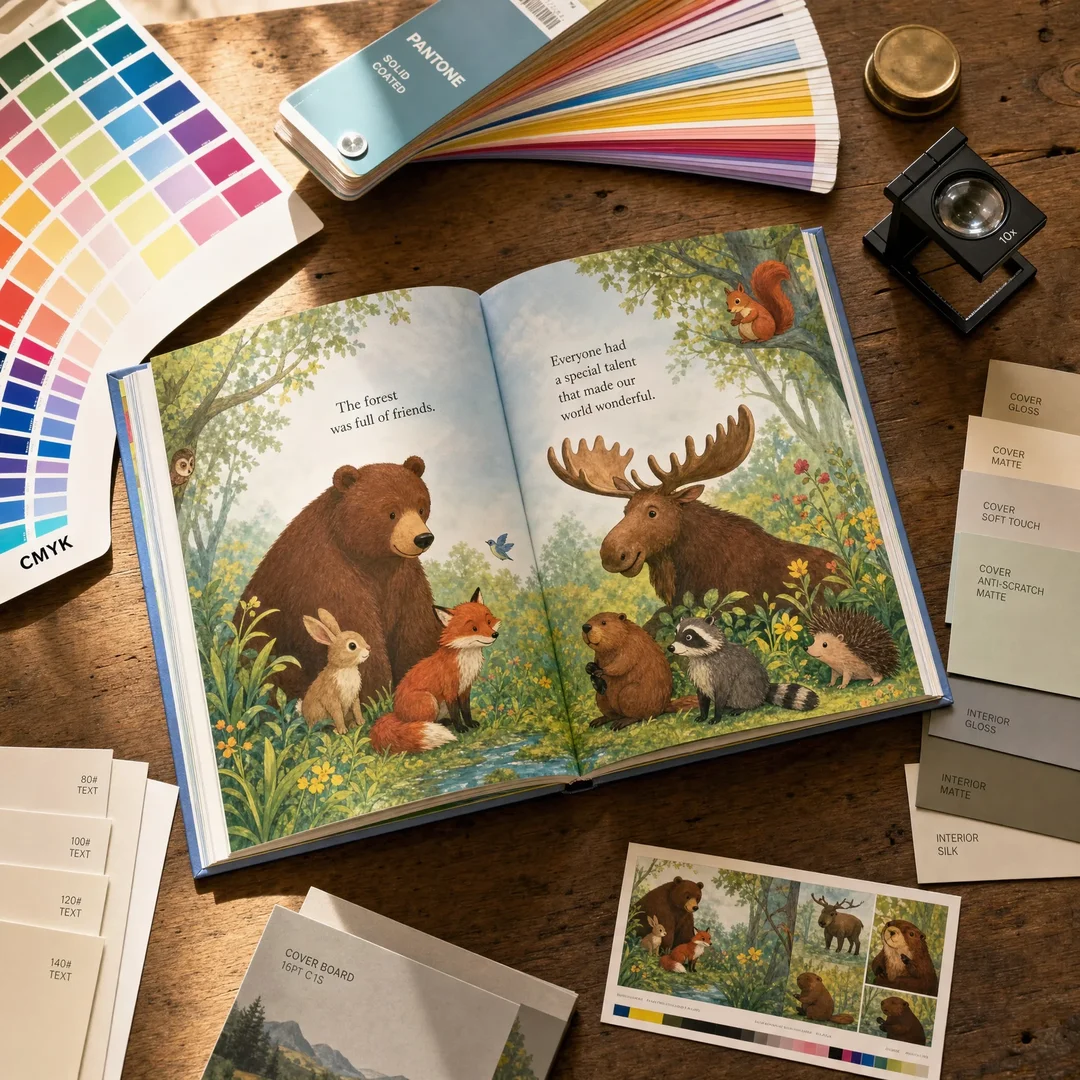
Equally important is how you handle proofing. A soft proof — your CMYK file viewed on a calibrated monitor with the printer’s ICC profile applied — gives a good approximation. But for picture books where color accuracy matters, a hard proof (contract proof or wet proof) printed on the actual press with the actual paper and ink is the only way to see exactly what you will get. Most reputable Chinese printers, including EcoPrinting, offer hard proof services before the full production run. It adds a few days and a couple hundred dollars, but can save thousands in reprints if the color is not what you expected.
Safety Certifications: CPSIA, ASTM, and What Keeps Your Book Compliant
Understanding CPSIA requirements for children’s books sold in the United States
If you plan to sell your picture book in the United States — whether through Amazon, independent bookstores, or direct-to-consumer — it falls under the Consumer Product Safety Improvement Act (CPSIA). The CPSIA defines a children’s product as any consumer product designed primarily for children 12 years of age or younger. Picture books and board books squarely fall into this category.
The good news is that ordinary books printed on paper or cardboard using conventional printing methods have benefited from practical exemptions. In 2009, the CPSC determined that paper, cardboard, and conventional printing inks do not inherently contain lead above legal limits, so ordinary books are exempt from mandatory third-party lead testing. However, this exemption does not cover everything. If your book includes non-paper components — a plush toy, a plastic sound module, metal spiral binding, a mirror insert, or glitter — those components must be tested for lead and phthalates separately.
The phthalate restriction under CPSIA Section 108 is particularly relevant for board books and any book with plastic elements. Eight specific phthalates (including DEHP, DBP, and BBP) are permanently prohibited in children’s products at concentrations above 0.1% in any accessible component. For a standard paper picture book with no added components, this is rarely an issue because paper and ink do not contain phthalates. But lamination film, plastic handles, or any synthetic material attached to the book must be verified.
ASTM F963, EN71, and the international certification landscape
Beyond CPSIA, the ASTM F963 standard applies to children’s books classified as toys. This is most relevant for board books, bath books, pop-up books, books with attached play elements, and any book designed to be manipulated rather than simply read. ASTM F963 covers physical and mechanical hazards (sharp edges, small parts, choking risks), flammability, and soluble heavy metal content in surface coatings and substrate materials.
For the European market, EN71 is the equivalent standard, with Part 3 addressing the migration of certain elements (lead, cadmium, mercury, chromium, and others) from toy materials. Canada applies the CCPSA (Canada Consumer Product Safety Act), which largely mirrors CPSIA but has its own testing and labeling obligations. If your book will be sold internationally, work with a printer in China who can arrange testing to all relevant standards through accredited labs — SGS, Intertek, TUV, or Bureau Veritas — and provide compliance documentation as part of the production package.
One practical point experienced self-publishers learn early: even if your book qualifies for the “ordinary book” exemption, retailers may still require a General Certificate of Conformity (GCC) as a matter of policy. Amazon, in particular, has requested safety documentation for children’s books, especially board books. Having your printer provide a certificate confirming that materials and inks comply with CPSIA limits is a small step that prevents major headaches at distribution.
Preserving Illustration Quality in Print
Resolution, file preparation, and why 300 DPI is the absolute minimum
The single most important technical specification for picture book printing is resolution. Your illustrations must be at minimum 300 DPI (dots per inch) at the final print size. If your book is 8.5 × 8.5 inches with a 0.125-inch bleed on each side, your full-bleed illustration file needs to be 8.75 × 8.75 inches at 300 DPI — that is 2625 × 2625 pixels. Anything less than 300 DPI, and the images will look soft or pixelated when printed.
This requirement has implications for how you create your illustrations. If you scan traditional artwork, the scanner must be capable of at least 300 DPI optical resolution at the final output size — for watercolor or pencil work with fine detail, 600 DPI is better. If you create digital art, your canvas must be set to the final print dimensions at 300 DPI or higher from day one. Scaling up a lower-resolution file in Photoshop creates interpolation artifacts that show up in print as softness or jagged edges.
Color mode is the other critical setting. Your files must be in CMYK, not RGB, before they go to press. Every professional printer will do a final preflight check and may convert RGB files automatically, but that conversion will be done with default settings that may not preserve your color intent. Converting to CMYK yourself using the printer’s recommended ICC profile gives you control over the conversion. It also lets you see — and adjust for — any colors that shift dramatically during the conversion, before the plates are made.
The proofing process for picture books deserves special attention. A digital proof (PDF soft proof on a calibrated monitor) is quick and free, but cannot show how ink will sit on the paper, how paper texture will affect the image, or whether binding will cause visible gutter distortion. A printed proof on the actual production paper is the only way to evaluate color accuracy, contrast, and detail before committing to a full print run. For a picture book where the illustrations are the product, skipping this step is a false economy.
MOQ, Pricing, and What Drives the Cost
What is the minimum order quantity for picture book printing in China, and how does it compare to other options?
Chinese commercial printers typically set MOQs between 300 and 500 copies for offset-printed picture books. This is driven by offset economics: fixed costs of plate making, press setup, and makeready are spread across the print run, and below a certain threshold, per-unit cost becomes prohibitively high. Some printers — EcoPrinting included — accommodate smaller runs of 100 to 200 copies for hardcover picture books, particularly for first-time authors testing the market or fulfilling a Kickstarter campaign. But expect a meaningfully higher per-unit price at these quantities.
To illustrate the economies of scale: a 32-page hardcover picture book at 8.5 × 8.5 inches on 200 gsm matte art paper might cost roughly $4.50 to $5.50 per unit at 500 copies. At 1,000 copies, the same book drops to $3.00 to $3.80. At 3,000 copies, you could be looking at $2.20 to $2.80. At 5,000 copies and above, per-unit price can approach $1.80 to $2.20. These are illustrative ranges — actual pricing depends on the specific combination of size, page count, paper, binding, and finishing.
What factors most influence the cost of printing a picture book?
The biggest cost driver is page count. In offset printing, every sheet goes through the press once per color — a 32-page book requires twice as many press sheets as a 16-page book. More pages also mean more paper, a thicker spine, and a heavier book, increasing shipping costs. Every additional 8-page signature adds a measurable increment to unit cost.
Trim size is the next major variable. A 10 × 10 inch book uses about 38% more paper than an 8 × 8 inch book. That additional paper cost compounds through the entire supply chain: larger sheets on press, larger cover boards, larger shipping cartons, and higher freight charges by both weight and volume. If your budget is tight, choosing an 8 × 8 or 8.5 × 8.5 inch format over a 10 × 10 inch can reduce your total production cost by 15% to 25%.
Binding style affects cost significantly. Hardcover case bound is more expensive than paperback perfect binding because of additional materials (grey board, endpapers, cover wrapping) and the labor involved in case making and casing-in. Board books are in a category of their own: the thick board substrate, mounting process, die-cutting, and lamination all add cost layers. A 20-page board book can easily cost as much to produce as a 32-page hardcover, despite having fewer pages.
Paper weight, finishing options like lamination and spot UV coating, and special treatments like foil stamping or embossing on the cover all add incremental costs. These details are where the per-unit price can drift upward without the author fully realizing it until the quote arrives. The best approach is to get a detailed, line-item quote from your printer that breaks down the cost contribution of each specification, so you can make informed trade-offs.
Why Print Picture Books in China
The practical advantages of Chinese printing for self-published children’s book authors
The cost advantage is real, and it is the reason most self-published authors eventually explore printing in China. For a full-color hardcover picture book, printing in China typically costs 30% to 50% less than equivalent quality from a US or European printer. This is not about cutting corners — it is about the scale, specialization, and vertically integrated supply chain. The major printing hubs in Guangdong, Zhejiang, and Shanghai host thousands of specialized book manufacturers who have invested in Heidelberg and Komori offset presses, automated case-making lines, and in-house post-press finishing equipment that would be uneconomical for a general commercial printer in North America.
Beyond price, the range of options is broader. A Chinese book printer can offer hardcover case binding, board book binding, saddle stitching, perfect binding, spiral binding, and wire-o binding under one roof. They stock a wider variety of paper stocks, including specialty art papers and textured stocks that are harder to source domestically. Finishing options — matte and gloss lamination, spot UV, foil stamping, embossing, debossing, die-cutting, and rounded corners — are part of the standard workflow rather than expensive add-ons.
The one-stop-shop model is another significant advantage. A full-service Chinese printer like EcoPrinting handles the entire production chain: pre-press file checking and color management, printing, binding, quality inspection, and logistics. They can arrange freight forwarding — sea freight for cost-sensitive shipments with 25 to 35 day transit, or air freight for time-sensitive deliveries in 5 to 10 days — and manage the customs documentation for both export from China and import into your destination country. For a self-published author who does not want to become an expert in international logistics just to get their book printed, this integrated service model removes a significant barrier.
Production timelines for picture book printing in China are typically 15 to 30 days from file approval to finished goods, depending on binding and finishing complexity. Adding sea freight to the US West Coast brings door-to-door to roughly 35 to 50 days. For authors working toward a specific launch date or holiday retail window, building this lead time into the schedule from the start is essential.