What Is Eco-Friendly Printing?
Eco-friendly printing is a holistic approach to manufacturing printed materials that minimizes environmental harm at every stage of production. It encompasses the choices made about paper sourcing, ink formulation, energy consumption, chemical usage, waste management, and end-of-life recyclability. Rather than a single technology or material swap, sustainable book printing requires rethinking the entire supply chain.
To understand why this matters, consider the baseline. Traditional offset printing relies on petroleum-based inks that emit volatile organic compounds (VOCs) such as toluene, benzene, and xylene during drying. These substances contribute to air pollution and pose health risks to press operators. Conventional paper production, when sourced from non-certified forests, drives deforestation at a staggering rate. The publishing industry alone consumes an estimated 32 million trees annually in the United States, according to research compiled by environmental advocacy groups. Add to this the energy demands of large-scale printing facilities, chemical-laden coatings, and plastic-based laminates, and the environmental cost of a single book becomes more significant than most readers realize.
Sustainable book printing addresses these issues systematically. It replaces petroleum-based inks with plant-derived alternatives. It swaps virgin paper from clear-cut forests for FSC-certified or post-consumer recycled stock. It favors water-based coatings over solvent-heavy chemical finishes. And increasingly, it powers production with renewable energy sources while offsetting unavoidable emissions through verified carbon credit programs.
The shift is not merely an ethical gesture. Consumer demand is reshaping the market. A recent IBM study found that nearly 60% of consumers are willing to change their purchasing habits to reduce environmental impact. Publishers, self-published authors, and corporate buyers are all asking their printers the same question: “What are you doing for the planet?” The answer increasingly determines who gets the business.
Sustainable Paper Materials: The Foundation of Green Book Manufacturing
Paper accounts for between 50% and 80% of a printed book’s carbon footprint, according to research by the French Publishers’ Association. Choosing the right paper is therefore the single most impactful sustainability decision a publisher can make. Fortunately, the range of environmentally responsible paper options has expanded dramatically in recent years.
Post-Consumer Recycled (PCR) Paper
Post-consumer recycled paper is manufactured from paper products that have already served their intended purpose—office documents, newspapers, packaging—and been collected through municipal recycling programs. This material is reprocessed into new paper without requiring freshly cut trees. The environmental savings are substantial: producing paper from 100% recycled fiber saves 100% of the trees, approximately 31% of the energy, 53% of the water, and reduces solid waste by roughly 39% compared to virgin paper production.
Historically, recycled paper carried a reputation for being slightly rougher or less bright than virgin stock. Those days are largely behind us. Modern recycled papers from premium mills now match the appearance, brightness, and print fidelity of virgin alternatives. Many options in the 30% to 100% post-consumer recycled range are available for book interiors, covers, and dust jackets. For text-heavy books with limited imagery, higher recycled content works beautifully. Full-color art books or photography collections may benefit from a blend with lower recycled content to preserve ink holdout and color accuracy.
FSC-Certified Paper
Forest Stewardship Council (FSC) certification is the gold standard for verifying that paper originates from responsibly managed forests. Founded in 1993 in response to global deforestation concerns, the FSC sets rigorous standards covering biodiversity protection, indigenous rights, water quality preservation, and long-term forest health. Over 200 million hectares of forest are now FSC-certified worldwide.
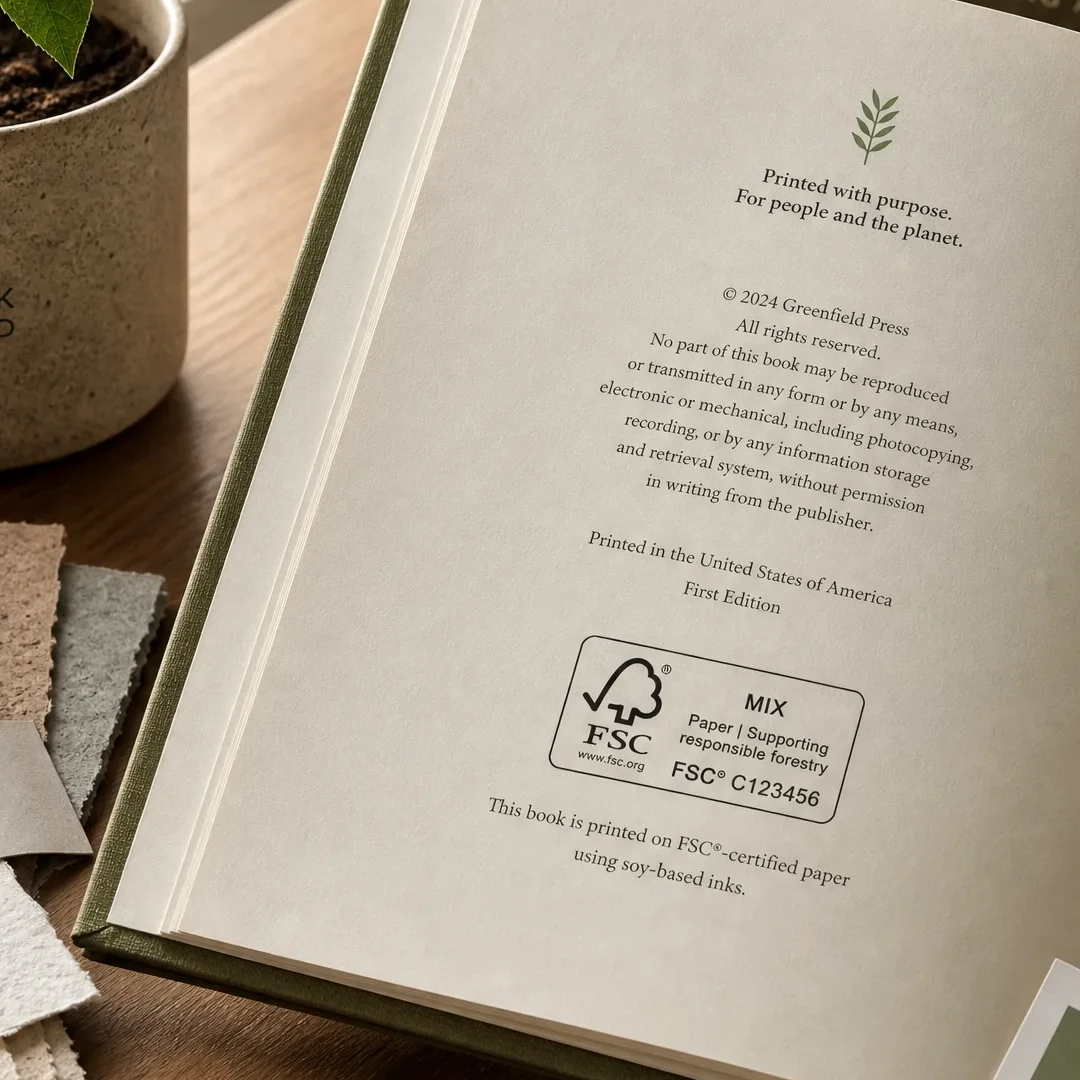
FSC-certified paper comes in three label categories. FSC 100% means the fiber is entirely from FSC-certified forests. FSC Mix indicates a combination of FSC-certified fiber, recycled material, and controlled wood. FSC Recycled verifies that the product is made from 100% recycled material. Each label provides a different level of assurance, but all three guarantee that the paper has not contributed to illegal logging or deforestation.
For publishers, specifying FSC-certified paper signals a genuine commitment to sustainability that readers can verify. The FSC logo on a book’s copyright page is a recognizable trust mark. Many retailers and institutional buyers now require FSC certification as a baseline requirement for the products they stock.
Alternative Fiber Papers — Bamboo, Bagasse, and Beyond
Beyond recycled and FSC-certified wood-based papers, a growing category of alternative fiber papers is entering the book printing market. Bamboo paper offers a compelling sustainability profile: bamboo grows rapidly—some species can grow up to 91 cm in a single day—requires minimal pesticides, and regenerates after harvesting without replanting. The resulting paper has a smooth, natural texture and excellent printability for both text and image reproduction.
Bagasse paper, made from the fibrous residue left after sugarcane juice extraction, turns an agricultural waste product into a valuable printing substrate. Instead of burning or landfilling bagasse, mills reprocess it into paper with a warm, natural tone and good opacity. For publishers who want to tell a circular economy story, bagasse paper provides a tangible narrative. Other emerging options include hemp paper, stone paper (made from calcium carbonate and a small amount of HDPE), and cotton-based paper sourced from textile industry offcuts.
Each alternative fiber has its own handling characteristics, ink absorption profile, and cost structure. The key is matching the right paper to the specific project requirements—a decision best made in consultation with a knowledgeable printing partner.
Soy-Based Ink vs. Petroleum-Based Ink: A Clear Environmental Choice
The story of soy-based ink begins with the 1970s energy crisis, when the Newspaper Association of America started searching for alternatives to petroleum-based inks. After testing more than 2,000 vegetable oil formulations, researchers identified soybean oil as the superior candidate. The first successful commercial press run using soy ink took place in 1987 at The Gazette in Iowa, and the technology has advanced steadily ever since.
Soy-based ink is manufactured by refining soybean oil and combining it with natural resins, waxes, and pigments. The soybean oil itself is a renewable, annually harvested resource. It is also biodegradable—soy ink degrades approximately four times faster than petroleum-based alternatives. This is particularly important during the paper recycling process, where soy ink separates from paper fibers more easily during de-inking, producing cleaner recycled pulp and reducing the energy required for reprocessing.
The environmental advantages extend across multiple dimensions. First, soy ink emits significantly fewer volatile organic compounds during printing and drying. VOCs such as benzene—a known carcinogen found in petroleum inks—contribute to ground-level ozone formation and pose workplace health risks. Switching to soy ink creates a safer environment for press operators and reduces the facility’s overall air quality impact. Second, because soybean oil is clearer and less viscous than petroleum oil, soy ink achieves brighter, more vibrant colors with less pigment. Ink mileage improves by approximately 15%, meaning a given quantity of soy ink covers more paper area than an equivalent amount of petroleum ink.
On the cost side, soy ink carries a premium of roughly 10% over conventional petroleum ink per unit volume. However, the improved coverage rate largely offsets this difference. The net cost impact for most book printing projects is marginal—typically less than 1% of the total project budget—while delivering a dramatically better environmental profile. For color-critical publications, the superior color vibrancy of soy ink can actually reduce the need for additional print passes or special color treatments, generating further efficiency savings.
Aqueous Coating and Eco-Friendly Finishing
A book’s environmental story does not end with paper and ink. The coatings, laminates, and binding methods used in finishing can either enhance or undermine the sustainability of the final product.
Aqueous coating is a water-based clear protective layer applied to printed sheets during or after printing. Unlike UV coating—which relies on chemical compounds cured under ultraviolet light—aqueous coating uses water as its primary solvent, resulting in dramatically lower VOC emissions. The dried coating film is biodegradable, recyclable, and repulpable, meaning it disperses harmlessly during the paper recycling process without interfering with fiber recovery.
The contrast with UV coating is instructive. UV coatings produce a high-gloss, almost wet-looking finish with excellent scratch and chemical resistance. However, the curing process requires significant energy input from UV lamps, and the uncured coating contains reactive components that can cause skin and eye irritation for workers. While cured UV coatings are technically recyclable, they cross-link during curing and biodegrade far more slowly than aqueous alternatives. For publishers who prioritize recyclability and worker safety, aqueous coating is the clear winner.
Varnish, the traditional oil-based alternative, remains the least protective and least environmentally favorable option. It yellows over time, offers minimal physical protection, and is being phased out by most modern printing facilities in favor of aqueous systems.
Eco-friendly binding deserves equal attention. PUR (polyurethane reactive) adhesive binding, while durable, introduces a synthetic polymer into the book that complicates recycling. Alternatives include thread-sewn binding, which uses no adhesives and allows for complete paper recovery, and staple binding (saddle stitching) for thinner publications. Some printers are now experimenting with biodegradable adhesives derived from plant starches, though these remain less common in commercial production.
Carbon-Neutral Printing: Beyond Materials
Material choices are essential, but they are not the whole picture. A truly sustainable printing operation must also account for its energy consumption and greenhouse gas emissions. This is where carbon-neutral printing enters the conversation.
A carbon footprint quantifies the total greenhouse gas emissions generated by a product or process, expressed in carbon dioxide equivalents (CO₂e). For a printed book, the footprint includes emissions from raw material extraction, manufacturing, transportation, and end-of-life disposal. Carbon-neutral printing means that all residual emissions have been measured, reduced where possible, and offset through verified carbon credit programs that fund projects such as reforestation, renewable energy development, or methane capture at landfill sites.
The most credible carbon-neutral claims follow established international frameworks such as PAS 2060, which requires public disclosure of a carbon footprint report, a carbon management plan detailing ongoing reduction efforts, and qualifying explanatory statements that document how neutrality was achieved. Annual re-verification is mandatory.
Leading printers are taking concrete steps to reduce their operational emissions before turning to offsets. These include installing rooftop solar arrays or purchasing wind energy through Renewable Energy Certificates, upgrading to energy-efficient LED-UV curing systems that consume less power than conventional drying, implementing heat recovery systems that capture and reuse waste heat from presses and dryers, and optimizing logistics to minimize transportation distances and consolidate shipments.
The distinction between reduction and offsetting matters. Purchasing carbon credits without first reducing emissions is increasingly viewed as greenwashing. The credible approach—and the one serious printing partners follow—is to reduce first, then offset what cannot yet be eliminated.
Green Printing in China: Policy, Certification, and Market Trends
China’s printing industry, the largest in the world with an annual output value exceeding 1.5 trillion RMB (approximately 214 billion USD), is undergoing a significant green transformation. This shift is being driven by a combination of government policy, market demand from international buyers, and the industry’s own recognition that sustainability is a competitive advantage.
The China Environmental Label—operated by the China Environmental United Certification Center since 1994—is the country’s premier green product certification program. Based on ISO 14024 Type I environmental labeling standards, it now covers over 90 product categories including printing, with more than 7,000 certified enterprises and 3.66 million certified product specifications. Since 2006, the Chinese government has incorporated China Environmental Label-certified products into its Green Public Procurement program. By 2020, government procurement of certified products reached 81.35 billion yuan, and all primary and secondary school textbooks—over 1.3 billion copies—were required to use China Environmental Label-certified green printing.
Beyond the China Environmental Label, printing facilities can pursue Green Factory certification under the national standard GB/T 36132-2018, which evaluates energy and water efficiency, materials utilization, pollution control, and continuous improvement. Certified factories gain access to financial incentives, preferential green credit, and technology upgrade subsidies. A 2025 draft revision (GB/T 36132-202X) is expected to tighten requirements further, reflecting the government’s broader carbon-neutrality goals targeting 2060.
The Ministry of Industry and Information Technology’s 2024 Technical Guidelines for Green and Low-Carbon Development of the Printing Industry explicitly encourage digital inkjet printing as a preferred green technology, citing its reduced chemical consumption, lower waste generation, and improved energy efficiency compared to traditional plate-based offset methods. Major printing exhibitions like All in Print China now feature dedicated sustainability zones showcasing eco-friendly materials and processes.
For international publishers printing in China, these developments are significant. A printer that holds China Environmental Label certification, operates a Green Factory, and maintains FSC chain-of-custody certification is operating at a level of environmental rigor that meets or exceeds Western standards. The key is verification—requesting copies of current certificates and understanding what each one covers.
How to Choose an Eco-Friendly Printing Supplier
Selecting a genuinely sustainable printing partner requires looking past marketing claims and evaluating specific, verifiable practices. Here is a practical assessment checklist for publishers and authors.
Start with certifications. Ask the printer to provide copies of current FSC chain-of-custody certification, China Environmental Label certification (if printing in China), and any relevant ISO certifications such as ISO 14001 for environmental management systems. Do not accept expired certificates or verbal assurances. Check that the certification scope covers the specific facility where your books will be produced.
Request a detailed paper sourcing statement. A responsible printer should be able to tell you the mill of origin and recycled content percentage for every paper they recommend. If they cannot name the mill or provide a fiber sourcing breakdown, that is a red flag. Ask specifically about post-consumer recycled content—”pre-consumer” recycled content, while better than virgin fiber, represents manufacturing scrap that never reached the consumer and therefore has a smaller environmental benefit.
Inquire about ink systems. Does the printer use soy-based or vegetable-based inks as standard, or only on request? What is the VOC content of their ink formulations? For large print runs, ask whether they can provide ink consumption data that demonstrates coverage efficiency.
Examine finishing practices. What type of coating do they apply by default? If they offer UV coating, ask whether they also provide aqueous alternatives and whether they explain the trade-offs to their clients. For binding, ask about adhesive types and whether thread-sewn options are available for hardcover projects.
Review their energy and waste practices. Do they publish an environmental report or carbon footprint disclosure? Are they using renewable energy for any portion of their operations? What happens to their production waste—paper offcuts, used plates, spent chemicals, packaging materials? A transparent printer will answer these questions directly and provide documentation on request.
Finally, request printed samples on the specific sustainable materials you are considering. Touch the paper. Examine the color reproduction. Fold the pages. Assess the coating finish. Sustainability should never compromise quality, and the best eco-friendly printers produce work that is indistinguishable from or superior to conventional alternatives.
EcoPrinting’s Commitment to Sustainable Book Manufacturing
At EcoPrinting, sustainable manufacturing is not a marketing campaign. It is how the facility has operated from day one. Every book produced at EcoPrinting runs on soy-based inks as standard—not as an optional upgrade with a surcharge attached. The default house stock is FSC Mix-certified paper sourced from audited mills with full chain-of-custody documentation, and clients receive a copy of the relevant certification with their order confirmation.
The facility uses aqueous coating for all standard finishing work. UV coating is available for projects that require maximum durability, but every client receives a clear explanation of the environmental trade-offs before making that choice. For hardcover bindings, thread-sewn construction is the recommended default, eliminating synthetic adhesives from the binding process and ensuring the finished book is fully recyclable at end of life.
EcoPrinting’s commitment extends to operational efficiency. The production floor runs on energy-efficient Heidelberg presses with heat recovery systems that capture waste thermal energy for facility heating. Production waste—paper trim, plate material, packaging—is segregated at source and directed to certified recycling partners. The facility holds China Environmental Label certification and maintains ISO 14001 environmental management accreditation with annual third-party audits.
For publishers who want to go further, EcoPrinting offers carbon footprint assessment for individual print projects, with the option to purchase verified carbon offsets that neutralize the residual emissions from manufacturing and shipping. Every offset purchase is documented with a retirement certificate so publishers can substantiate their carbon-neutral claims to their own customers.
Frequently Asked Questions
Does eco-friendly printing cost more than conventional printing?
The premium for sustainable book printing has narrowed significantly over the past decade. FSC-certified paper is now widely available at prices comparable to non-certified alternatives. Soy ink’s higher per-unit cost is largely offset by better coverage rates. Aqueous coating is generally less expensive than UV coating. For most projects, the total cost difference between conventional and sustainable printing is in the range of 2% to 5%—and for some configurations, there is no premium at all.
Does recycled paper affect print quality?
Modern recycled papers have closed the quality gap with virgin stock. For text-heavy books, 100% post-consumer recycled paper performs excellently. For full-color image reproduction, a blend with lower recycled content or FSC-certified virgin fiber may deliver sharper results. The key is to request printed samples on your chosen paper before committing to a full production run.
Can soy-based ink match the durability of petroleum ink?
Yes. Soy ink provides excellent adhesion, rub resistance, and color stability. In fact, the superior clarity of soybean oil often produces more vibrant colors than petroleum-based alternatives using the same pigment load. For archival-quality printing, soy ink on acid-free paper creates a stable, long-lasting product.
How do I verify a printer’s environmental claims?
Ask for current copies of all relevant certifications—FSC, ISO 14001, China Environmental Label, or equivalents in your region. Check the certification body and validity dates. Request a tour of the production facility if possible. Look for third-party verified claims rather than self-declared marketing statements. A trustworthy printer will welcome scrutiny and provide documentation without hesitation.
Conclusion: Making the Switch to Sustainable Printing
Sustainable book printing is no longer a niche option for a committed minority. It is rapidly becoming the expected standard across the publishing industry. The technology is mature, the cost premium is minimal, and the availability of certified materials has never been broader. Every book printed on FSC-certified paper with soy-based ink represents a tangible reduction in environmental impact—fewer trees harvested, fewer petrochemicals consumed, and fewer VOCs released into the atmosphere.
The most important step is simply to start the conversation. When requesting a printing quote, specify your environmental requirements up front. Ask for FSC-certified or recycled paper options. Request soy-based or vegetable-based inks. Inquire about aqueous coating and sustainable binding methods. Your printer’s response to these questions will tell you everything you need to know about whether they are genuinely committed to sustainability or simply paying lip service to a trend.
Whether you are publishing a single self-published title or managing a catalog of thousands, the choices you make about how your books are manufactured have consequences that extend far beyond the printed page. Choose a partner who shares your values. Choose sustainable printing.