Why So Many Publishers Choose Board Book Printing in China
If you have ever held a children’s board book in your hands, there is a good chance it was manufactured in China. The country produces a massive share of the world’s toddler book printing and picture book printing output — and not just because of lower costs. Chinese print factories have spent decades perfecting the craft of making thick, durable, kid-proof books. They have the machinery, the material supply chains, and the specialized labor that most domestic printers simply cannot match at scale.
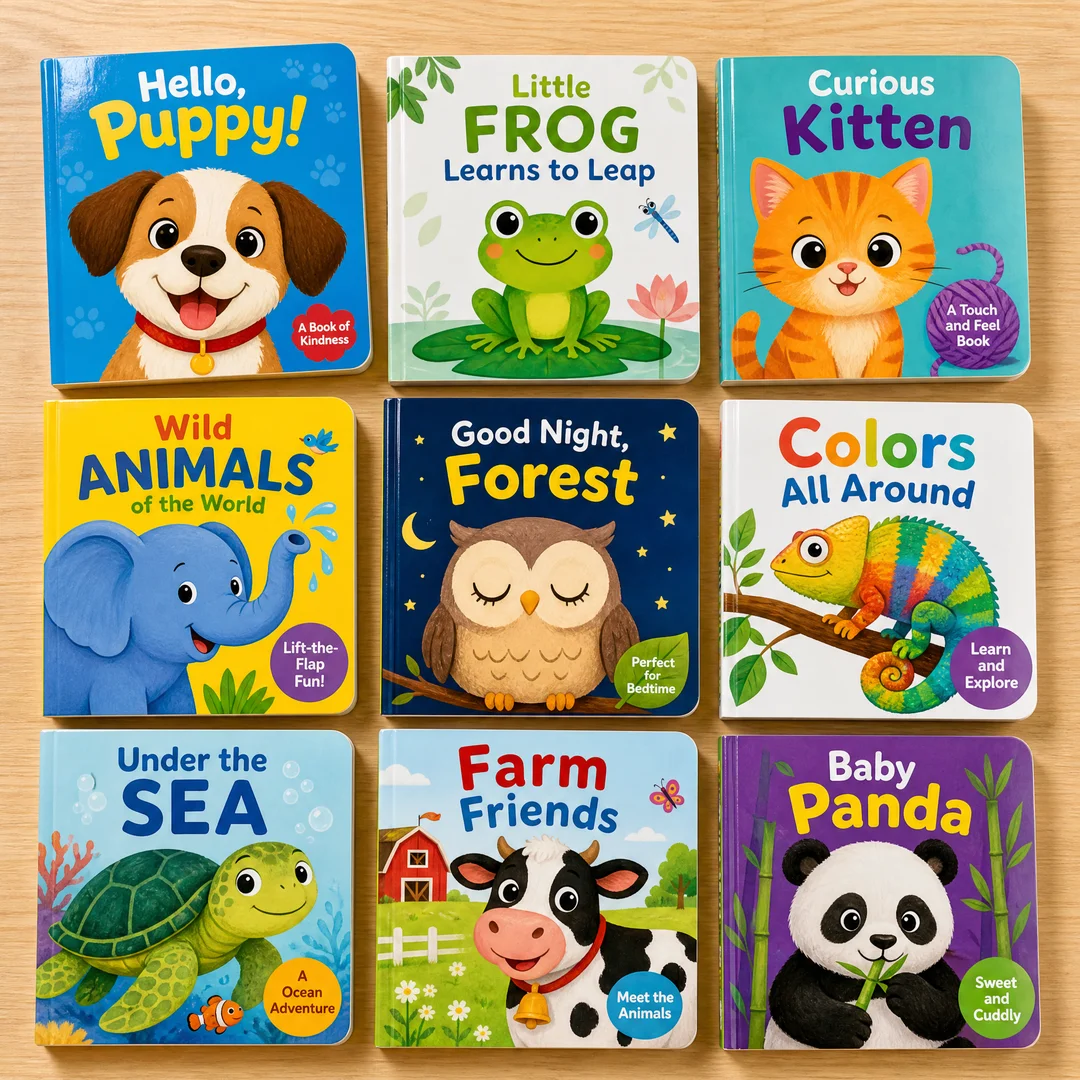
Walk into any Barnes & Noble children’s section and flip through the board books. Look at the perfectly rounded corners, the glossy laminated pages that resist drool, the vibrant colors that pop off the page. These are not accidents. They are the result of a manufacturing ecosystem that has optimized every step of board book production — from grey board sourcing to automated die-cutting to export logistics.
The question is not really “Why China?” anymore. It is “Which Chinese manufacturer can deliver the quality and consistency your title needs?” That is what this guide is here to answer.
Self-Cover vs Hardcover Board Books: What Is the Difference?
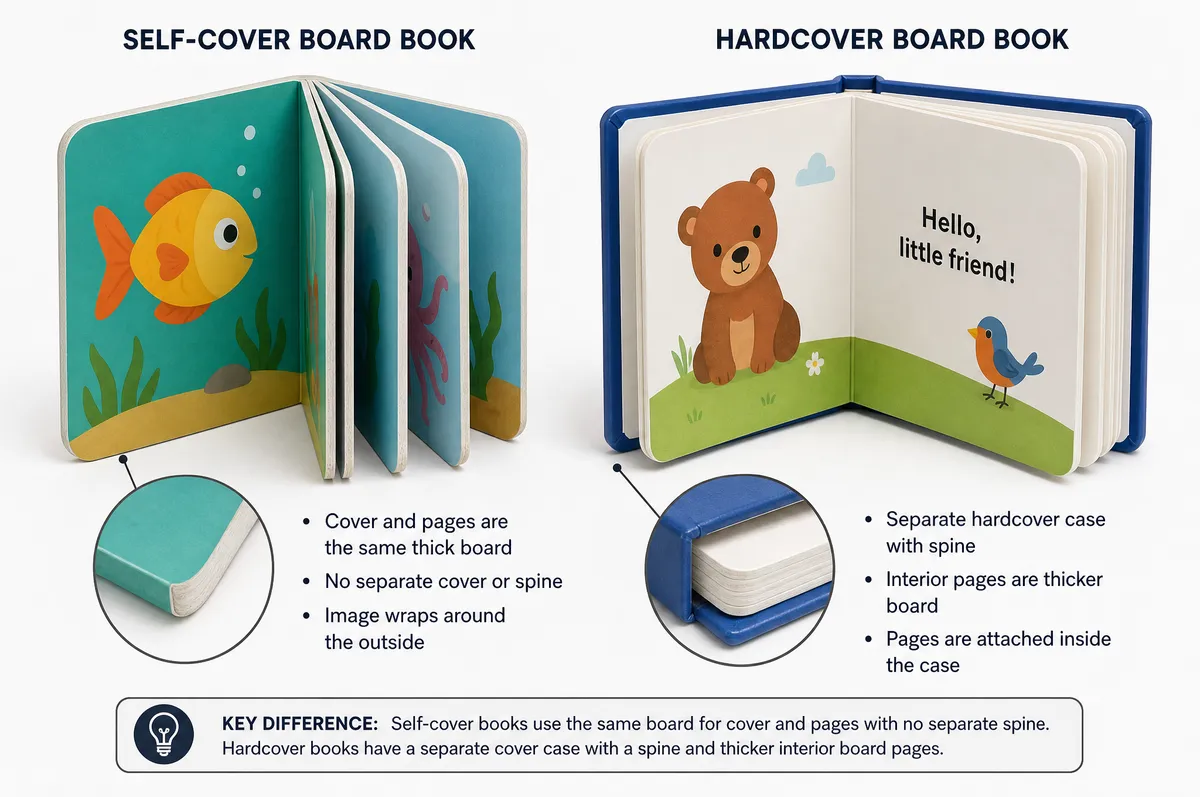
Before you even think about paper weight or print run size, you need to decide which board book format fits your project. There are two main types, and the cost difference between them is significant.
A self-cover board book uses the same thick grey board for both the cover and the interior pages. Every page — including the cover — is the same material, usually mounted with printed paper on both sides. This is the classic format you see in most toddler book printing: chunky pages, rounded corners, lightweight enough for small hands. Self-cover board books typically have 8 to 24 pages (counting each side as a page). They are the most economical option and account for roughly 70% of custom board book printing orders coming through Chinese factories.
A hardcover board book pairs thick interior board pages with a separate hardcover case. The case is made from grey board wrapped in printed paper or cloth, with a spine that gives the book a more traditional “big kid book” feel. Hardcover board books cost more to produce — figure 30-50% higher than self-cover — but they look premium on a shelf and hold up better over years of rough handling. Publishers of gift editions and keepsake picture books often go this route.
When you request a quote for board book printing in China, specify which format upfront. The production process diverges at the very first station on the factory floor.
Grey Board Thickness: Making Sense of 800gsm to 2000gsm
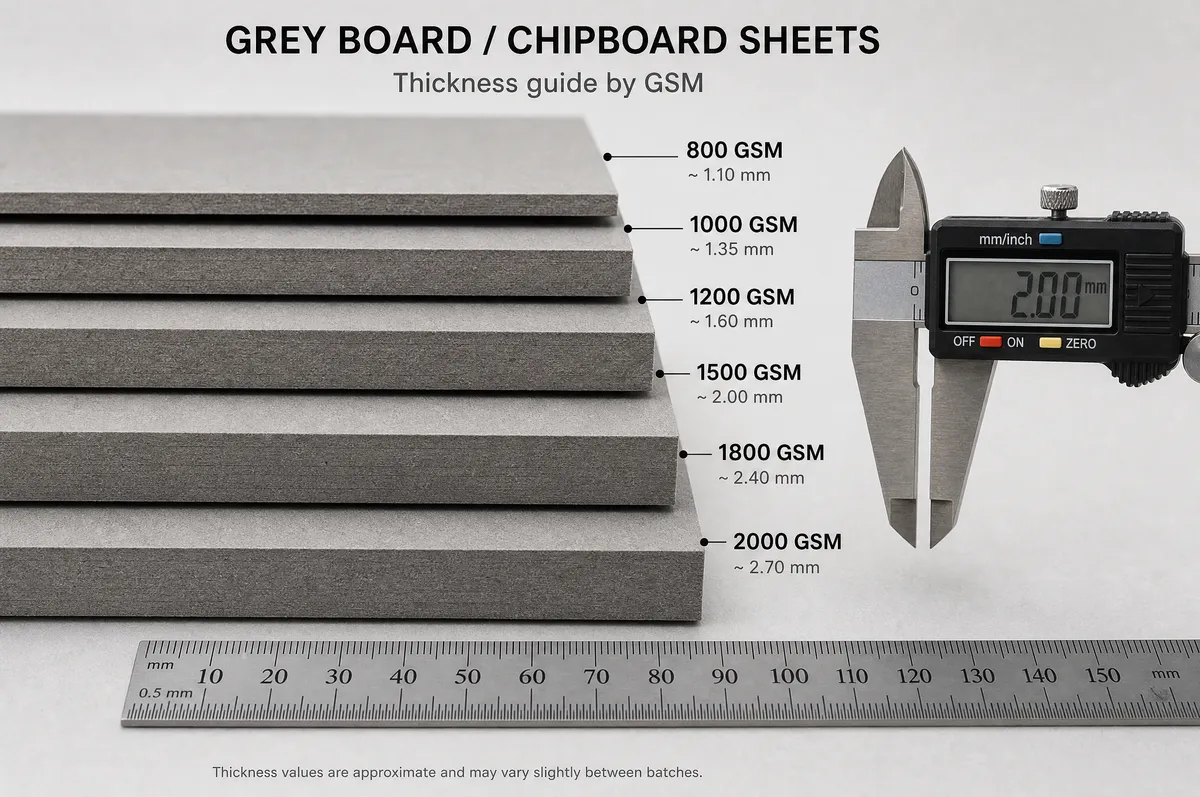
Grey board is the backbone of every board book. It is a dense, recycled-fiber paperboard that gives board books their signature rigidity. If you are new to custom board book printing, the GSM (grams per square meter) numbers can feel abstract. Here is a practical breakdown that will help you choose.
At 800gsm to 1000gsm, you get a page roughly 1.0mm to 1.2mm thick. This is the standard for most commercial board books — think Goodnight Moon board edition or basic first-words books. Pages feel substantial but not heavy. A 10-spread book at this thickness lands around 12-15mm total spine width.
1200gsm to 1500gsm gives you pages about 1.5mm to 1.8mm thick. This is the premium range. Pages feel noticeably thicker, resist bending, and survive aggressive page-turning from enthusiastic one-year-olds. Most publishers who are serious about durability choose this range for toddler book printing.
1800gsm to 2000gsm delivers pages 2.0mm to 2.5mm thick. At this point, each page is practically a panel. These books are heavy, almost indestructible, and typically reserved for specialty formats like puzzle board books or interactive books with embedded elements. The downside is weight — shipping costs climb fast at these thicknesses.
The grey board used by most Chinese manufacturers comes from domestic mills in Guangdong and Zhejiang provinces. Quality varies. Ask your printer what grade they use. Recycled grey board with consistent density beats cheaper mixed-fiber board every time. Warped pages and uneven thickness are dead giveaways of low-grade material.
Safety Standards: CPSIA, ASTM F963, and EN71 Compliance
Children put books in their mouths. That is not a possibility — it is a certainty. A board book will be chewed, drooled on, and possibly used as a teething device before it is ever read. This is why safety compliance is the single most important factor in children’s board book manufacturing, and why you need to verify it before placing an order.
For the US market, two standards govern board book safety. CPSIA (Consumer Product Safety Improvement Act) sets limits on lead content in surface coatings and substrates — specifically, total lead must not exceed 100 ppm in any accessible component. It also restricts six specific phthalates. While ordinary paper-and-ink books printed by conventional methods are largely exempt from third-party testing requirements, board books often fall into a gray area because they are intended for children under three and have toy-like characteristics.
ASTM F963 (the latest revision is F963-23) is the mandatory toy safety standard in the US. It covers mechanical hazards like sharp edges and small parts, flammability, and soluble heavy metals. Since board books are handled by children under 36 months, many importers choose to test against ASTM F963 to cover their liability, especially for books with interactive elements like flaps, pop-ups, or attached components.
For the European market, EN71 applies. Part 1 covers mechanical and physical properties (no sharp edges, no small parts that detach). Part 3 covers migration of certain elements (heavy metals). If you are selling into the EU, your manufacturer should be able to provide EN71 test reports from an accredited lab.
A serious children’s board book manufacturer in China will have these certifications ready to show you. If a factory hesitates when you ask about CPSIA or EN71 compliance, move on. The risk is not worth the savings.
Offset vs Digital Printing: Which One Fits Your Board Book Run?
The printing method shapes your cost, your timeline, and your color consistency. For board books, offset printing rules the factory floor — but digital has carved out a useful niche for short runs.
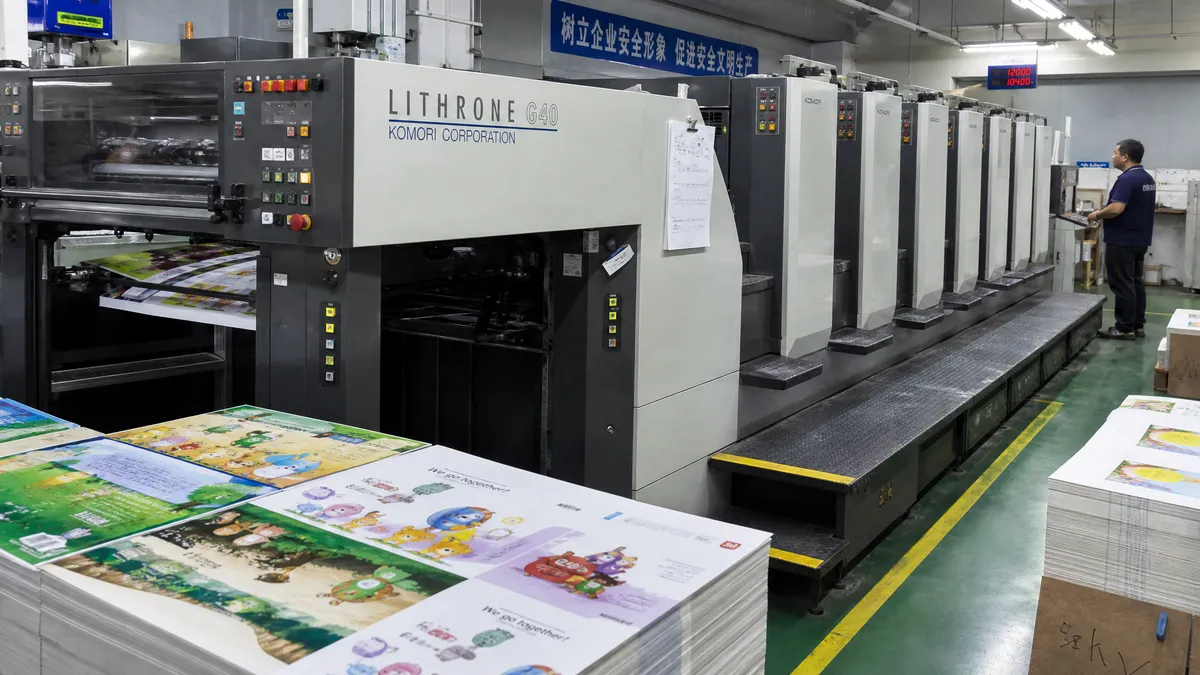
Offset printing uses metal plates to transfer ink onto paper via a rubber blanket. The setup cost is front-loaded: you pay for plate-making regardless of whether you print 500 copies or 50,000. But once the plates are running, the per-unit cost drops dramatically. Offset delivers consistent color across long runs, handles Pantone spot colors natively, and produces the kind of vibrant, sharp imagery that children’s books demand. For any run above 1,000 copies, offset is almost certainly the right call.
Digital printing skips plates entirely and prints directly from a digital file. The per-unit cost stays flat regardless of quantity — no economies of scale kick in. But digital excels at short runs. If you need 100 or 200 copies for a market test, a Kickstarter fulfillment, or a limited edition, digital board book printing saves you from paying for plates you will never use again. The trade-off: color on digital presses can drift slightly across a long run, and the finish options are more limited.
Most board book printing in China runs on offset. The factories are set up for it — Heidelberg and Komori presses, six-color configurations with inline coating units. Digital is available at select facilities but costs more per copy than offset at volume.
Rounded Corners, Die-Cuts, and Lamination: The Details That Matter
The difference between a board book that feels generic and one that feels thoughtfully made lives in the finishing details. Chinese factories offer a wide menu of post-press options, and knowing what to ask for separates professional publishers from first-timers.
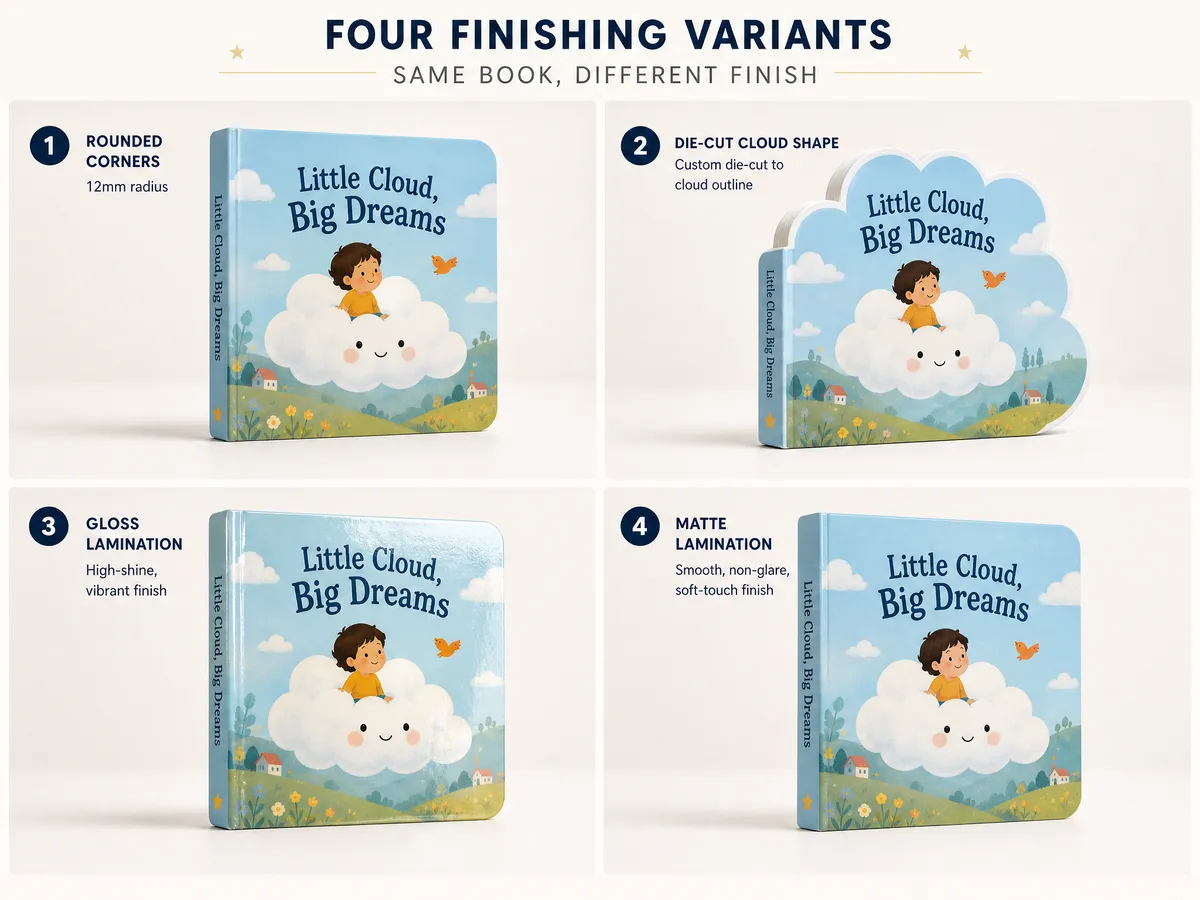
Rounded corners are not optional — they are essential safety features. Sharp 90-degree corners on thick board pages are a hazard for toddlers. Most factories round corners to a 12mm or 15mm radius. Some offer smaller radii for aesthetic reasons, but anything under 10mm on a 2mm-thick page still feels sharp. Worth noting: automated corner-rounding machines handle this in bulk, so there is usually no per-unit upcharge for standard rounding.
Die-cut shapes turn a rectangular book into something memorable — a cloud, a car, an animal silhouette. Die-cutting requires a custom steel-rule die, which adds a one-time tooling cost (typically $50 to $150 depending on complexity). The die is then used on a hydraulic or platen press to cut through the mounted board. Tolerances matter here: a poorly made die produces fuzzy edges and misalignment between pages. Good factories keep their dies sharp and replace them before quality degrades.
Lamination protects printed surfaces from moisture, scratches, and general toddler abuse. Gloss lamination makes colors pop — it is the standard choice for most board books because it enhances illustration work. Matte lamination gives a softer, more sophisticated feel and reduces glare under overhead lighting. It costs slightly more than gloss and shows fingerprints less. Some publishers use matte on the cover and gloss inside, or vice versa.
Spot UV adds a high-gloss coating to specific areas — a character’s eyes, a title treatment — creating contrast against a matte background. It is a premium touch that makes a book stand out on a crowded shelf.
MOQ and Pricing: What the China Factory Advantage Looks Like
Minimum order quantities are the gatekeeper of board book printing in China. Most factories set their MOQ between 500 and 1,000 copies per title. Some will go as low as 300 for simple self-cover formats, but the per-unit price jumps noticeably below 500.
Why do factories enforce MOQs? Board book production involves multiple setup steps — plate-making for offset, die creation for shapes, machine calibration for the mounting and binding line. Each setup costs time and materials whether they run 100 copies or 10,000. The MOQ ensures they recover those fixed costs.
Here is roughly what you can expect for a standard 10-spread (20-page) self-cover board book, 6″ x 6″, 1200gsm grey board, gloss lamination, rounded corners, 4/4 color offset printing, FOB China port:
- 500 copies: approximately $2.80–$3.50 per unit
- 1,000 copies: approximately $2.00–$2.60 per unit
- 3,000 copies: approximately $1.50–$1.90 per unit
- 5,000 copies: approximately $1.20–$1.60 per unit
These numbers are ballpark estimates. Actual quotes depend on page count, format, paper grade, finish complexity, and the specific factory. But the pattern is clear: unit costs drop significantly as quantity climbs. This is the structural advantage of manufacturing in China — the factories are built for volume, and volume buyers capture the savings.
Compare that to domestic US board book printing, where $5–$8 per unit at 1,000 copies is common. For indie authors and small publishers working with tight margins, the math speaks for itself.
Production Workflow: What Happens After You Approve the Proof?
Understanding the production timeline helps you plan your publishing calendar and catch potential delays before they become emergencies.
Week 1 – Prepress and Proofing: Your print-ready files go through preflight checks. The factory checks bleeds, resolution (300dpi minimum), color profiles (CMYK), and font embedding. They produce a digital proof — usually a PDF soft proof or, for color-critical projects, a printed hard proof shipped to you via DHL. Hard proofs add about a week but are worth it for first-time orders.
Week 2-3 – Plate Making and Printing: Once you sign off on the proof, aluminum plates are created for each printing form. Offset printing begins. A typical 10-spread board book runs on 5 large sheets printed on both sides. Sheets go through checks for registration, color consistency, and surface defects.
Week 3-4 – Mounting and Binding: Printed sheets are mounted onto grey board using water-based adhesive. This is the most critical step in board book production. Uneven adhesive application causes bubbling and delamination. Good factories use automated mounting lines with precise pressure and drying controls. After mounting, pages are trimmed to final size, corners rounded, and the book block assembled.
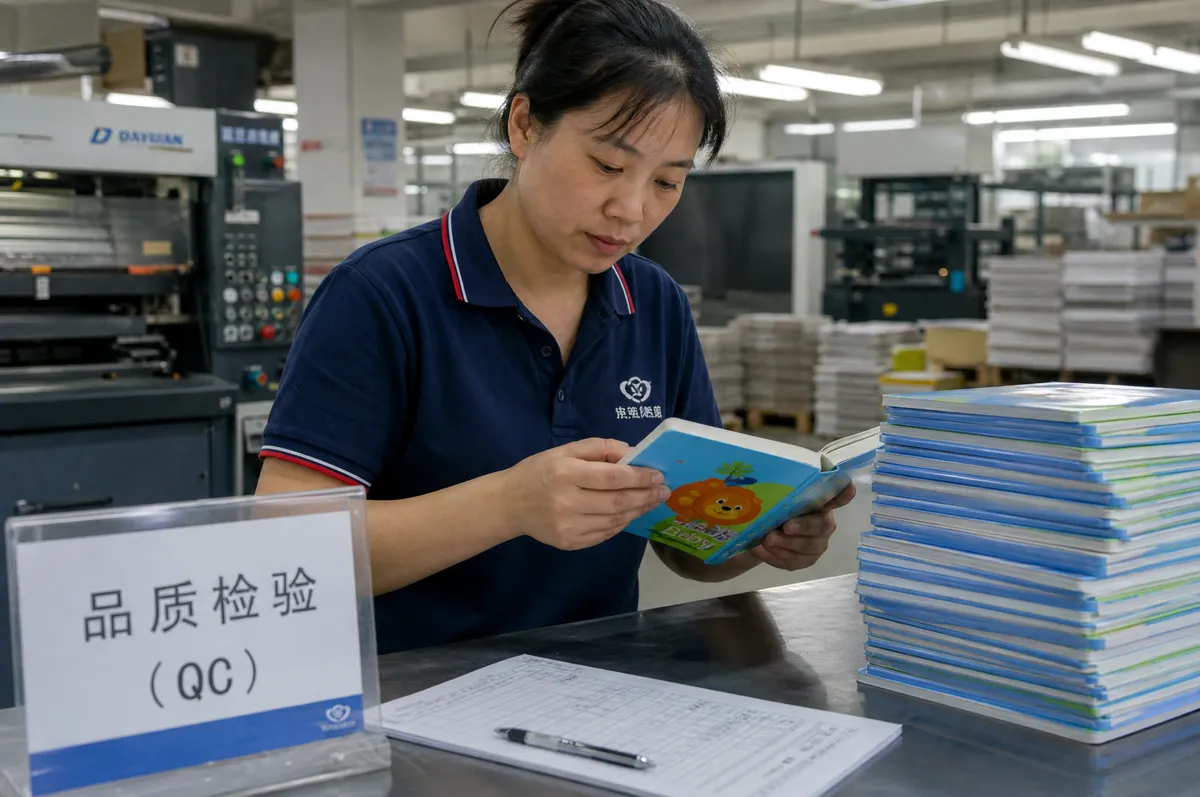
Week 4-5 – Finishing and Quality Inspection: Lamination is applied (gloss or matte), die-cuts are executed, and any special finishes like spot UV are added. Each book goes through a final QC check — page order, binding integrity, corner smoothness, surface quality. A random sample undergoes pull-testing to verify that mounted pages will not separate.
Week 5-6 – Packing and Shipping: Books are shrink-wrapped, packed into export cartons, and palletized. FOB terms mean your freight forwarder takes over at the port. Sea freight to a US West Coast port takes about 14-18 days. East Coast destinations add another 5-7 days through the Panama Canal.
Total timeline from file approval to delivery at your warehouse: roughly 6 to 8 weeks, assuming no major revision cycles.
How to Choose a Board Book Printer in China
Not all board book printing factories in China are created equal. Some focus on ultra-low-cost production with minimal quality oversight. Others serve premium publishers and invest in modern equipment, trained QC teams, and international certifications. Here is how to separate the two.
Ask for samples first. A factory that is proud of its work will send you physical samples of similar projects without hesitation. Look at the corner rounding — is it clean or ragged? Squeeze the pages — do they feel solid or does the board give way too easily? Check the lamination — are there bubbles, peeling edges, or uneven gloss?
Verify certifications. ISO 9001 for quality management is table stakes. FSC certification confirms responsible paper sourcing. For children’s products, ask to see CPSIA compliance documentation and EN71 test reports. If a factory cannot produce these within 24 hours of your request, they probably do not have them.
Test their communication. Do they respond to emails within one business day? Can the account manager discuss technical specifications in clear English? Are they proactive about flagging issues in your files — low-resolution images, insufficient bleed, text too close to the trim edge? A responsive, detail-oriented account manager prevents more problems than any QC checklist.
Start with a small order. Place a 500-copy trial run before committing to a 5,000-copy purchase order. The trial lets you evaluate the final product in your hands and test the factory’s reliability on deadlines. A factory that handles a small order professionally will likely handle a large one the same way.
At EcoPrinting, we operate ecobookprinting.com as a direct bridge between international publishers and our vetted manufacturing partners in China. We handle the sourcing, quality control, and logistics so you can focus on creating great children’s content.
Frequently Asked Questions
How much does board book printing in China cost per unit?
Costs range from approximately $1.20 to $3.50 per unit FOB, depending on quantity, page count, format size, board thickness, and finish options. Larger quantities drive the per-unit price down. Request a custom quote for your specific specifications.
What is the typical MOQ for board book printing?
Most factories set MOQs between 500 and 1,000 copies. Some will accept 300 copies for simple self-cover formats, but expect a higher per-unit cost below 500. Digital printing options may allow even lower quantities at select facilities.
How long does board book production take?
Plan for 6 to 8 weeks from proof approval to delivery at your warehouse in the US or Europe. This includes prepress, printing, mounting, binding, finishing, quality inspection, and ocean freight. Air freight can reduce transit time to about one week at significantly higher cost.
Are Chinese board books safe for babies and toddlers?
Yes, when manufactured by a reputable factory that complies with CPSIA, ASTM F963, and EN71 standards. Water-based adhesives, soy-based inks, and laminated surfaces are standard at quality-focused manufacturers. Always verify test reports before production begins.
What file format should I send for board book printing?
Print-ready PDF files with 3mm bleed, 300dpi minimum resolution, CMYK color space, and fonts outlined or embedded. Include a dieline file if your project has die-cut shapes. Most factories provide a detailed file preparation guide upon request.
Get Your Board Book Project Started
Board book printing in China is not a mysterious black box. It is a well-established manufacturing process with clear variables: format, materials, quantity, finishes, and quality standards. Once you understand how these variables interact, you can make informed decisions that balance cost, quality, and timeline.
Whether you are publishing a first-words book, a bedtime story collection, or an interactive picture book, the right manufacturing partner makes the difference between a book that delights children and one that falls apart after the third reading.
Ready to explore your options? Visit ecobookprinting.com to request a custom quote for your board book project. Include your desired format, page count, quantity, and any special finishing requirements — our team will get back to you with a detailed proposal within one business day.