Someone Told You Packaging from China Is Cheap. They Left Out the Part Where the Math Gets Complicated.
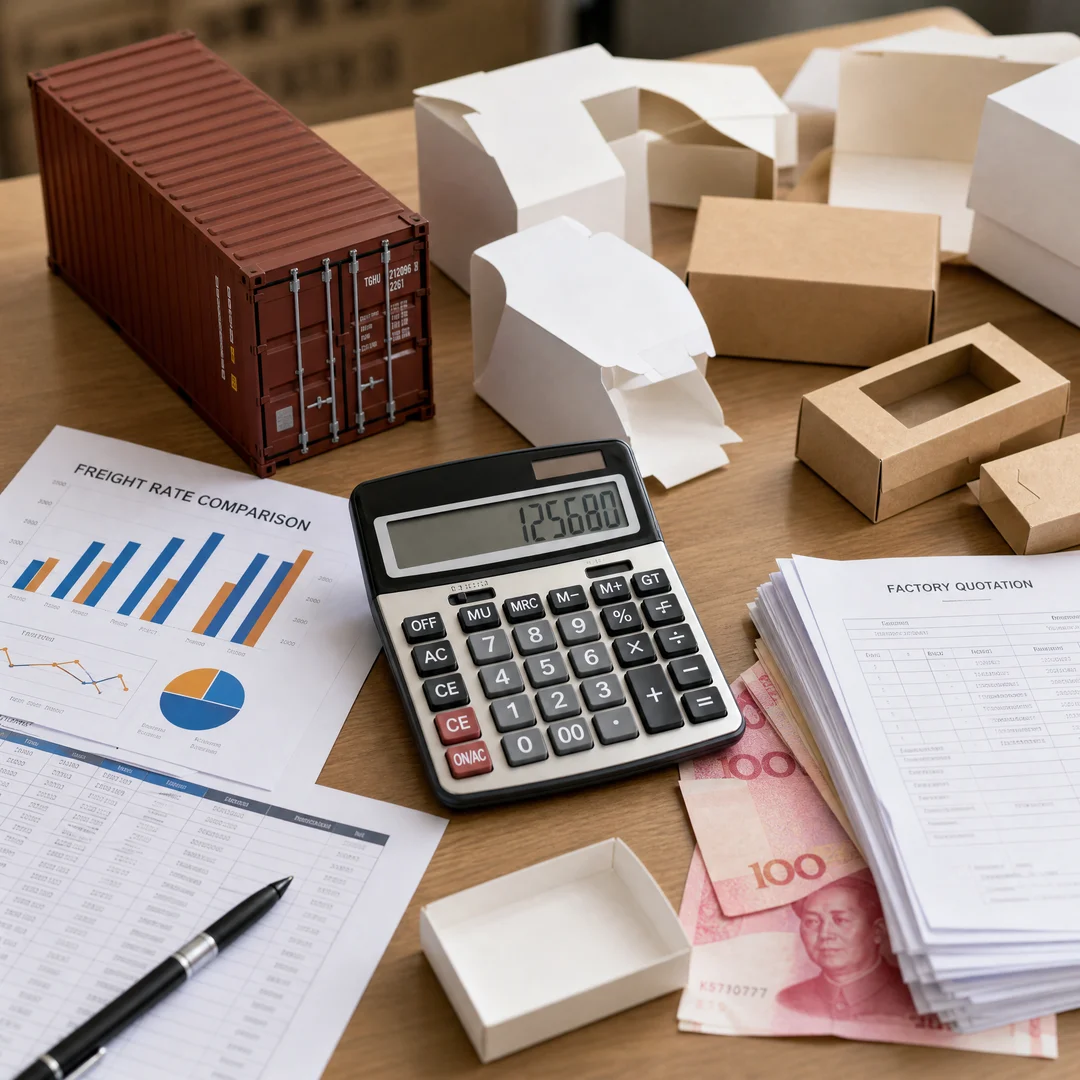
The phrase “cheap Chinese packaging” floats around trade shows and sourcing forums like it is a settled fact. And in one narrow sense, it is true: the unit prices that come back from factories in Guangdong and Zhejiang are genuinely lower than what you would pay from a domestic manufacturer in Europe, the UK, or North America. What nobody tells you is that the unit price on a quote sheet is not the final number. It is the starting line of a math problem that involves MOQ cliffs, freight cube calculations, tariff classifications, and a dozen small fees that nobody mentions until the invoice arrives.
You can print 500 rigid boxes for a reasonable per-unit cost, then watch that cost triple when you add air freight and customs clearance because the boxes ship assembled and you are paying to move air inside a container. You can print 5,000 folding cartons at a price that looks too good to be true and then get it, exactly, because the factory used a thinner paperboard than what you spec’d and now the box buckles under its own product weight. You can chase the lowest quote and end up paying more in total — more in reprints, more in customer complaints, more in the slow-burning regret of having cut one corner too many.
This guide is about the real numbers behind packaging printing cost china . Not the glossy brochure numbers. The ones that show up on actual factory quotes, on freight forwarder invoices, and on the customs bill that lands in your inbox three weeks after the shipment arrives. Paperboard economics. MOQ math. Die-cutting fees explained. Surface finishing marginal costs. Offset versus digital break-even points. Sea freight versus air freight versus rail freight with real cost ranges. Import duties by destination country. The hidden fees. The RFQ template that gets usable quotes. And the cost traps that turn a cheap order into an expensive mistake.
What Drives Packaging Printing Cost
Every packaging quote from a Chinese factory breaks down into a handful of cost buckets, and the buckets interact in ways that are not obvious until you have seen enough quotes to recognize the pattern. Change the paperboard weight, and you change the shipping cost because the carton gets heavier. Change the box structure from folding to rigid, and you change the shipping cost again because rigid boxes travel assembled. Add a spot color, and you add a plate cost that is fixed whether you print 500 boxes or 50,000. Understanding the drivers separately is the prerequisite for understanding the total.
Why do two boxes of the same dimensions have completely different price quotes?
Dimensions are only the container. What goes inside that container — the paperboard, the printing process, the finishing treatments, and the structural complexity — determines the cost. A 200 × 150 × 50 mm rigid box with 2.0 mm grey board core, 157 GSM art paper wrap, matte lamination, and gold foil logo stamping will cost three to five times more per unit than a 200 × 150 × 50 mm folding carton printed on 350 GSM CCNB with standard CMYK and no finishing. Same external dimensions. Completely different cost structures.
The cost drivers stack in a roughly predictable order of magnitude. Paperboard type and thickness is the largest single material cost, typically 30 to 45 percent of the total. The printing process — CMYK offset, CMYK plus spot colors, or digital — accounts for 15 to 25 percent. Surface finishing, if included, adds 5 to 15 percent. The box structure — folding carton versus rigid box versus drawer box — determines labor cost, which can range from 10 percent of the total for a simple automated folding carton to 30 percent or more for a rigid box that requires hand assembly and wrapping. Setup costs — plates, dies, samples — are fixed and distributed across the print run, which is why they are a large percentage of small orders and a rounding error on large ones.
The factory’s profit margin — usually 8 to 15 percent after all costs — is layered on top. This is not a negotiable line item in the way that Western buyers sometimes assume. Chinese packaging factories operate on thin net margins, often 3 to 5 percent after overhead. The room to discount comes from efficiency, not from margin giveaway. A factory that consistently quotes 20 percent below market rates is not being generous. It is cutting something — the paperboard thickness, the ink density, the quality control pass rate, or all three.
How does paperboard GSM affect my packaging cost per unit?
Paperboard is sold by weight, not by sheet count, and the weight difference between grades translates directly into cost. Moving from 300 GSM CCNB to 400 GSM CCNB adds roughly 25 to 35 percent to the raw material cost because the board contains proportionally more fiber. The effect on the final unit price is smaller — perhaps 8 to 15 percent — because material is only one cost component, but the direction is always upward.
The real cost impact of GSM is not just in the paperboard price. A heavier board is thicker, and thickness affects die-cutting performance (thicker board requires more cutting force, which wears dies faster), folding and gluing speed (thicker board slows the folding line because the creasing takes more dwell time), and — critically — shipping weight. A 5,000-piece order of boxes at 350 GSM adds roughly 15 to 20 percent to the shipping weight compared to the same boxes at 300 GSM, and the freight forwarder charges by weight or volume, whichever is higher. The cost of going heavy compounds.
The rule for when to step up in GSM is straightforward. If the packaging is structural — if the box must support weight, survive stacking, or hold its shape on a shelf — then the thicker board pays for itself by preventing product damage and customer returns. If the packaging is purely decorative — a lightweight sleeve, an insert card, a secondary wrapper — then the thinner board saves money without compromising function. The trap is treating GSM as a quality indicator rather than a functional requirement. A 300 GSM box that does its job is better than a 400 GSM box that costs more to make and more to ship but adds no perceptible improvement to the customer experience.
MOQ Economics: The Numbers That Change Everything
Minimum order quantity is the single most misunderstood number in packaging procurement. Buyers treat it as an arbitrary gate — “the factory says I have to order at least 1,000 pieces” — when it is actually a cost calculation in disguise. Below a certain quantity, the fixed setup costs (plates, dies, machine setup time, ink mixing) overwhelm the per-unit material and labor costs, and the per-unit price becomes unsustainably high. The factory’s MOQ is the point where the unit price starts to make economic sense for both sides. Here is what that looks like in practice.
What is the real per-unit cost difference between 500 and 5,000 boxes?
The numbers shift dramatically across volume tiers. For a standard custom folding carton — 300 GSM CCNB, CMYK printing, matte lamination, basic tuck-end structure, dimensions roughly 150 × 100 × 40 mm — the unit pricing from a mid-tier factory in Guangdong or Zhejiang follows a predictable curve.
At 500 pieces, the per-unit cost sits around USD 0.85 to USD 1.40. The wide range reflects the fixed setup costs: plates at USD 40 to 60 each (four for CMYK, so USD 160 to 240), a cutting die at USD 60 to 120, plus machine setup and ink mixing time. Spread across only 500 units, those setup costs add roughly USD 0.50 to 0.70 per box, which is more than the material and printing cost combined. At this volume, digital printing — with no plate costs — can sometimes beat offset on total cost, though the quality and substrate options are narrower.
At 1,000 pieces, the per-unit cost drops to roughly USD 0.50 to USD 0.80. The setup costs are now spread across twice as many units, cutting their per-unit contribution roughly in half. The material and labor costs per unit stay roughly the same — paper and ink are priced by consumption, not by order size — so the price drop is almost entirely from the fixed-cost amortization.
At 5,000 pieces, the per-unit cost falls to USD 0.25 to USD 0.45. The setup costs are now negligible per unit — less than USD 0.10 per box — and the factory has moved into efficient production territory where the press runs at speed, the die-cutting line runs continuously, and the folding-gluing operation achieves its target throughput. This is the volume tier where packaging printing cost china economics really pull away from Western alternatives.
At 10,000 pieces and above, the unit cost continues to decline but the curve flattens. The per-unit price at 10,000 pieces might be USD 0.20 to USD 0.35 — the setup costs are a rounding error, and the remaining cost is materials, labor, and machine time, none of which get meaningfully cheaper with additional volume beyond about 10,000 units for a standard folding carton. For rigid boxes, the curve is similar in shape but higher at every tier: USD 2.50 to USD 4.00 at 500 pieces, USD 1.80 to USD 2.80 at 1,000, USD 1.20 to USD 1.80 at 5,000, and USD 1.00 to USD 1.50 at 10,000.
Is there a minimum order quantity threshold where offset printing becomes cheaper than digital?
The break-even between digital and offset for packaging varies by format, but the general range for folding cartons is 300 to 500 units. Below that threshold, digital printing wins because it eliminates plate costs entirely — a digital press prints directly from the file with no setup beyond calibration. The per-unit digital print cost is higher than offset at volume — digital toner or inkjet ink is more expensive per sheet than offset ink per impression — but avoiding USD 200 to 300 in plate and setup charges makes digital cheaper for very short runs.
Above 500 units, offset printing becomes cheaper and stays cheaper at every higher volume tier. The fixed plate and setup cost is fully amortized by this point, and the offset press runs faster, prints on a wider range of substrates, and delivers better color consistency across the run. For rigid boxes and premium packaging, the break-even is lower — around 200 to 300 units — because the base cost is higher to begin with, which makes the setup cost a smaller relative percentage.
One nuance that matters: digital printing for packaging has improved significantly in the last three years. HP Indigo presses can now print on substrates up to 400 GSM with near-offset quality, and the digital embellishment options — digital foil, digital spot UV — have reduced the gap between what digital and offset can deliver. But digital cannot yet match the per-unit economics of offset above 1,000 units, and it cannot print on grey board, corrugated board, or rigid box wrapping papers at the same quality level. The break-even is not just about cost. It is about whether the substrates and finishes your packaging needs are even available in digital.
Die-Cutting and Setup Fees: One-Time or Recurring?
Setup fees are the line items on a packaging quote that first-time buyers either ignore or obsess over. Both reactions are wrong. Ignoring them means underestimating your true delivered cost. Obsessing over them means negotiating pennies on setup while leaving dollars on the table in per-unit pricing. Understanding what each fee covers and whether it recurs is the middle path.
Do I pay the die-cutting fee once, or every time I reorder?
A cutting die — the laser-cut wooden form with embedded steel rule blades that punches a flat sheet of paperboard into the shape of your box — is a one-time cost per design. Once the die is made, the factory stores it for your future orders. On a reorder of the same box with the same dimensions, you do not pay the die-cutting fee again. The die is pulled from storage, mounted on the die-cutting press, and the production run proceeds.
The die itself is a consumable with a finite lifespan. A steel-rule die in a wooden base will last for roughly 100,000 to 200,000 impressions before the blades dull and the cutting quality degrades. For most packaging buyers, that is effectively forever — a 5,000-piece reorder four times a year takes eight years to use up a die, and by then the design will almost certainly have changed. For high-volume buyers running 50,000 units per order, the die wears faster and may need replacement every few production runs. Replacement die cost is the same as the original: USD 60 to 200 depending on size, complexity, and the number of creasing rules.
A related point that surprises first-time buyers: the cutting die is not the printing plate. Printing plates — one per color for offset lithography — are also a one-time cost, but unlike dies, they deteriorate with every press run. A set of CMYK plates costs USD 160 to 240 total and lasts for a single production run. On a reorder, new plates must be made. The reorder plate cost is the same as the original — the factory does not store used plates because the aluminum surface degrades after the press run and cannot produce consistent results on a second run.
What other setup costs show up on a packaging quote?
Beyond die-cutting and printing plates, the standard setup line items on a Chinese packaging factory quote include prepress and color management (file inspection, trapping, and imposition — USD 20 to 50), a digital proof or white sample (USD 20 to 60 per round), foil stamping dies if applicable (USD 80 to 250, one-time, stored for reorders), embossing or debossing dies (USD 80 to 250, one-time), and screen printing screens if applicable (USD 10 to 30 per color).
One fee that catches buyers off guard is the plate change fee or setup fee on reorders. If you reorder the same box but change one color — say the background changes from navy to forest green — you need a new plate for that color unit, but the other three CMYK plates and the cutting die are unchanged. The factory charges for the new plate (USD 40 to 60) plus a reduced setup fee (USD 30 to 50) to cover the machine calibration time. It is cheaper than a full new order setup, but it is not free.
Surface Finishing: The Marginal Cost of Premium
Surface finishing is the line item where packaging buyers spend money that does not show up as a physical material. You cannot weigh lamination the way you can weigh paperboard. You cannot measure foil coverage in GSM. And yet the finishing choice determines more about how the box reads as premium, mid-tier, or budget than almost any other decision. The costs are modest in absolute terms but significant in relative terms, and knowing which finishes cost what prevents overpaying for an effect that could be achieved cheaper.
Which surface finishing technique costs more: lamination, UV, or foil stamping?
Ranked from cheapest to most expensive per unit at medium volume (5,000 pieces), for a standard folding carton roughly 150 × 100 × 40 mm:
Gloss or matte lamination: USD 0.02 to 0.04 per box. Lamination is the baseline finish on most commercially printed packaging, and the cost is so low at volume that many factories include it in the base unit price rather than listing it as a separate line item. The film is purchased in bulk rolls, the laminating machine runs at high speed inline with the printing press or as a separate pass, and the per-square-meter cost is fractions of a cent. There is essentially no cost difference between gloss and matte film — they are priced identically by film suppliers.
Spot UV: USD 0.04 to 0.12 per box. Spot UV adds cost for two reasons: it requires a UV coating plate (a one-time USD 40 to 80 plate fee), and it requires a separate pass through a UV curing station that prints, applies UV varnish to the designated areas, and cures the varnish with ultraviolet light. The per-box cost depends on the coverage area — a small logo highlight costs less than a full-panel pattern — and the plate cost is amortized across the run.
Soft-touch lamination: USD 0.05 to 0.12 per box. The film itself is more expensive than standard lamination film by roughly 30 to 50 percent, and the application requires tighter process control — the soft-touch film is more heat-sensitive and prone to marking during lamination if the machine temperature is not carefully managed. The manufacturing yield is slightly lower than standard lamination, which adds a small waste cost.
Foil stamping: USD 0.06 to 0.20 per box, plus a one-time die cost of USD 80 to 250. Foil itself is the most expensive consumable — metallic foil rolls cost significantly more per square meter than lamination film — and the stamping process is slower than lamination because each sheet must be precisely registered under the heated die. The per-box cost depends heavily on the foil coverage area. A small logo stamp at 2 cm² costs a few cents. A full-cover foil stamp across an entire box panel costs much more. The die cost is stored for reorders, so repeat orders eliminate the die fee.
Embossing and debossing: USD 0.06 to 0.18 per box, plus a one-time die cost of USD 80 to 250. The embossing die — a matched male-and-female metal set — is the most expensive die type because it requires precision milling on both halves. The per-box cost is driven by the complexity of the embossed area and the pressure required to deform the paperboard without cracking it.
The efficient stacking strategy: matte lamination as the base finish, plus spot UV for the logo and key graphic elements, creates a premium look for roughly USD 0.06 to 0.10 per box above the base price. Adding foil stamping on top — matte lamination, spot UV pattern, foil stamped logo — brings the total finishing cost to USD 0.12 to 0.25 per box. That is the cost of the full premium treatment, and at 5,000 units, it adds USD 600 to 1,250 to the total order. Whether that is expensive or cheap depends entirely on what the box is selling.
Offset Versus Digital: Where the Cost Lines Cross
The offset-versus-digital decision for packaging is not the same as for commercial printing. Packaging substrates are heavier. The color consistency demands are stricter — a box that shifts half a Delta E across the run is more visible than a brochure that does the same. And the range of finishing options is wider, which limits what digital can realistically deliver. But the cost curves have shifted meaningfully in the last few years, and the old rule of thumb — “offset always below 500 units” — needs an update.
At what quantity does offset printing become cheaper than digital for packaging?
The break-even for folding cartons on 300 GSM to 350 GSM board sits between 300 and 500 units, depending on the number of colors and the finishing requirements. Below 300 units, digital wins on total cost because the plate and setup charges are eliminated. The per-sheet print cost of digital is higher — roughly USD 0.50 to USD 1.50 per sheet for a four-color print on a digital packaging press versus USD 0.10 to USD 0.30 per sheet for offset at volume — but the absence of USD 200 to 400 in setup costs outweighs the higher per-sheet cost at very small quantities.
Above 500 units, offset wins and the gap widens with every additional thousand units. At 2,000 units, offset is reliably 15 to 30 percent cheaper than digital, and at 5,000 units, the gap is 30 to 50 percent. The difference is driven by ink cost: offset ink is commodity-priced at a few dollars per kilogram and prints thousands of sheets per kilogram, while digital toner or inkjet ink is proprietary and priced at a significant premium per page.
There is a middle ground that some factories now offer: hybrid production where the packaging is printed digitally for color-critical elements and offset-printed for backgrounds or large flat color areas. This approach is niche — it requires precise registration between the two processes — but for short runs with complex artwork that includes both photography and large solid-color areas, it can offer the best of both cost curves.
Can digital printing match offset quality for luxury packaging?
Digital quality has improved to the point where a well-calibrated HP Indigo press can produce results that a non-professional eye would struggle to distinguish from offset on coated paperboard. The Indigo uses liquid electrophotographic ink that sits on the substrate surface much like offset ink, rather than the toner-on-surface look of older dry-toner digital presses. Color gamut is competitive with offset for most CMYK ranges, though digital still cannot match the saturation depth of offset on a heavy ink laydown.
Where digital falls short for luxury packaging is not in color but in finish compatibility. Lamination adheres differently to digital prints than offset prints — the toner or inkjet ink layer creates a different surface energy profile than offset ink film, and some lamination films bond less reliably. Foil stamping over digital prints is riskier because the heat and pressure of the stamping die can cause toner to lift or shift. Spot UV registration is tighter on offset because the offset ink surface provides a more consistent substrate for the UV varnish to grip. These are solvable problems — digital packaging suppliers have developed workarounds for each — but the solutions add cost and reduce the pool of factories that can deliver them.
For rigid boxes with grey board cores and art paper wraps, offset remains the default because the wrapping paper must be printed separately and then laminated to the grey board. Digital presses cannot handle the full workflow. For corrugated mailer boxes, digital direct-to-corrugate printing is viable at small quantities, with the same cost and quality trade-offs.
Freight and Logistics: The Invisible Half of Your Budget
If there is one number that first-time packaging buyers consistently underestimate, it is the freight cost. A quote for USD 1,500 worth of printed boxes becomes a total landed cost of USD 2,200 to 3,000 after freight, customs clearance, duties, and destination handling. The freight-to-product-cost ratio is not fixed — it depends on the package weight, the package volume, the shipping mode, and the destination — but a ratio of 30 to 100 percent is common for small-to-medium orders. For rigid boxes that ship assembled and take up disproportionate container volume, the ratio can exceed 100 percent.
How much should I budget for shipping packaging from China?
The answer depends on mode, weight, volume, and destination, but realistic ranges for a typical packaging shipment — roughly 200 to 500 kg, one to three cubic meters — from Shenzhen or Shanghai to major Western ports are as follows.
Sea freight (LCL — less than container load): USD 150 to USD 400 per cubic meter. Transit time is 25 to 40 days to the US West Coast, 30 to 45 days to Europe, and 35 to 50 days to the UK. LCL is the most economical mode for shipments that are too small to fill a container but too heavy or bulky for air freight to make sense. The per-unit shipping cost at LCL rates for a 5,000-piece folding carton order is typically USD 0.03 to 0.10 per box, depending on carton size and nesting efficiency. LCL pricing is calculated by volume (per CBM) or weight (per 1,000 kg), whichever is higher, so lightweight but bulky packaging — like rigid boxes shipped assembled — pays by volume.
Sea freight (FCL — full container load): A 20-foot container from Shenzhen to Los Angeles runs roughly USD 2,000 to USD 4,000 at 2025-2026 rates. A 40-foot container runs USD 3,000 to USD 6,000. FCL becomes economical at roughly 15 to 20 cubic meters — below that threshold, LCL is cheaper even though the per-CBM rate is higher, because you are only paying for the space you use. At 20-plus cubic meters, the per-CBM cost of FCL drops below LCL rates and the full container becomes cheaper.
Air freight: USD 3.50 to USD 8.00 per kilogram. Transit time is 3 to 7 days door-to-door. At 500 kg, an air freight shipment costs USD 1,750 to USD 4,000 — often more than the product cost itself. Air freight only makes economic sense for high-value, low-weight packaging (small rigid boxes, premium gift packaging), for urgent timelines where the cost of being out of stock exceeds the freight premium, or for sample and prototype shipments where the weight is minimal.
Rail freight (China-Europe Railway Express): USD 1,800 to USD 3,500 per 20-foot container equivalent, with transit times of 15 to 20 days from Chinese rail terminals (Zhengzhou, Chongqing, Chengdu, Xi’an) to European hubs (Duisburg, Hamburg, Warsaw, Madrid). Rail splits the difference between sea and air — roughly twice the cost of sea but half the transit time — and has become a meaningful option for packaging printing cost china to Europe logistics. The rail route covers most Western and Central European destinations through the Duisburg-Hamburg hub, with final-mile trucking adding 3 to 5 days and USD 200 to 500 depending on distance.
How does packaging volume affect shipping cost, and can flat-packing help?
Rigid boxes ship assembled unless you specifically negotiate with the factory to ship them flat-packed (unwrapped grey board pieces and printed wrapping sheets), which requires assembly at the destination. Folding cartons naturally fold flat because their structure is designed to — the carton is die-cut with crease lines, folded on the gluing line, and shipped flat in bundles. The difference in shipping volume between the two structures is enormous: 5,000 flat folding cartons might occupy one cubic meter. The same 5,000 rigid boxes shipped assembled might occupy five to eight cubic meters.
The volume difference translates directly to freight cost. At LCL sea freight rates of USD 200 per CBM, the folding cartons cost USD 200 to ship. The rigid boxes cost USD 1,000 to 1,600 — USD 0.20 to 0.32 per box just for freight. If the rigid box has a unit production cost of USD 2.00, freight alone adds 10 to 16 percent. If the box is a USD 1.20 folding carton converted to rigid design, the freight cost flips the economics: the rigid box now costs USD 3.20 to 3.52 landed versus the folding carton at roughly USD 1.50 landed.
Flat-packing rigid boxes is possible but adds complexity. The factory ships the grey board panels flat, the printed wrapping sheets flat, and the buyer assembles at the destination — either in-house with adhesive and manual labor, or through a co-packing service that charges per-unit assembly fees. The labor cost of assembly must be weighed against the freight savings. A rule of thumb: if the freight cost per box exceeds the assembly labor cost per box at the destination, flat-packing makes sense. For most rigid box orders under 5,000 units shipped to the US or Europe, assembly labor costs at destination are USD 0.40 to 0.80 per box, which is typically higher than the freight savings — so assembled shipping wins. At 10,000 units or for orders shipped to regions with lower labor costs, the math may flip.
Nesting — designing boxes so that smaller ones fit inside larger ones during shipping — is a more accessible volume optimization strategy. If your product line includes multiple box sizes, shipping them nested rather than separately packed can reduce total volume by 20 to 40 percent. The catch is that nesting requires the factory to pack the shipment differently than their standard workflow, and some factories charge a repacking fee for non-standard packing arrangements.
Import Duties and Hidden Customs Costs
Packaging falls into specific Harmonized System (HS) code categories that determine the duty rate at the destination country. The rate varies by material composition and whether the packaging is printed or unprinted. Printed packaging — the category that covers almost all custom-branded boxes and cartons — is classified differently from plain unprinted shipping cartons, and the duty rate on printed packaging is often lower because the customs classification treats printing as adding value beyond the base material.
What import duties apply to printed packaging from China?
For the United States, printed paper and paperboard cartons and boxes typically fall under HS code 4819.10 (cartons, boxes, and cases of corrugated paper or paperboard) or 4819.20 (folding cartons, boxes, and cases of non-corrugated paper or paperboard), with duty rates ranging from 0 percent to 3.5 percent depending on the specific sub-classification. The US has not imposed the Section 301 tariffs on printed paper packaging the way it has on some other Chinese goods — printed paper and paperboard packaging has generally been excluded from the additional 25 percent tariff that applies to certain categories.
For the European Union, printed paper and paperboard packaging falls under HS codes 4819.10, 4819.20, and 4819.50, with import duty rates of 0 percent for most sub-categories. The EU’s tariff schedule for printed paper packaging is remarkably favorable — essentially duty-free — which is one reason European brands source packaging from China in significant volumes. Value-added tax (VAT) at the destination country’s rate (typically 19 to 25 percent) applies on top of the CIF value plus duty, but VAT is recoverable for registered businesses in most EU member states.
For the United Kingdom, post-Brexit, printed paper packaging from China is classified under the UK Global Tariff with duty rates of 0 percent for most paper and paperboard packaging categories. UK VAT at 20 percent applies on the total landed cost including freight and insurance.
For Canada, Australia, and New Zealand, most printed paper packaging enters at duty rates between 0 percent and 5 percent under their respective tariff schedules. The key variable across all destinations is the HS code classification — a misclassified shipment can trigger a higher duty rate than necessary, and a customs broker who specializes in printed goods and packaging can save hundreds to thousands of dollars on a full-container shipment by ensuring the correct sub-classification.
Beyond duties, customs clearance fees — broker fees, terminal handling charges, inspection fees, and bond fees — add USD 150 to 500 per shipment depending on the port and the complexity of the entry. These are fixed costs, not percentage-based, so they matter more as a percentage of small shipments than large ones. A USD 300 customs clearance fee on a USD 1,500 order is 20 percent. The same fee on a USD 15,000 order is 2 percent.
Hidden Costs That First-Time Buyers Never See Coming
The unit price on a factory quote is a number. The landed cost — unit price plus freight plus duties plus fees plus the cost of fixing what went wrong — is the number that matters. The gap between the two is filled with costs that experienced buyers budget for and first-time buyers discover on the invoice. Here is what lives in that gap.
What fees do packaging factories charge beyond the unit price?
Sampling fees: Most factories charge for pre-production samples — USD 30 to 80 for a digital proof, USD 50 to 150 for a physical white sample (a blank structural sample with no printing), and USD 80 to 250 for a printed pre-production sample on the actual substrate with actual inks and finishing. Some factories credit sampling fees against the production order if it proceeds; others treat sampling as a separate service. Ask about the crediting policy before approving sample charges, and get it in writing.
Design revision fees: If your artwork file requires prepress adjustments — trapping corrections, bleed extensions, color separation work, dieline alignment — the factory’s prepress department charges for the labor. Reasonable revision fees run USD 30 to 80 per round. Unreasonable ones — USD 200-plus for basic file adjustments — are a red flag. A factory that charges aggressively for minor prepress work may be using it as a hidden margin source.
Rush fees: Standard production lead times for custom packaging in China are 15 to 25 working days for folding cartons and 20 to 35 working days for rigid boxes. Cutting into that timeline — asking for delivery in 10 days instead of 20 — incurs a rush surcharge. The surcharge ranges from 15 to 30 percent of the production cost, depending on how much the factory has to rearrange its production schedule to accommodate the rush order. Rush fees are a function of factory capacity: a factory running at 70 percent utilization can often accommodate a small rush order without a surcharge. A factory at 95 percent utilization cannot. The buyer has no way to know the factory’s utilization rate, so the best approach is to assume the standard lead time applies and build buffer into the project timeline.
Storage and warehousing fees: If your finished packaging sits in the factory’s warehouse waiting for shipping arrangements to be finalized, the first 7 to 14 days are usually free. Beyond that, warehousing fees of USD 3 to 8 per cubic meter per day start accruing. More importantly, warehouse storage carries a risk of damage: boxes stored at the bottom of a stack for weeks can deform, and humidity in un-air-conditioned warehouse spaces can warp paperboard. Schedule shipping before production completes so there is no gap between manufacturing and dispatch.
Payment processing fees: Wire transfer fees from Western banks to Chinese bank accounts typically cost USD 15 to 45 per transfer. If the factory insists on a letter of credit (LC) for a large order, the bank charges for LC issuance and confirmation add USD 150 to 500. Some factories accept PayPal or Alibaba Trade Assurance, which add a 2.5 to 4.5 percent processing fee that is either built into the unit price or listed as a separate line item.
Quality inspection fees: Third-party inspection services — SGS, Bureau Veritas, Intertek, AsiaInspection — charge USD 250 to 400 per day for a factory inspection and USD 300 to 500 for a full container loading supervision. These are not mandatory, but for a first order from an unproven factory, an inspection is insurance that costs less than a reprint. Budget USD 300 to 500 for a third-party inspection on a first-time order.
How to Request a Packaging Quote: The RFQ That Gets Real Numbers
The quality of the quote you receive is directly proportional to the quality of the information you provide. A one-line email — “how much for 1,000 boxes?” — will get you a one-line price that is either inflated to cover unknowns or low enough to win the business and then adjusted upward when the real specifications come in. A detailed RFQ gets you a detailed quote that you can actually compare across factories.
What information should I include in a packaging printing RFQ?
A packaging RFQ to a Chinese factory should answer every question the factory’s estimator would otherwise have to guess at. Guesses in an estimate become surcharges on the invoice. The template below covers the minimum viable specification set.
Box style and dimensions: Length × width × depth in millimeters, plus the box type (folding carton, rigid magnetic box, drawer box, mailer box, book-style box, or custom). If the box has inserts, trays, or internal dividers, describe them separately with dimensions. Include a die-line diagram or a reference photo of a similar box.
Paperboard specification: Material grade (grey board, CCNB, SBS, corrugated), thickness (in GSM for folding board, in millimeters for grey board core), and any special requirements (FSC certified, food-grade, acid-free, recycled content percentage). If the box is rigid, specify both the grey board thickness and the wrapping paper GSM.
Printing specification: Number of printing colors (CMYK only, CMYK plus spot colors with Pantone numbers), printing coverage (single side, both sides, inside and outside), and any special ink requirements (metallic, fluorescent, opaque white, food-safe). If the box design includes printing on the inside, specify that — inside printing is not assumed and adds cost.
Finishing specification: Lamination type (gloss, matte, soft-touch), spot UV areas and coverage percentage, foil stamping areas and foil color, embossing or debossing areas, and any special coating (aqueous, UV, anti-scuff). If multiple finishes combine on the same box, describe the stacking order — for example, “matte lamination full surface, then gold foil on logo area 20 × 15 mm, then spot UV on background pattern covering approximately 30 percent of the top panel.”
Quantity and delivery: Total quantity, whether partial shipments are acceptable, the preferred Incoterm (FOB Shenzhen is the standard quote basis — the price covers manufacturing and delivery to the port; freight, insurance, and import duties are the buyer’s responsibility), the destination port or address, and the required delivery date. If the timeline is flexible, say so — it gives the factory room to slot your order into a production gap at a lower cost.
Sampling and quality requirements: Whether you need pre-production samples before the main run, the acceptable defect rate (industry standard for packaging is 1 to 3 percent; specifying a lower rate adds cost because the factory must perform additional sorting), and any third-party inspection requirements.
A factory that receives this RFQ can quote accurately. A factory that receives this RFQ and still comes back with vague pricing or requests for clarification on basic points is signaling that its quoting process is not systematic — which usually means its manufacturing process is not systematic either.
Cost Traps: The Cheap Options That Cost More Later
Every packaging buyer, at some point, receives a quote that is 20 to 30 percent below the market rate and has to decide whether they found a factory with better efficiency or a factory cutting corners. The answer is almost always the corners. Here is where the corners are and what happens when they are cut.
What happens when you cut costs by using thinner paperboard?
A box made from 250 GSM board instead of the spec’d 350 GSM is lighter, uses less material, and costs roughly 15 to 20 percent less to produce. It also fails predictably. The side walls bow outward under light pressure. The corners crush during stacking. The box that looked fine on the sample table arrives at the customer with creases, dents, or — worst case — a product that escaped because the structure gave out.
The failure mode is not always dramatic. Sometimes the box simply feels wrong. The customer picks it up and it flexes more than expected. The subconscious judgment is “cheap” — not because of any visible flaw, but because the haptic feedback does not match the price point. That is a harder failure to quantify but a more damaging one: the box that feels cheap does not get returned, it gets thrown away, and the brand that made it does not get another order.
The practical defense is to specify the material grade and GSM in the purchase order and to verify it with a sample check. A micrometer or caliper gauge measures paperboard thickness in seconds — a 350 GSM CCNB board should measure approximately 0.40 to 0.48 mm, and if the sample measures 0.30 mm, you know the board is under-spec before the production run starts.
What about reducing or skipping surface finishing to save cost?
Eliminating lamination from a folding carton saves roughly USD 0.02 to 0.04 per box — a small absolute number that saves a noticeable percentage on a large run. The cost of that saving is the scuff resistance and moisture protection that lamination provides. An un-laminated printed box scuffs easily — the ink surface abrades against adjacent boxes during packing and shipping, and by the time it reaches the customer, the printed surface shows visible wear. In high-humidity environments, un-laminated paperboard absorbs moisture and warps, creating a box that no longer sits flat or closes cleanly.
Skipping finishing on a box that lives inside another box — a secondary insert card or an interior divider — is a legitimate cost optimization. Skipping finishing on the primary packaging that the customer touches is a false economy. The few cents saved on lamination are dwarfed by the cost of a customer who receives a scuffed box and concludes the brand is careless.
Is skipping sample approval to save time ever worth the risk?
No. The sample approval step — specifically the pre-production sample, printed on the actual substrate with actual inks and actual finishing — is the last checkpoint before the factory runs several thousand units. Skipping it saves 7 to 14 days and USD 80 to 250 in sampling fees. The potential cost of a skipped sample includes the entire production cost of the order if the color is wrong, the die-cutting is misregistered, the lamination peels, the foil stamping placement is off, or any of a dozen other things that show up on a physical sample but not on a PDF proof.
The math is simple. A USD 2,500 production order with a USD 150 sample fee is a 6 percent insurance premium. On a USD 10,000 order, the sample fee is 1.5 percent. Neither number justifies the risk of a full-production error. The only scenario where skipping the sample makes sense is a reorder of a box that has been produced before, on the same equipment, by the same factory, with no specification changes — and even then, a digital proof for color reference is worth the USD 30 to 50 it costs.
FAQ
How much does packaging printing cost in China per box?
For standard custom folding cartons (300-350 GSM CCNB, CMYK printing, basic finish, quantity 5,000), unit prices range from USD 0.25 to 0.60 per box. For rigid magnetic boxes (2.0 mm grey board, 157 GSM wrap, CMYK plus foil stamping, quantity 1,000), unit prices range from USD 2.00 to 4.00 per box. For corrugated mailer boxes (E-flute, CMYK printing, quantity 1,000), unit prices range from USD 0.80 to 2.50 per box depending on size and print coverage. These are factory-gate prices FOB Shenzhen or FOB Shanghai; landed cost at destination is typically 30 to 60 percent higher after freight, duties, and clearance fees.
Why are packaging printing costs in China lower than in Europe or North America?
The cost difference is driven by three factors. Labor cost is the largest — a packaging factory production worker in Guangdong earns roughly USD 500 to 800 per month, compared to USD 2,500 to 4,000 in Western Europe or North America. Raw material cost is lower because China is both the world’s largest paper and paperboard producer and the largest consumer, creating economies of scale in material pricing. And equipment utilization is higher — Chinese packaging factories typically run two or three shifts around the clock, spreading equipment depreciation across more output than a single-shift Western facility. The combination of cheaper labor, cheaper materials, and higher equipment utilization creates a structural cost advantage that no single Western factory can match.
What is the cheapest packaging material for a startup?
For a startup with a limited budget, corrugated E-flute mailer boxes with single-color or two-color printing offer the best balance of cost, protection, and brand presence. Corrugated board is cheaper per square meter than folding carton board at equivalent structural performance. Single-color printing eliminates color registration issues and keeps plate costs to one or two plates. The mailer box structure ships flat, keeping freight costs manageable. A starting budget of USD 1,000 to 2,000 can cover 500 to 1,000 printed mailer boxes with basic branding, which is enough for a product launch or a first production run.
Can I negotiate packaging printing prices with Chinese factories?
Yes, but the room to negotiate is narrower than most Western buyers expect. Chinese packaging factories operate on net margins of 3 to 5 percent after all costs. A price that drops by 3 to 5 percent through negotiation is reasonable and often achievable — the factory finds efficiency savings or accepts a slightly thinner margin for a new client relationship. A price that drops by 15 to 20 percent through negotiation is a warning sign: the factory is either starting from an inflated initial quote (which suggests they quote differently to different buyers — not a pattern you want in a long-term supplier) or they will make up the difference by cutting costs somewhere in production. The more productive negotiation approach is to negotiate on terms rather than on price: ask for the sampling fee to be credited against the production order, ask for the die storage to be free for future reorders, ask for the payment terms to shift from 50-50 to 30-70, or ask for the first reorder to include free plate replacement. These are value-concessions that cost the factory less than a price reduction but deliver real savings to the buyer.
How do I compare packaging quotes from different Chinese factories?
Create a comparison spreadsheet with every line item split out: unit price per box, setup fees broken down by type (plates, die, foil die, embossing die), sampling fees, payment terms, lead time, Incoterm, and any exclusions or assumptions noted on the quote. Compare quotes line by line, not total by total. A quote with a lower unit price but higher setup fees may be cheaper at 5,000 units but more expensive at 500. A quote that excludes lamination from the unit price looks cheaper until you add the finishing cost back in. A quote with FOB terms versus ex-works terms includes different cost coverage and the comparison is not apples-to-apples until you adjust for the Incoterm difference. The factory that provides the most transparent, most detailed quote — with every assumption stated and every exclusion noted — is almost always the better supplier, even if their unit price is 5 to 10 percent higher than a competitor’s vague quote.