Two Machines, One Question: Which Actually Makes Sense for Your Print Run?
Walk into any commercial print shop and you will hear the same debate echoing off the concrete floors. Offset or digital? The old guard swears by the roar of the Heidelberg. The new school taps a touchscreen and watches toner fuse to paper before you finish your coffee. Both camps are right—and both are wrong, depending on what you are actually trying to print.
The real answer to the offset vs digital printing comparison is not about which technology is “better.” It is about which one matches your quantity, your deadline, your substrate, and your tolerance for imperfection. A 50,000-unit cereal box run and a 50-copy wedding invitation suite live in completely different worlds. This guide walks through every factor that matters—no marketing fluff, no brand cheerleading, just the mechanics and the math.
How the Ink Actually Hits the Paper
What is the fundamental difference between offset and digital printing?
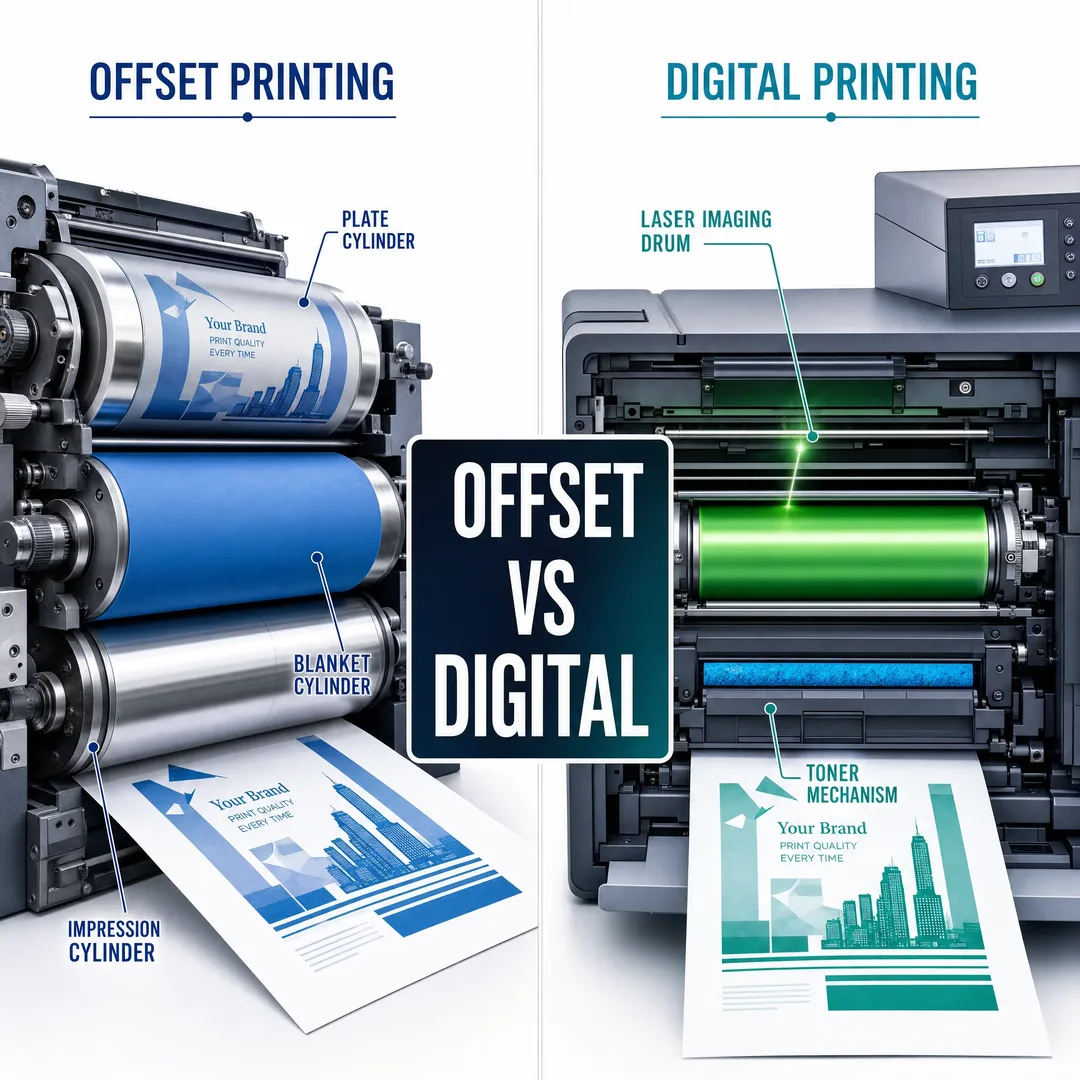
Offset printing uses a three-cylinder chain: a plate cylinder carries the etched aluminum plate for each color, a blanket cylinder receives the ink from the plate, and an impression cylinder presses the paper against the blanket. The ink never jumps directly from plate to paper—it is “offset” onto the rubber blanket first. That extra step is why offset delivers such sharp dot reproduction. It is also why every job needs plates: one per color, burned, mounted, and registered before a single sellable sheet comes off the stack.
Digital printing eliminates plates entirely. A laser writes the image onto a photoconductive drum, toner or liquid ink adheres to the charged areas, and the image transfers straight to the substrate. Inkjet presses fire microscopic droplets through thousands of nozzles—no drum, no blanket, just a direct raster path from RIP to surface. No plates means no plate cost. It also means no plate-level color consistency across a million impressions.
Why does offset printing still dominate long-run production?
Once the plates are hung and the ink-water balance stabilizes, an offset press runs at 12,000 to 18,000 sheets per hour—and every sheet costs less than the one before it. The plate-making fee, paper waste during makeready, and press-crew time get amortized across the entire run. At 100 copies, those fixed costs feel brutal. At 10,000 copies, they vanish into rounding errors. Offset’s unit economics reward volume the way a factory rewards scale. That is the entire argument in one sentence.
The Money Question Nobody Answers Honestly
At what quantity does offset printing become cheaper than digital?
There is no universal crossover number, but 500 to 1,500 units is where most jobs flip. A typical digital quote might run $0.48 per piece with zero setup. An offset quote might charge $0.28 per piece—but with a $400 plate and makeready fee buried in the line items. At 2,000 copies, the offset total lands around $960. The digital total hits the same number. Above 2,000, offset pulls ahead and keeps pulling. Below 1,000, digital wins on both price and speed almost every time.
What throws this math off is finishing. If your job needs die-cutting, foil stamping, or perfect binding, those costs are identical regardless of print method. The crossover point drifts higher when post-press costs dominate the invoice. A 500-copy hardcover book with foil stamping might cost nearly the same either way because the binding and foil are eating 60% of the budget.
Are there hidden costs that make one method more expensive than it looks?
Offset hides cost in setup waste. Makeready sheets—the first 200 to 500 impressions used to dial in registration and color—get thrown away, and you pay for the paper. Overs are another trap: offset printers often run 10% extra “just in case,” and you get billed for them. Digital’s hidden cost is per-click service contracts. The click charge includes toner, drum wear, and technician visits, and that rate rarely drops. For variable-data jobs, digital’s per-piece cost stays flat, which is either a blessing (short runs) or a curse (long runs) depending entirely on quantity.
Color Quality and the Pantone Problem
Can digital printing match offset color accuracy for brand work?
Offset gives you CMYK plus actual Pantone spot colors—physically mixed ink from a can, not a simulation. When Coca-Cola prints red, they use PMS 484 mixed from a Pantone formula, laid down as a fifth or sixth unit on the press. No CMYK combination on earth reproduces that exact red. Digital presses simulate spot colors using extended gamut CMYK (sometimes adding orange, green, or violet units), and the best ones now hit about 90% of the Pantone library. For most brands, that is enough. For a luxury perfume box where the gold must match the bottle cap under retail lighting, it is not.
Sheet-to-sheet consistency tells a different story. Offset color can drift as ink-water balance shifts over a 50,000-sheet run. Digital presses apply the same toner density on sheet one and sheet fifty thousand. If your job spans multiple production days, digital gives you reprint consistency that offset struggles to match without obsessive press-side monitoring.
Why do some designers still insist on offset for art books and photography?
Offset’s halftone rosette pattern—the microscopic dot arrangement that tricks your eye into seeing continuous tone—has been refined for over a century. The dots are sharp-edged, the ink sits cleanly on the paper surface, and the result under a loupe looks crisp. Digital halftones, especially from toner-based presses, can look slightly fuzzy at the dot edge. Inkjet digital closes this gap dramatically; high-end inkjet presses now produce stochastic (FM) screening patterns that rival offset sharpness. But offset still wins on substrates that drink ink—uncoated stocks where offset ink bites into the fiber and digital toner sits on top like a sticker.
Speed, Deadlines, and the Makeready Black Hole
How much faster is digital printing than offset for rush jobs?
Digital wins the stopwatch from file upload to first printed sheet. A digital press goes from file receipt to running in under 10 minutes—RIP the PDF, load the stock, hit print. Offset needs plate making (30–45 minutes per set), plate mounting, ink-key profiling, and register adjustment. Total makeready: 1 to 3 hours before production sheets start stacking. For a job due tomorrow, offset is out of the conversation unless the printer already has plates from a previous run.
Once running at speed, offset is the faster machine. An offset press at 15,000 sheets per hour will bury a digital press capped at 4,000. But speed only matters when the run is long enough to repay the setup time investment. A 500-sheet job: digital finished before offset finishes registration. A 50,000-sheet job: offset catches up around sheet 3,000 and never looks back.
What is the typical turnaround time difference between the two methods?
Digital: same-day to 48 hours for most commercial work. Offset: 3 to 7 business days from file approval to shipping, with plate-making and drying time baked in. Rush offset exists but costs a premium that often erases its volume advantage. If your launch date moved up and you need boxes on a loading dock Friday, call a digital shop. If your catalog mails in six weeks, offset planning works fine—and saves real money.
Paper, Plastic, and Everything In Between
Which printing method handles more paper types and specialty substrates?
Offset eats almost anything you feed it. 60 gsm bible paper? Runs. 400 gsm board stock? Runs. Synthetic waterproof sheets, metallic foil laminates, carbonless NCR paper, textured linen stock—offset presses have the grip, the impression pressure, and the ink formulation to handle them. The blanket cylinder conforms to surface texture, so even deeply embossed papers print cleanly.
Digital presses are pickier. Toner-based machines need paper that holds a consistent electrostatic charge and withstands fuser heat (180–200°C). Inkjet digital needs coated stocks formulated for aqueous ink reception, or the ink bleeds into the fiber and turns sharp text into watercolor. The substrate gap is narrowing fast—new inkjet primed papers and toner-compatible synthetics hit the market every quarter—but offset still wins on raw material range, especially at the extremes of thickness and texture.
Can you print on dark paper or specialty materials with digital?
Digital presses with white toner or white inkjet channels can lay down an opaque underbase on dark stock—then print CMYK on top. The technology exists and works, but it is slow (multiple passes), expensive (white toner costs more than black), and limited to specific press models. Offset prints white ink as a standard spot color unit at full production speed. For dark-paper jobs at any scale, offset remains the practical choice.
Variable Data and the Personalization Revolution
Why is variable data printing only practical with digital technology?
Variable data printing means every sheet carries different content—a unique name, a sequential barcode, a regional offer, a personalized image. On an offset press, changing content requires stopping the machine, swapping plates, and restarting. That is economically insane for one-to-one personalization. On a digital press, the RIP swaps the variable data fields between impressions without slowing the engine. The machine never stops between sheets.
This single capability reshaped entire industries. Direct mail response rates jumped from 2% to 8% when marketers started printing “John, here is your local offer” instead of “Dear Resident.” Textbook publishers now print customized editions per school district. Pharmaceutical packaging runs unique serial numbers and QR codes for track-and-trace compliance. None of this exists without digital.
What types of variable data can digital printing handle?
Text-level VDP (name, address, offer code) is the entry point—every digital press handles it. Image-level VDP swaps photographs based on demographic data. Full-page VDP builds entirely different layouts for different recipients in the same print stream. The ceiling is the data file, not the press. Modern digital workflows can process millions of unique records in a single run, each one verified by inline camera systems that cross-check barcodes and block mismatched pages from reaching the finishing line.
Proofing Realities That Affect Your Wallet
Why does offset proofing cost so much more than digital proofing?
An offset contract proof requires burning actual plates and running live sheets on the production press—the same machine, same ink, same stock. That proof costs $300 to $800 because it consumes plate material, press-crew time, and makeready sheets. A digital proof costs whatever one click on the RIP costs—pennies. You print one copy, check it under the light booth, sign off, and run the job. If you spot a typo, fix the file and re-proof in two minutes. On offset, a typo caught at the proof stage means new plates and another setup charge.
The quality gap between a desktop inkjet proof and a final offset sheet is real. An Epson proof on glossy proofing paper does not replicate how offset ink spreads on uncoated stock. Digital press proofs close this gap because they use the same imaging engine as the production run. What you see on the single-copy digital proof is what you get in the full run—same raster, same toner, same fusing.
Environmental Math: Chemicals, Waste, and Carbon
Which printing method has a smaller environmental footprint?
Digital wins on waste avoidance. No plates to etch and dispose of. No fountain solution—a water-and-chemical mixture that offset presses consume by the liter and that requires hazardous-waste handling in many jurisdictions. No makeready sheets headed to the recycling bin before a single good copy prints. Digital prints exactly the quantity ordered, period. No overs, no warehouse inventory, no pulping of unsold copies six months later.
Offset wins on energy per sheet at high volumes. The press runs on electricity and compressed air, and once it is moving, the energy per impression is tiny. Digital toner manufacturing and cartridge disposal carry their own environmental costs. The honest answer: for short runs where you only print what you need, digital is greener. For million-sheet runs where offset plates amortize across an ocean of paper, the gap narrows. The greenest print method is always the one that does not print copies that end up in a landfill.
Are there eco-friendly advances in offset printing?
Vegetable-based inks replaced petroleum-based formulations across most commercial offset shops over the past decade. Alcohol-free fountain solutions eliminated VOC emissions. Computer-to-plate (CTP) technology killed the film-and-chemical darkroom step that used to define prepress. Modern offset is cleaner than its reputation, though it still generates more process waste per job setup than digital.
Hybrid Printing: When You Stop Choosing Sides
What is hybrid printing and when does it make sense?
Hybrid printing runs the static content on offset and the variable content on digital—on the same sheet, in sequence. A catalog cover prints offset for brand colors and glossy finish, then runs through a digital inkjet head that sprays each recipient’s name and a personalized offer code onto a designated white box. A direct mail postcard prints the full-color photography offset, then gets a unique QR code and address block from a digital overprint unit inline.
The economics are compelling when you need offset-quality color plus digital personalization. Instead of running the entire piece on a slow digital press at high per-click rates, you print 90% of the coverage on an offset press at low unit cost, then add the variable 10% digitally. The combined cost per piece beats pure digital at moderate to high volumes.
Can you mix offset and digital in the same project?
Yes, and book publishers do it constantly. The interior text block prints offset for sharp typography and consistent ink density across thousands of copies. The dust jacket runs digital because each one carries a different ISBN barcode or regional pricing. Postcards, folded cartons, and pharmaceutical inserts all benefit from the split approach. The technical challenge is registration—making sure the digital overprint lands exactly where intended on the offset-printed sheet. Modern inline camera systems handle this with sub-millimeter precision, reading registration marks printed during the offset pass and adjusting the digital head position in real time.
Which Method Fits Which Job: A Scene-by-Scene Breakdown
Should art books and photography books use offset or digital printing?
Offset. Art books demand the widest color gamut, the sharpest halftone reproduction, and the ability to print on heavy uncoated stocks where the ink sinks into the fiber. A 300-copy art monograph printed offset on 170 gsm matte art paper will look like a museum catalog. The same book printed digital on the same stock will show a visible toner sheen and softer shadow detail. If the print run is under 100 copies, digital inkjet with stochastic screening is the practical alternative—not quite offset quality, but close enough that only a printer with a loupe would notice.
Is offset or digital better for custom packaging and folding cartons?
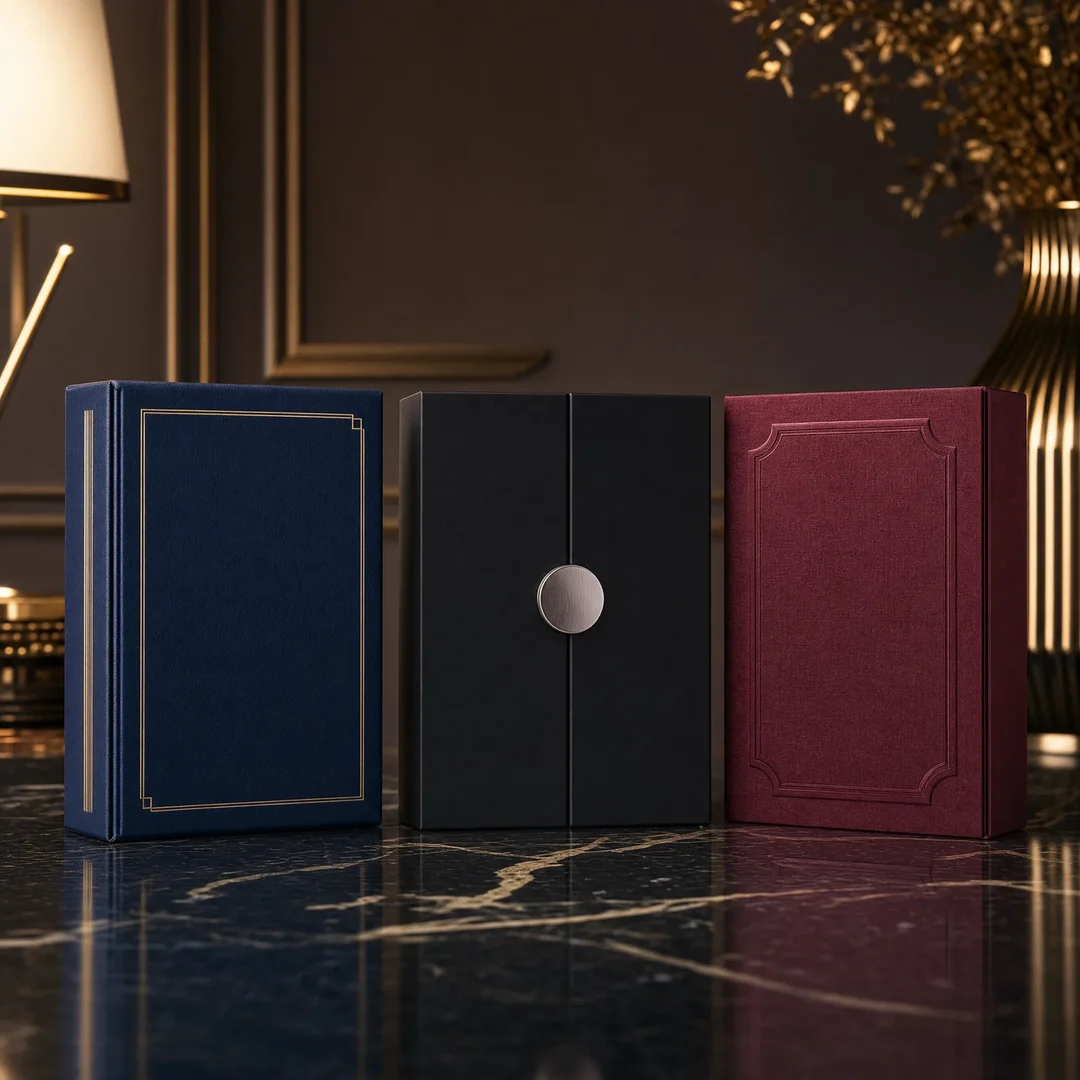
Offset dominates packaging for a simple reason: cardboard. Folding carton board, corrugated liner, and clay-coated newsback run through offset presses at industrial speed and thickness. Spot colors are essential for brand packaging, and offset delivers them natively. Digital packaging presses exist—the HP Indigo 30000 series prints folding cartons at 3,000 sheets per hour—but the substrate range is narrower and the per-sheet cost stays high. For 5,000 cereal boxes, offset pays for itself. For 200 prototype boxes for a trade show, digital is the only option that does not require a second mortgage.
What about labels, stickers, and narrow-web work?
Labels live in both worlds. Digital label presses (toner and inkjet) have eaten the short-run label market—1,000 to 10,000 linear feet, multiple SKU variants, fast turnaround. Offset flexo still owns the long runs: millions of identical beer labels, shampoo bottles, wine labels where metallic Pantone inks run as spot colors. The crossover sits around 10,000 linear feet for simple labels and higher for multi-color jobs. Digital also enables a business model offset cannot touch: order 50 custom labels for a limited-edition hot sauce batch, delivered in three days.
Is digital printing viable for book production at scale?
Digital book manufacturing crossed a threshold around 2020. High-speed inkjet web presses now print 800 to 1,200 black-and-white pages per minute, inline with binding lines that trim and glue in a single pass. For runs under 1,500 copies, digital book production beats offset on both cost and time. For runs over 2,000, offset still holds the edge. The trendline is clear: the crossover point moves up every year as inkjet speeds increase and click charges drop. Trade paperbacks, academic monographs, and print-on-demand titles are already digital-dominant. Mass-market paperbacks and four-color textbooks remain offset territory for now.
The Future: Will Digital Ever Fully Replace Offset?
How close is digital printing to matching offset on cost and quality at scale?
Quality-wise, digital has already caught offset for 95% of commercial print applications. The remaining 5%—ultra-fine stochastic screening, metallic Pantone matches, extreme substrate thickness—still belong to offset. Cost-wise, the crossover point rises roughly 100 to 200 copies per year as digital press speeds increase and click charges fall. High-speed inkjet web presses running at 1,200 feet per minute now compete directly with small-format offset presses in the 1,500 to 5,000 copy range.
What digital will not replace is offset’s raw throughput economics at massive scale. A 64-page web offset press running 40,000 impressions per hour produces a finished signature every rotation. That physics advantage—ink drying on paper moving at highway speed—will hold for decades. The printing industry is not heading toward a winner-take-all outcome. It is heading toward a split: offset for the long, static, standardized runs; digital for the short, personalized, rapidly changing ones.
Will offset printing be obsolete in ten years?
No. Offset equipment sales are declining at roughly 2.5% annually, but the installed base is enormous and the replacement cycle is long. Presses built in 2010 still print high-quality work every day. What is changing is the type of offset press being sold: smaller formats, faster makeready automation, fewer units. The 8-color 40-inch perfectors of the 1990s are being replaced by 4-color 29-inch presses with 5-minute automatic plate changers. Offset is shrinking, not disappearing. It will serve the big-run, high-color-fidelity niche for decades—a smaller market, but a profitable one for the shops that commit to it.
More than a quarter of print service providers surveyed by Keypoint Intelligence say they plan no further offset investments and intend to go fully digital. That is not a death sentence for offset. It is market segmentation. The shops that stay in offset will have less competition and higher margins on the work digital cannot touch.
Quick Answers to the Questions You Actually Search For
Is offset printing higher quality than digital?
On smooth coated stock with a full CMYK-plus-spot workflow, yes—offset still delivers sharper dots, wider color gamut, and true Pantone matches. On standard uncoated stock at typical commercial resolutions, the difference is visible to trained eyes but negligible for most end users. Modern digital presses produce output that 95% of customers would call “excellent.” The quality gap that mattered in 2010 has largely closed.
Which is cheaper for 500 copies?
Digital. At 500 copies, offset setup costs (plates, makeready, washup) have not yet amortized. Digital’s per-piece cost is higher, but with zero setup, the total invoice lands lower. Expect digital to be 20–40% cheaper at this quantity for standard commercial work.
Can digital printing do spot UV and foil stamping?
These are post-press finishing processes, not print methods. Both offset-printed and digital-printed sheets can go through spot UV coating machines, foil stamping presses, and embossing dies. The limitation is with toner-based digital prints: the fuser oil and toner surface can interfere with foil adhesion. Some digital presses use oil-free toner specifically to solve this. Always test adhesion on the actual stock and press combination before committing to a full run.
Does digital printing fade faster than offset?
Toner-based digital prints are fused plastic on paper; they resist UV fading about as well as offset ink. Inkjet digital prints using dye-based inks can fade noticeably within months of direct sunlight exposure. Pigment-based inkjet inks are far more stable. Offset inks, particularly when UV-cured, have the longest proven lightfastness. For archival work intended to last decades, offset with archival-grade paper remains the standard.
What file format should I prepare for each method?
Both methods accept PDF/X-4 as the industry standard. Offset requires proper bleed (usually 3mm), trim marks, and CMYK color space with any spot colors defined as separations. Digital presses can often handle RGB files with automatic conversion, but do not rely on that. Provide CMYK PDFs with embedded fonts, 300 dpi images minimum, and a clear indication of any spot color requirements. For digital, also specify whether you need variable data fields and provide the data merge file in CSV format.