What Is Minimum Order Quantity (MOQ) and Why Does It Matter in Book Printing?
If you are self-publishing a book, launching a small-run catalog, or ordering branded materials for your business, you have likely come across the term Minimum Order Quantity (MOQ) . In the printing industry, MOQ refers to the smallest number of units a printer is willing to produce per single print run. It is not an arbitrary rule — MOQ exists because printing involves fixed setup costs that are spread across every copy produced. Understanding MOQ is the first step toward making smart, cost-effective decisions for your print project.
At EcoPrinting , we believe in transparency. That is why we clearly communicate our MOQ structure so that every customer — whether ordering 100 books or 5,000 — knows exactly what to expect in terms of pricing, turnaround time, and production method.
The printing process involves several fixed-cost steps: plate-making, machine setup, color calibration, paper cutting, and bindery preparation. These costs remain roughly the same whether you print 50 copies or 5,000 copies. If a printer accepted very small orders, the setup cost per unit would become prohibitively high, making it uneconomical for both the printer and the customer. That is why a well-defined MOQ creates a win-win situation — the printer runs efficiently, and the customer gets a fair per-unit price.
EcoPrinting’s Standard MOQ: 500 Copies Per Title
EcoPrinting’s standard Minimum Order Quantity is 500 copies per title . This means that for any single book title or product specification — including trim size, paper stock, cover type, and binding method — the baseline production run is 500 units.
Why 500? This number has been calibrated over years of experience in both offset and digital printing to strike the best balance between affordability and production efficiency. At the 500-copy threshold, the fixed setup costs are spread thinly enough that the unit price remains attractive for customers — while the printer can operate its equipment at a reasonable utilization rate.
It is also worth noting that MOQ applies per title . If you have three different books to print, each one constitutes its own title and requires its own MOQ of 500 copies. However, there is good news: many customers consolidate multiple titles into a single production schedule to optimize logistics and shipping costs. EcoPrinting’s team can help you plan your titles in batches to reduce overall expenses.
Standard offset printing: 500 copies per title is the baselineHardcover and softcover: Both binding styles follow the same MOQCustom sizes and paper: Special specifications still apply under the 500-copy minimumMultiple titles: Each unique title counts toward its own MOQ
What If You Need Fewer Than 500 Copies?
Not every project needs 500 books. Maybe you are testing a niche market, printing a limited-edition art book, or creating internal documentation for a small team. EcoPrinting understands that lower quantities are sometimes the right choice — and we do not turn those projects away.
Orders below 500 copies are absolutely possible. However, because the fixed setup costs remain constant, the per-unit price will be higher. For example, printing 200 copies of a 200-page paperback will cost more per book than printing 500 copies of the same title. The smaller the order, the higher the unit price — simply because the setup overhead is distributed across fewer books.
For orders under 100 copies, EcoPrinting strongly recommends digital printing instead of offset printing. Here is why:
No plate-making required: Digital printing goes straight from file to press, eliminating the expensive plate setup stepLower setup cost: With no plates and minimal machine preparation, the barrier for small runs drops significantlyFaster turnaround: Digital presses require less prep time, so orders under 100 copies often ship fasterVariable data capability: Digital printing allows each copy to differ slightly if needed — ideal for personalized editions
That said, digital printing has its trade-offs. The per-page cost is typically higher than offset at scale, and some finishing options (like foil stamping or embossing) may not be available on digital equipment. For quantities between 100 and 499 copies, EcoPrinting will evaluate your specific project and recommend the most economical method — whether that is digital or a hybrid approach.
Why 1,000+ Copies Is the Sweet Spot
This is one of the most important insights in book printing: the cost difference between 500 copies and 1,000 copies is often surprisingly small.
How can that be? The answer lies in how offset printing pricing works. In an offset run, a significant portion of the total cost comes from fixed expenses — plate-making, ink setup, press calibration, paper preparation, and bindery configuration. These costs are essentially the same whether you run 500 sheets or 1,000 sheets through the press.
When you double the quantity from 500 to 1,000, the per-unit price can drop by 30-40% or more, even though the total price only increases by a modest margin. In many cases, the total cost for 1,000 copies may be only 50-70% more than the cost for 500 copies — meaning you get nearly twice the inventory for a fraction of the proportional increase.
Quantity
Relative Setup Cost
Per-Unit Price Trend
Best For
Under 100
Low (digital)
Highest per unit
Test runs, proofs, limited editions
100 – 499
Medium (offset setup)
Moderate per unit
Small launches, internal use
500
Fixed (standard MOQ)
Baseline price
Standard orders
1,000
Same as 500
30-40% lower per unit
Recommended sweet spot
2,000+
Same as 500
Even lower per unit
Bulk inventory, retail distribution
For authors and publishers planning to sell their books, ordering 1,000 copies instead of 500 can make a dramatic difference to your bottom line. With a much lower cost per book, your profit margin per sale increases significantly. And you have the added benefit of not needing to reorder as quickly — saving you time and reorder shipping costs.
Economies of Scale: Why Larger Orders Pay Off
The principle of economies of scale is at the heart of every printing cost calculation. As order volume increases, the fixed costs are spread across more units, and variable costs — paper, ink, binding materials — can often be negotiated at bulk rates. This is where larger orders truly shine.
Consider a practical example. A 300-page softcover book printed at 500 copies might cost roughly $4.50 per unit. At 1,000 copies, the per-unit price could drop to around $3.00. At 3,000 copies, that figure can fall to $2.20 or lower. The jump from 500 to 1,000 alone saves over 30% per book — which, for a publisher selling at $15 per copy, translates directly into healthier margins.
Here are the key factors that make larger orders more cost-effective:
Paper bulk purchasing: Ordering paper for a 5,000-copy run costs significantly less per sheet than for a 500-copy runPress efficiency: Once the press is calibrated, running additional sheets adds only marginal time and costBinding throughput: Perfect binding, saddle stitching, and case binding all benefit from longer continuous runsReduced handling: Fewer setup changes per book mean less labor cost allocated per unitShipping consolidation: Larger orders often qualify for palletized freight, which lowers per-unit shipping costs
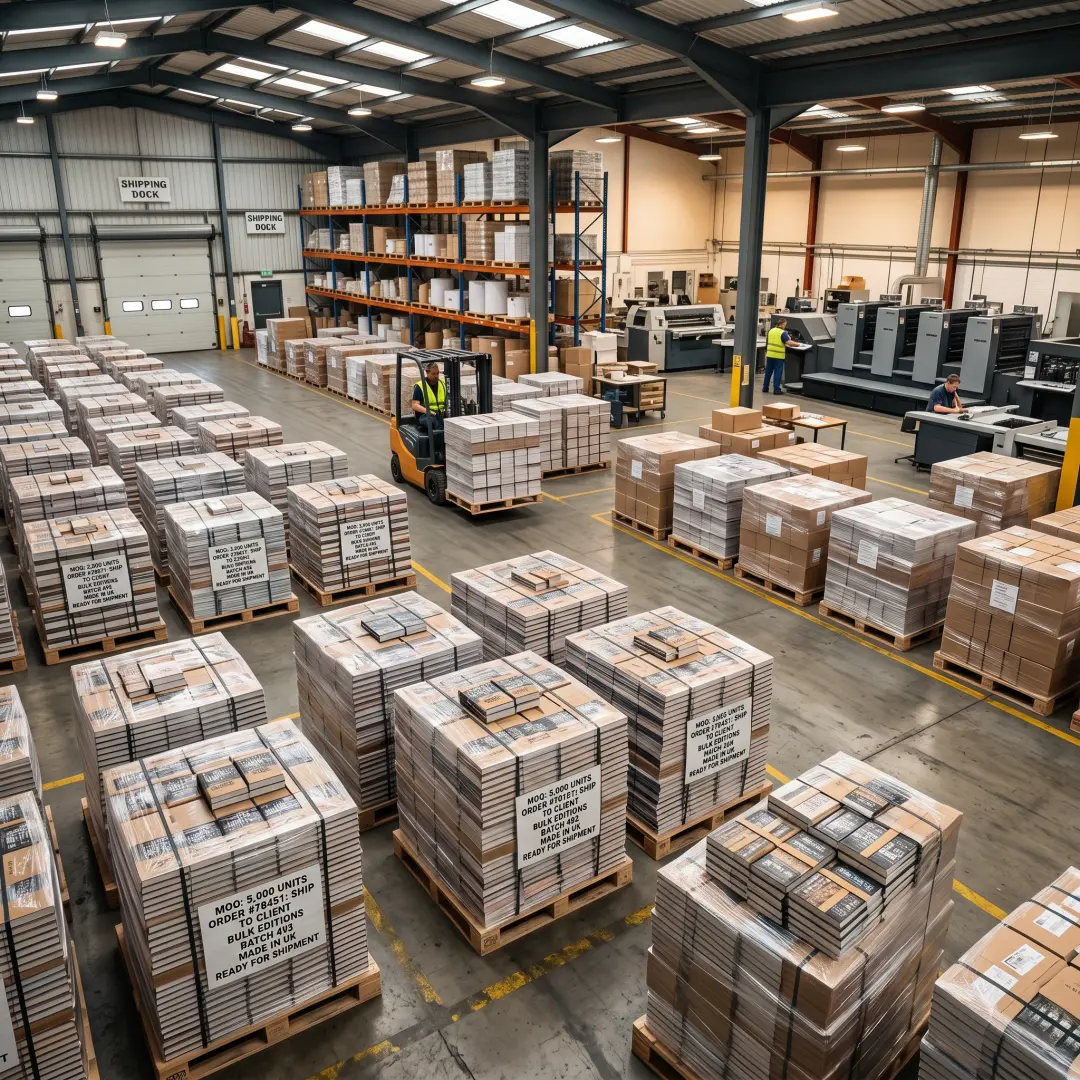
EcoPrinting encourages customers who have a clear sales forecast or distribution plan to order at least 1,000 copies per title. Not only does this maximize your return on investment, but it also ensures you have enough inventory to support marketing campaigns, book launches, and wholesale orders without rushing back for a reprint.
How to Determine the Right Quantity for Your Project
Choosing the right print quantity depends on several factors beyond just MOQ. Here is a framework to help you decide:
Your budget: Determine your total available spend for printing. Then calculate how many copies you can afford at different per-unit pricesYour sales velocity: Estimate how many copies you expect to sell per month. A 3-6 month inventory buffer is typically idealStorage space: 1,000 copies of a standard paperback take roughly 10-15 cubic feet — ensure you have roomDistribution channels: If you are selling through Amazon, bookstores, or wholesale distributors, they may require specific minimum order quantities from youRevision risk: If your content may need updates soon (e.g., a yearly report or a fast-changing topic), a smaller first run may be wiser
Still unsure? EcoPrinting’s experienced team can walk you through a cost comparison table for your specific book specs. We provide transparent, itemized quotes — no hidden surprises — so you can make a confident decision.
Get Your Custom Quote from EcoPrinting Today
Understanding MOQ is the foundation of smart print planning, but every project is unique. Whether you need 50 copies of a premium hardcover art book or 5,000 copies of a standard trade paperback, EcoPrinting has the production capabilities to match your needs.
We specialize in a wide range of book printing services — from perfect-bound paperbacks and smyth-sewn hardcovers to spiral-bound notebooks and saddle-stitched booklets. Our state-of-the-art offset and digital presses handle everything from black-and-white text blocks to full-color images with rich, accurate reproduction.
Here is what you can expect when you work with EcoPrinting:
Clear, upfront MOQ and pricing with no hidden fees
Expert recommendations on offset vs. digital printing for your quantity
Free personalized consultation to optimize your print run size
Competitive bulk pricing for orders of 1,000+ copies
Fast turnaround times with reliable shipping worldwide
Ready to bring your book to life? Visit EcoPrinting today or contact our support team to request a free, no-obligation quote. Tell us your trim size, page count, binding preference, and target quantity — and we will get back to you with a detailed pricing breakdown within 24 hours.
Your book deserves the best print quality at the right price. Let EcoPrinting help you find the perfect balance.